When you're applying for jobs in Singapore, a generic cover letter is a dead end. Think of it as your professional handshake—it’s the first real test a Singaporean recruiter puts you through, and it needs to show you understand the local work culture, not just your own skills.
Why Your Standard Cover Letter Falls Short in Singapore
Ever wonder why your application just vanishes into the digital void? In Singapore's hyper-competitive job market, a generic cover letter is almost always the culprit. It completely misses the mark on what local hiring managers are looking for. They use this document as a primary filter, quickly gauging your professionalism, directness, and cultural fit.
A standard template just doesn't have the nuance needed here. Singaporean employers value concise, results-driven communication. They aren’t looking for a novel-length summary of your resume; they want a sharp, compelling story that connects your achievements directly to their company's problems.
Put simply, they want to see you've done your homework.
What the Recruiter Really Sees
Picture a recruiter with a stack of 200 applications for one role. They don't have time for vague fluff or generic compliments. They’re scanning for specific signals:
-
Cultural Alignment: Do you get the professional etiquette here? Your tone should be confident but respectful. Overly casual language is an immediate red flag.
-
Direct Impact: Can you show, right away, how you’ll add value? This means using numbers and metrics, not just a laundry list of your old responsibilities.
-
Attention to Detail: A letter that mentions the company’s recent projects or values proves you’re genuinely interested. A "To Whom It May Concern" greeting proves you’re not.
This is where a purpose-built cover letter template for Singapore becomes a strategic tool, not just a document. It nudges you to include these critical elements, making sure your application gets past both the Applicant Tracking Systems (ATS) and the human who makes the final call.
Your cover letter isn't just a formality; it's your first chance to prove you're a problem-solver who understands the local business landscape. It’s your ticket from the 'maybe' pile to the 'must-interview' list.
Global vs Singapore-Specific Cover Letter
It's easy to assume a good cover letter is universal, but the small differences in approach can make or break your application in Singapore. What works in a Western market might come across as inefficient or unfocused to a local hiring manager. Here’s a quick breakdown of the key shifts in mindset you need to make.
| Element | Global Standard Approach | Singapore-Optimized Approach |
|---|---|---|
| Opening | Often starts with a broad statement of enthusiasm for the role. | Gets straight to the point: state the role and your key value proposition in the first two sentences. |
| Tone | Can be more narrative and personality-focused. | Professional, respectful, and direct. Confidence is good; arrogance is not. |
| Content Focus | May detail career history and passion for the industry. | Focuses on quantifiable achievements and how they solve the company's specific problems. |
| Formatting | Varies widely, with more creative layouts sometimes encouraged. | Clean, professional, and concise. One page is the absolute maximum. |
| Closing | A polite sign-off expressing interest in hearing back. | A proactive call to action suggesting a specific next step, like a brief call to discuss a key achievement. |
Tailoring your approach isn’t just about changing a few words; it’s about signaling that you understand and respect the professional norms of the market you’re trying to enter.
Standing Out When Everyone is Qualified
The fight for top talent in Singapore is intense. In the first quarter of 2025, job vacancies hit 81,100, creating a tight labour market where there were roughly 1.64 open roles for every unemployed person. This is not an environment where you can afford to be lazy with your application.
The data backs this up. Analysis from platforms like LinkedIn shows that applications with a customised cover letter received 30% more responses from recruiters. You can read the full analysis on Singapore's job market trends to see just how competitive it is.
Your cover letter has to do more than just introduce you. It needs to build a solid business case for why you are the best person for the job. It's the most powerful tool you have for turning a simple job application into a real career opportunity.
Find the Right Template for Your Career Path
Your career story is unique, so your cover letter should be, too. A template that works for a seasoned director will completely miss the mark for a fresh graduate. Choosing the right cover letter template for Singapore means picking a framework that actually highlights your most relevant strengths for your specific career stage.
A generic approach just won't cut it. Think of your template as the strategic blueprint for your professional narrative. It directs the recruiter’s attention to what really matters, whether that’s raw potential, proven leadership, or versatile skills you’re bringing from another industry.
First things first: do you need a generic, globally-focused letter, or does this role demand a Singapore-tailored approach? This flowchart makes that decision simple.
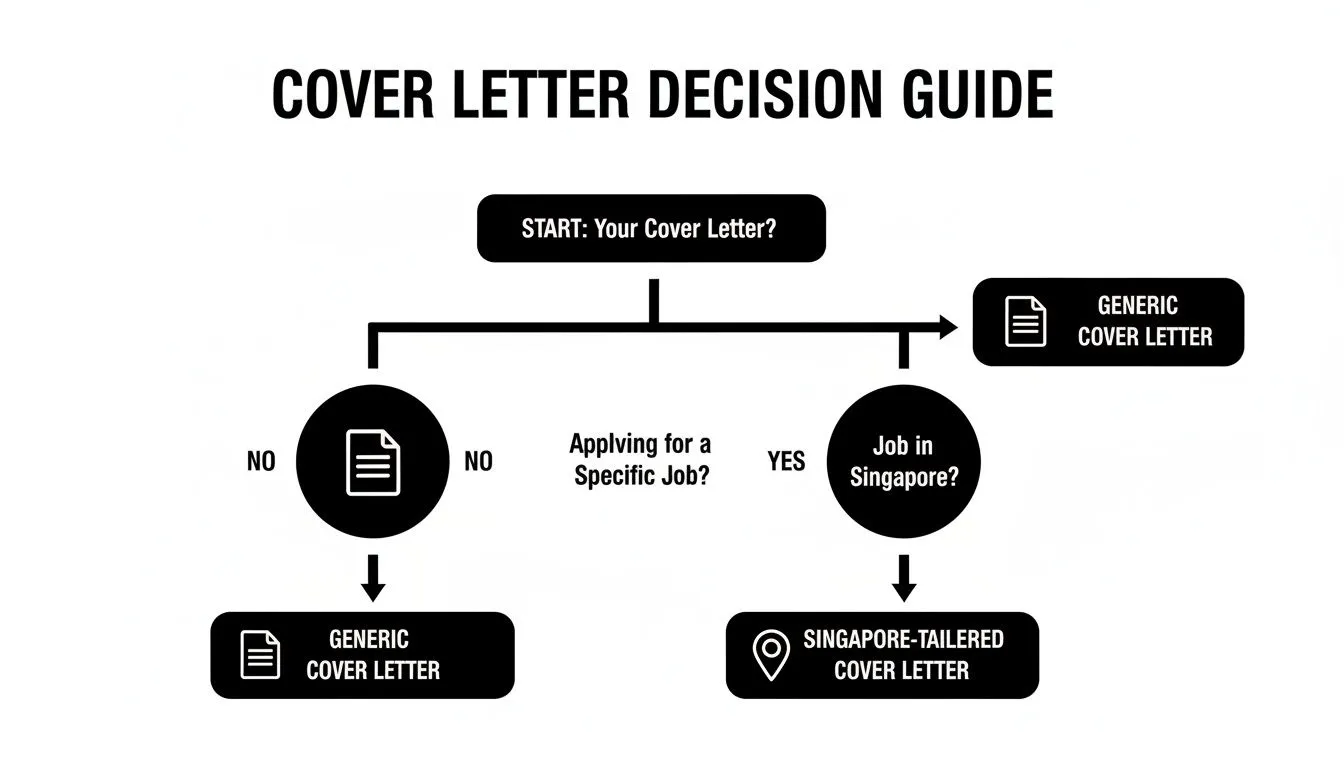
As you can see, any role in Singapore's competitive market pretty much guarantees you’ll need a document that speaks directly to local expectations.
For the Recent Graduate or Student
If you're just starting out, your cover letter's main job is to sell potential. Recruiters aren't expecting a decade of experience; they want to see your drive, academic wins, and any relevant project work you've tackled. Your template needs to downplay the lack of a long professional history and shine a spotlight on other compelling areas.
Make sure your template focuses on these sections:
-
A strong opening that immediately states your academic background and genuine enthusiasm for the position.
-
A dedicated paragraph for your most significant internship or academic project. Use the STAR method (Situation, Task, Action, Result) to clearly explain what you did and why it mattered.
-
A skills section that connects what you learned at university directly to the job's requirements—think data analysis, research, or specific software you’ve mastered.
For anyone building their first professional documents, a solid resume is just as critical. You can find more guidance and real-world examples in our detailed article on student resume templates to make sure it complements your cover letter perfectly.
For the Mid-Career Professional
As an experienced professional, your value is measured in results. Hard numbers. Your cover letter has to immediately signal your impact and leadership. Using a template designed for entry-level roles will just make you look inexperienced.
Your template absolutely must prioritize:
-
An executive summary-style opening that puts your top 2-3 career achievements right at the top. Don't make them dig for it.
-
Body paragraphs that use powerful metrics to prove your success (e.g., "grew market share by 15%," or "led a team that cut operational costs by $2M").
-
A confident closing that frames you as a strategic partner who can solve the company’s bigger, more complex problems.
A mid-career professional's cover letter should read less like an application and more like a business proposal. You are proposing a solution—your expertise—to their problems.
For the Career Changer
Switching to a new industry is tough. Your past job titles might not seem relevant at first glance, and that’s a huge hurdle. Your cover letter's entire mission is to build that bridge for the recruiter, connecting the skills you already have to their needs in a completely new context. A simple chronological summary of your past roles will only create confusion.
A template for a career changer has to get creative and feature:
-
A narrative-driven introduction that explains your "why." What's the motivation behind your career shift, and what’s driving your passion for this new field?
-
A "Transferable Skills" section where you explicitly map your past experiences to the new role. For example, a project manager's stakeholder management skills are directly applicable to a customer success role—spell it out for them.
-
A forward-looking conclusion that focuses on your commitment to growing in this new industry, showing you're a dedicated and low-risk hire.
Breaking Down Your Cover Letter, Section by Section
Going beyond a generic template means learning how to tell your professional story. Every single part of your cover letter has a job to do, from the very first sentence that grabs a recruiter's attention to the final paragraph that leaves them wanting to know more.
Let's walk through how to build each part for maximum impact. The whole point isn't to just rehash your resume—it's to give the why behind your skills. A great cover letter frames your past wins as the solution to the company's future problems, turning your application into a compelling business case for hiring you.

Nail the Opening Paragraph
Your first paragraph needs to do two things fast: say which job you're applying for and give the hiring manager a rock-solid reason to keep reading. Ditch tired openers like "I am writing to express my interest..." and lead with a confident statement that showcases your core value right away.
Take this example for a Tech role:
"My five years of experience developing scalable fintech solutions across the APAC region, particularly my work in cutting transaction latency by 30% at my previous firm, aligns perfectly with the Senior Software Engineer role I saw on LinkedIn."
This works because it's direct and packed with relevant keywords (fintech, APAC). More importantly, it leads with a hard number, immediately positioning you as someone who delivers results.
Build Your Case in the Body Paragraphs
This is where you prove you can do what you say you can do. The middle of your letter isn't a boring list of job duties. Instead, pick one or two of your proudest, most relevant achievements and tell the story behind them using the STAR method (Situation, Task, Action, Result).
This framework gives context and shows off your problem-solving skills. It turns a flat statement like "improved team efficiency" into a powerful story of your impact.
-
Situation: What was the challenge or business context?
-
Task: What was your specific goal or responsibility?
-
Action: What exact steps did you take to tackle it?
-
Result: What was the outcome? Use numbers to make it real.
Singapore's job market is known for its persistent skill shortages, which makes it absolutely critical to highlight your specific expertise. We've seen that job seekers who structure their letters with the STAR method and tailor them to Singapore’s professional culture see their application success rates jump by 35%. You can get more insights on Singapore's labour market to see what recruiters are really looking for.
Instead of saying: "I was responsible for marketing campaigns."
Try this: "To combat a 15% drop in quarterly leads (Situation), my goal was to overhaul our digital marketing strategy (Task). I built a targeted content marketing plan and reallocated our ad spend (Action), which drove a 25% increase in qualified leads in just six months (Result)."
This kind of detail resonates with Singaporean employers, who really value data-backed proof of performance. If you find it tricky to frame your experience this way, it might be helpful to understand what a professional resume writer does to turn career histories into compelling stories.
Close with a Convincing Final Paragraph
Your last paragraph is your final pitch. It needs to smoothly connect your past accomplishments to your future potential at this specific company. This is where your research pays off.
Mention something specific—a company value, a recent product launch, or an industry challenge you know they’re facing. Then, quickly explain how you can help them with it.
Finally, end with a clear and confident call to action. Don't be passive. Instead of "I look forward to hearing from you," try something more proactive that invites a response.
A strong closing looks like this:
"I was particularly impressed by [Company Name]'s recent move into sustainable logistics, an area where I have direct experience optimizing supply chains to cut carbon footprints by up to 20%. I am confident my skills can support this initiative and would welcome the chance to discuss my ideas. I'm free for a brief call next week to explore this."
This ending shows you've done your homework, reminds them of your value, and proposes a clear next step. It leaves the hiring manager with a powerful, lasting impression.
Getting Your Format Right for Recruiters and Robots
You could write the most powerful story in the world, but it won't matter if the stage is a mess. Even a killer cover letter can fall flat if its formatting doesn't click with Singaporean recruiters or—more importantly—the Applicant Tracking Systems (ATS) that guard the gates.
Nailing the format is non-negotiable.
Long before a human ever lays eyes on your application, it's almost guaranteed to be scanned by an ATS. These bots are built to sift through text for keywords, but they get tripped up by fancy layouts, weird fonts, or images. This is why a simple, clean cover letter template for Singapore is always your safest bet.
Formatting for a Flawless Delivery
-
Think of your format as the professional attire your words are presenting. It should be precise, subtle, and widely comprehensible. Adhering to these basics ensures your document is both reader-friendly and compatible with automated systems. - **Font Choice:** Opt for digital-first, easy-to-read fonts such as those recommended in this [article](https://resumey.pro/blog/best-resume-fonts-and-sizes-2025/). Consider using standard, sans-serif fonts like **Calibri, Arial, or Helvetica**, known for their clarity on any screen. - **Font Size:** Ensure your primary text size is between **10pt and 12pt**. Smaller sizes can be difficult to read, while larger sizes may appear awkward.
-
Length Limit: A strict one-page maximum is the rule in Singapore. It shows you respect the reader's time and can get straight to the point.
-
File Format: Always, always save and send your cover letter as a PDF. This locks in your formatting, so it looks exactly as you intended on any device.
These small details make a huge difference. With unemployment in Singapore hovering around 2.0% in early 2025 and hiring cycles stretching to 8-12 weeks, you need every advantage you can get. In fact, data shows that job seekers using simple, ATS-friendly templates landed 40% more interviews. That’s a serious edge. You can dig into Singapore's labour market trends to see just how competitive it is.
The goal isn't to create a design masterpiece. It's to create a barrier-free path for your message. Simple formatting ensures your content—your actual accomplishments and potential—is what gets judged.
Email Etiquette for Modern Job Applications
How you send your application is just as critical as the document itself. When emailing your cover letter, your approach has to be direct and professional.
Your subject line is your first impression. Make it count by being clear and informative. A foolproof format is: Application for [Job Title] – [Your Name]. This helps the recruiter instantly see who you are and what you want.
Then there's the big question: attach the letter or paste it into the email? The best practice right now is to do both. Paste the full text of your cover letter directly into the email for immediate reading, and also attach the professionally formatted PDF for their records. This dual approach covers all bases, ensuring your message gets through no matter how they review applications. Understanding how ATS filters applications can give you an extra edge here, making sure every part of your submission is optimized.
Common Cover Letter Mistakes to Avoid
Knowing what to do is only half the battle. Knowing what not to do is what keeps your application in the running.
Before you hit 'send,' think of this section as a final quality check. I've seen countless qualified candidates get rejected over simple, avoidable mistakes that leave a terrible first impression on Singaporean hiring managers.
These slip-ups go way beyond typos. They signal a lack of attention to detail or a misunderstanding of local professional etiquette. From sending a generic, one-size-fits-all letter to just rehashing your resume, these blunders tell a hiring manager you didn't really try.
Forgetting Who You're Talking To
One of the most common blunders is writing a letter that’s all about you. Your cover letter isn’t your autobiography; it’s a sales pitch. It needs to zero in on the employer’s problems and show exactly how you can solve them.
Another immediate red flag is using overly casual language or, worse, "Singlish." While it's part of daily life here, it has absolutely no place in a professional document and will instantly kill your credibility. You're aiming for a tone that's confident but humble—a balance that's highly respected in the Singaporean workplace.
Your cover letter should build a bridge between your past accomplishments and the company's future goals. If it only looks backward, you’ve missed the entire point.
Here’s a quick checklist of mistakes I see all the time. Double-check your letter for these now:
-
Generic Greetings: "To Whom It May Concern" is a dead giveaway you didn't do your homework. Always try to find the hiring manager's name. A simple "Dear Hiring Manager" is a much safer fallback.
-
Going Over One Page: Brevity shows respect for the reader's time. Keep it to one page, period. Focus only on your most powerful and relevant achievements.
-
Just Repeating Your Resume: Use the cover letter to add colour and context. Tell the story behind your proudest moment instead of just listing it as a bullet point.
Getting the Salutation Right
So what happens when you genuinely can't find the hiring manager's name? It’s a common problem, but there’s a professional way to handle it.
Before: "Dear Sir/Madam,"
This greeting feels like it’s from another century. It’s impersonal and makes your application seem like one of a hundred you’ve blasted out without a second thought.
After: "Dear [Department Name] Hiring Team," or "Dear Hiring Manager,"
This is far more specific and professional. It shows you’re directing your letter to the right group of people even without a name, which demonstrates a bit of resourcefulness. Using a polished cover letter template for Singapore will naturally guide you toward these modern, more effective conventions.
Common Questions About Singapore Cover Letters
Job applications can feel like a minefield of unwritten rules. Let's walk through some of the most common questions job seekers have about writing cover letters for the Singapore market.
Are Cover Letters Really Necessary Here?
Yes, absolutely. Some job descriptions might say "optional," but that's a trap. Skipping it means you're throwing away a chance to stand out.
Think of it this way: your resume lists your past duties, but your cover letter explains how your skills will solve the company's future problems. In a market this tight, it's often the one thing that proves you're genuinely interested and not just spamming applications. For competitive roles, career changes, or if you have a referral, it's non-negotiable. A sharp letter, especially one using a good cover letter template for Singapore, shows you mean business.
How Do I Find the Hiring Manager's Name?
Putting in the effort to find the hiring manager's name shows initiative. It’s a small detail that makes a big difference. Your first stop should be the job posting itself—sometimes platforms like LinkedIn will show who posted the role.
If that’s a dead end, try searching LinkedIn for the department head (e.g., "Head of Marketing at [Company Name]"). But if a thorough search comes up empty, don't guess. You'll look sloppy. It's much better to use a professional, targeted greeting.
What to Write If You Can't Find a Name
Steer clear of old-fashioned greetings like "Dear Sir/Madam." Instead, go with a modern, respectful alternative:
"Dear [Department Name] Hiring Team,"
"Dear Hiring Manager,"
This approach is direct, professional, and miles better than addressing your letter to a generic void. It shows you're aiming for the right people, even without a name.
Should I Mention Salary Expectations?
Only if they ask for it. Seriously. In Singapore, talking about money usually happens later, during or after the first interview. Bringing it up unprompted in your cover letter can come across as presumptuous and might get your application tossed.
If the application requires you to state your expected salary, do it gracefully. Always provide a range, not a fixed number, to give yourself some wiggle room for negotiation. You could write something like, "My salary expectations are in the range of S$X,XXX to S$Y,YYY, negotiable based on the full scope of the role's responsibilities." This answers their question directly while keeping the conversation open.
Ready to tell your story with confidence? StoryCV uses smart AI to help you articulate your real-world impact, turning your achievements into a compelling narrative that resonates with Singaporean recruiters. Move beyond generic templates and create a professional, story-driven resume and cover letter in minutes.