The question isn't whether you should use bullet points. It's why you would ever use paragraphs.
Recruiters don't read resumes. They scan them. In about seven seconds.
Paragraphs bury your best work in a wall of text. They ask a busy person to slow down and hunt for the good stuff. Bad idea.
Bullet points are built for speed. They force you to be sharp, clear, and to the point. They make your achievements impossible to miss. This isn't a debate. It's a strategic choice.
Should resume be bullet points or paragraphs? Let's settle this.
Your resume is a high-speed ad for your career, not a novel. A recruiter gives it 7.4 seconds on the first pass. They're looking for keywords, numbers, and proof of your impact.
Paragraphs fail this test. Every time.
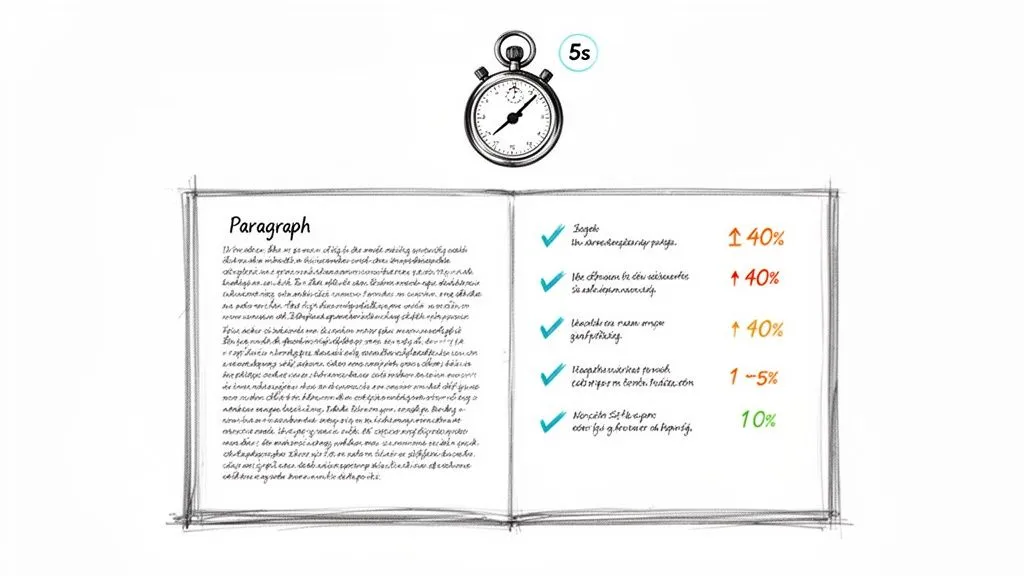
This isn’t about some dusty formatting rule. It’s about making your value obvious in under eight seconds.
The Problem with Paragraphs
Paragraphs demand to be read from start to finish. They ask the reader to invest mental energy to find the main point. On a resume, that’s a fatal flaw.
A recruiter doesn't have time to unpack your narrative. They need highlights. Now. Hiding your biggest wins in a dense paragraph is like burying treasure without a map.
The Power of Bullet Points
Bullet points are designed for scanning. They slice information into high-impact, digestible statements. The format also forces you to be concise and results-focused, which is exactly what hiring managers and Applicant Tracking Systems (ATS) want.
Think about it:
-
They guide the eye. Bullets create a clean path, pulling attention to your accomplishments.
-
They force conciseness. No rambling. You get straight to the action and the result.
-
They are ATS-friendly. Software easily parses keywords from bulleted lists.
Let's put them head-to-head.
Bullet Points vs. Paragraphs: A Quick Comparison
| Attribute | Bullet Points | Paragraphs |
|---|---|---|
| Readability | High; easy to scan | Low; requires linear reading |
| Impact | Immediate; highlights achievements | Delayed; value is often buried |
| Conciseness | Forces directness | Encourages wordiness |
| ATS Friendliness | Excellent; easily parsed | Poor; can confuse bots |
| Recruiter Preference | Strongly preferred | Often skipped |
The verdict is clear. For your "Experience" section, bullet points are the only choice. They deliver what recruiters need, how they need it.
Your resume is a tool to get an interview, not a place for prose. The goal is instant clarity. Bullet points aren't just a format; they're a strategy.
Why Bullet Points Work: The Psychology of Scannability
Hiring managers don’t read your resume. They scan it.
Their eyes flash across the page in an ‘F’ or ‘Z’ pattern, hunting for keywords, titles, and numbers. They have a mountain of applications and are looking for reasons to say "no" just to shrink the pile. Bullet points are designed for this ruthless reality.
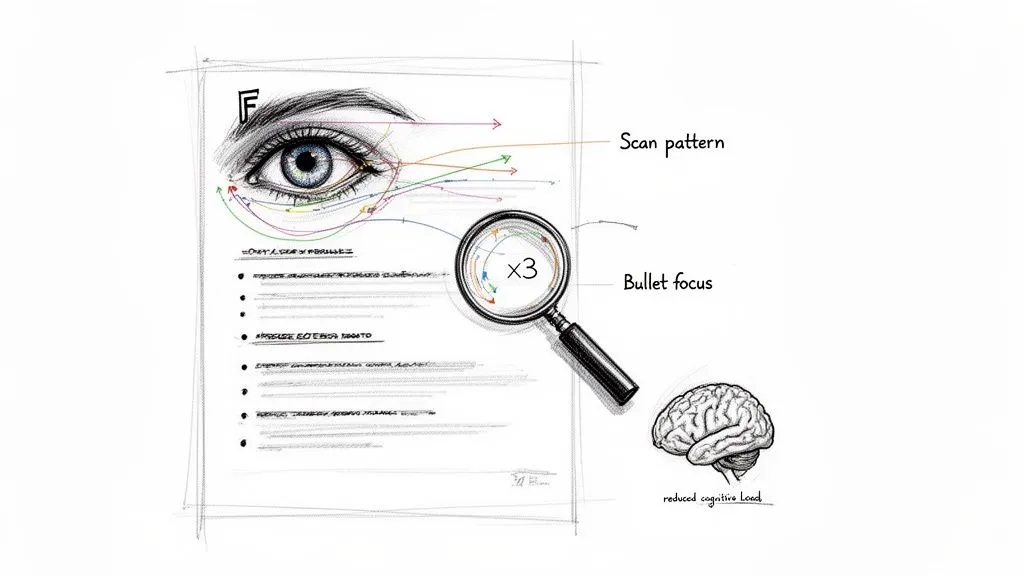
This isn't preference; it's neuroscience. A paragraph is a "wall of text." It increases what psychologists call cognitive load. For a tired, stressed recruiter, a high cognitive load feels like a chore. And resumes that feel like a chore get tossed.
Bullet points are the antidote. They break your story into bite-sized pieces, instantly lowering that mental strain.
Guiding the Reader’s Eye
Well-crafted bullets act like signposts. The dot grabs the eye. The short line of text that follows is absorbed in a single glance. This structure guides the recruiter’s gaze right to your biggest wins.
Look at the difference:
-
Paragraph Version: In my role, I was responsible for overseeing the entire project lifecycle, which involved developing the initial project plan, managing the team's weekly tasks, and ensuring all milestones were met on time. I also handled the budget and communicated progress to key stakeholders, successfully delivering the project under budget.
-
Bullet Point Version:
-
Managed the end-to-end project lifecycle, from initial planning to final delivery.
-
Led a team of five to meet 100% of project milestones on or ahead of schedule.
-
Delivered the project 15% under budget through strategic resource allocation.
-
The paragraph tells a story. The bullet points prove your value. Instantly.
Forcing Clarity and Focus
Here's the secret benefit: bullet points force discipline on you. You can't hide behind vague descriptions. The format demands you boil your experience down to sharp, powerful statements.
A bullet point isn't a sentence with a dot. It’s a miniature headline for your achievement. It demands a strong action verb and a quantifiable result.
By using bullets, you’re not just making your resume scannable; you’re making it punchier. Each point is a self-contained argument for why you deserve the interview. You're respecting the recruiter's time by giving them exactly what they need.
So when asking, should you use bullet points in a resume, the answer is an emphatic, strategic yes.
The Anatomy of a Perfect Resume Bullet Point
A great bullet point is a miniature story of your impact. It’s not a sentence with a dot. It’s a distilled, high-proof shot of your value.
Forget the fluff. "Team player" and "detail-oriented" are empty claims. Prove it.
The formula is simple and repeatable. No templates, no thesaurus. Just three core components that turn a weak task description into an undeniable achievement.
The Action Verb + Task + Result Formula
Every powerful bullet point has these three elements.
-
Start with a strong action verb: Kick it off with a word that shows you did something. "Led," "Launched," "Built," "Negotiated," "Optimized." Ditch passive phrases like "Responsible for."
-
Describe the task: Briefly explain the action. What project did you lead? What system did you build? Keep it concise.
-
Show the result: This is the most crucial part. How did your action help the company? Use numbers, percentages, or concrete outcomes. This is your proof.
Let's see it in action.
Weak:
- Responsible for social media marketing campaigns.
Strong:
- Launched 5 multi-channel marketing campaigns, boosting lead generation by 40% in six months.
The first is a job description. The second is an achievement. See the difference?
Why Metrics Are Not Optional
Numbers don’t lie. They transform vague claims into tangible results.
"Improved efficiency" is nice, but it's meaningless. "Automated a reporting process that saved 10 hours per week" is undeniable. Recruiters hunt for these metrics because they are the clearest indicators of your potential.
Dig for the numbers.
Every task has a metric. Your job is to find it. How many? How much? How often? How fast?
Crafting High-Impact Bullet Points: Before and After
Here’s how to apply the formula and transform bland statements into compelling proof.
To really master this, it helps to know the different types of resume bullet points and the formulas that make each one work.
| Weak Bullet (Before) | Strong Bullet (After) |
|---|---|
| Managed the company blog. | Grew organic blog traffic by 250% in one year by implementing a new SEO content strategy. |
| Handled customer support inquiries. | Maintained a 95% customer satisfaction score over 1,000+ support tickets. |
| Worked on a new software feature. | Coded and shipped a key user-requested feature, which increased user engagement by 15%. |
Action, task, and a hard, quantifiable result. It’s a simple framework that makes your contributions impossible to ignore. For more guidance, check out our insights on how to use bullet points in a resume.
When to use a Paragraph (Hint: Almost Never)
Let’s be clear: bullet points are the undisputed champ for your work experience. Paragraphs are almost entirely useless. But they have one, very specific role. Get it wrong, and you bury your best work.
The only place for a paragraph is your professional summary. This is the 2-3 sentence intro at the top of your resume. Its job is to frame your value before a recruiter sees a single bullet point. It’s the headline for your career.
When Context is Critical (and Still Risky)
For a few professionals, a short paragraph can act as a bridge.
-
Career Changers: A brief paragraph can connect the dots. It explains why your skills as a construction project manager fit a tech ops role.
-
Senior Executives: For C-suite roles, a concise paragraph can set the stage, summarizing a leadership philosophy or strategic win before the bullets break it down.
But even here, the heavy lifting of proving your impact must be done with bullet points. The paragraph sets the scene; the bullets deliver the proof.
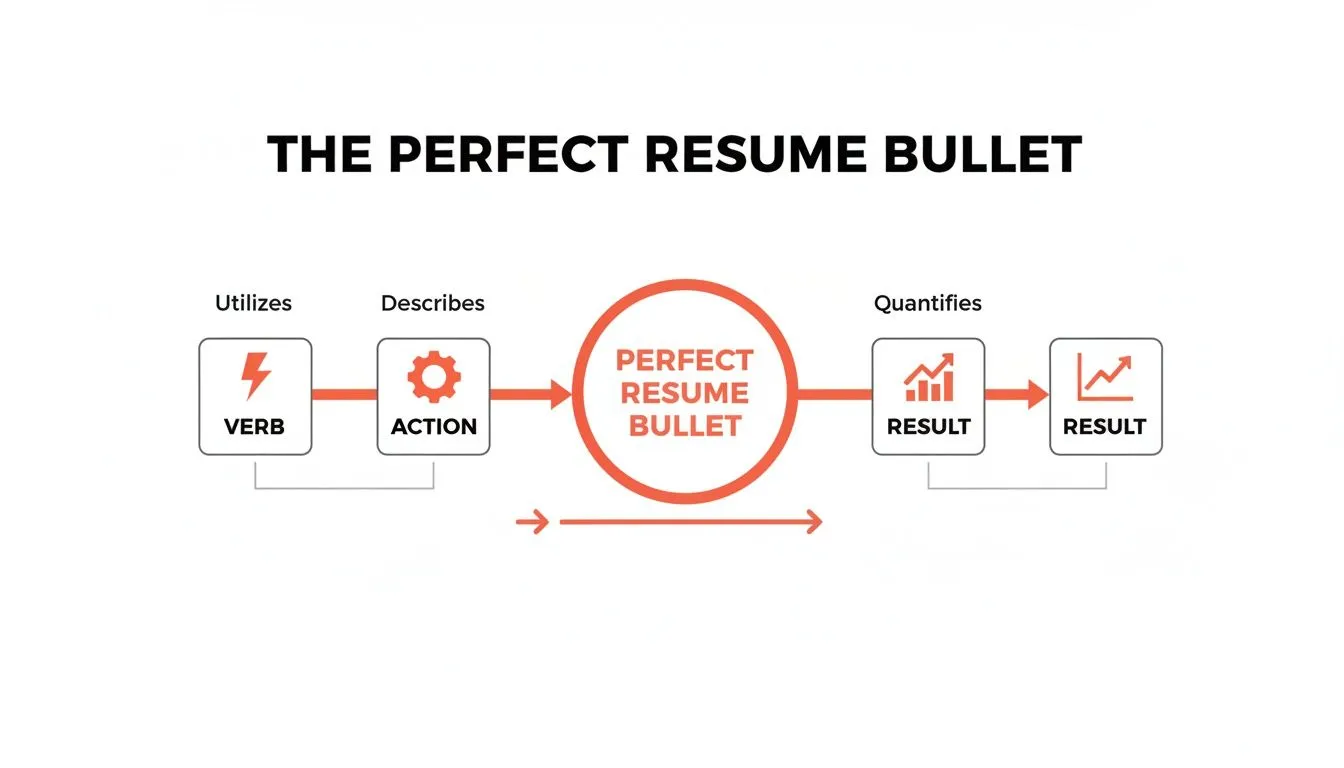
This diagram shows the simple, powerful formula for every bullet: verb, task, and quantified result. It shifts the focus from listing responsibilities to showing tangible impact.
Striking the Right Balance
A paragraph provides the ‘why,’ but your bullets must deliver the ‘what’ and ‘how much.’ It’s a supporting actor, never the star.
Your resume must be scannable. Any paragraph has to justify its existence by adding crucial context that bullets can't. If it doesn't, cut it. Your achievements deserve the spotlight of a clean, impactful, bulleted list.
Wondering if you have too many bullets? Check our guide on the right number of bullet points per job on your resume. It will help you stay concise while making your impact shine.
Beyond the Basics: Advanced Bullet Point Tactics
Standard bullets get the job done. But once you master the basics, you can use more advanced structures to tell a clearer story. This is about being strategic, not just following a formula.
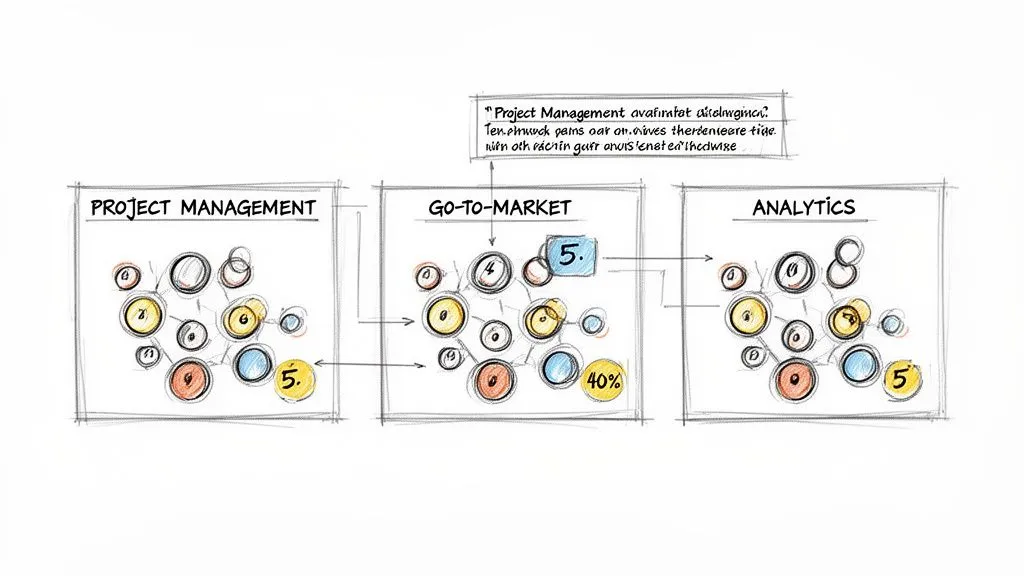
Sometimes a role is too complex for a simple list. You need to frame your impact so the recruiter instantly gets the why behind your work.
The Micro-Paragraph for Context
Think of this as a one-sentence opener under your job title, right before the bullets. It’s a high-level summary that explains the scope of your role. It’s incredibly useful if your title was vague ("Consultant") or you led a critical initiative.
Example: Product Manager
Led the company's first expansion into the European market, owning the product roadmap from market research to launch in three new countries.
-
Drove a 25% increase in user acquisition in Q1 by tailoring features to local compliance and user behavior.
-
Conducted 50+ user interviews to define the MVP, reducing initial development time by 4 months.
-
Coordinated cross-functional teams (Engineering, Marketing, Legal) across three time zones to ensure seamless GTM execution.
That first sentence sets the stage. It gives vital context, making the following bullets land with more power.
Grouped Bullets for Complex Roles
If you’ve been a consultant or project manager, your work can feel all over the place. Standard bullets can look scattered. Grouped bullets are the solution. You cluster related achievements under a subheading to show deep expertise in distinct areas.
Grouping your bullets brings order to complexity. It tells a recruiter, "I didn't just do a lot; I drove results in specific, important areas."
This organizes your impact, making it simple for a hiring manager to see your capabilities where they care most.
Example: Senior Consultant
Go-to-Market Strategy
-
Developed a new channel partnership strategy for a SaaS client, resulting in a $1.2M pipeline increase in six months.
-
Restructured the client's sales messaging, contributing to a 20% shorter sales cycle.
Operational Efficiency
-
Implemented a new CRM workflow, reducing manual data entry by 15 hours per week for the sales team.
-
Led a change management initiative that saw 98% user adoption of new software in 90 days.
Using these tactics signals a higher level of communication. It proves you know how to present complex information clearly—a valuable trait in any senior professional.
FAQ: Nailing the Details on Resume Bullet Points
The big picture is clear. But the devil is in the details. Here are the practical, no-fluff answers to common questions.
How Many Bullet Points Should I Use Per Job?
Quality over quantity. Always. It’s a highlight reel, not a task list.
-
Most Recent/Relevant Roles: 3-5 high-impact bullet points. Make every one count with a powerful metric.
-
Older/Less Relevant Roles: 1-3 bullets are plenty. Show competence and move on. No one needs a deep dive into your job from ten years ago.
If you’re struggling, it’s a sign you need to dig deeper. Don't just list what you did; explain the result.
Should My Resume Summary Be in Bullet Points?
No. Your professional summary is one of the few places a short paragraph is better. It’s your 2-3 sentence elevator pitch that frames your entire career. A paragraph here provides a smooth intro before the reader hits the hard data.
Do I Need a Period at the End of Every Bullet Point?
The only rule is consistency. Pick a style and stick with it. Inconsistency looks sloppy.
Our take? Use a period. It’s clean, professional, and correct for complete sentences. Even for fragments, it creates a consistent, finished look. Don't overthink it—just be consistent.
Can I Use Sub-Bullet Points on My Resume?
You can, but tread very carefully. Overusing them makes your resume cluttered and defeats the purpose of being scannable. They are a tool for clarification, not a go-to format.
Only use a sub-bullet when a single, major accomplishment has distinct parts that are all crucial to explain. And even then, just one level of indentation. Honestly, if you feel the need for sub-bullets, your main bullet is probably not focused enough. For more on this, see our guide on keeping resume bullet points to one line.
Tired of turning your accomplishments into powerful bullet points? StoryCV is a Digital Resume Writer, not another template. We use a smart interview to pull out your best stories and write a resume that gets you noticed. Start for free and see the difference.
https://story.cv