Wondering how to make your resume stand out? The secret lies in the perfect number of bullet points for each job. Stick to 3 to 5 bullet points to effectively showcase your achievements while keeping it concise for recruiters who skim through countless applications.
The Only Resume Bullet Point Rule You Need
Your experience is solid, but you’re stuck on a simple question: how many bullet points is the right amount?
This isn’t about some random rule. It's about strategy.
Recruiters spend about 10 seconds on your resume. Your bullet point count is critical. Too few, and you look underqualified. Too many, and your best achievements get lost in the noise.
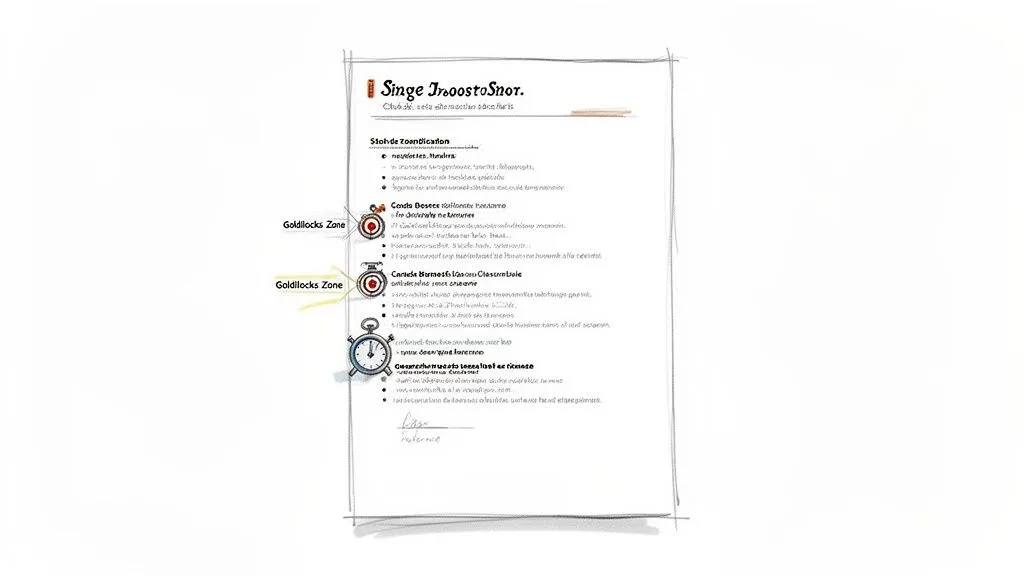
The Goldilocks Zone: 3 to 5 Bullets
The goal is the "Goldilocks Zone": three to five powerful, achievement-driven bullets for your most relevant jobs. This range respects the recruiter’s time. It also forces you to focus only on what truly matters.
Think of each bullet as a mini-story that screams value. If it doesn’t, cut it. It’s just taking up space. You can find some great resume bullet point examples that show how to frame your wins.
For a quick reference, here's how recruiters see it.
Bullet Point Quick Guide
| Bullet Count | Recruiter's Perception | The Outcome |
|---|---|---|
| 1-2 Bullets | "Not enough impact." | You look inexperienced or irrelevant. |
| 3-5 Bullets | "Just right. Clear and focused." | Your key achievements stand out. |
| 6+ Bullets | "Too much detail." | Important results get buried. |
Sticking to 3-5 is the safest, most effective strategy. It’s the perfect balance of proof and clarity.
Your resume isn't a list of everything you've ever done. It's a marketing document to get you an interview. Brevity is a strategic advantage.
Why This Simple Rule Works
This approach isn't about limiting your story. It's about making sure your story gets heard.
Sticking to this guideline creates a resume that is scannable, impactful, and professional. It shows you know what hiring managers want—results, not a laundry list of responsibilities.
As you refine your bullets, remember that how to craft resumes for remote jobs that truly get noticed starts here. This simple rule is the first step toward a resume that opens doors.
Why 3 to 5 Bullets Is the Unspoken Standard
This isn't an arbitrary rule. It’s pure strategy. Understanding how many bullet points per job on a resume is key to surviving that first 10-second glance.
Recruiters are scanners, not readers. They’re hunting for proof. A wall of text is their enemy. When they see eight bullets under one job, they don’t read faster. They just give up.
Forcing yourself to stick to critical achievements does the hard work for them. You guide their eyes directly to your biggest wins.
Hitting the Word Count Sweet Spot
This approach also keeps your total word count right where it needs to be. Each bullet should be about 15-25 words. Using 3-5 bullets per role naturally keeps your entire document lean.
According to key resume statistics, resumes between 475 and 600 words get more interviews. But a shocking 77% of resumes are too long or too short. The 3-5 bullet rule is your safety net to stay in that winning zone.
This isn't about cutting your story short. It's about framing it so it actually gets heard.
Designed for Humans and Machines
This format isn’t just for human eyes. It works for Applicant Tracking Systems (ATS), too.
The ATS isn't impressed by how many bullets you cram in. It’s looking for relevant keywords and a clean structure. Overloading an entry just dilutes the keywords that matter.
A resume with three powerful, quantified achievements will always crush one with seven vague responsibilities. The game is maximum impact in minimum space.
When you stick to the 3-5 rule, your resume is:
-
Highly Scannable: A human digests your value in seconds.
-
Impact-Focused: You prioritize achievements over boring duties.
-
ATS-Friendly: It presents info in a clean format the bots can read.
Ultimately, knowing how many bullet points on a resume is less about counting and more about making strategic cuts. It’s the filter that ensures only your most compelling evidence makes it to the page.
Tailoring Bullet Points To Your Experience
One size never fits all. The 3-5 bullet rule is a starting point, not a cage. How you use it should change based on where you are in your career and how relevant each job is to what you want to do next.
Your resume is a strategic document, not a historical archive. The goal is to build a case for where you're going. That means giving more space to the roles that matter most right now.
For your most recent and relevant jobs, use the full five bullets. This is your prime real estate. Pack it with your biggest, most quantifiable achievements.
Allocating Bullets Strategically
As you go back in time, shift your focus. Older roles show progression, but they shouldn't steal the spotlight.
For a job from 5-10 years ago, dial it back to two or three bullets. Pick a key win that’s still relevant, then move on.
And that job from over a decade ago? Be ruthless. Use one or two bullets at most. Or just list the title and company. This prevents ageism and keeps the reader focused on what you can do for them today.
Your resume's job isn't to list everything you've ever done. Its job is to get you an interview for what you want to do next. Every bullet point must earn its place.
This strategy keeps your resume tight. The decision tree below shows how staying within the ideal 475-600 word count is a critical first step.
The right word count dramatically increases your chances. And strategically allocating bullets is the best way to control it.
Here's a quick breakdown of how to think about it.
Bullet Point Strategy by Career Stage
| Career Stage / Job Type | Bullet Count Per Job | Strategic Focus |
|---|---|---|
| Most Recent & Relevant | 4-5 Bullets | Maximize impact with your best, quantified achievements. This is your hero section. |
| Past Relevant Roles (5-10 yrs) | 2-3 Bullets | Show progression and key wins without overshadowing current skills. |
| Older or Irrelevant Roles | 1-2 Bullets (or none) | Fill in work history. Keep it brief to focus attention on what matters now. |
| Internal Promotion | 4-5 (Senior) / 2-3 (Junior) | Show growth by giving more weight to the senior position. |
| Career Change | 3-4 Bullets | Reframe all bullets to highlight transferable skills for the new field. |
This isn't about rigid rules. It's about making conscious choices.
Scenarios For Mid-To-Senior Professionals
Your experience level dictates how you answer how many bullet points per job on a resume.
-
Career Progression: Got promoted? Show it. Use more bullets for the senior role (4-5) and fewer for the junior one (2-3). This paints a clear picture of your growth.
-
Career Changers: Pivoting? Connect the dots for the recruiter. Use 3-4 bullets per past role, but frame every one to highlight transferable achievements. Learn more about tailoring your resume to the job description.
You control the narrative. Use your bullet points to direct the recruiter’s attention exactly where you want it to go.
Transforming Duties into High-Impact Achievements
Knowing the right number of bullets is step one. Making them count is the hard part.
A resume with five weak bullets is worse than one with three that pack a punch. The gap between getting an interview and getting ignored is turning a bland list of duties into a compelling story of achievement.
Most people write their resumes like a job description. Big mistake. A hiring manager already knows what a "Project Manager" does. They want to know what you did.
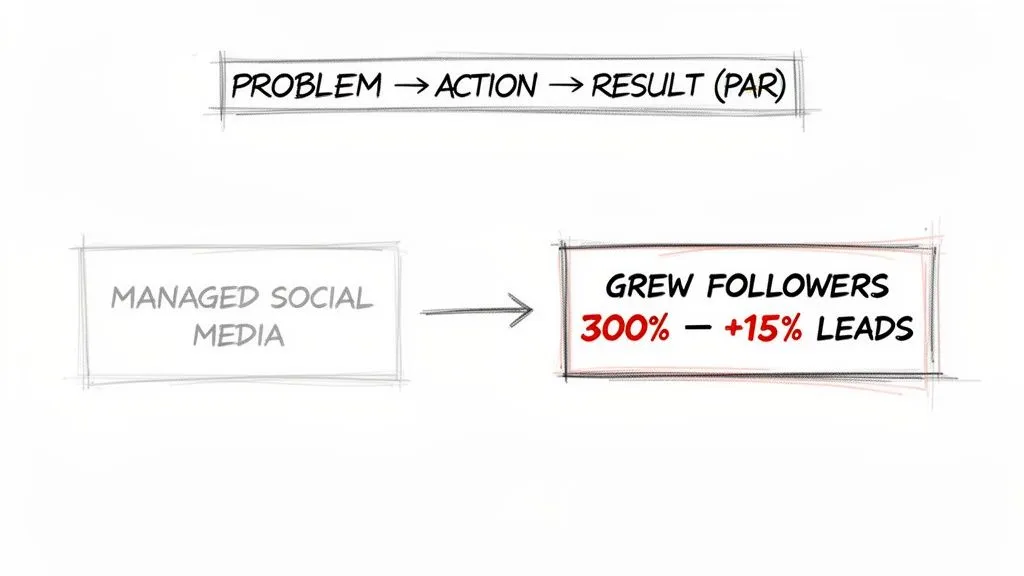
Uncovering the "So What?" with PAR
The simplest way to make this shift is the Problem-Action-Result (PAR) framework. It’s a mental model to pull the real story out of your work.
For every task, ask yourself:
-
Problem: What was the challenge?
-
Action: What specific steps did I take?
-
Result: What was the measurable outcome?
This forces you to move beyond vague responsibilities and focus on tangible impact. It's the "so what?" behind everything you did. The result is what gets you hired.
From Bland to Bold: Before and After
Let's see PAR in action.
Before (Duty-Focused):
- Managed social media accounts for the company.
After (Achievement-Focused):
- Grew organic Instagram following by 300% in 6 months by launching a targeted content series, resulting in a 15% increase in inbound leads.
Before (Duty-Focused):
- Responsible for coordinating team projects.
After (Achievement-Focused):
- Streamlined project workflows using Asana, reducing average project completion time by 20% and improving on-time delivery from 75% to 95%.
See the difference? The "After" examples are specific and quantified. They prove your worth instead of just stating your duties. This is the heart of a resume that works.
Don't just list your responsibilities. Sell your achievements. Your resume is a sales pitch, and the product is you.
Quantifying your results is non-negotiable. One study found that 44% of resumes are tossed for lacking measurable achievements. Don’t be one of them.
Knowing how many bullet points on a resume to use is pointless if the content is weak. Each one needs to be a concise story of your impact. For a deeper dive, see our guide on how to write achievements in a resume. To make your words pop, check out these 8 Practical Examples of Diction to Elevate Your Writing.
Common Bullet Point Mistakes to Avoid
Knowing the rules is half the battle. Avoiding the traps is the other half. Even with the right number of bullets, a few mistakes can sink your resume.
Think of this as a quick audit to fix the fatal errors.
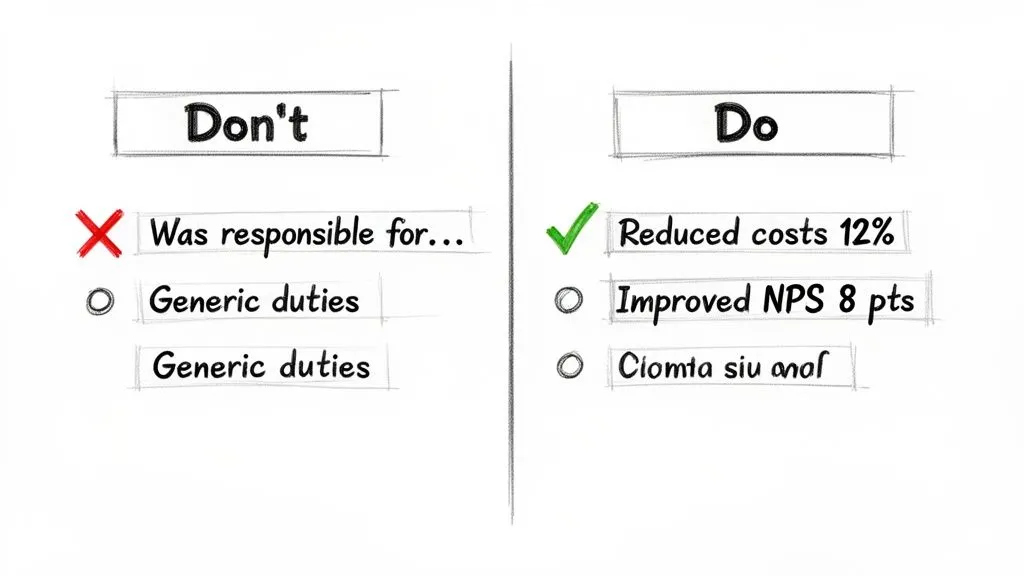
Mistake 1: Using a Passive Voice
The fastest way to sound like a bystander is to use a passive voice. Phrases like "was responsible for" are weak. They kill momentum.
-
Don't: "Was responsible for managing the quarterly marketing budget."
-
Do: "Managed a $150K quarterly marketing budget, reallocating funds to high-performing channels to increase ROI by 18%."
Active verbs put you in the driver’s seat.
Mistake 2: Forgetting to Quantify Results
Numbers speak louder than words. A bullet point without a metric is just an opinion. Saying you "improved efficiency" is nice. Showing you "reduced project completion time by 20%" is undeniable proof.
-
Don't: "Improved website traffic through new content."
-
Do: "Increased organic website traffic by 45% in Q3 by publishing 12 SEO-optimized articles and building 50+ high-quality backlinks."
Your resume is evidence, not a list of claims. Numbers are your strongest evidence. If a bullet lacks a metric, ask if it has earned its spot.
Mistake 3: Creating a Wall of Text
This is directly tied to how many bullet points on a resume is too many. Going beyond five bullets creates a dense block of text recruiters will skip.
Recruiters scan. A wall of text guarantees your biggest wins will be missed.
-
Don't: Listing eight separate bullets detailing every minor task.
-
Do: Combining related tasks into a single, powerful achievement and sticking to your top 3-5 impacts.
Fixing these mistakes isn’t about tweaking words. It’s about changing how you present your value. Switch from a passive list of duties to an active showcase of quantified achievements.
Let a Digital Resume Writer Do the Heavy Lifting
Figuring out how many bullet points per job on a resume is draining.
And let's be honest, templates are soul-crushing. Filling out boxes is for machines.
That’s why we built StoryCV. We're your Digital Resume Writer. We provide editorial judgment at software speed. Our guided interview pulls out your best stories, helps you quantify them, and shapes them into powerful, clean bullets.
You don't need another tool or a blank template. You need a partner to help you tell your story. That's what a good writer does.
We handle the tedious parts—structuring, wording, formatting. You just talk about your wins. A short, smart conversation turns into a resume that gets you noticed. We figure out the ideal number of bullet points, so you don't have to.
Stop wrestling with words. Try StoryCV for free and watch your career story come to life.
Got Questions? We've Got Answers.
You've got the rules. What about the exceptions?
Does Every Job on My Resume Need Bullet Points?
For your recent and pertinent roles, spanning the past 5 years, employ 3-6 bullet points, concentrating on accomplishments and outcomes rather than routine duties.
For positions held more than 5 years ago, you can provide 1-2 bullet points or simply list the job title and company to conserve space.
If a previous job holds no relevance to your current application, consider excluding bullet points altogether or omitting it from the resume. This approach keeps your resume concise and emphasizes your current skills and contributions.
How Many Total Bullet Points Should My Entire Resume Have?
There's no magic number. A solid one-page resume with 3-4 roles will land around 12-20 bullet points.
The real target is keeping your resume within the 475-600 word sweet spot. The 3-5 bullet rule is a great way to hit that mark.
Knowing how many bullet points on a resume is less important than making each one count.
What if I Can't Find a Number to Quantify My Work?
It happens. When you can’t nail down a metric, pivot to showing the scope, scale, or impact of what you did.
Don't just say, "Led a project."
Instead, give it context: "Led a cross-functional project with team members from Engineering, Marketing, and Sales to launch the new company website." This reframe shows scale and collaboration—a strong signal of your capabilities.
You've already done the hard work. Talking about it shouldn't be another chore. Instead of wrestling with templates, let StoryCV act as your Digital Resume Writer. Our guided interview uncovers your best achievements and crafts them into a powerful narrative. Try StoryCV for free and see your story come to life.