Your resume is a spec sheet. But it's selling the wrong thing.
Recruiters don't care that you know Python. They care what you built with it. Your resume isn't proof of your coursework. It's proof you can solve real problems.
Why Your Engineering Resume Fails
Your resume is probably just a list. A list of classes, programming languages, and an internship where you "assisted." It reads like a component list for a machine nobody built.
This is the problem with 99% of student resumes. They list qualifications, not capability.
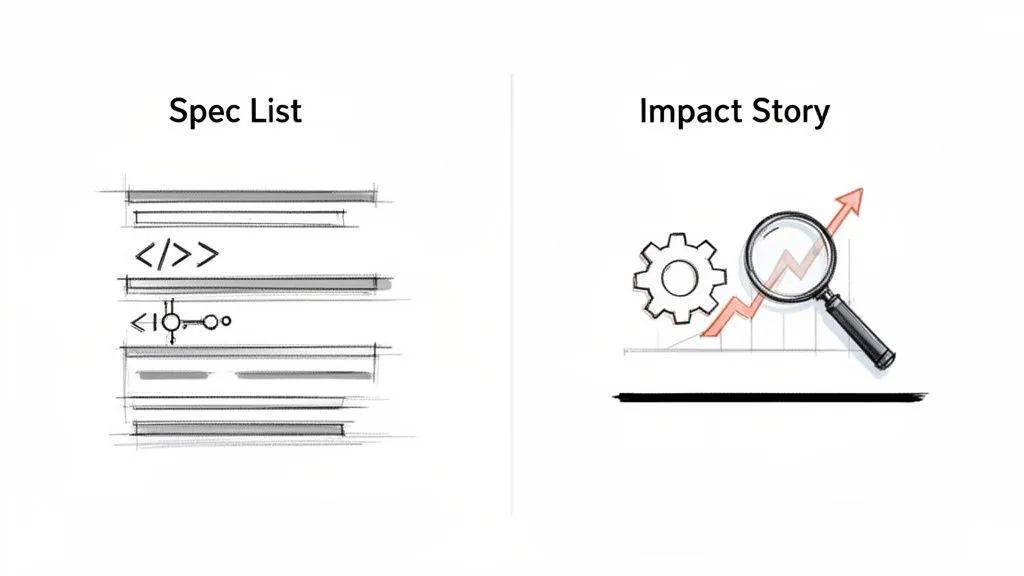
Hiring managers don’t hire skills. They hire people who can fix their problems. Your resume must prove you’re that person. The fix isn't a better template. It's a fundamental shift in how you talk about yourself. Move from a passive list to an active story of your impact.
From Tasks to Impact
Stop describing your duties. Start showing results.
Nobody cares that you "worked on a team project." They care if it did something. Did it improve efficiency? Did it solve a bug that stumped the seniors? Did it win a competition?
This shift is everything.
In a sea of graduates—the landscape of STEM graduates is massive—a generic resume is invisible. Resumes without clear impact are filtered out. By both humans and machines. But a resume with hard numbers can boost your callback rate significantly.
Your resume is an engineering project. The goal isn’t to list the materials. It’s to show the final product works and delivers results.
If you wanted to learn how to become an F1 engineer, you’d focus on performance, not car parts. Your resume needs that same mindset.
The Before and After
See it in action. A small wording change turns a weak statement into a powerful achievement. It’s the difference between being a participant and being a problem-solver.
Before and After The Impact-Driven Resume
| Weak Bullet (The 'What') | Strong Bullet (The 'So What?') |
|---|---|
| • Worked on a university robotics project. | • Designed and implemented a Python-based navigation algorithm for an autonomous rover, improving obstacle detection accuracy by 35% in cluttered test environments. |
| • Responsible for testing software modules. | • Developed and executed 50+ unit tests using JUnit for a new software feature, increasing code coverage from 60% to 92% and identifying 3 critical pre-launch bugs. |
| • Assisted in data analysis for research. | • Automated a data processing workflow using MATLAB scripts, reducing the time required to analyze experimental results from 4 hours to just 15 minutes per dataset. |
The "strong" examples prove your value with actions and measurable outcomes. They tell a story.
Tired of DIY? The top AI resume writer tools help draft these narratives from your experience. They provide the editorial judgment. You provide the facts.
The High-Impact Resume Structure
Forget templates. Your resume isn't a form to fill out. It's a strategic document. Its only job is to get you an interview. For an engineer, that means one clean, scannable page that screams competence.
Objective statements? Summaries? Dead. They are wasted space where every millimeter counts. A hiring manager spends about seven seconds on your resume. Don't tell them your objective—show them what you can do.
The Essential Sections
Your resume's blueprint should be simple. Brutally focused. Anything else is noise.
Here's the non-negotiable list:
* Contact Info: Name, phone, email, LinkedIn URL. A link to your GitHub or portfolio is better. It shows you build things.
* Education: University, degree, expected graduation date. GPA only if it's 3.0 or higher.
* Projects: This is your proving ground. Where you show you can apply theory to build real things. More important than experience for students.
* Experience: Internships or relevant part-time gigs. Title matters less than impact.
* Skills: A curated list of your technical arsenal. Programming languages, CAD software, lab equipment.
This structure gets past the initial scan. From both bots and humans. It puts your most impressive qualifications first.
Your resume structure isn’t about following rules. It’s about controlling the conversation. You decide what the reader sees first. Make it your strongest evidence.
Why It Works
This stripped-down approach forces ruthless editing. Every section earns its place.
Education proves your foundation. Experience and Projects prove you can execute. Skills provides a quick technical reference.
Together, they paint a picture of a capable, hands-on problem solver. Not just another student who sat through lectures.
For inspiration on filling these sections, check out our guide with a complete student resume template with real examples.
Writing Project Bullets That Land Interviews
This is where the real work is. Your project and experience sections are the heart of your resume.
"Assisted with coding" or "Worked on a team project" are resume killers. They tell a recruiter nothing. They guarantee your application gets ignored.
Stop listing tasks. Start proving your value. Use the Problem-Action-Result (PAR) framework.
You found a Problem, you took a specific Action, and you delivered a measurable Result.
This structure transforms you from a student who completed assignments into an engineer who solves problems. It's the difference between saying you know a tool and showing what you built with it.
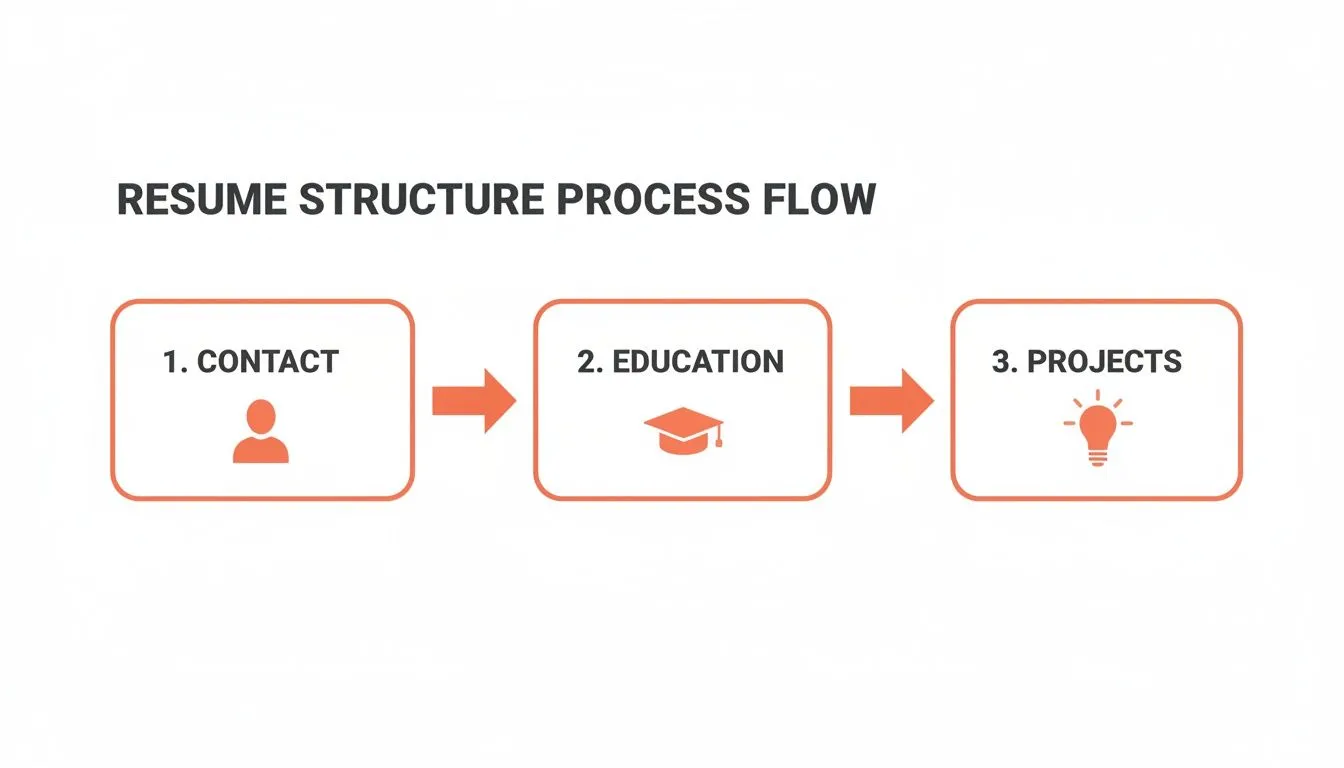
The flow of a great resume is intentional. It moves from who you are, to what you know, to what you can do. That’s where PAR-based bullets make all the difference.
The PAR Framework In Action
Let's break it down. You don’t need a fancy internship to write killer bullets. Your senior design project or a weekend hackathon are perfect material. Just frame them correctly.
The secret? Add numbers. Metrics. Quantifiable proof. Resumes with metrics get more interviews. Numbers are your best weapon.
Start with a strong action verb, describe the specific action you took, and end with the quantified result.
Engineering Achievement Examples
Here are concrete examples.
| Discipline | Weak Bullet | Strong, Quantified Bullet |
|---|---|---|
| Software Engineering | Coded a mobile app for a class project. | Developed an Android application for real-time bus tracking, implementing Google Maps API to reduce average student wait times by 15% on campus. |
| Mechanical Engineering | Designed a part in SOLIDWORKS. | Engineered a lightweight mounting bracket for a Formula SAE car using SOLIDWORKS and FEA, achieving a 30% weight reduction while maintaining a safety factor of 2.5. |
| Electrical Engineering | Worked with microcontrollers. | Programmed an Arduino-based weather station to collect and transmit temperature and humidity data, achieving 98% data transmission accuracy over a 24-hour test period. |
| Civil Engineering | Assisted with a bridge design project. | Modeled a pedestrian bridge in AutoCAD and performed structural analysis with RISA-3D, ensuring the design could withstand 120% of the required load capacity. |
See? The strong examples are specific, use powerful verbs, and include a clear, numerical result. This makes a hiring manager stop scrolling. For a deeper look, check our guide on writing effective bullet points in a resume.
You're not just listing experiences. You're providing evidence of your competence. Each bullet point is a mini case study proving you deliver value.
What If You Don't Have Numbers?
"But I don't have any metrics."
Yes, you do. Dig deeper. Metrics aren't just percentages or dollars. They can be scale, frequency, or comparison.
Ask yourself:
- How many lines of code did you write?
- How many users was the project for?
- How many tests did you run?
- Did you reduce the time to complete a task?
- Was your project selected for a showcase?
Even a "failed" project has metrics. "Identified a critical design flaw through rigorous testing, saving an estimated 40+ hours of rework."
Stop thinking like a student. Start thinking like an engineer documenting outcomes.
Anatomy of a Killer Engineering Student Resume
Talk is cheap. Let's look at a real-world example.
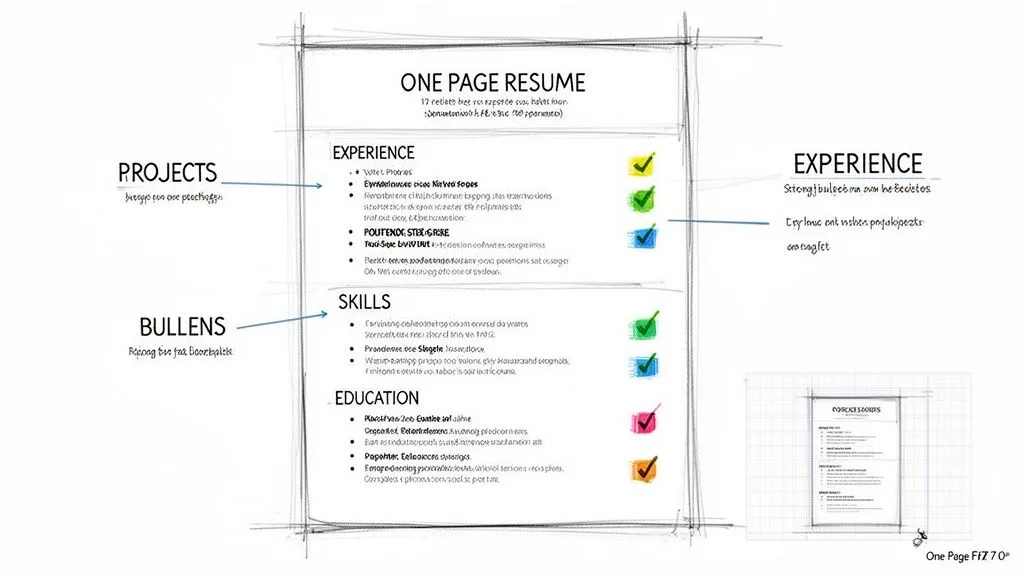
This isn't a template to copy. Templates are for robots. This is a model to understand the why behind the choices. So you can apply the same logic to your own story.
The Layout
First, notice what's missing. No fluffy objective. No buzzword summary. It gets straight to the point.
- One Page: Non-negotiable for a student. It proves you can prioritize information. A core engineering skill.
- Clear Hierarchy: Your name is the biggest thing. Section headers are bold. The layout guides the reader's eye.
- White Space: The page doesn't feel crammed. It makes the content easier to read. A lifesaver for a recruiter scanning quickly.
The Project Section is King
For most students, Projects matter more than Experience. This is your proof of work.
The bullet points don't just say, "Built a robot." They use the PAR framework. Each bullet is a tiny case study, starting with an action verb and ending with a number.
Let's break one down:
* "Engineered a lightweight mounting bracket for a Formula SAE car using SOLIDWORKS and FEA..." (The Action)
* "...achieving a 30% weight reduction while maintaining a safety factor of 2.5." (The Result)
This simple structure tells a powerful story. You understand constraints, you know industry-standard tools, and you deliver measurable results.
Your resume isn't a passive document. It's an active argument for why you're a valuable hire. Every line should be evidence.
Quantified Internship Achievements
The Experience section uses the same logic. It avoids lazy phrases like "Assisted engineers." Instead, it provides concrete proof of your contributions.
In a competitive market, this is what separates you. Demand for sharp engineering grads is high. Getting hired comes down to who tells the most compelling story. A bullet like, "Won 1st place in a hackathon by developing an algorithm that was 40% faster" grabs attention.
The Skills Section: Curated, Not Cluttered
The Skills section isn't a brain dump. It’s a carefully curated list, organized into logical categories.
- Programming Languages: Python, Java, C++
- CAD/Simulation Software: SOLIDWORKS, AutoCAD, Ansys
- Lab Equipment: Oscilloscope, Multimeter, Spectrum Analyzer
This organization makes it easy for a recruiter or an ATS to confirm you have the technical chops. A strong example shows how all these pieces create a document that's more than a list. It's proof of your potential.
Common (and Dumb) Resume Mistakes
Smart students make dumb mistakes. All your hard work can be undone by a few careless errors. Think of this as your pre-flight check.
Dodging these traps makes your resume instantly look more professional than most.
Sending a .docx File
This is a rookie mistake. It's the easiest way to have your layout fall apart on the recruiter’s machine. Different versions of Word mangle fonts and margins.
Always submit a PDF. It locks your formatting. It ensures what you see is what they see. It signals professionalism and attention to detail.
Your resume is a technical document. Submitting it in a format that breaks is like shipping code that doesn't compile. It kills your credibility.
The Endless Tech List
The "kitchen sink" approach to Skills is noise. Listing every piece of software you’ve ever touched—including Microsoft Word—makes you look unfocused.
Curate your skills. Focus on the tools relevant to the job.
- Group them logically: "Programming Languages," "CAD & Simulation Software," etc.
- Be honest: Don't list a language you used once for homework. You will be asked about it.
- Remove the obvious: No one needs to see "Microsoft Office." Use that space for a specialized skill.
Buzzwords and Passive Voice
"Team player," "hard worker," "detail-oriented" are a waste of space. These are empty claims. Your resume must prove these traits, not state them.
Passive language also weakens your impact. "Was responsible for" or "assisted with" makes you sound like a bystander. Use strong, active verbs.
Instead of:
* Was responsible for testing software modules.
Write this:
* Executed 50+ unit tests using JUnit, increasing code coverage to 92%.
This isn't just about confidence. It's about taking ownership of your work and communicating the value you delivered.
Your Top Resume Questions, Answered
Got questions? Good. It means you’re thinking critically. Let's get you straight answers.
How long should my resume be?
One page. No exceptions.
Recruiters spend seven seconds scanning it. As a student, everything important fits on one page. This isn't a limitation; it's a feature. It forces you to be precise.
Should I include my GPA?
Only if it's 3.0 or higher.
If it's lower, leave it off. Your resume is a marketing document, not an academic record. Let your projects do the talking. The goal is to prove your skills with tangible results.
A high GPA is a nice bonus. A well-executed project that solved a real problem is hard evidence. Evidence always wins.
How do I show experience without internships?
Your 'Projects' section is your experience section.
Detail your capstone, side-projects, or hackathon entries. Use the PAR framework to show the challenge, your solution, and the outcome. This proves you can deliver value without a formal job title. For more career advice, a specialized job portal blog can be a great resource.
Is a summary or objective necessary?
No. They are outdated and waste valuable space.
Your entire resume is the summary. Don't tell a recruiter what you want. Show them what you can do. Let your achievements speak.
Quick Answers for Engineering Students
I get these questions all the time. Here are the rapid-fire answers.
| Question | The Short Answer |
|---|---|
| How do I list a project I'm still working on? | List it as "In Progress" with an expected completion date. Focus on what you've already accomplished. |
| Should I include coursework? | Only if it’s highly specialized and relevant (e.g., "Advanced Fluid Dynamics"). Keep it to 3-4 key courses. |
| Is a two-column resume format okay? | No. Stick to a single column. It’s cleaner, easier to scan, and safer for Applicant Tracking Systems (ATS). |
| What file format should I use? | Always PDF, unless the application specifically demands a .docx. A PDF preserves your formatting perfectly. |
Nail these fundamentals. You're already ahead of the competition.
Tired of guessing what recruiters want? Stop filling out soul-crushing templates. StoryCV acts as your Digital Resume Writer, using a smart interview to turn your experience into a compelling narrative. We help you articulate your impact so you can land more interviews. Get your first role drafted for free at https://story.cv.