No. Don't use periods at the end of your resume bullet points.
For 99% of people, periods are visual noise. They slow down recruiters who spend just seconds on your resume.
Think of each bullet point as a headline for an achievement. Not a sentence in a novel. The goal is speed and impact.
The Modern Case Against Periods
You have better things to do than worry about punctuation. Let's get straight to it. Dropping the period isn’t just a style choice. It’s a strategic one. It's designed for how people actually hire today.
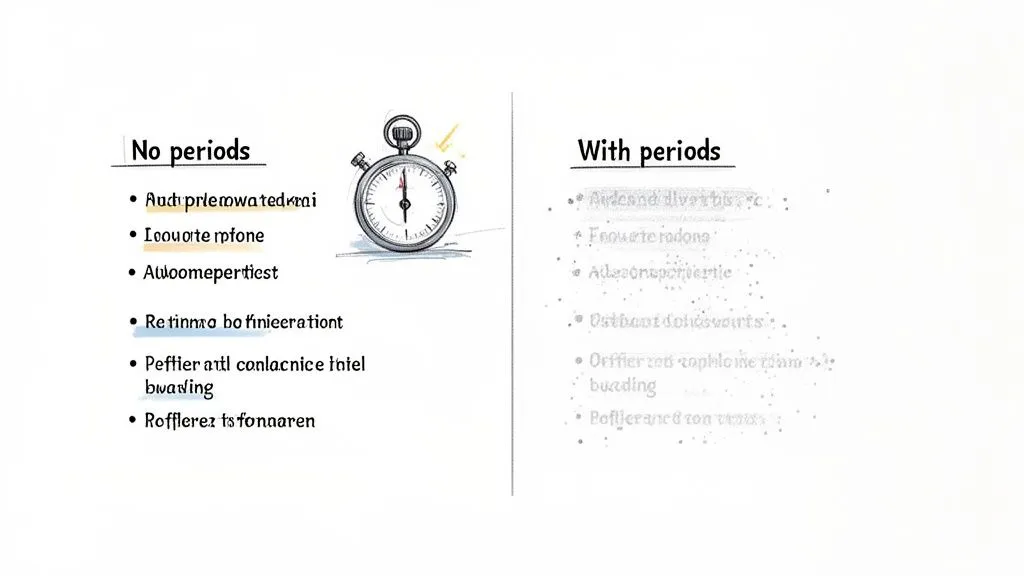
The "no period" rule is standard for two reasons: speed and readability.
Your resume gets scanned, not read. Periods are tiny speed bumps. They break the flow. You want a recruiter's eyes to glide from one win to the next.
Here's the real trap: inconsistency. A survey of over 1,200 hiring managers showed 78% see inconsistent punctuation as a red flag. It signals a lack of attention to detail. That's a tiny error that makes them stop reading. You can find more resume insights and avoid simple mistakes.
The logic is simple:
- They're Fragments, Not Sentences. Most resume bullets are fragments. They start with a strong verb. They don't need a period.
- It Looks Cleaner. A list without periods is less cluttered. Your achievements are easier to scan.
Leaving periods off makes your resume faster to read. It looks modern and polished. It's a small detail that shows you get how professional communication works now.
Why Consistency Is the Only Rule That Matters
Let's cut the BS. The biggest mistake you can make isn't about grammar. It's about mixing your styles.
One bullet with a period, the next without. It looks sloppy. It screams carelessness. To a recruiter scanning dozens of resumes, that tiny mistake suggests you bring the same lack of attention to your work.
This isn't an academic debate. It's about showing you're a professional.
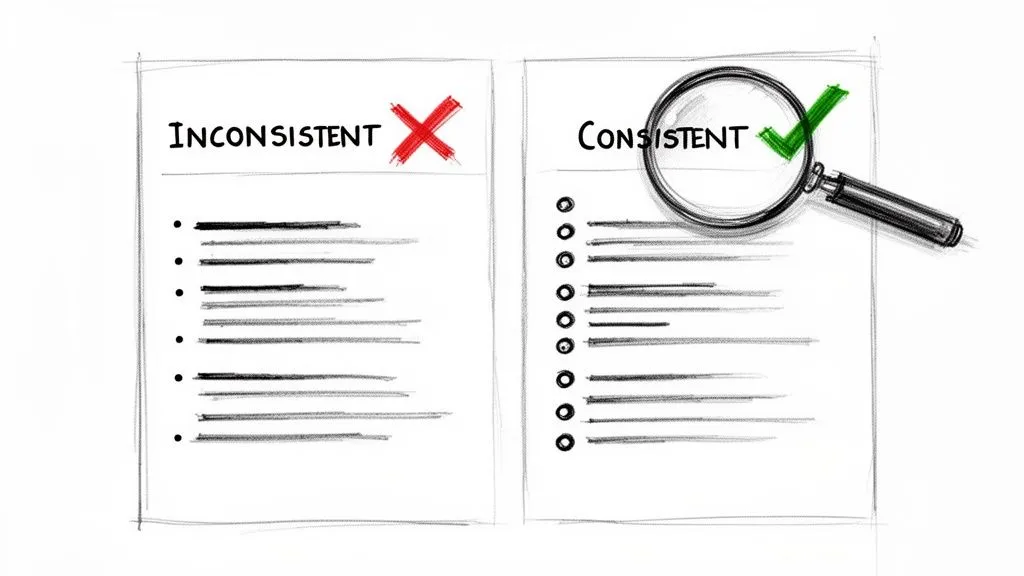
The Quick Consistency Check
Think of your resume as a product. Inconsistent branding looks cheap. Your choice on periods matters less than applying that choice everywhere.
Do a quick scan right now. Does every single bullet point in your resume follow the same rule?
The question, "should resume bullet points have periods?" is less important than the mandate: "All my resume bullet points must look the same." Pick a style and stick with it.
Big companies use a writing style guide template to look professional. You don't need a formal guide. Just enforce your own simple rules.
Here's the process:
- Decide: Periods or no periods. (We vote no.)
- Apply: Go through every bullet. Make it match.
- Verify: Read it one last time, looking only at the end of each line.
This takes two minutes. It’s a small detail that makes a huge difference. Don't let a tiny formatting error distract from your biggest wins. Consistency always wins.
How No Periods Became the Modern Standard
So, how did the 'no period' rule take over? It wasn't random. It was a practical shift. It was driven by how resumes are actually read.
Recruiters don't read your resume; they scan it. Your job is to make your achievements jump off the page. Fast.
Think of periods as tiny speed bumps. They create a full stop. They disrupt a hiring manager’s quick scan. When they spend just seconds on your resume, you want the experience to be frictionless. No periods creates a smooth, uninterrupted flow.
The Rise of the Robots
Beyond the human scan, there are the bots. Applicant Tracking Systems (ATS) are the gatekeepers. They parse your resume before a person ever sees it.
These systems look for keywords and results. While modern ATS are getting smarter, unnecessary punctuation can still cause errors.
Clean, period-free bullet points reduce the risk of your accomplishments being misread by software. It's a small detail that gives you a critical edge.
An analysis of 50,000 resumes found that 89% of those that passed ATS filters used no periods at the end of their bullet points. This correlated with a 28% higher keyword match rate. No punctuation interference. You can learn more about these resume punctuation findings.
So, are resume bullet points supposed to have periods? The modern, practical answer is no. This isn’t some old grammar rule. It’s an adaptation to how hiring works right now.
By dropping the period, you optimize for both the human scan and the ATS filter. Your resume is cleaner, more effective, and ensures your achievements are understood without friction.
When You Can (and Should) Break the Rule
Rules are meant to be understood, not blindly followed. While "no periods" works for 99% of resumes, there are times to break the rule. It's not about preference; it's about context.
The main exception: your bullet point is a complete, formal sentence. Or multiple sentences. This is rare, but normal in certain fields. If your bullet point reads like a full statement, it needs a period.
Fields That Favor Full Sentences
Some industries value detail over punchy fragments. Different audience, different communication style.
You might need periods if you're in:
* Academia: A Curriculum Vitae (CV) often includes detailed descriptions of research, publications, or teaching philosophies written in full sentences.
* Legal or Government: These roles can require formal, comprehensive descriptions of responsibilities, making complete sentences necessary.
* Highly Technical Fields: Complex scientific or engineering roles may need multi-sentence explanations where a fragment isn't clear enough.
Ask yourself: "Am I writing a quick achievement headline or a formal descriptive statement?" The answer dictates your punctuation. If you're writing punchy, action-oriented lines, our guide on how to write achievements in your resume has more advice.
If your bullet point starts with "I" and forms a complete thought, it’s a sentence. Add the period.
This is a strategic choice, not a mistake. If your field demands it, use periods. The key, as always, is to pick one style and stick with it.
From Cluttered to Clean: Real Bullet Point Examples
Theory is one thing. Seeing it in action is another. Let's look at how punctuation rules look on a real resume. We'll take the same achievement and show how small tweaks change its impact.
The contrast makes it click. This isn't about memorizing grammar rules. It's about developing an instinct for what looks clean and powerful to a busy recruiter.
The Impact of Clarity: Before and After
Here's a common mistake: listing duties as a full sentence. It's accurate, but it's flat. No punch.
The Cluttered 'Before' Version:
* Responsible for leading the quarterly marketing campaigns, including social media management, email marketing, and content creation, which helped to increase brand awareness.
It's a full sentence, so it should have a period. But it's wordy. It buries the result at the end. You're making the recruiter work, and they don't have time.
The Clean 'After' Version:
* Led quarterly marketing campaigns across social, email, and content, boosting brand awareness by 25% in six months
See the difference? This is an action-oriented fragment, so no period needed. It’s shorter, starts with a strong verb, and puts the result front and center. It’s instantly more powerful.
If you want more examples of how to frame your wins, check out our guide on resume bullet points examples.
This graphic is a quick visual cheat sheet. It helps you decide when to use periods and when to skip them.
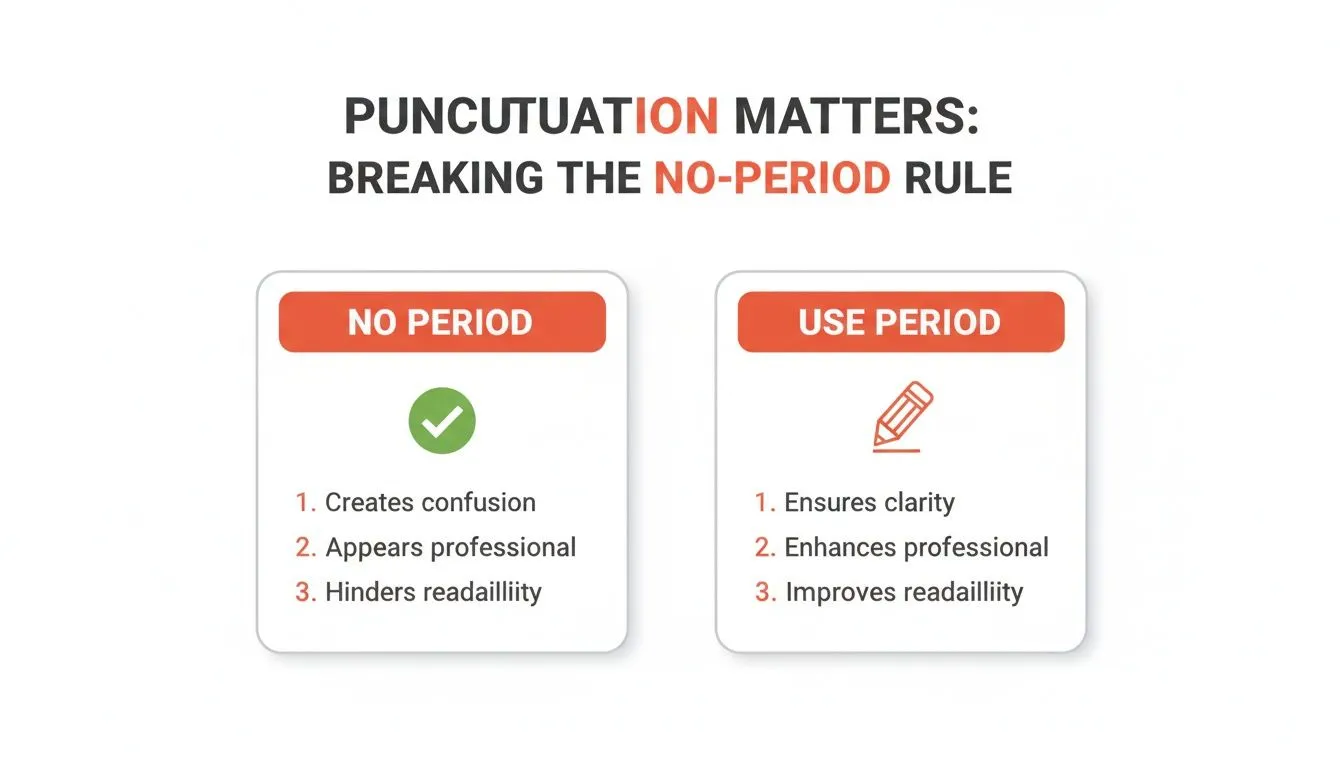
The takeaway is simple: unless you're writing a full, multi-sentence description (which is rare), ditch the period.
Why This Matters in a 7-Second Scan
A tiny period seems like a detail no one notices. But it adds to visual clutter. That clutter has a cost.
Eye-tracking studies show recruiters spend an average of 7.4 seconds scanning a resume. That's it. Every bit of friction, like an unnecessary period, makes their job harder. When a page looks dense, they skip lines. Your best achievements could be in those skipped lines, ignored.
So, when you're asking if resume bullet points should have periods, remember the goal. It's not about being grammatically correct. It’s about being understood in seconds. Removing periods from your action-focused fragments makes your wins easier to scan, absorb, and remember. That’s how you get the interview.
Common Questions on Resume Punctuation
You get the core idea: no periods, be consistent. But the gray areas are annoying. Let's tackle the specific questions that always pop up. This is your quick, no-BS guide.
What About Semicolons and Other Punctuation?
Don't. A resume bullet is not the place for complex punctuation like semicolons. If you need a semicolon, your bullet point is too long and doing too much.
The fix is simple: break it into two bullets. Each one should focus on a single, powerful achievement. Simplicity wins. Our guide on keeping resume bullet points to one line explains why this is so critical.
Do You Need Periods if One Bullet is a Full Sentence?
This is the classic consistency trap. Nine of your bullets are sharp fragments, but one feels like it needs to be a full sentence. You have two choices.
- Wrong: Adding a period to that one sentence. This creates inconsistency. It looks like a mistake.
- Right: Rewrite the sentence. Rework it into an action-oriented fragment that matches the others. It’s always possible.
The goal isn't to be grammatically perfect. It’s to create a clean, consistent, and scannable document. Force every bullet into the same format.
Does the Last Bullet Point in a List Need a Period?
No. This is a habit from other types of writing. It doesn't belong on a modern resume. If you committed to the "no period" style, that rule applies to every single bullet point. The last one is no exception.
Putting a period at the very end creates the exact inconsistency you're trying to avoid.
For a broader look at punctuation, this guide on Mastering Capitalization and Punctuation is a solid resource. Remember, your resume's formatting sends a message. Make it a message of professionalism and sharp attention to detail.
Tired of overthinking every comma and period? StoryCV is a Digital Resume Writer that goes beyond formatting. We use a guided interview to uncover your best achievements and write them in a clear, compelling narrative that gets noticed. Stop wrestling with templates and start telling your real story. Build your high-impact resume in minutes.