Stop listing job duties. Start showing your impact.
That’s it. That's the secret. It’s the difference between "Managed social media" and "Grew Instagram followers by 200% in 6 months with zero ad spend."
One is a task. The other is a result. One gets ignored. The other gets you an interview.
Why Your Resume Gets Ignored (And How to Fix It)
Recruiters spend about 7 seconds on your resume.
They scan hundreds a day. They all look the same. "Responsible for..." "Duties included..." It’s noise. It tells them what you were supposed to do, not what you actually did.
You’re describing your job. You need to describe your impact.
Shift From Responsibilities to Results
Forget your job description. Think about what got better because you were there.
This isn’t about fluffing up your resume. It’s about telling the truth about your value. It’s the one change that separates a resume that gets deleted from one that gets a call.
Look at how this one shift changes everything.
Responsibility vs. Achievement: The 7-Second Difference
A recruiter spots the difference instantly. One resume is a task list. The other is a highlight reel of wins.
| Resume Element | Responsibility-Focused (Gets Ignored) | Achievement-Focused (Gets Interviews) |
|---|---|---|
| Headline/Summary | "Experienced marketing professional..." | "Marketing specialist who grew organic traffic 200% in 12 months." |
| Job Bullet Point | "Responsible for managing social media accounts." | "Increased social media engagement by 45% in Q3 by launching a new content strategy." |
| Project Description | "Involved in website redesign project." | "Led the UI/UX for a website redesign that cut bounce rates by 30%." |
| Overall Impression | "This person did their job." | "This person gets results." |
The achievement-focused column proves why the work mattered. Using a sharp professional Notion resume template helps, but the words are what count.
The goal is to move from "I did this" to "Because I did this, this happened." That second part is where your value lives.
The Numbers Don't Lie
Quantified achievements are undeniable. Metrics grab attention. They provide proof, clarity, and show you understand what drives a business.
Adding numbers is the fastest way to get a recruiter to stop scrolling. You’re not just claiming you’re good; you’re showing them the evidence.
Moving from a list of duties to a showcase of achievements is the most critical step. If you're struggling to frame your story, check out our guide on how to create my perfect resume. It’s not about finding a perfect template—it’s about finding your perfect story.
The PAR Method: A Simple Formula for Impact
Forget the dozen complicated frameworks. You only need one simple formula to show your value.
It’s called the PAR method: Problem, Action, Result.
This isn’t another acronym. It’s a way of thinking. It forces you to connect your work to a real business outcome. It shifts your mindset from "here’s what I did" to "here’s why it mattered."
Problem: What Was Broken?
Every real achievement starts with a problem. A slow process, falling engagement, rising costs. This is the "why" behind your work.
State the problem. It gives your achievement context. It shows a recruiter you spot things that need fixing, not just a list of tasks to complete.
- Example Problem: The sales team wasted 10+ hours a week on manual data entry.
- Example Problem: Customer churn jumped 15% because of slow support responses.
Action: What Did You Do About It?
This is where you’re the hero. What did you do to fix the problem? Use strong verbs. "Developed." "Implemented." "Redesigned."
Take ownership. Even on a team, focus on your direct contribution. This proves your skill and initiative.
Your action is the bridge between a business problem and a business result. It shows how you got there. This is how you write achievements that prove your skill.
Result: The Measurable Outcome
This is the most critical part. What happened because of your action?
Bring the numbers. The result is the hard proof that your work delivered real value. Did you save time? Cut costs? Drive revenue? Quantify it. A result without a metric is just an opinion.
- Increased revenue by 12% in six months.
- Reduced project delivery time by 30%.
- Improved customer satisfaction scores from 85% to 95%.
- Cut operational costs by $50,000 annually.
The PAR method isn't a box to fill. It's a storytelling structure that makes your impact impossible to ignore. It turns a boring duty into a powerful narrative a recruiter understands in seconds.
For more on structuring these, check out these examples of powerful resume bullet points. This approach ensures every line is packed with value.
Real-World Examples of Powerful Resume Achievements
Theory is fine. Seeing it in action is better.
Let's look at some before-and-after examples. We'll flip a boring responsibility into a metric-driven achievement. This works for a mid-level pro, a career changer, or a recent grad.
The goal isn't to copy-paste. It's to internalize the thinking so you can do it yourself. The framework is always PAR—Problem, Action, Result.
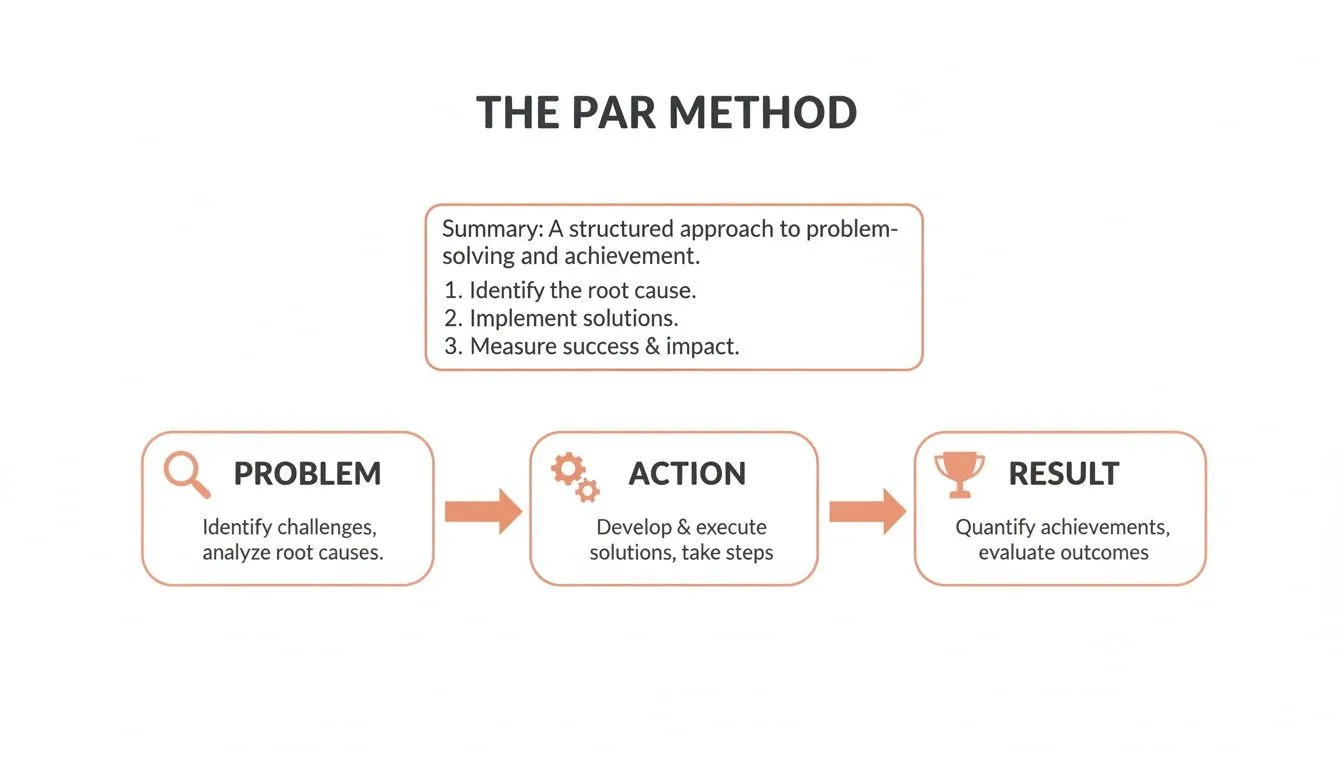
This flow is your secret weapon: find a business problem, take a specific action, and deliver a measurable result.
For The Mid-Level Professional (Project Manager)
Mid-level pros love listing their duties. Stop talking about what you did and start showing the impact you made.
Before (The Old Way):
* Responsible for managing project timelines and team communication.
This is a job description bullet. Passive. Vague. A waste of space.
After (The PAR Method):
* Steered a cross-functional team of 8 to launch a new software feature 3 weeks ahead of schedule, contributing to a 10% Q4 revenue uplift.
This version has a pulse. It quantifies the team size (8), shows a clear time-based result (3 weeks ahead of schedule), and ties the project to a business outcome (10% Q4 revenue uplift). This screams competence.
For The Career Changer (From Marketing to Product Management)
Changing careers? You have to translate past wins into the language of your future role. Show transferable impact.
Before (The Old Way):
* Created content for marketing campaigns and managed social media.
This sounds irrelevant for a Product Manager role. It fails to show the product-centric thinking they need.
After (The PAR Method):
* Analyzed user engagement data from marketing campaigns to identify key pain points, leading to a new feature proposal that increased user retention by 15%.
See the shift? "Created content" becomes "analyzed user data"—a core PM skill. This reframes what you did to prove you can think like a product owner. For a deeper dive, our guide on crafting a powerful career change resume has more tactics.
You don't need a new history, just a new story. Reframe what you did in the context of what they need.
For The Recent Graduate (Internship or University Project)
Recent grads think they have no achievements. Wrong. Your projects and internships are packed with them. The same rules apply.
Before (The Old Way):
* Helped organize a university club event.
"Helped" is weak. "Organize" is vague. This has zero impact.
After (The PAR Method):
* Led event logistics for a 200+ attendee university career fair, securing 5 new corporate sponsors and increasing student sign-ups by 40% over the previous year.
This version shows leadership, scale (200+ attendees), and tangible outcomes (5 new sponsors, 40% increase). It proves you can deliver results, even without a formal job title.
Before and After Achievement Examples
Let's put them side-by-side. One approach gets you ignored. The other gets you interviews.
| Role | Before (The Old Way) | After (The PAR Method) |
|---|---|---|
| Project Manager | Responsible for managing project timelines and team communication. | Steered a cross-functional team of 8 to launch a new software feature 3 weeks ahead of schedule, contributing to a 10% Q4 revenue uplift. |
| Career Changer | Created content for marketing campaigns and managed social media. | Analyzed user engagement data from marketing campaigns to identify key pain points, leading to a new feature proposal that increased user retention by 15%. |
| Recent Graduate | Helped organize a university club event. | Led event logistics for a 200+ attendee university career fair, securing 5 new corporate sponsors and increasing student sign-ups by 40%. |
The "After" column isn't just better writing. It’s a different way of thinking. It shows your job isn’t to do tasks, but to create value.
How to Find Your Metrics When You Think You Have None
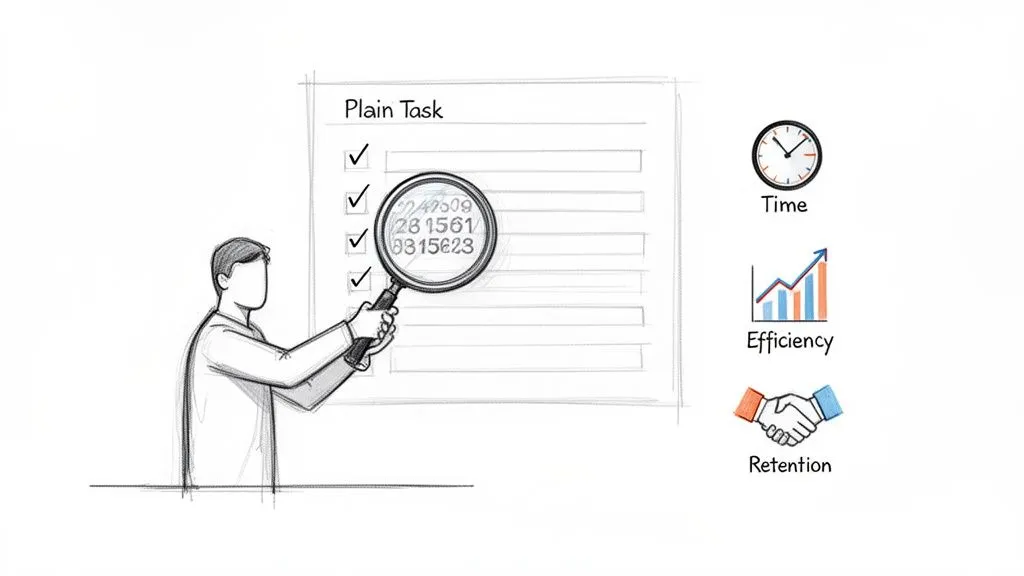
"But my job isn't about numbers."
This is a lie. Everyone has metrics. Your impact is measurable, even if it’s not in a sales report. You just have to know where to look.
Thinking your job is purely qualitative is a trap. It leads to a resume full of vague duties instead of hard proof. Let's fix that.
Think in Proxies
Metrics aren't just dollars and percentages. They are proxies for value. Time, quality, efficiency, scale. They're all measurable.
Did you improve a process? That’s time saved. Did you train someone? That’s increased team efficiency. Did you solve a tough customer issue? That’s retention.
Every task has a hidden metric. Your job is to uncover it. Stop thinking about duties and start thinking about the consequences of your work. The consequence is where the number lives.
Brainstorming Questions to Uncover Your Impact
Dig for the numbers. Grab a notebook and answer these questions about your work.
Questions About Time and Efficiency
- What process did you make faster? By how much? (e.g., “cut weekly reporting time from 4 hours to 30 minutes”)
- Did you automate a task? How many hours did that save the team per week?
- How many people did you train? How much faster did they ramp up? (e.g., “reduced new hire onboarding from 4 weeks to 2”)
- Did you create a template or system? How many people use it now?
Questions About Quality and Cost
- Did you reduce errors? What was the error rate before and after?
- Did you find a cheaper tool or renegotiate with a vendor? How much did that save? (e.g., “saved $15,000 annually by switching software vendors”)
- Did you catch a costly mistake? Estimate the loss you prevented.
- How did you improve customer satisfaction? Did positive reviews go up?
This process forces you to think about outcomes. And it’s not just about business metrics; showing your skill with complex software is just as critical. For more on this, check out our guide on listing examples of technical skills in your resume.
From Vague Action to Tangible Metric
Let's put this into practice. The goal is to connect your work to a number, even if it’s an estimate. Good-faith estimates are fine.
- Vague Action: "Improved team communication."
-
Metric-Driven Result: "Introduced a new project management tool that reduced weekly status meetings by 50%, saving the 8-person team 4 hours per week."
-
Vague Action: "Handled customer complaints."
-
Metric-Driven Result: "Managed 50+ high-value client accounts, resolving escalations 30% faster than the team average and maintaining a 98% retention rate."
-
Vague Action: "Organized company files."
- Metric-Driven Result: "Digitized and reorganized 5,000+ legacy documents, cutting file retrieval time by an estimated 75%."
You don’t need an accounting degree. Just be curious about the real-world impact of your work. The metrics are there. Go find them.
Common Mistakes That Make Your Achievements Invisible
You can find your achievements and still make them invisible. It happens all the time. Good work gets buried under bad writing.
The problem isn't a lack of impact; it's that you're hiding it. Let’s fix the common mistakes.
Your Language Is Vague and Passive
Weak language kills achievements. Words like "helped," "assisted," or "was responsible for" are resume poison. They signal you were a passenger, not the driver.
Vague claims like "improved processes" are empty. A recruiter has seen those exact words a thousand times.
- Weak: "Assisted with a project to improve team workflow."
- Strong: "Overhauled the team’s workflow by implementing a new PM tool, cutting project delivery times by 15%."
Use strong, direct verbs. Don't "help"; lead, create, build, reduce. Be the agent of the action.
You Bury the Result
Classic blunder. You describe the context and your actions, then tack the result on at the end. Recruiters scan in an "F" pattern. They might not get to the end of your sentence.
Lead with the result. Put your best number at the beginning.
Don't make them wait for the good part. Start with the impact, then explain how you did it.
Burying the lead:
* "Implemented a new email marketing strategy by segmenting the user base and A/B testing subject lines, which increased open rates by 20%."
Leading with impact:
* "Increased email open rates by 20% by launching a new segmentation strategy and A/B testing subject lines."
The second version is instantly more powerful. The recruiter sees 20% first and is immediately engaged.
You Use Insider Jargon
No one knows what "Project Phoenix" is. Using company-specific acronyms or jargon confuses the reader.
Your resume is a marketing document for an external audience. Translate your work into universal business language.
- Jargon: "Managed the 'Q4-Go' initiative to hit our MQL targets."
- Clear: "Led a Q4 lead generation campaign that exceeded marketing qualified lead (MQL) targets by 25%."
If your cousin in a different industry can't understand it, rewrite it.
You Clutter Your Resume with Too Much
More is not better. A dozen bullet points under each job is overwhelming. It dilutes the impact of your best achievements.
Your resume isn't a log of every task you've ever done. It’s a highlight reel.
Pick your top 3-5 achievements for your most recent roles. Make them sharp and powerful. A few high-impact bullet points will always beat a wall of text. It shows you can prioritize. It also respects the recruiter's time.
Your Questions About Resume Achievements, Answered
You have the framework. You know the mistakes. But a few questions always pop up. Here are some quick, no-BS answers.
How Many Achievements Should I List Per Job?
3-5 powerful achievements for your most recent roles. Anymore is just noise.
For older jobs (5-7+ years back), trim it to 1-2 killer bullet points. The goal is to show a history of success, not log every task. Prioritize ruthlessly.
Should I Use The PAR Method For Every Bullet Point?
Yes, basically. But don't treat PAR (Problem-Action-Result) like a soul-crushing template. Think of it as a mental checklist.
Every bullet point needs to show an action you took and the positive result it created. This forces you to stop listing duties and start proving your value. It’s the fastest way to show why your work mattered.
The PAR method is a thinking tool, not a writing rule. Use it to make sure every line on your resume is pulling its weight.
What If I Truly Cannot Find A Number For My Achievement?
Pivot to qualitative impact. Show tangible, positive change. Frame it in terms of scope, scale, or influence.
Instead of a vague statement like "Improved team documentation," get specific.
Example: "Developed a new documentation framework that was adopted as the standard for the entire 50-person engineering department, eliminating information silos."
This shows your initiative had a broad, lasting effect. That’s just as powerful as a percentage because it demonstrates leadership.
Is It Okay To Estimate Metrics If I Don’t Know The Exact Numbers?
Yes, good-faith estimates are fine. And often necessary. Be ready to explain your logic if asked. Don't invent numbers.
Base your estimates on logical assumptions. If you automated a task that took two hours a week, you can confidently say you "saved over 100 hours of manual work annually."
Use cautious language like "approximately," "over," or "around." For instance, "Reduced onboarding time by approximately 20%" sounds both confident and honest. It shows you think in terms of impact, even without perfect data.
Tired of staring at a blank page? StoryCV isn't a template library. We're a Digital Resume Writer. Our guided process helps you uncover your real impact and turns it into a compelling narrative that gets you noticed. Stop wrestling with bullet points and start telling your story. Get your first role written for free at https://story.cv.