
Your job is solving messy problems. Yet your resume reads like a checklist: "Managed budgets," "Oversaw team," "Improved processes."
This is noise. It tells a hiring manager nothing. It gets your resume ignored.
Great resume bullet points for an operations manager don't list duties. They tell a story of impact. Problem, action, result. They make the reader think, "How did they do that?" They prove you create value.
This isn't a template library. Templates are for machines. They create boring, identical resumes.
This is a strategic breakdown of the stories you should be telling. We'll deconstruct powerful bullet points across key operational functions, with concrete examples.
- Process Optimization & Efficiency
- Team Leadership & Capacity Building
- Budget Management & Cost Control
- Project & Initiative Execution
The goal: turn your experience into sharp, powerful statements that open doors.
1. Process Optimization & Efficiency Metrics
Your job is to make things run better, faster, and cheaper. Your resume needs to prove it with numbers. These bullets show a clear "before and after" picture where you are the agent of change.
Hiring managers want to see that you identify a problem, devise a specific solution, and measure the result. This proves your direct value.
Example Breakdown
Let’s dissect a few powerful resume bullet points for an operations manager focused on efficiency.
Example 1: Cycle Time Reduction
Reduced order fulfillment cycle time from 48 to 31 hours by redesigning the warehouse layout and implementing a zone-picking system, boosting customer satisfaction scores by 22%.
- Problem: Slow order fulfillment (implied 48 hours).
- Action: Redesigned layout and implemented a new picking system.
- Result: A 17-hour (35%) reduction in cycle time and a 22% jump in customer satisfaction. This connects your operational fix directly to a business-critical KPI.
Example 2: Cost & Labor Savings
Cut procurement costs by $2.3M annually and maintained a 99.2% on-time delivery rate by optimizing supply chain logistics and renegotiating vendor contracts.
- Problem: High procurement costs and the risk of service disruption.
- Action: Optimized logistics and renegotiated contracts.
- Result: A massive $2.3M in savings without sacrificing performance. The 99.2% delivery rate is crucial; it shows you achieved savings without creating new problems.
Actionable Takeaways
- Quantify Everything: Attach a number or percentage to every claim. If you don't have exact figures, make a solid, defensible estimate. Learn more about which metrics matter on how to use metrics on your resume.
- Use P.A.R.: State the Problem you found, the Action you took, and the Result you delivered. This narrative structure makes your impact undeniable.
- Connect Operations to Business Goals: Don't just say you "improved efficiency." Show how that efficiency increase led to saved money, happier customers, or faster growth.
2. Team Leadership & Capacity Building
Great operations managers don't just manage systems; they build and lead teams. Your resume needs to show you're a force multiplier—someone who can recruit, mentor, and scale a high-performing team. These bullets prove you develop talent and create a structure where people thrive.

Hiring managers are looking for leaders who can handle growth. Show you can build capacity, improve retention, and create future leaders. This proves you think strategically about your most valuable asset: your people.
Example Breakdown
Let’s analyze some strong resume bullet points for an operations manager focused on team growth.
Example 1: Team Scaling & Retention
Grew the operations team from 5 to 18 people across 3 locations while maintaining a 94% retention rate and promoting 4 team members to supervisory roles.
- Problem: The company needed to scale operations without sacrificing team stability or quality (implied).
- Action: Grew the team by over 3x across multiple sites and actively developed internal talent.
- Result: Impressive growth (5 to 18 people), elite retention (94%), and a clear leadership pipeline (4 promotions). This shows you can manage complexity and cultivate loyalty.
Example 2: Training & Onboarding Efficiency
Developed a comprehensive onboarding program that reduced new-hire ramp-up time by 40% and increased first-year retention by 26%.
- Problem: New hires were taking too long to become productive, and many were leaving.
- Action: Created a structured onboarding and training system.
- Result: A 40% faster time-to-productivity and a 26% improvement in retention. This bullet links your leadership initiative directly to labor efficiency and cost savings.
Actionable Takeaways
- Quantify Human Impact: Don't just say you "managed a team." State its size, growth, retention rate, and the number of people you promoted. These are hard metrics for soft skills.
- Showcase System Building: Did you create a training framework or a performance review system? Mentioning the systems you built proves you can scale your leadership.
- Connect Team Health to Business Health: Frame your leadership wins in a business context. Better training means lower recruiting costs. Higher retention means more institutional knowledge.
3. Vendor & Supplier Relationship Management
Your company doesn't operate in a vacuum. The quality, cost, and reliability of your suppliers directly impact your bottom line. Your resume needs to show you can manage these external partnerships strategically, turning them into a competitive advantage.
Hiring managers look for proof that you can secure favorable terms, ensure quality, and reduce operational risk. It's about building a robust network that supports the business's goals.
Example Breakdown
Let's break down some powerful resume bullet points for an operations manager focused on supplier partnerships.
Example 1: Contract Negotiation & Cost Reduction
Renegotiated contracts with 12 key suppliers, securing an 18% cost reduction ($4.2M annually) while maintaining SLA compliance at 98%+.
- Problem: High supplier costs and the risk of service degradation.
- Action: Renegotiated with a specific number of key vendors.
- Result: A massive $4.2M in annual savings without sacrificing performance. The 98%+ SLA compliance metric is critical; it shows you drove a hard bargain while protecting service levels.
Example 2: Performance Management & Consolidation
Implemented a vendor scorecard system to track quality and delivery, improving on-time arrivals from 88% to 96% and consolidating the supplier base from 47 to 18 to gain volume discounts.
- Problem: Poor supplier performance and a fragmented, inefficient vendor list.
- Action: Created a data-driven scorecard and strategically consolidated vendors.
- Result: A clear 8-point jump in a key metric (on-time delivery) and reduced complexity. This shows you make decisions based on performance data.
Actionable Takeaways
- Quantify Both Sides: Show the financial win (cost savings) and the quality win (SLA compliance, on-time delivery). This demonstrates strategic thinking.
- Explain the 'Why': Don't just say you consolidated vendors. Explain why it mattered: to reduce complexity, negotiate volume discounts, or improve oversight. Detailing proficiency in contractor management proves you can streamline these external relationships.
- Mention Your Tools: Did you use a vendor scorecard or a performance tracking system? Naming the tools you implemented adds technical credibility.
4. Compliance, Safety & Risk Management
Managing risk protects the company’s people, assets, and reputation. Bullet points about compliance and safety show you build resilient operations. This is critical in regulated fields like manufacturing, healthcare, or logistics.
Hiring managers in these industries need evidence you can build and maintain systems that meet strict standards. These resume bullet points for an operations manager prove you can turn complex regulations into tangible, safe, and profitable outcomes.
Example Breakdown
Let's break down how to frame these achievements for maximum impact.
Example 1: Certification & Quality Systems
Achieved ISO 9001:2015 certification within 18 months by designing and implementing a new quality management system, resulting in zero non-conformances in the initial audit.
- Problem: Lack of a certified, standardized quality management system.
- Action: Designed and rolled out a new QMS across the entire organization.
- Result: Gained a major industry certification (ISO 9001) in a quick timeframe and passed the crucial first audit flawlessly. This signals operational excellence.
Example 2: Safety Program Impact
Reduced workplace safety incidents by 67% over 3 years through comprehensive hazard analysis, equipment upgrades, and a behavior-based safety training program for 150+ employees.
- Problem: High rate of workplace safety incidents.
- Action: Implemented a multi-faceted safety program including analysis, new equipment, and training.
- Result: A massive 67% drop in incidents. This metric shows a direct impact on employee well-being and a reduction in company liability.
Actionable Takeaways
- Lead with Impact: Start your bullet point with the result. "Reduced incidents by 67%" is much stronger than "Implemented a safety training program."
- Name the Standard: Be specific. Mention the exact regulation, framework, or certification you worked with, like ISO 9001, OSHA, or FDA inspections. This adds credibility.
- Connect to Business Goals: Show how your compliance work enabled business success. Passing an audit isn't just about following rules; it's about launching an "$8M new product line."
5. Budget Management & Cost Control
Operations managers are stewards of company resources. Your ability to manage a budget is non-negotiable, and your resume must prove your financial responsibility. These bullets show you can deliver results within financial limits, making you a trusted business partner.
Hiring managers need to see that you view cost control as a strategic function. The goal is to optimize spending to improve performance, not just to save a few dollars at the expense of quality.
Example Breakdown
Let’s analyze a few resume bullet points for an operations manager that effectively demonstrate financial acumen.
Example 1: Budget Oversight & Performance Improvement
Managed a $12.5M annual operations budget, consistently delivering 3-5% under budget while improving service delivery metrics by 12%.
- Problem: The need to maintain fiscal discipline over a significant budget.
- Action: Proactive budget management and resource allocation.
- Result: Saved $375K-$625K annually while simultaneously improving service delivery. This bullet is powerful because it refutes the assumption that cost savings must come at the expense of quality.
Example 2: Overhead Reduction
Identified and eliminated redundant processes and software subscriptions, reducing operational overhead by $340K annually without impacting service levels.
- Problem: Bloated operational overhead from legacy systems and redundant workflows.
- Action: Conducted a thorough audit of processes and software licenses to find waste.
- Result: A substantial and recurring $340K annual saving. Mentioning "without impacting service levels" is critical; it shows you made intelligent cuts, not desperate ones.
Actionable Takeaways
- Pair Savings with Outcomes: Never present a cost reduction in isolation. Always connect it to a stable or improved operational outcome (e.g., maintained quality, improved service delivery).
- Quantify Your Budget: Stating the size of the budget you managed (e.g., "$12.5M") provides immediate context and demonstrates the level of trust the company placed in you.
- Distinguish Savings Types: Differentiate between one-time savings (a contract renegotiation) and recurring annual savings (eliminating a subscription). Annual savings demonstrate a more profound, lasting impact.
6. Systems, Technology & Digital Transformation
Modern operations live and die by technology. Your role is to select, implement, and optimize the systems that make work flow—not just add another login for your team to forget. These bullets prove you're a savvy leader of technological change.

Hiring managers need to see you can bridge the gap between a business problem and a tech solution. It's about demonstrating ROI and ensuring the new tool actually gets used.
Example Breakdown
Let’s dissect a few powerful resume bullet points for an operations manager focused on technology implementation.
Example 1: ERP Implementation & Change Management
Led enterprise resource planning (ERP) implementation across 8 locations, managing a $2.1M budget and ensuring 95% user adoption within 90 days through targeted change management and training programs.
- Problem: Disconnected operations across multiple locations (implied) and the high risk of a failed, expensive tech rollout.
- Action: Led the project, managed a significant budget, and crucially, focused on user adoption via change management.
- Result: A successful, on-budget implementation with a 95% adoption rate. This shows you can manage both the technical and human side of a major system overhaul.
Example 2: WMS & Performance Improvement
Implemented a new warehouse management system (WMS) that increased picking accuracy from 97.2% to 99.8% and reduced order cycle time by 28% for 250+ daily orders.
- Problem: Inaccurate and slow order picking, impacting customer satisfaction and costs.
- Action: Implemented a new WMS to automate and guide warehouse tasks.
- Result: A direct and measurable improvement in two core operational metrics: accuracy and speed. This is a classic example of technology solving a specific operational bottleneck.
Actionable Takeaways
- Focus on Business Outcomes: Don't just list the technology (e.g., "Implemented Salesforce"). State the business problem it solved ("cut sales cycle by 15% by implementing a new CRM").
- Quantify User Adoption: A new system is worthless if no one uses it. Metrics like user adoption rates or training completion percentages prove you can manage the human element of change.
- Showcase ROI: Connect the technology to money. Did it reduce labor hours, cut waste, or increase throughput? Tie the implementation to a specific financial gain. Mentioning experience with initiatives like smart warehouse automation design enhances your resume.
7. Quality Assurance & Continuous Improvement
Your role isn't just managing what exists; it's about making it better, systematically. Highlighting your commitment to quality excellence shows you can embed rigor into every process. These resume bullet points for operations manager prove you can drive iterative improvements and build a culture of quality.
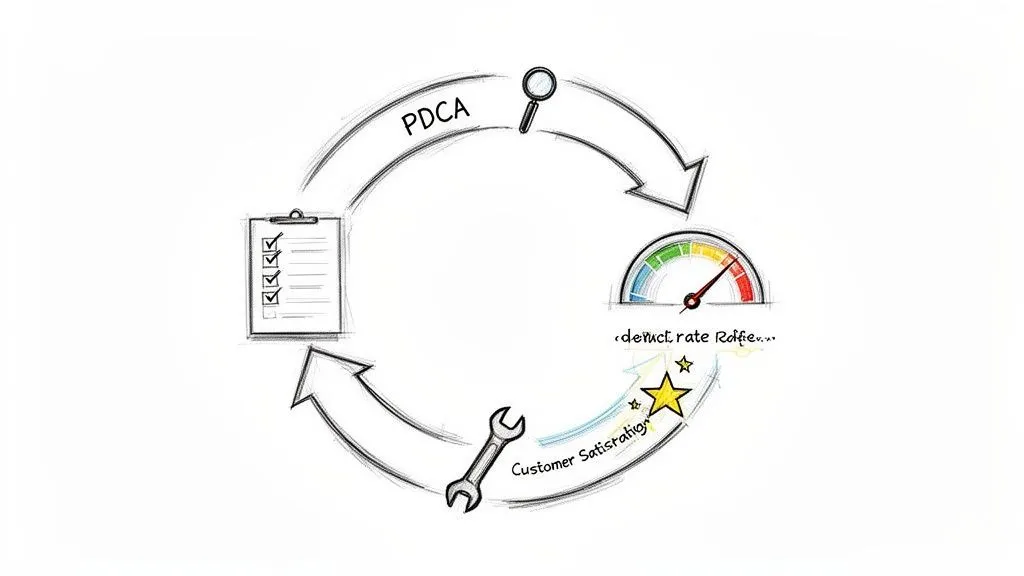
Recruiters look for systematic thinkers who can identify root causes of defects and implement lasting solutions using frameworks like Lean, Six Sigma, or SPC.
Example Breakdown
Let’s review some specific resume bullet points for an operations manager that demonstrate a strong handle on quality.
Example 1: Lean Methodology Application
Established a continuous improvement program using Lean methodology, identifying and eliminating 47 process waste points over 18 months, which reduced product defects by 52% and improved on-time delivery to 98%.
- Problem: High defect rates and process waste (implied).
- Action: Created a formal continuous improvement program based on Lean principles.
- Result: A 52% reduction in defects and a near-perfect 98% on-time delivery rate. The 47 identified waste points provide specific, credible detail.
Example 2: Statistical Process Control (SPC)
Implemented a statistical process control (SPC) system to monitor 23 critical quality parameters in real-time, enabling predictive quality management and reducing customer returns by 34%.
- Problem: Reactive quality control leading to customer returns.
- Action: Deployed an SPC system for proactive, real-time monitoring.
- Result: A 34% drop in customer returns by catching deviations before they became defects. This shows a transition from reactive to predictive management.
Actionable Takeaways
- Explain the "How": Don't just name-drop "Lean" or "Six Sigma." Briefly explain how you applied it to solve a specific business problem. Show you understand the methodology, not just the buzzword.
- Link Quality to Customer Outcomes: Connect your quality initiatives directly to customer-facing metrics. Show how reducing defects led to fewer complaints, lower returns, or a higher Net Promoter Score (NPS).
- Show System and People Skills: Great quality systems require both technical implementation and team buy-in. Mentioning you "led a team" or "established a program" demonstrates the leadership needed to make it stick.
8. Project Management & Complex Initiative Execution
Great operations managers drive significant change. Your resume must show your capacity to lead complex projects from concept to completion. These initiatives, like facility moves or system overhauls, demonstrate high-level strategic impact beyond daily tasks.
Hiring managers look for evidence you can manage the chaos of major projects: aligning stakeholders, controlling budgets, and delivering on schedule without disrupting business-as-usual.
Example Breakdown
Let’s analyze some resume bullet points for an operations manager that showcase strong project leadership.
Example 1: Facility Relocation
Led relocation of a 350-person operations center, including 18,000+ SKU inventory migration, completing the project 3 weeks ahead of a 24-week timeline and $180K under the $3.2M budget with zero downtime.
- Problem: The immense complexity of moving a large-scale operations center, its people, and its inventory without interrupting service.
- Action: Led the entire project, managing logistics, inventory migration, and personnel coordination.
- Result: Delivered ahead of schedule, under budget, and with zero operational downtime. The metrics prove exceptional planning and risk management.
Example 2: Enterprise-Wide Consolidation
Managed a $4.5M manufacturing process redesign affecting 120 employees and 6 product lines, owning scope, timeline, and risk while maintaining 99.2% operational uptime during the transition period.
- Problem: Implementing a disruptive process change across multiple teams and product lines while avoiding a drop in production.
- Action: Managed the project from end-to-end, focusing on scope, timeline, risk, and change management.
- Result: A major redesign was executed successfully with near-perfect operational stability (99.2% uptime), showing you can lead change without sacrificing performance.
Actionable Takeaways
- Showcase Complexity: Don't just say "managed a project." Specify the moving parts: number of people, budget size, number of stakeholders, or inventory scale. This frames the challenge and magnifies your achievement.
- Highlight Delivery & Business Outcomes: Include both project metrics (on-time, on-budget) and the business impact (efficiency gained, zero downtime). For more on crafting impactful statements, see this guide on how to write bullet points.
- Emphasize Risk Mitigation: Mentioning "zero downtime" or "maintaining 99.2% operational uptime" is a powerful way to demonstrate foresight and effective risk management, a key skill for any senior operations role.
Operations Manager Resume: 8-Bullet Comparison
| Area | Implementation Complexity 🔄 | Resource Requirements ⚡ | Expected Outcomes 📊 | Ideal Use Cases 💡 | Key Advantages ⭐ |
|---|---|---|---|---|---|
| Process Optimization & Efficiency Metrics | Moderate→High 🔄, requires process analysis & methodology | Moderate ⚡, data access, analytics, automation effort | High 📊, measurable time/cost reductions and throughput gains | Bottleneck elimination, workflow redesign, automation pilots | Demonstrates ROI and quantifiable impact; ATS-friendly |
| Team Leadership & Capacity Building | Moderate 🔄, ongoing coaching and program design | Moderate-High ⚡, hiring/training time and managerial bandwidth | Medium-High 📊, improved retention, promotions, productivity | Scaling teams, succession planning, culture change | Builds leadership pipeline and team capability |
| Vendor & Supplier Relationship Management | Moderate 🔄, negotiation and performance frameworks | Low-Moderate ⚡, procurement resources and contract support | High 📊, cost savings and quality/reliability improvements | Supplier consolidation, cost-negotiation, vendor scorecards | Direct impact on cost structure and supplier quality |
| Compliance, Safety & Risk Management | High 🔄, regulatory frameworks and audit readiness | Moderate-High ⚡, training, systems, compliance audits | High 📊, incident reduction, certifications, liability mitigation | Regulated industries, audit remediation, safety programs | Reduces risk and supports certification-driven differentiation |
| Budget Management & Cost Control | Moderate 🔄, forecasting, variance control, governance | Low-Moderate ⚡, financial systems and reporting cadence | High 📊, cost savings, margin protection, forecast accuracy | Operating expense control, budgeting cycles, cost avoidance | Demonstrates financial stewardship and cross-functional value |
| Systems, Technology & Digital Transformation | High 🔄, integration, change management, vendor selection | High ⚡, implementation budgets, IT and training resources | High 📊, automation, visibility, efficiency gains if adopted | ERP/WMS/BI deployments, legacy migrations, automation | Enables scalability and strategic modernization of ops |
| Quality Assurance & Continuous Improvement | Moderate-High 🔄, methodology deployment (Lean/Six Sigma) | Moderate ⚡, tooling, training, CI teams | High 📊, defect-rate reduction, higher customer satisfaction | Product/process quality initiatives, CI programs | Drives sustained quality improvements and customer loyalty |
| Project Management & Complex Initiative Execution | High 🔄, multi-stakeholder coordination and risk mgmt | High ⚡, budget, cross-functional resources, timeline control | High 📊, on-time/on-budget delivery and capability gains | Facility moves, large-scale redesigns, enterprise projects | Demonstrates execution capability and strategic leadership |
Translate Your Impact, Don't Just List It
The core lesson is simple: a great resume doesn't list duties. It translates your achievements into the language of quantifiable impact.
Your job was never just “managing inventory.” It was about solving specific problems. You cut holding costs. You improved team productivity. You negotiated better terms. These are the stories that matter. The strongest resume bullet points for an operations manager are miniature case studies: a clear problem, a specific action, and a metric-driven result.
The Shift from Task to Story
Most resumes are a collection of generic tasks. They read like a job description, not a record of accomplishment. Make this critical shift.
- From: "Responsible for vendor management."
- To: "Consolidated vendors from 25 to 12, improving purchasing power and negotiating an 18% reduction in annual material costs, saving $250K."
The first is a passive statement. The second is an active story of value creation. It's the difference between getting your resume skimmed and getting an interview.
Your Action Plan: Build Your Narrative
Stop thinking about what you did. Start articulating the value you created. Go back through your work history:
- Process Optimization: Where did you remove a bottleneck? How much faster did things get?
- Team Leadership: How did your team's performance improve? By what metric?
- Cost Control: Where did you find savings? How much money did you put back into the business?
- Systems Implementation: What process did you automate? How many hours did it save?
Answering these questions turns bland duties into compelling narratives. Each bullet becomes a powerful argument for why you are the right person for the job. You’re not just an operations manager; you are a problem-solver who delivers measurable results. That’s the story your resume needs to tell.
If you've done the work but struggle to find the right words, you're not alone. StoryCV is a Digital Resume Writer. We act as your editorial partner, using a guided interview to pull these exact stories from your experience and frame them with impact. Stop staring at a blank page. Let us help you build the narrative your career deserves.