Most advice about a job application email treats the email like a shipping label for your resume. Add a polite greeting. Attach PDF. Say you're excited. Hit send. Then wonder why nothing happens.
That approach is lazy. Your email is not admin. It's your first writing sample, your first positioning move, and often your first proof that you understand how to talk to another adult at work. If your message reads like a form letter, people assume your application is one too.
Why Your Job Application Email Fails
Your job application email usually fails for one reason. It was written to complete a process, not start a conversation.
Most applicants write like this:
Dear Hiring Manager, please find attached my resume for your consideration.
That sentence says nothing. It shows no judgment. It doesn't tell the reader why you matter, why this role fits, or why they should care enough to open the attachment.
Silence is common. Candidate-experience research published in 2026 found that 65% of candidates do not receive consistent communication after applying, and 36% were still waiting 1-2+ months for next steps, according to JobScore's candidate experience statistics. That means your email can't afford to be generic. It has to earn attention fast.
The real mistake
People think the resume does the selling and the email does the housekeeping.
Wrong.
The email is the first test. Can you summarize your value clearly? Can you write with focus? Can you make someone curious in a few lines? If you can't do that in the inbox, why would anyone trust you in the role?
If you're struggling to stand out, start with the basics of differentiation, not decoration. Story matters more than formatting. That's why this guide on how to stand out in job applications is worth reading after this one.
What bad emails have in common
-
They sound mass-sent
No company reference. No role-specific angle. No sign of thought. -
They repeat the resume
If the body is a mini cover letter stuffed into email form, it's already too long. -
They hide the point
The reader shouldn't need to hunt for your role, fit, or ask.
Your job application email should do one thing well. Make the next action easy.
The Subject Line Your Only Goal Is the Open
Your subject line has one job. Get opened.
That's it. Not impress. Not show personality. Not prove you're “passionate.” Open first. Everything else comes later.
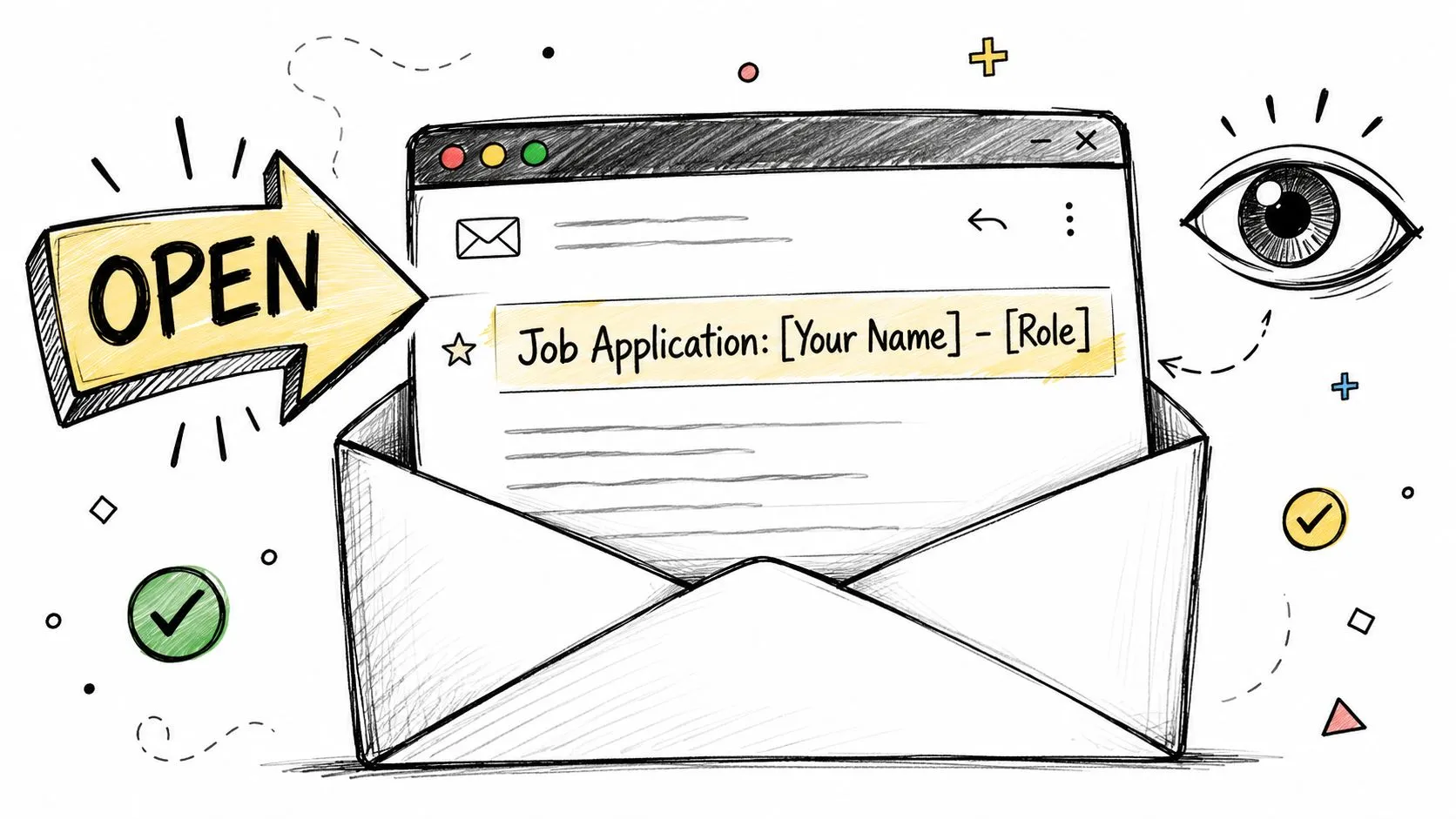
A good subject line is boring in the best way. Clear. Searchable. Specific.
In recruitment-email datasets, 82% of experts used subject lines under 60 characters, as noted in Try Kondo's write-up on cold networking numbers. Keep it short because inboxes cut off long lines, especially on mobile and desktop previews.
Use this formula
[Job Title] | [Your Name]
Examples:
-
Senior Product Manager | Maya Patel
-
Operations Lead | Daniel Kim
-
Application for Finance Manager | Elena Cruz
-
Backend Engineer | Alex Morgan
If the employer gave a required format, use it exactly. Don't “improve” it. Following instructions is part of the test.
If you need more examples, this guide to a strong subject for job application gives you more role-specific variations.
What to avoid
Here's the junk people keep sending:
| Bad subject line | Why it fails |
|---|---|
| Job Application | Too vague. Hard to search later. |
| Resume Attached | Says nothing about role or candidate. |
| Passionate professional seeking opportunity | Bloated and self-important. |
| Hello | Looks careless or spammy. |
Short beats clever.
Specific beats enthusiastic.
Useful beats “creative.”
A quick breakdown helps here:
The only exception
If you have a real referral, lead with that.
Referral from Priya Shah | Staff Designer | Jordan Lee
That works because it gives the reader context fast. Otherwise, don't get fancy. Fancy subject lines belong in marketing campaigns, not your job application email.
Your Opening Hook in the First 15 Words
The first line decides whether your email gets read or skimmed into oblivion.
“Dear Hiring Manager” is not fatal, but it is lazy. It tells me you didn't find a name and didn't compensate with a sharper opening. If you know the person's name, use it. If you don't, skip the theatrical greeting and get to the point.
A common blind spot in advice is emailing for unadvertised roles or generic inboxes. Indeed's guidance on applying for a position notes that finding a named contact is ideal, but strong direct outreach to a generic inbox can still work when done well.
If you have a name
Use it easily.
Hi Ms. Chen, I'm applying for your Senior Operations role and bring experience leading cross-functional execution.
That works because it identifies the role and signals relevant value immediately.
If you don't have a name
Don't panic. Don't write “To Whom It May Concern” unless you enjoy sounding like a tax letter.
Use one of these instead:
-
Hello Recruiting Team, I'm applying for the Customer Success Manager role and have led renewals and onboarding programs.
-
Hello Acme Team, I'm reaching out about the open Brand Marketing role after reviewing the job description.
-
Hi, I'm writing to express interest in your unadvertised partnerships work after following your recent expansion.
Your first line should do one of three things
-
Name the role
-
Signal relevant fit
-
Give a reason for this company
Not all three in a bloated sentence. Just enough to create relevance.
Skip ceremonial greetings. Start with useful information.
A weak opening sounds polite but empty. A strong opening sounds like someone who knows why they're there.
The Body A Three-Sentence Pitch Not a Novel
Your email body is not a cover letter in disguise.
If you paste three dense paragraphs into the message, nobody's impressed. They're tired. Your reader is scanning. They want proof, not autobiography.
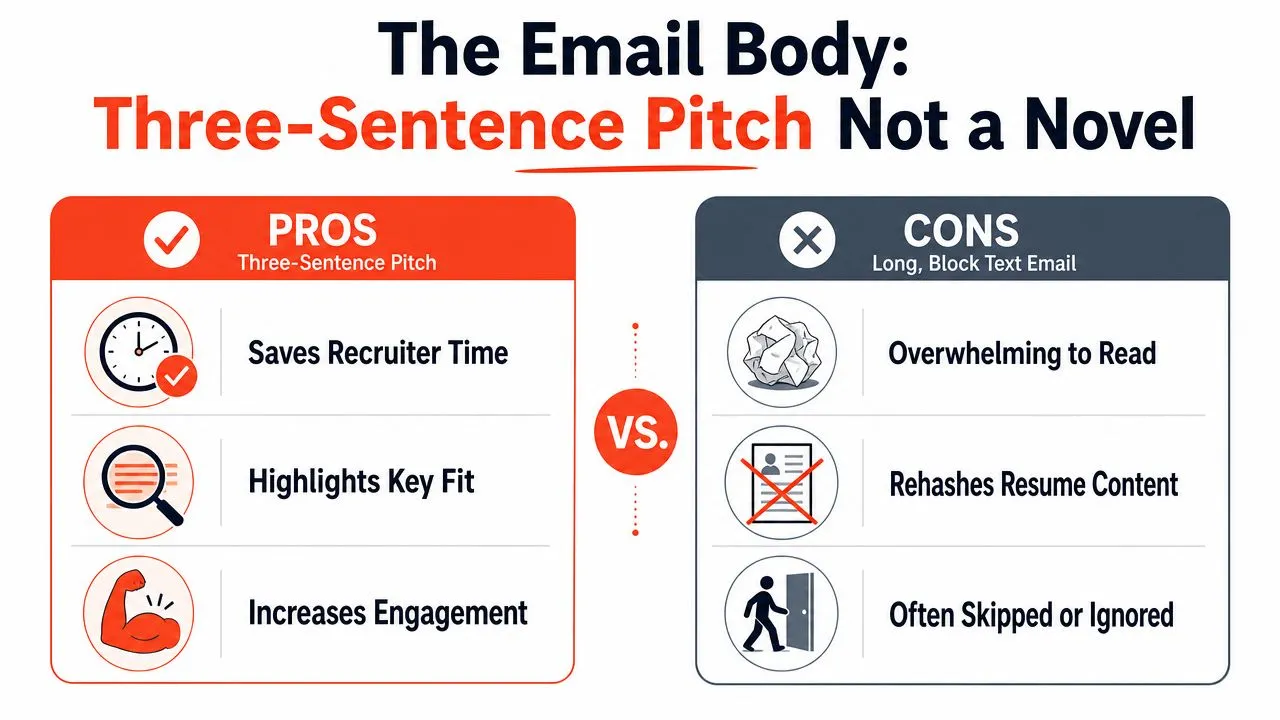
The average application-to-interview response rate is 2–3%, and LoopCV's guide to job application response rate argues that generic applications perform badly enough that you need a sharper case, not more fluff. It also says direct applications can get 2–3x higher response rates than Easy Apply. That's exactly why your email has to carry weight.
The three-sentence structure
Use this:
-
Why you're writing
-
Why you fit
-
What happens next
That's the whole game.
Here's the pattern:
-
Sentence 1
I'm applying for the [Role] position and was drawn to it because [specific reason]. -
Sentence 2
In my current/recent role, I [specific achievement or responsibility] that connects directly to [their need]. -
Sentence 3
I've attached my resume and would welcome a conversation if this looks relevant.
What sentence two should actually do
Applicants often waste sentence two on bland claims.
Bad:
-
I'm a hardworking team player with strong communication skills.
-
I believe my background would make me a great fit.
-
I have several years of relevant experience.
That's filler.
Use one concrete achievement, one useful problem, one clean connection.
Good:
-
I've led onboarding and retention programs in a B2B SaaS environment, which lines up closely with your focus on customer expansion and cross-functional account management.
-
I've managed vendor operations across multiple regions, which matches the role's emphasis on process ownership and stakeholder coordination.
-
I've built reporting rhythms for commercial teams, which speaks directly to your need for cleaner forecasting and execution discipline.
Keep the email shorter than your attachment
That sounds obvious, but people still get this wrong.
Practical rule: If your email says everything already, the resume has no job left to do.
Your job application email should create interest, not exhaust it.
A clean example
Subject: Senior Operations Manager | Nina Rao
Hi Mr. Ellis,
I'm applying for the Senior Operations Manager role and was interested by the way the position combines process design with team execution. In my current role, I lead cross-functional operational planning and have built reporting and workflow systems that support faster decision-making across finance, support, and delivery. I've attached my resume and would be glad to discuss whether my background fits what your team needs.
That's enough. Clear. Calm. Adult.
Attachments and Closing Without Sounding Desperate
Sloppy attachments make competent people look careless.
If your file is called Resume_Final_v7_REALFINAL2.pdf, fix it. You're asking strangers to handle your materials. Help them.
Name files like a professional
Use this format:
-
FirstName-LastName-Resume.pdf
-
FirstName-LastName-Cover-Letter.pdf
If you're tailoring by role, add the role at the end.
- Ava-Lewis-Resume-Product-Manager.pdf
That naming convention is clean, searchable, and doesn't make the recruiter guess what they opened.
If you work in software or engineering, file hygiene matters even more because people infer your standards from tiny details. For a solid breakdown of how technical candidates should present themselves on paper, read Codeling's advice for developer resumes.
You should also decide whether your email is carrying the job of a cover letter or whether a separate letter helps. If you need one, these sample cover letter for job application approaches show how to avoid repeating yourself.
Close like someone worth interviewing
Weak closings sound like this:
-
Hope to hear from you soon
-
Looking forward to your positive response
-
Kindly consider my application
That language shrinks you.
Try these instead:
-
I've attached my resume and would welcome a conversation if the role aligns.
-
Happy to share more detail if my background looks relevant.
-
I'd be glad to discuss how my experience maps to the role.
Confident is good. Pushy is not. Desperate is poison.
Real Job Application Email Examples Not Templates
Templates make people sound interchangeable. You don't need that. You need to see how the thinking changes by situation.
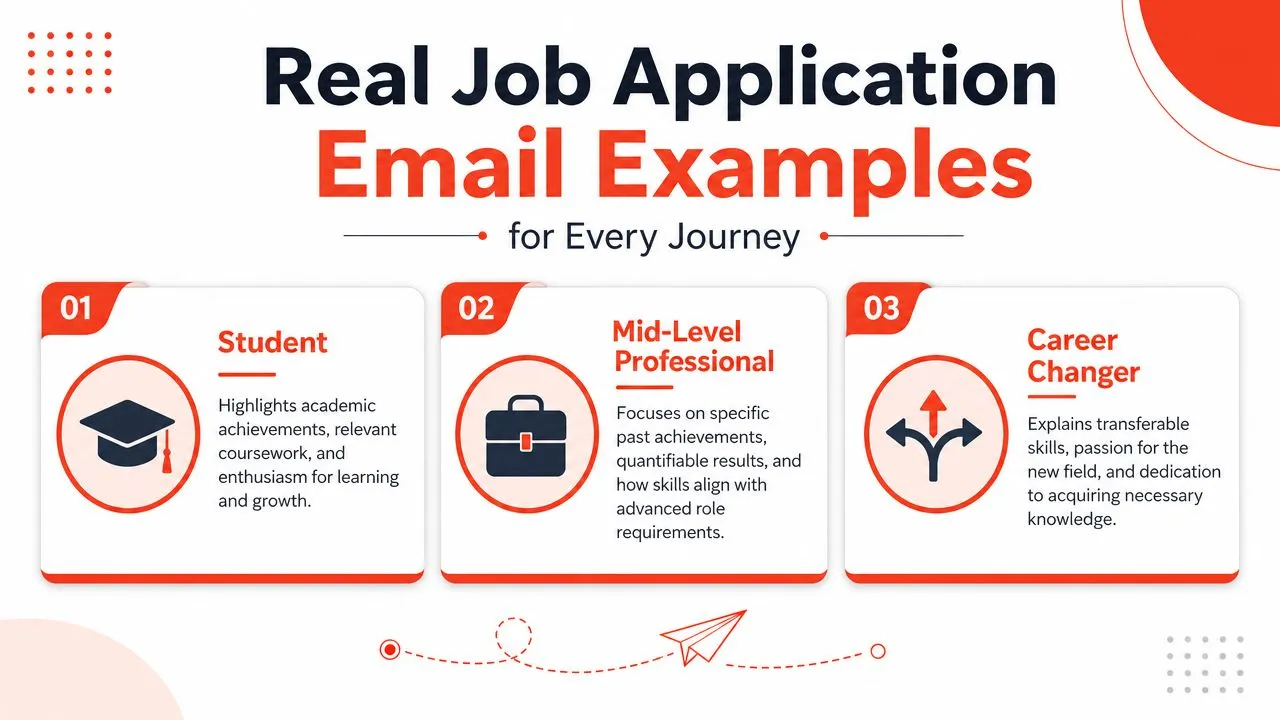
Below are four actual examples written for different people. Don't copy them line for line. Steal the logic.
Student example
A student can't fake seniority. Don't try. Lead with relevance, not apology.
Subject: Marketing Coordinator | Sara Ahmed
Hi Hiring Team,
I'm applying for the Marketing Coordinator role and was drawn to the mix of content, campaign support, and analytics in the job description. During my final year and internship work, I supported content planning, audience research, and campaign reporting, which gave me hands-on experience with the kind of coordination this role requires. I've attached my resume and would welcome the chance to discuss how I could contribute and grow with the team.
Why this works
-
It doesn't say “Although I don't have much experience.”
-
It connects coursework and internship work to actual job tasks.
-
It shows readiness without pretending to be more advanced than reality.
Mid-level professional example
This person has enough experience to be selective. The email should sound like someone who knows their lane.
Subject: Customer Success Manager | James Ortega
Hi Ms. Patel,
I'm applying for the Customer Success Manager role because the position's focus on retention, adoption, and cross-functional execution matches the work I've been doing in SaaS account management. In my current role, I manage strategic customer relationships across onboarding, renewal, and internal coordination with product and support teams, which aligns closely with the responsibilities you listed. I've attached my resume and would be glad to speak if my background looks like a fit.
Why this works
The achievement here is framed as scope, not slogans. Mid-level applicants often sabotage themselves by stuffing the email with every win they've ever had. This version shows pattern match. That's what matters.
Career changer example
Career changers need translation. Not defense.
Subject: People Operations Role | Lena Brooks
Hello Recruiting Team,
I'm reaching out about your People Operations opening after several years in client-facing program management roles that depended on onboarding, communication, and process improvement. Much of my recent work has involved coordinating stakeholders, improving handoffs, and supporting employee-facing workflows, which is why this move into People Operations is a direct shift rather than a random pivot. I've attached my resume and would welcome a conversation if that background is relevant to your team.
Why this works
-
It reframes the move as continuity.
-
It identifies transferable work instead of begging for a chance.
-
It avoids the terrible phrase “even though I come from a different background.”
Tech role example
Technical people often overdo jargon or underwrite the message entirely. Both are mistakes.
Subject: Backend Engineer | Victor Huang
Hi Engineering Team,
I'm applying for the Backend Engineer role and was interested by the emphasis on API design, reliability, and collaboration with product teams. In recent engineering work, I've built and maintained backend services, worked across debugging and implementation cycles, and partnered with non-engineering stakeholders to ship features cleanly and predictably. I've attached my resume and would be happy to talk if my experience aligns with the role.
Why this works
It avoids laundry-listing tools. It focuses on capability, collaboration, and shipping. That reads better than dumping a stack into the inbox.
If you want help writing the achievement itself
A lot of people know what they did but can't phrase it cleanly. That's where tools that act more like editors than template-fillers are useful. StoryCV, for example, is a digital resume writer that uses a guided interview to turn your experience into clearer resume language, which can make sentence two of your email much easier to write.
The Art of the Follow-Up Email
Most applicants either never follow up or follow up badly.
Both are weak moves.
A field report found an 82% no-response rate across 92 applications, according to The Undercover Recruiter's report on response rates from a jobseeker perspective. Silence is normal. Don't treat it like a personal verdict.
When to follow up
Wait 3–5 days after sending the original email. Then send one short follow-up.
Not “just checking in.”
Not “wanted to bump this.”
Add something useful.
What a good follow-up looks like
Subject: Re: Senior Operations Manager | Nina Rao
Hi Mr. Ellis,
Following up on my application for the Senior Operations Manager role. I also noticed your team is expanding its delivery operations, which stood out because much of my recent work has involved building clearer cross-functional workflows during growth periods. Happy to share more detail if useful.
Best,
Nina Rao
A follow-up should add context, not repeat the first email with different punctuation.
That's enough. One reminder. One extra signal. One professional touch.
If your experience is real but your resume and email still sound generic, StoryCV can help you turn messy career history into sharper language. It works like a digital resume writer, not a box-filling builder, so you can pull stronger proof points into your next job application email without sounding templated.