Looking for a standout sample cover letter for a job application? Forget seeing it as a formality. Think of it as a strategic narrative—the story that tells the why behind the what on your resume.
A really good cover letter connects what you’ve done directly to what a company needs. It can turn your application from just another file in the pile into a compelling solution to their problems.
Why Your Cover Letter Still Matters in Modern Hiring
Let’s be honest, you’ve probably wondered if anyone even reads cover letters anymore. In a world of one-click applications and automated screeners, it’s easy to write them off as an outdated relic.
But recruiters and the data tell a very different story.
Your resume is the evidence—a list of your skills, experiences, and accomplishments. Your cover letter, on the other hand, is the argument. It’s your chance to build a narrative that bullet points alone can’t capture, connecting your unique value directly to the employer’s pain points.
The Recruiter's Perspective
For hiring managers drowning in hundreds of similar applications, a cover letter is a massive differentiator. It offers a quick glimpse into your communication style, your genuine interest in the role, and how well you understand the company’s mission.
It’s the first real test of your professional voice and attention to detail. And the numbers back this up.
Here’s a quick look at why this "optional" document is often a game-changer.
Cover Letter Impact At a Glance
| Statistic | What It Means For You |
|---|---|
| 74% of recruiters prefer applications with cover letters. | Even when it's optional, submitting one gives you an immediate edge over most of the competition. |
| ~40% of hiring managers pay more attention to an application with a cover letter. | It’s a simple way to make sure your resume gets a closer look instead of a six-second skim. |
| 26% say it’s an important factor in their final hiring decision. | For a quarter of decision-makers, it could be the very thing that tips the scales in your favor. |
These aren't just vanity metrics. They show a clear pattern: a thoughtful cover letter commands attention and influences decisions.
A Strategic Tool, Not a Formality
Viewing the cover letter as a strategic tool changes everything. It’s your one shot to address a potential weakness, explain a career transition, or highlight a specific achievement that perfectly mirrors the job description.
Your cover letter is the bridge between your past accomplishments and the company's future needs. It’s where you translate your skills into solutions, proving you're not just qualified but are the best fit for their specific challenges.
While a compelling cover letter is essential, it’s just one piece of your professional presence. It works best when it complements your other efforts, like building a robust personal brand on LinkedIn, to create a consistent and powerful narrative.
Anatomy of a Cover Letter That Gets Read
Forget the stiff, formal letters you were taught to write in school. A modern cover letter that actually gets read is built for impact. It’s short, scannable, and tells a story that your resume alone can’t. This is your chance to connect the dots and show an employer exactly how you solve their problems.

This simple blueprint—Hook, Value, Close—is a proven structure that hiring managers appreciate. Think of it as a quick, three-act story designed to grab and hold their attention from the first sentence to the last.
The Winning Structure
Every powerful cover letter I've ever seen follows this flow. It’s designed to quickly prove your value, and mastering it is the key to creating a document that feels both professional and persuasive.
-
The Compelling Opening: Your first paragraph is the hook. It needs to grab the reader immediately. State the role you're applying for and then hit them with your core value proposition—the single biggest reason they should keep reading.
-
The Value-Driven Body: This is the heart of your letter, where you back up your claim. In just one or two short paragraphs, you need to provide the proof. Use a specific, quantified achievement that lines up perfectly with a key requirement from the job description.
-
The Confident Closing: End strong with a clear, proactive call to action. Reiterate your excitement and confidently guide them to the next step: a conversation about how you can help their company.
A cover letter isn't a summary of your past; it's a pitch for your future. Each section builds on the last, creating a tight argument that you are the solution to their specific needs.
Ideal Length and Format
When it comes to your cover letter, less is absolutely more. Recruiters spend mere seconds on each application. A dense, full-page letter is a surefire way to get skipped. The goal is clarity, not clutter.
The data backs this up. While 88% of job seekers believe a cover letter helps their chances, 66% also feel it should be half a page or less. This lines up perfectly with what recruiters want: three to four short paragraphs, totaling around 300–400 words. That’s all the space you need.
For more on what recruiters are looking for, check out this comprehensive trends survey.
The language in your letter is just as critical as its structure. It should reflect the same professional story you're telling elsewhere. To keep everything consistent, take a look at our guide on how to describe yourself in a resume. When your resume and cover letter tell the same powerful story, you create an application package that’s impossible to ignore.
See It in Action: Four Cover Letter Samples for Any Situation
Theory is great, but seeing it in action is better. We can talk about hooks, value propositions, and metrics all day, but watching them work together in a real-world document is where it all clicks.
Here are four detailed, annotated sample cover letters, each designed for a specific career moment. Think of them as case studies, not rigid templates. We'll break them down to show the strategic choices behind the tone, structure, and language. This is where you'll see exactly how to frame transferable skills or translate a technical win into tangible business value.
Sample 1: The Recent Graduate
Our first example is for a recent graduate applying for an entry-level marketing coordinator role. Notice how it leans into potential and academic projects to make up for a shorter work history.
Subject: Application for Marketing Coordinator – [Your Name]
Dear [Hiring Manager Name],
As a recent summa cum laude graduate with a B.S. in Marketing and a passion for building data-driven brand narratives, I was thrilled to see the Marketing Coordinator opening at [Company Name] on LinkedIn. My capstone project, where I developed and executed a digital campaign that grew a local nonprofit's social engagement by 45% in three months, aligns directly with the creative and analytical skills you're seeking for this role.
During my internship at [Previous Company], I was responsible for more than just scheduling posts. I took the initiative to analyze weekly performance metrics, identifying a key insight that led to a 15% increase in click-through rates on our email newsletter. I am proficient in HubSpot, Google Analytics, and the full Adobe Creative Suite, and I am eager to apply my skills to help the [Company Name] team achieve its Q4 growth targets.
I have followed [Company Name]'s innovative approach to [mention a specific campaign or value] for the past year and am deeply impressed by your commitment to [mention a company value]. My goal is to contribute my fresh perspective and dedicated work ethic to a team that is setting the standard in the industry.
Thank you for considering my application. I am excited about the possibility of discussing how my skills in digital marketing and content creation can benefit your team.
Sincerely,
[Your Name]
Why This Works:
-
Powerful Opening: It doesn't waste time. The first sentence hits on the degree, a key achievement (summa cum laude), and connects a specific project result directly to the role's needs.
-
Proof with Numbers: Even with limited experience, it uses concrete numbers like "45%" and "15%" from an internship or academic project. This proves capability, which is far more convincing than just listing duties.
-
Shows They Did Their Homework: Mentioning a specific company campaign or value proves this isn't a copy-paste job. It shows genuine interest and research, which recruiters notice.
-
Confident Closing: The sign-off is proactive. It’s focused on the value they can bring to the company, not just on their desire to get any job.
Sample 2: The Mid-Level Professional
This next one is for an experienced Project Manager aiming for a senior role. The focus here shifts from potential to a proven track record of delivering complex projects and leading teams.
Subject: Senior Project Manager Application – [Your Name]
Dear [Hiring Manager Name],
With over eight years of experience leading cross-functional teams to deliver complex SaaS projects on time and 10-15% under budget, I am confident I possess the strategic planning and leadership skills required for the Senior Project Manager position at [Company Name].
In my current role at [Current Company], I spearheaded the launch of our flagship "Project Nova," coordinating efforts across engineering, marketing, and sales. By implementing a new Agile workflow, my team reduced the development cycle by 20% and improved stakeholder satisfaction scores by 30 points. This experience in streamlining processes and fostering collaboration directly mirrors the responsibilities outlined in your job description.
I was particularly drawn to this opportunity because of [Company Name]'s commitment to innovation in the fintech space. My background in managing projects with budgets exceeding $2M and my PMP certification have prepared me to handle the scale and complexity of your product roadmap.
I am eager to bring my expertise in risk mitigation and resource optimization to your team. I look forward to discussing how I can contribute to [Company Name]'s continued success.
Best regards,
[Your Name]
Why This Works:
-
Pitches Value Immediately: The very first sentence is a killer summary of their entire value proposition: years of experience, tangible results (under budget), and the exact skills the job requires.
-
Shows a Clear "Problem-Solution" Story: It highlights a specific project ("Project Nova"), explains the action they took (implemented Agile), and showcases the impressive results (20% faster cycle, 30-point satisfaction bump).
-
Mirrors the Job Description: By explicitly connecting their experience to the requirements in the job posting, they make the recruiter’s job incredibly easy. It’s a direct match.
-
Adds Credibility with Specifics: Dropping in details like the budget size ("$2M") and relevant certifications (PMP) adds a layer of authority and proves they can handle the scope of the role.
Sample 3: The Career Changer
Career changers have a unique puzzle to solve: connecting experience that looks unrelated to a brand new field. This sample shows how a former teacher can apply for a Corporate Trainer role by focusing entirely on transferable skills.
Subject: [Your Name] for Corporate Trainer Role
Dear [Hiring Manager Name],
For the past six years, I've designed and delivered curriculum to over 150 high school students annually, consistently achieving a 95% pass rate on state certifications by making complex subjects accessible and engaging. I am now eager to apply my expertise in instructional design, audience engagement, and performance measurement to the Corporate Trainer position at [Company Name].
While my title was "Teacher," my role was that of a trainer and performance coach. I developed customized learning plans for diverse groups, utilized technology to enhance material retention, and tracked progress through data-driven assessments. For example, I introduced a peer-mentoring program that boosted student performance on collaborative projects by 25% in a single semester. My skills in communication, curriculum development, and feedback delivery are directly transferable to training your sales team on new software.
I've been following [Company Name]'s growth and admire your focus on employee development. I am excited by the prospect of using my passion for education to help your team master new skills and drive business results.
I am confident that my unique background can bring a fresh and effective perspective to your training programs. Thank you for your time and consideration.
Sincerely,
[Your Name]
Why This Works:
-
Reframe, Don't Just Restate: The opening instantly reframes "teaching" into corporate-speak: "curriculum design," "engagement," and "performance measurement." It translates the experience before the recruiter has a chance to dismiss it.
-
Connect the Dots for Them: The body explicitly states, "My skills...are directly transferable," leaving zero room for doubt. It draws a straight line from classroom activities to the company’s specific needs.
-
Metrics That Travel Well: A 95% pass rate and a 25% performance boost are powerful numbers that show an ability to drive results in any environment, not just a school.
-
Explain the "Why": The letter clearly explains the motivation for the career change, linking a personal passion for education to the company’s stated value of employee development. It makes the transition feel intentional and authentic.
How to Customize Your Cover Letter for Any Role
If there’s one thing that separates a cover letter that gets read from one that gets deleted, it’s customization. And I’m not talking about just swapping out the company name and job title. Real tailoring is about doing a little detective work to prove you've done your homework and actually understand what they need.
This isn’t about tricking a recruiter. It's about showing them you're the solution to their specific problem. The data is crystal clear on this: a personalized approach gets you noticed, lifting your application way above the generic pile.
Of course, the way you customize your letter changes depending on where you are in your career—whether you're a recent grad, a mid-level pro, changing careers entirely, or a tech specialist.
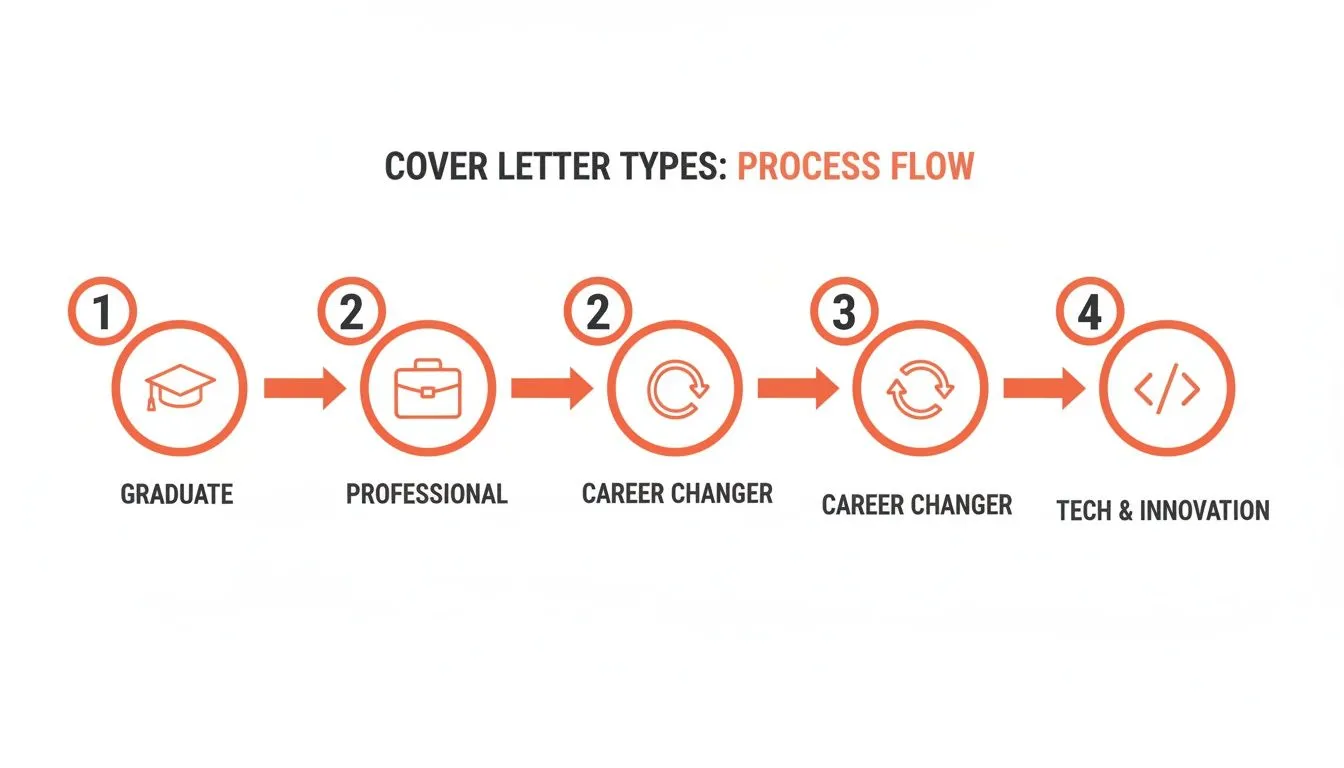
Each of these stages requires a totally different storytelling angle to make your value pop.
Dissect the Job Description
First things first: treat the job description like a treasure map. It’s packed with clues pointing to the company’s biggest headaches and top priorities.
-
Spot the Pain Points: Hunt for action verbs and themes that keep showing up. If they mention "streamline processes" three times, you've found a major pain point. Your letter needs to show how you've streamlined things before.
-
Mirror Their Language: This is a simple but powerful trick. Use the exact keywords and phrases they use. If the description says "client relationship management," use that term instead of "account management." This not only helps you get past the Applicant Tracking Systems (ATS) but also signals to the hiring manager that you speak their language.
Go Beyond the Job Posting
A little bit of research is what creates a genuine connection that a template just can't fake. All it takes is 15 minutes to dig into what the company is up to right now.
Find a recent press release, a new product launch, or a quote from the CEO. Mentioning this directly—"I was particularly impressed by your recent launch of Project Sparrow..."—shows you're not just looking for any job. You're interested in this one.
This small gesture proves you have authentic interest. And it works. A whopping 61% of recruiters say this level of detail is a surefire way to stand out. Think about it: while 35.4% of applicants just tweak an old letter, 34.1% write a new one from scratch every single time. Guess who gets the interview?
Finally, tie it all together. Connect what you found back to your own skills. Explain how your experience can help them with their new project or aligns with their core values. This is where you focus on what makes you a unique fit. If you need help zeroing in on your best attributes, check out our guide on how to list strengths on your resume.
Avoiding Common Mistakes and Passing ATS Scans
You’ve poured hours into telling a great story. The last thing you want is for a simple, avoidable mistake to get your cover letter tossed before a human ever sees it. This is your final quality check—think of it as a pre-flight inspection to make sure your hard work lands safely in the “interview” pile.
The most common errors are often the easiest to fix. A single typo or glaring grammar mistake can signal a lack of attention to detail, which is a red flag for any role.
Then there’s the generic, lazy stuff. Greetings like "To Whom It May Concern" feel completely impersonal. A quick LinkedIn search can usually uncover the hiring manager’s name, showing you’ve done your homework. Another classic misstep is making the letter all about "I, I, I" instead of focusing on what you can do for them. Frame every accomplishment as a solution to one of their problems.
Navigating the Robots: Applicant Tracking Systems
Let's talk about the gatekeepers. Many companies, including over 98% of Fortune 500 businesses, use Applicant Tracking Systems (ATS) to do the initial screening. These bots scan your documents for specific keywords and formatting, meaning a poorly optimized letter might get filtered out automatically.
But getting past the bots doesn't mean you should write for the bots. Your strategy needs to be subtle and smart.
-
Mirror the Job Description: Don't just stuff keywords. Weave the language from the job posting into your own narrative naturally. If the description mentions "agile project management," find a way to include that exact phrase when describing a relevant project.
-
Keep Formatting Simple: Stick to a clean, standard font. Avoid columns, text boxes, and fancy graphics. ATS software can get confused by complex layouts, and your carefully crafted letter will turn into garbled nonsense on their end.
-
Always Send a PDF: Unless the application specifically asks for a different format, a PDF is your best friend. It locks in your formatting, ensuring what you see on your screen is exactly what the recruiter sees on theirs, no matter what device or system they're using.
The real secret to passing an ATS scan is to stop trying to game the system. Just focus on writing an excellent, human-readable letter that naturally aligns with the language in the job description. The bot will see the right keywords, and the human will see a compelling candidate.
One last simple but crucial tip: name your file professionally. Something like "JaneDoe-CoverLetter-StoryCV.pdf" is perfect. It’s organized, clear, and makes the recruiter’s life just a little bit easier. If you want a deeper dive into how these systems work, you can learn more about the rule that gets applications past the ATS filter.
Cover Letter Do's and Don'ts Checklist
Before you hit "submit," run through this quick checklist. It’s a simple gut check to ensure you’re putting your best foot forward and avoiding those little mistakes that can make a big negative impact.
| Do This | Avoid This |
|---|---|
| Address the hiring manager by name. | Using generic greetings like "To Whom It May Concern." |
| Tailor every letter to the specific job and company. | Sending the same generic letter for every application. |
| Use keywords from the job description naturally. | Stuffing your letter with keywords that sound robotic. |
| Focus on what you can do for the company. | Making it all about what you want from the job. |
| Use a clean, simple format and a professional font. | Using complex layouts, graphics, or hard-to-read fonts. |
| Proofread at least twice for typos and grammar mistakes. | Submitting without a final review. |
| End with a clear call to action. | Leaving the next steps vague or undefined. |
| Name your file professionally (e.g., YourName-CoverLetter-CompanyName.pdf). | Using a generic file name like "CoverLetter.pdf." |
Treat this table as your final once-over. These small details show professionalism and respect for the reader's time, and in a competitive market, they absolutely matter.
Your Top Cover Letter Questions, Answered
Even after you've seen a few good examples, some practical questions always come up. Let's clear up the common sticking points so you can send your application with confidence.
How Long Should a Cover Letter Be?
Aim for 300 to 400 words. That's it.
This usually works out to three or four short, punchy paragraphs that fill about half a page. It’s the sweet spot—just enough room to introduce yourself, connect your biggest wins to the job, and close with a clear call to action.
Anything longer risks losing the hiring manager's attention. The cardinal rule? Never, ever go onto a second page.
Do I Really Need a Different Cover Letter for Every Single Job?
Yes. One hundred percent, yes. You can absolutely start with a core template that highlights your main value, but each letter must be customized for the specific role and company.
Think of it this way: recruiters read hundreds of these things. They can spot a generic, copy-pasted letter from a mile away, and it usually goes straight to the "no" pile.
Taking a few extra minutes to mirror the language from the job description and speak to the company's actual needs will radically improve your chances of getting a call back.
What if I Can't Find the Hiring Manager's Name?
It happens. Hunting down the hiring manager's name on LinkedIn or the company website is always the best first step, but sometimes you just come up empty. When that happens, you need a solid backup plan.
Forget old-school, stuffy greetings like "To Whom It May Concern." Instead, go for something specific and professional like "Dear Hiring Manager," "Dear Marketing Team," or "Dear Software Engineer Search Committee." It shows you put in the effort and is a much more modern way to open your letter.
Your cover letter is what gets your foot in the door, but acing the interview is what lands you the job. Once that letter works its magic, your preparation is everything. To help you get ready, check out these tips on how to use interview notes to boost your confidence and leave a killer impression.