The single best way to list strengths on your resume is to stop listing them at all. Instead, weave them directly into your work experience as measurable accomplishments. It's a simple shift, but it transforms your resume from a generic list of claims into a powerful story of your actual impact.
Why Your Strengths Matter More Than You Think
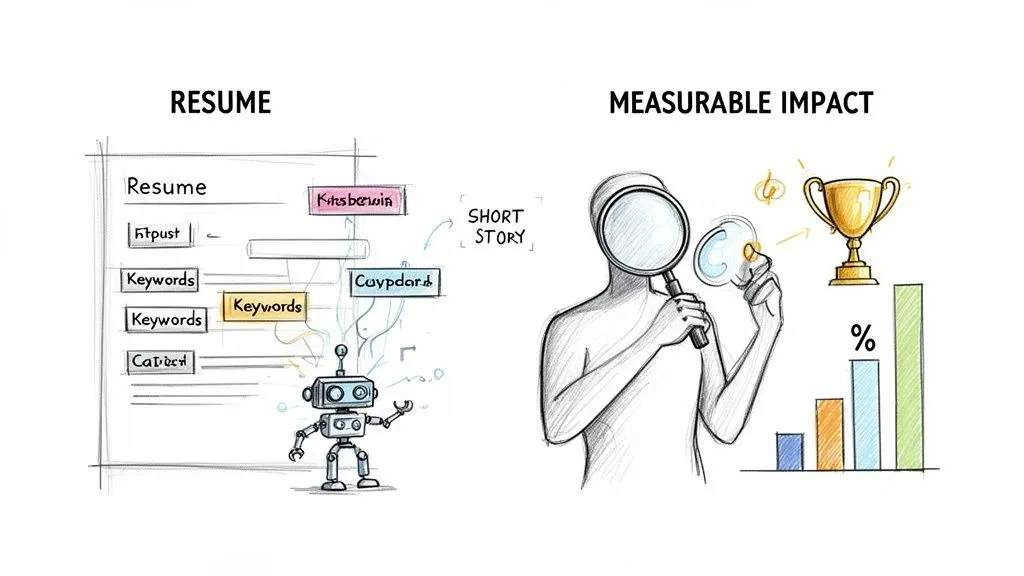
Let’s be real. The old advice to "show, don't tell" feels a bit worn out. But for your resume, it's never been more critical. Modern hiring is a two-stage process. First, you have to get past the Applicant Tracking System (ATS) bot. Then, you have to impress a human.
While the ATS is busy scanning for keywords, the hiring manager is hunting for proof. They want to see what you’ve actually done. A simple list of skills like "Team Player" or "Problem-Solver" provides zero context and is, frankly, easy for a human to ignore.
Moving Beyond the Generic Skills List
Think of your resume as a marketing document, not a historical record. Its one and only job is to sell the value you create. When you isolate your strengths in a separate skills section, they become hollow claims. The real magic happens when you embed them into your achievements.
Just look at the difference:
- Generic Claim: Listing "Strong communication skills."
- Proven Strength: "Presented weekly project updates to a 15-person stakeholder group, ensuring alignment and cutting scope creep by 25%."
The second one doesn't just claim the skill—it proves it. It gives a specific action and a quantifiable result. This is the language hiring managers are trained to look for. It speaks volumes more than a simple keyword ever could.
To help you make this shift, here's a quick look at how to transform weak, generic phrases into compelling, evidence-based statements.
Weak vs Strong Phrasing for Resume Strengths
| Generic Strength Claim | Powerful Achievement Bullet |
|---|---|
| "Team player" | "Collaborated with a 5-person cross-functional team to launch a new product feature, contributing to a 15% increase in user engagement." |
| "Problem-solver" | "Identified and resolved a critical bug in the payment processing system, preventing an estimated $10,000 in potential revenue loss." |
| "Organized and detail-oriented" | "Managed a project budget of $50,000, tracking all expenses and delivering the project 10% under budget without sacrificing quality." |
| "Strong leadership skills" | "Led a team of 3 junior developers, mentoring them on best practices and improving team code quality by 30% based on peer reviews." |
These examples aren't just about sounding better; they're about providing concrete evidence of your capabilities. It's the difference between saying you're a good cook and showing someone a delicious meal you've prepared.
The Overlooked Power of Soft Skills
It's easy to get caught up in technical abilities, but soft skills are often the tiebreaker. Recent analyses show that skills like teamwork, adaptability, and problem-solving consistently top the list of what recruiters are looking for.
In fact, over 40% of recruiters feel that candidates' resumes don't adequately show these crucial soft skills. That gap is your opportunity. When you integrate these strengths into your experience bullets, you're not just listing a trait; you're demonstrating the self-awareness that truly drives success. If you're looking for more data on this, recent resume skills research offers some powerful insights.
Treat every bullet point as a mini-story. It should have a character (you), a challenge (the task), an action (your strength in motion), and a resolution (the measurable outcome).
How to Figure Out Your Most Valuable Strengths
Before you can show off your strengths on a resume, you have to know what they are. A lot of people get stuck here, but it’s simpler than it seems. The trick is to stop looking inward and start by looking at the job you actually want.
The job description is your cheat sheet. It’s the company literally telling you what they care about most. Print it out, pull it up on your screen, and get ready to break it down.
Dissect the Job Description
First thing's first: start categorizing what they're asking for. You’ll usually see a jumble of technical skills, soft skills, and day-to-day responsibilities. Your job is to sort the absolute must-haves from the nice-to-haves.
- Must-Haves: These are the dealbreakers. Look for phrases like "required," "must have X years of experience," or specific software they list right at the top.
- Nice-to-Haves: These are the bonus points. You'll see words like "preferred," "a plus," or "familiarity with."
This little exercise gives you a laser-focused target. Your most valuable strengths are the ones that perfectly match the employer's must-have list. It’s about what they need, not just what you think you’re good at.
Still feeling a bit lost after reading the job description? Sometimes you need a second pair of eyes. If you’re not sure what skills to put on your resume, an AI tool can help you spot important keywords and transferable skills you might be overlooking.
Brainstorm Your Wins with the STAR Method
Okay, now you know what the company wants. It’s time to find the proof in your own history. The STAR method (Situation, Task, Action, Result) isn't just an interview gimmick—it's a powerful way to dig up your best achievements.
Think back to specific moments in your career where you really made a difference. This could be from a previous job, a university project, or even volunteer work. For each story, quickly answer these questions:
- Situation: What was going on? (e.g., "The marketing team's lead conversion rates were tanking.")
- Task: What were you supposed to do? (e.g., "I was tasked with redesigning our main landing page to get more sign-ups.")
- Action: What specific things did you do? (e.g., "I ran A/B tests on three new layouts and rewrote all the call-to-action copy.")
- Result: What was the outcome? Use numbers. (e.g., "The new page boosted conversions by 18% in the first month.")
Don't get hung up on perfect wording right now. The goal is just to get a raw list of accomplishments down on paper. You’ll be surprised how many solid strengths—like Data Analysis, Copywriting, and Project Management—naturally fall out of these short stories.
This isn't about listing your old job duties. It's about excavating the moments where you went beyond your job description and delivered real, measurable value.
Create Your Master List of Strengths
Now, take your highlighted job description and your STAR notes and combine them. Create one master list and start grouping your strengths into categories. This helps you see where you truly shine and gives you the raw material for every bullet point on your resume.
This approach is a lifesaver for career changers, too. By using the STAR method to focus on transferable skills, you can pull compelling strengths from experiences that don't seem related on the surface. That heavy research project from your master's degree? It proves your analytical skills. Organizing that charity 5K? That’s leadership and logistics right there.
Turning Your Strengths into Measurable Achievements
Okay, so you’ve identified your strengths. That’s a great first step, but it's only half the battle. To actually get noticed, you have to turn those abstract ideas into cold, hard proof.
This is where most resumes fall flat. Vague statements like "good communicator" or "detail-oriented" are just dead space. They’re subjective, unproven, and frankly, every other candidate is saying the same thing. The real key is connecting every strength to a quantifiable outcome.
You have to move beyond telling a recruiter you're good at something and start showing them the impact you’ve made. Even if you're not in a sales role, there are always numbers to be found—metrics tied to time, money, efficiency, or satisfaction.
This visual shows the simple flow: analyze the job, brainstorm your skills, and then list out your core abilities. That process gives you the raw material for this next, crucial step of adding numbers.
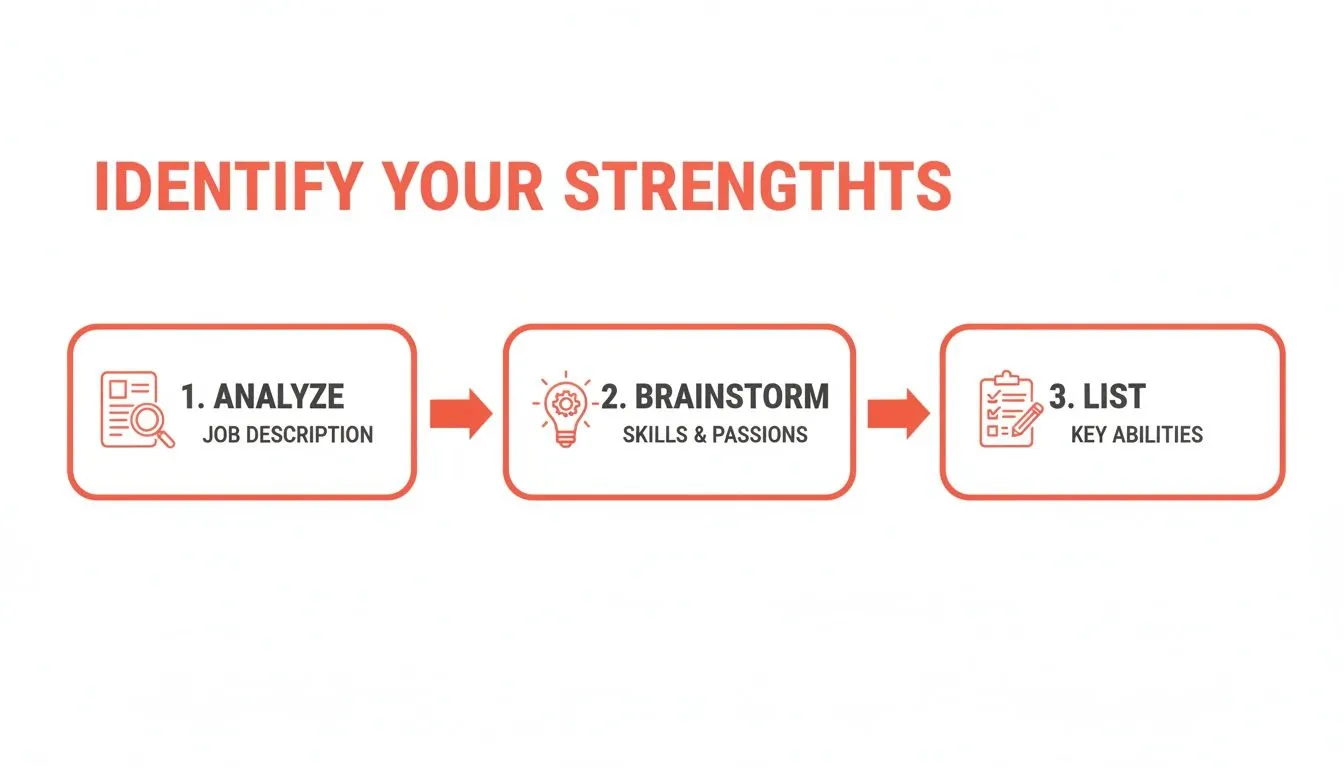
Following this sequence ensures the strengths you highlight are directly tied to what the hiring manager is looking for, making your achievements far more compelling.
How to Find the Numbers
Quantifying your impact can feel tricky, but the data is usually there if you just know where to look. Think about the results of your actions. Did you save time? Cut costs? Improve a process? Make customers happier?
- Time Saved: Did you automate a manual task? Figure out how many hours per week that saved the team.
- Costs Reduced: Did you negotiate a better deal with a vendor or find a more efficient software tool?
- Processes Optimized: Did you streamline a workflow, cutting the number of steps from 10 to 6? That’s a 40% improvement right there.
- Satisfaction Improved: Did your work contribute to a higher Net Promoter Score (NPS) or better customer reviews?
This isn't just a "nice-to-have" strategy; it's absolutely essential. Research shows that 44% of hiring managers consider a lack of measurable results a dealbreaker. Adding hard metrics can give you a 40% higher chance of landing an interview, yet most resumes don't include them.
Key Takeaway: Every bullet point on your resume should answer the question, "So what?" Adding a number provides a clear, undeniable answer that screams value.
The Power of Strong Action Verbs
Once you have your achievement, you need to frame it with a powerful action verb. This one word sets the tone for the entire statement. Ditch passive phrases like "Responsible for" and lead with dynamic words that convey ownership and impact.
This is especially critical for students and recent grads trying to frame project work and internships. You can see great examples of this in our guide on building a powerful student resume template with real examples.
To get you started, here are a few verbs categorized by the type of strength they represent:
- For Leadership Strengths: Orchestrated, Mentored, Spearheaded, Directed, Guided
- For Analytical Strengths: Assessed, Forecasted, Modeled, Audited, Quantified
- For Creative Strengths: Designed, Conceptualized, Pioneered, Prototyped, Revitalized
Real-World Before and After Examples
Let's put it all together. Here’s how a vague, forgettable strength can be transformed into a powerful achievement bullet that’s impossible to ignore.
Before (Marketing): "Good at social media marketing."
After (Marketing): "Developed and executed a new Instagram content strategy, increasing follower engagement by 45% and driving a 15% growth in inbound leads over six months."
See the difference? The "after" example proves creativity, strategic thinking, and data analysis all in one punchy sentence—without ever needing to say "I'm creative."
Before (Operations): "Responsible for managing inventory."
After (Operations): "Implemented a new inventory tracking system that reduced stock discrepancies by 98% and decreased order fulfillment time by an average of 24 hours."
This version instantly showcases strengths in process improvement, attention to detail, and efficiency. By focusing on the result, you turn your resume into a highlight reel of your capabilities, making the decision to interview you a no-brainer for the hiring manager.
Where Should Strengths Go on Your Resume?
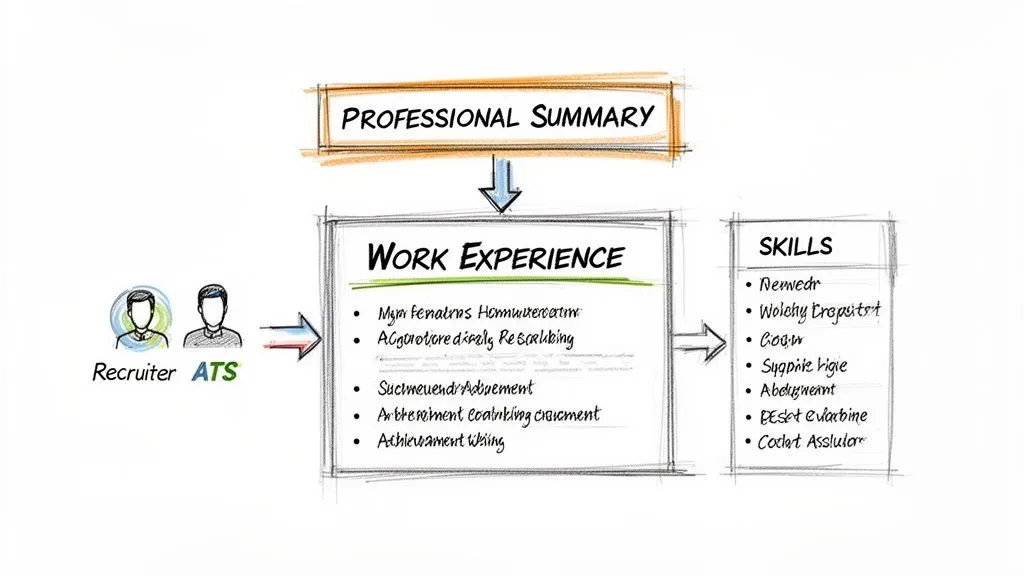
Alright, so you’ve got these powerful, achievement-focused statements. Now, where do you actually put them? Just listing them out won't work. The key is to strategically weave them throughout your resume so they’re impossible to miss—for both human readers and the dreaded Applicant Tracking Systems (ATS).
The goal is a resume where every section reinforces the same core message about the value you deliver.
The most valuable real estate on your resume is, without a doubt, the Work Experience section. This is where your strengths truly come to life, not just as claims but as proven facts embedded in your bullet points.
Instead of a boring list of duties, this section becomes your highlight reel. Every bullet point is a mini-case study showcasing a specific strength through a tangible result. This is the heart of your resume—it’s where you prove what you can do.
Weave Strengths into Your Professional Summary
Your professional summary, sitting right at the top, is your first hook. It's a two-to-three-sentence pitch that needs to grab a recruiter’s attention immediately by highlighting your most critical strengths, framed by your best achievements. Think of it as the trailer for your career.
For example, instead of the generic, "Experienced marketing manager with strong leadership skills," try something with teeth:
"Results-driven Marketing Manager with 8+ years of experience leading teams to smash performance targets. I spearheaded a content strategy overhaul that drove organic traffic up by 150% and boosted lead conversion by 40%."
See the difference? This version instantly demonstrates leadership and strategic thinking with hard, undeniable numbers. It sets a powerful tone and makes the reader want to see how you did it.
Design a Complementary Skills Section
Finally, you've got the "Core Competencies" or "Skills" section. Too many people make the mistake of turning this into an endless, overwhelming list of keywords. The smarter move is to use this space to complement, not just repeat, the strengths you’ve already proven in your work experience.
This section is primarily for the ATS bots that scan for specific keywords. Keep it concise. Focus on relevant hard skills and technical tools.
- For a Software Engineer: List languages (Python, Java), frameworks (React, Django), and tools (Git, Docker).
- For a Project Manager: Include methodologies (Agile, Scrum) and software (Jira, Asana).
This strategy lets your skills section act as an ATS-friendly keyword bank, while your work experience provides the compelling, human-readable proof. When both sections work in tandem, you get a resume that satisfies both bots and hiring managers. Getting this balance right is everything; for a deeper dive, check out the thinking behind a successful ATS filter strategy. It ensures the achievements you worked so hard on are actually seen.
Common Mistakes to Avoid When Listing Strengths
Crafting a powerful resume is a game of inches. After you've done the hard work of identifying your core strengths and turning them into achievements, a few simple mistakes can completely undermine your efforts.
Think of this final review as your quality control check. Let's make sure you're not falling into these common traps.
The most frequent mistake? Falling back on tired clichés. Phrases like "team player," "hard worker," or "detail-oriented" are so overused they’ve become invisible to recruiters. These are just baseline expectations, not standout strengths.
Instead of just saying you're a "team player," prove it. Turn that empty phrase into a bullet point like, "Collaborated with a 5-person cross-functional team to launch a new feature." That replaces a hollow claim with concrete evidence, which is far more convincing.
Mismatching Strengths to the Role
Another major pitfall is listing strengths that have nothing to do with the specific job you're applying for. While your proficiency in video editing might be impressive, it's just noise on a resume for an accounting position.
Always tailor your resume to the job description. A good rule of thumb is to ensure that at least 80% of the strengths you highlight directly map to a need mentioned in the job posting. This shows the hiring manager you've done your homework. Irrelevant skills just make it seem like you're spamming them with a generic resume.
Your resume isn't a comprehensive list of everything you're good at. It’s a targeted marketing document designed to solve a specific company's problem with your specific skills.
Creating the Dreaded "Wall of Text"
The skills section can be a dangerous place. Many candidates create an overwhelming block of text, listing every tool and technique they've ever touched. This is a huge turn-off for both human readers and ATS scanners.
A crowded skills section is impossible to scan, forcing recruiters to hunt for your key qualifications. Keep it clean and focused.
- Do: Use bullet points and group related skills into logical categories (e.g., "Programming Languages," "Marketing Tools").
- Don't: Jam dozens of keywords into a single paragraph or write long, descriptive sentences.
Listing Technical Skills Without Context
Simply listing a tool like "Python" or "Salesforce" tells a recruiter very little. What did you actually do with it? Providing context is what demonstrates the real-world value of your technical chops.
Without that context, a hiring manager is left guessing about your proficiency. Instead of just listing the tool in a skills section, integrate it into your work experience to show how you applied it.
Weak Version:
* Skills: Python, SQL
Strong Version (in Work Experience):
* Wrote Python scripts to automate data extraction from multiple sources, feeding into a SQL database and reducing manual reporting time by 10 hours per week.
To help you keep these points straight, here’s a quick-reference table. It’s a simple cheat sheet to make sure you’re presenting your strengths in the most effective way possible.
Resume Strengths Dos and Don'ts
| Do | Don't |
|---|---|
| Quantify your achievements with numbers and metrics. | Use vague, overused clichés like "team player." |
| Tailor your strengths to the specific job description. | List skills that are irrelevant to the role you want. |
| Group skills into categories for easy scanning. | Create a dense "wall of text" in your skills section. |
| Integrate technical skills into your experience bullets. | List tools and software without any context of how you used them. |
| Use action verbs to start your bullet points. | Describe job duties instead of accomplishments. |
Use this table as a final check before you hit "send." By spotting and fixing these common mistakes when listing strengths on your resume, you ensure your final document is polished, powerful, and perfectly positioned to land you that interview.
Your Top Questions About Resume Strengths, Answered
Even with a solid plan, you'll hit a few snags when you're in the thick of writing. Getting these details right is what separates a good resume from a great one. Let's walk through some of the most common questions that come up.
How Many Strengths Should I Actually List?
There's no magic number here. The real goal is quality over quantity. Stick to the three to five most critical strengths that scream "I'm the right fit for this job."
Think of it this way: your resume is prime real estate. Every word has to earn its spot. Highlighting a few core competencies in your summary and then proving them in your experience section is way more powerful than a laundry list of ten generic skills. A tight, focused approach shows you get it.
Should I Create Separate Sections for Hard and Soft Skills?
Sometimes. In a dedicated skills section, it can make things easier for a recruiter to scan. Creating subheadings like "Technical Proficiencies" or "Languages" helps them quickly find the specific qualifications they're looking for.
But the most effective place to show off your soft skills is buried inside your achievement bullet points. Anyone can write "Leadership" in a list. It’s weak. Describing how you "Mentored a team of 3 junior analysts, improving their report accuracy by 25%" proves it without ever having to say the word. That's how you give your soft skills real credibility.
Your skills section is for the ATS bot, which loves scannable keywords. Your work experience section is for the human, who needs compelling evidence of those skills in action.
What if I’m a Career Changer?
When you're switching careers, your transferable skills are everything. Stop thinking about your old job titles and start focusing on the core strengths that apply anywhere—project management, data analysis, client communication, strategic planning.
Your job is to frame your past experience through the lens of the new role you want. It's about connecting the dots for the hiring manager so they don't have to.
If you want to see how well you're highlighting these skills, an AI Resume Checker tool can give you a quick, objective look and spot any gaps. Sometimes, though, you need more than a tool. Professional guidance can be a game-changer, especially for a career pivot. If you’re curious about what a resume writer does, they specialize in this exact kind of translation—turning your past into a compelling story for your future.
Ready to transform your experience into a powerful narrative? StoryCV uses AI to help you articulate your achievements and craft a resume that truly stands out. Stop guessing and start telling your unique career story. Get your professionally written resume draft in minutes.