Your bullet points are the first thing a recruiter sees. Get the formatting wrong, and it might be the last.
The only approach that works is radical simplicity. Clean, scannable, and focused on your impact. Fancy templates and clever symbols won’t save you from a wall of text. This isn't about filling out boxes. It's about telling a human what you've achieved.
Why Your Resume Gets Ignored in 7 Seconds
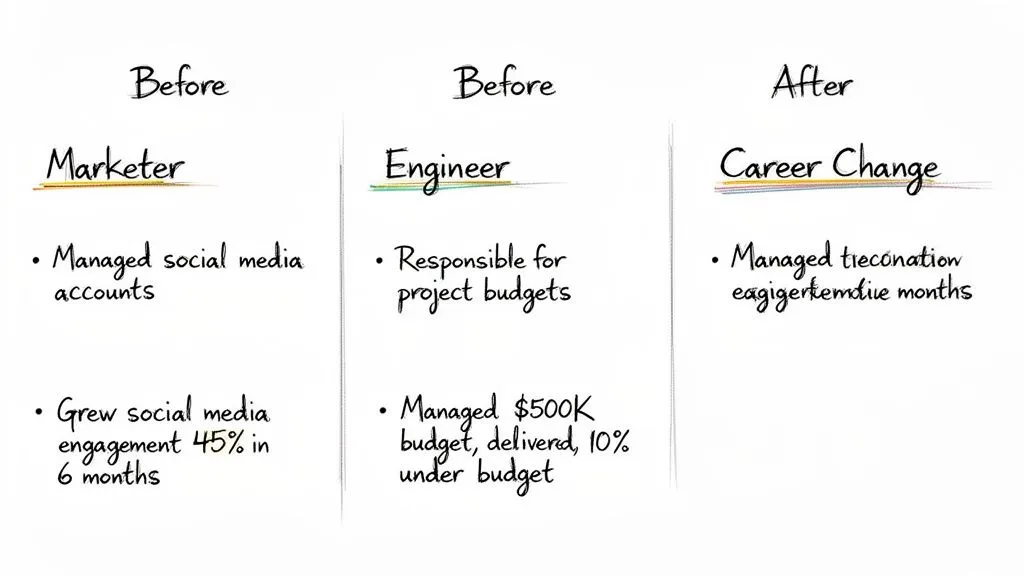
You have seven seconds. A recruiter spends an average of 7.4 seconds scanning a resume before moving on. With hundreds of applicants for one role, that first glance is your entire pitch.
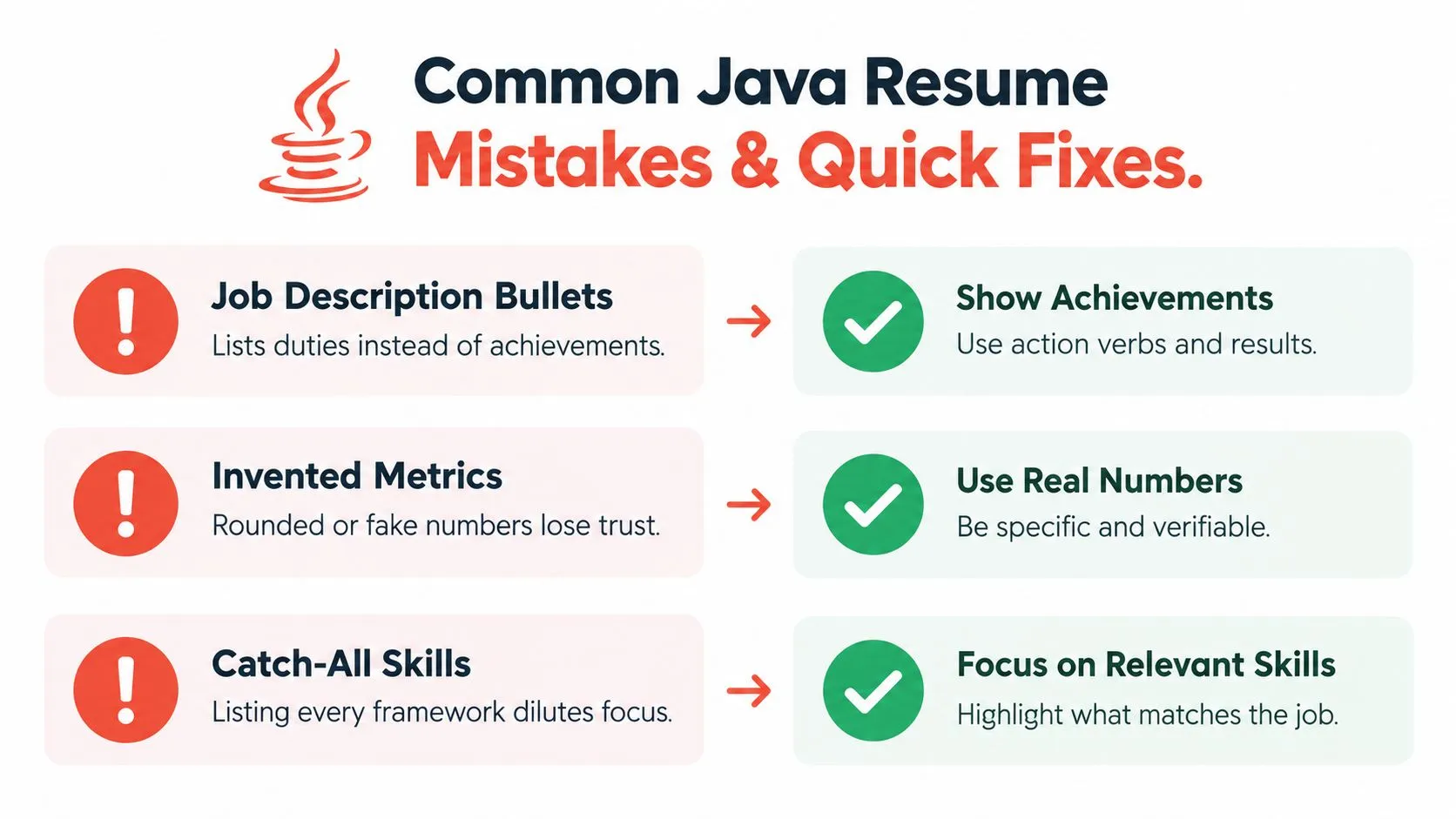
If your bullet points are dense, vague, or stuffed with jargon, you’ve already lost. Professionals with great experience make this mistake all the time. They list job duties, not achievements.
Great bullet point formatting isn't about rules. It’s about clarity. It’s about telling your story of impact, fast.
Your resume isn't a comprehensive history of every task you’ve ever done. It's a marketing document. Its only job is to get you an interview.
From Duty to Impact
The problem is a mindset issue. We’re taught to describe what we did, not what we accomplished.
-
Bad: "Responsible for managing the team's project pipeline."
-
Good: "Streamlined the project pipeline, reducing task completion time by 20%."
The first is a passive duty. The second is an active, measurable achievement. That’s the entire game. Good bullet points force you to think in results. It's not about listing tasks; it's about connecting your work to a business outcome.
This principle extends beyond your resume. For example, learning how to generate leads on LinkedIn follows a similar logic—turning a static profile into a compelling narrative that drives action. Your bullet points are the headlines of your career story. Make them count.
The Only Resume Bullet Point Format That Matters
Forget about templates. Forget about filling in the blanks. Most resume advice overcomplicates the simplest, most powerful part of your resume: the bullet points.
There’s only one format that works consistently. It isn't a rigid template. It's a way of thinking about your work.
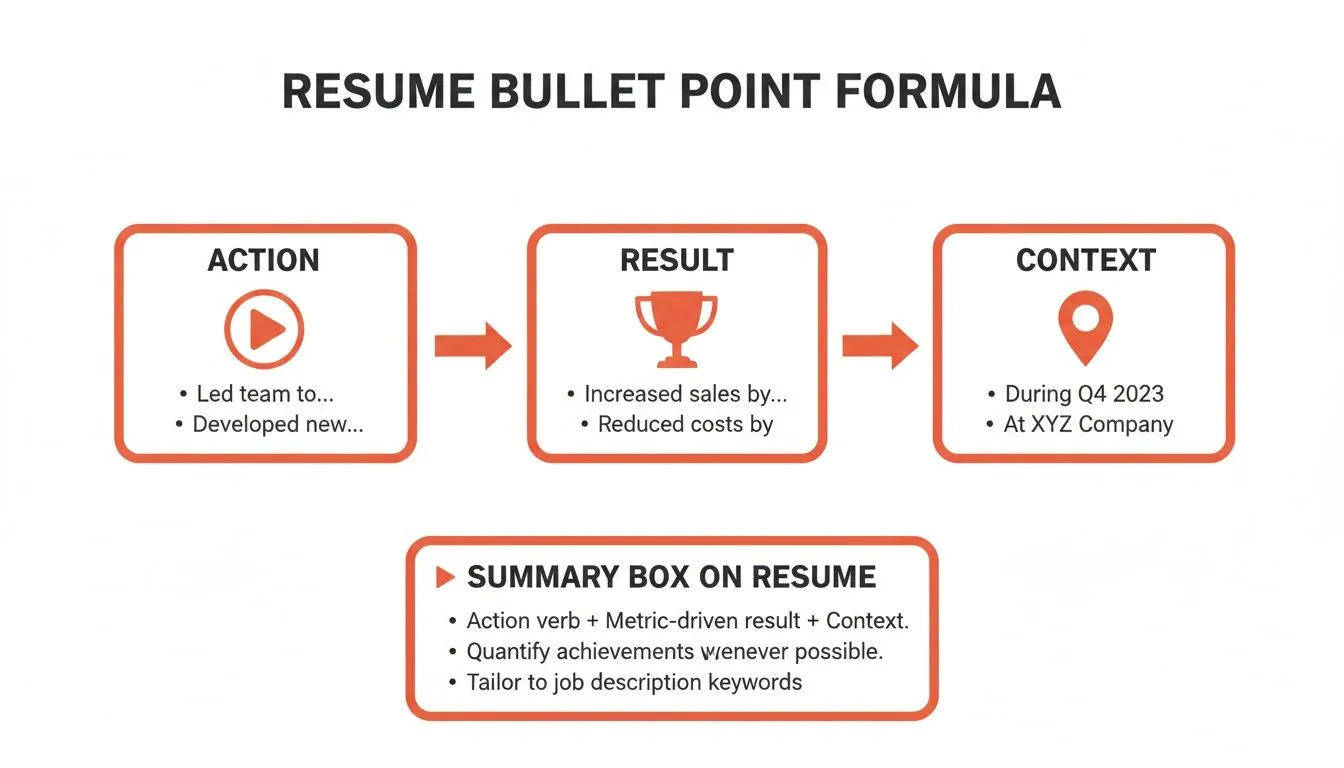
It looks like this: Action Verb + Quantifiable Result + Context.
That’s it. No fluff. No corporate jargon. Just a sharp, clear statement that proves your value. This isn't about listing what you did; it’s about framing what you accomplished.
The Action-Result-Context Formula
Let's break this down. The best bullet points tell a simple, three-part story.
-
Action Verb: Start strong. Use a powerful verb that describes what you did. Words like "Managed" or "Responsible for" are weak. Use words like "Launched," "Engineered," "Negotiated," or "Redesigned."
-
Quantifiable Result: This is the core of your achievement. How did your action make things better? Use numbers, percentages, or dollar amounts. This turns a vague claim into a hard fact.
-
Context: What was the situation? This part adds credibility, explaining the how and why behind your result.
Most people just list job duties. That’s a mistake. Duties are boring. Achievements get you hired.
Here's the shift in thinking:
-
Before (Duty): "Managed social media accounts."
-
After (Achievement): "Grew social media engagement by 45% in six months by launching a targeted B2B content series."
See the difference? The first is a task. The second is a specific success story that belongs only to you. It proves you don't just do the work—you deliver results. For a deeper dive, learn more about writing effective bullet points in a resume.
Your resume isn't a log of your responsibilities. It’s a highlight reel of your greatest hits. Every bullet point is a chance to prove you're an asset, not just a resource.
Building Your Bullet Point Outline Format
Let's put this into practice. Think of an accomplishment. Don't worry about perfect writing yet. Just answer these three questions.
Example Scenario: A Project Manager
-
What was the action? Implemented a new project management software.
-
What was the quantifiable result? Reduced project delays. By how much? By 30%.
-
What was the context? The team was struggling with missed deadlines and poor communication.
Now, assemble those pieces:
- "Reduced project delays by 30% within one quarter by implementing Asana and standardizing cross-functional team workflows."
This is the only resume bullet point format you need. It forces a critical mindset shift. Stop describing your job. Start proving your impact.
Choosing The Best Bullet Point Symbol for Your Resume
Does the symbol you use matter? Yes, but not how you think. It’s not about finding a unique icon; it’s about choosing one so clean it becomes invisible.
The best bullet point symbol for a resume is one nobody notices.
Fancy symbols—like arrows (➤), checkmarks (✓), or hollow circles (○)—are a liability. They clutter your layout, distract from your achievements, and can get scrambled by an Applicant Tracking System (ATS). The goal is radical simplicity.
The best design is invisible. Your bullet points should be clean, classic, and consistent. Anything else is noise.
Your focus is readability and professionalism. For this reason, the best resume bullet point format prioritizes function over flair. Stick to the basics.
Bullet Point Symbol Comparison for Resumes
Here’s a quick guide. The goal is clarity and universal compatibility.
| Symbol Type | Recommendation | Why It Works |
|---|---|---|
| Solid Circle (●) | Highly Recommended | The default in Microsoft Word and Google Docs. It's the universal standard—clean, professional, and 100% ATS-safe. You can't go wrong. |
| Solid Square (■) | Recommended | A crisp, modern alternative. It provides a slightly bolder look while being just as safe and effective. |
| Hollow Circle (○) | Use with Caution | Can look visually weaker than its solid counterpart, especially if the resume is printed or converted to different formats. |
| Dash/Hyphen (-) | Not Recommended | Looks unprofessional and can create alignment issues. It can also be misinterpreted by older ATS parsers. |
| Arrow/Chevron (➤) | Avoid | Distracting and unprofessional. These custom symbols are the most likely to cause parsing errors in an ATS. |
| Checkmark (✓) | Avoid | Distracting and non-standard. They belong in a task list, not a professional resume. |
The choice is simple. Pick the solid circle or the solid square. Use it consistently. And move on to what really matters: the content.
That's it. Don't overthink it. This consistency is a core part of a strong bullet point outline format.
While the symbol is simple, the content it introduces must be powerful. The real work is in structuring your accomplishments.
The key takeaway: use a boring symbol, but write an exciting accomplishment.
How to Format Bullet Points in Word and Google Docs
Getting your resume bullet point format perfect is easy, but many people get it wrong. Inconsistent indentation or mixed symbols look careless.
Here's the right way in Microsoft Word or Google Docs:
-
Type out your list of achievements.
-
Highlight the entire block of text.
-
Click the "Bullets" button in the toolbar.
This single click applies the default symbol and, more importantly, standardizes the indentation for every line.
Whatever you do, don't create bullets manually by typing an asterisk or dash. Using the built-in function is the only way to guarantee every bullet is perfectly aligned. It’s a small detail that signals professionalism.
Creating a Bullet Point Outline That Beats the Bots
Your resume's format is its first line of defense. Get it wrong, and you might as well have never applied. All those carefully worded achievements? Never seen.
It's a harsh reality. Nearly 75% of resumes are automatically rejected by an Applicant Tracking System (ATS) before a human ever sees them. These bots are the first gatekeepers. You have to understand how they "read" to create a bullet point outline format that sails right through. If you're curious, check out this breakdown of resume statistics.
The good news is the rules are simple. An ATS doesn’t care about clever designs; it only cares about a clean, predictable structure.
The ATS-Friendly Blueprint
Think of an ATS as a simple data entry clerk. It scans for hierarchy and key info—job titles, dates, and the achievements listed underneath. Anything that breaks that simple flow, like tables or columns, just confuses it.
Here’s the no-nonsense guide to ensure your resume bullet point format gets parsed correctly:
-
Font Choice: Stick to standard fonts. Your best bets are Calibri, Arial, Georgia, or Times New Roman. Anything fancy is asking for trouble.
-
Font Size: Keep body text between 10-12pt. This isn't just for the bot; it’s for the human who reads it.
-
Structure: Use a simple, single-column layout. The bot reads left to right, line by line. Don't put dates in one column and your job description in another.
Your resume’s job is to communicate information, not win a design award. Optimize for clarity and structure, and you'll beat the bots every time.
By keeping the layout clean, your powerful bullet points are correctly tied to the right job. Once your resume passes this digital test, a human takes over. That's why your formatting has to work for both. For more on creating a resume that wins over recruiters, you can explore our guide to writing a perfect resume.
Balancing Readability for Bots and Humans
A clean bullet point outline format isn't just for software. It creates a better reading experience for the recruiter, who only has seconds to scan your career. Make their job easy.
This means using consistent bullet point formatting throughout your document. As covered, stick to a solid circle (●) or a simple square (■) as the best bullet point symbol for a resume. This choice looks professional and guarantees ATS compatibility.
To make sure your content is not just readable but also optimized, you can dig into effective text formatting online strategies.
Ultimately, the best resume bullet point format is invisible. It presents your achievements so clearly that the reader focuses only on your value, not your design choices.
Real Examples of the Best Resume Bullet Point Format
Theory is one thing. Seeing it in action is another. Let’s stop talking and start showing. We'll transform common, duty-focused bullet points into achievement-oriented statements that get a recruiter's attention.
This is the best resume bullet point format at work.
Mid-Level Marketer
Marketers often just list their activities. A hiring manager doesn't care that you "ran campaigns." They need to know if those campaigns made money.
Before:
-
Responsible for email marketing campaigns.
-
Managed the company's social media accounts.
-
Wrote blog posts for content marketing efforts.
This is a list of tasks. It's passive, uninspiring, and tells a reader what you were assigned, not what you accomplished.
After:
-
Drove $75K in new revenue by developing and executing an automated email nurture sequence for qualified leads.
-
Increased social media engagement by 40% in 6 months by launching a data-driven content strategy on LinkedIn.
-
Boosted organic traffic by 25% quarter-over-quarter by writing and optimizing long-form blog posts targeting high-intent keywords.
The "after" examples are specific stories of success. Each one answers the recruiter's unspoken question: "So what?"
Senior Software Engineer
Technical roles are no exception. All those lines of code are a means to an end. Focus on what that code accomplished for the business.
Before:
-
Worked on backend services for the main application.
-
Participated in code reviews to ensure quality.
-
Fixed bugs reported by the QA team.
This is what every engineer does. It doesn’t set you apart. It makes you sound like a cog in the machine.
After:
-
Architected and deployed a new microservices-based backend, reducing API latency by 60% and supporting a 200% increase in user traffic.
-
Mentored 4 junior engineers through rigorous code reviews, improving team-wide code quality and reducing production bugs by 15%.
-
Resolved a critical memory leak that was causing a 10% crash rate, improving application stability and user retention.
This version demonstrates ownership and impact. The resume bullet point format here directly connects technical work to business metrics like performance, team efficiency, and user experience.
Career Changer
When changing careers, you must translate your experience. Show how skills from your last role are relevant to your next one. A solid bullet point outline format makes these connections impossible to ignore.
Take a retail store manager applying for a Project Coordinator role.
Before:
-
Managed daily store operations.
-
Responsible for staff scheduling and training.
-
Handled inventory management and ordering.
These bullets are stuck in retail. They don’t speak the language of project management.
Your job is to connect the dots for the hiring manager. Don't make them guess how your experience is relevant—show them.
After:
-
Coordinated all Q4 holiday season operations, managing a $50K inventory budget and ensuring project completion 10% ahead of schedule.
-
Onboarded and trained a team of 15 associates, developing a new training program that reduced ramp-up time by 3 weeks.
-
Implemented a new inventory tracking system that cut stock discrepancies by 30%, improving resource allocation and budget accuracy.
This is a strategic reframe. The actions are the same, but the language now aligns with project coordination—budgets, timelines, and process improvement.
If you need more inspiration, check out these other powerful resume bullet points examples for a wide range of roles.
Common Questions About Bullet Point Formatting
Alright, you've got the strategy. Now let's tackle the small questions that always pop up. No theory, just straight answers.
How Many Bullet Points Should I Use Per Job?
There's no magic number, but a good rule is 3 to 5 bullet points for each role.
This limit forces you to prioritize your most impressive accomplishments, which is what a recruiter wants to see. For your most recent job, lean toward 5. For older roles, 2 or 3 is plenty. Go beyond that, and you risk drowning your best work in minor duties.
Your resume is a highlight reel, not a documentary. Brevity is confidence. A long list of minor tasks tells a recruiter you can't tell the difference between being busy and making an impact.
This keeps your bullet point formatting sharp and focused on what matters: proving your value, fast.
What if My Achievements Aren’t Quantifiable?
Not everything comes with a neat percentage. That's okay. The goal is to show impact, even when it's qualitative. Instead of numbers, focus on the scope, scale, or significance of your work.
Here’s a common, weak bullet point:
- Before: "Trained new team members."
Now, reframe it to show significance without a number:
- After: "Developed and implemented a new onboarding program that became the standard for the entire marketing department."
See the difference? The "after" version proves impact. It shows initiative, ownership, and a lasting contribution. The best resume bullet point format is flexible. Always ask yourself: what changed because of my work? That's your story.
Should My Bullet Points Be Full Sentences?
No. Think of them as concise, powerful statements.
Every bullet point should start with a strong action verb. Drop personal pronouns like "I" or "My"—they're implied and waste space. For punctuation, consistency is everything.
Choose one style for your bullet point outline format and stick with it. Either put a period at the end of every bullet point, or use no end punctuation at all. Mixing and matching looks sloppy. This small detail about your resume bullet point format is a quiet signal of your attention to detail.
Tired of guessing what recruiters want? StoryCV is a Digital Resume Writer that interviews you to find your best achievements and writes them for you. Stop wrestling with bullet points and start telling your career story with clarity. Get started for free at https://story.cv.