Writing resume bullets is hard. You’ve shipped complex projects, navigated shifting goals, and managed messy trade-offs. The real impact wasn't in the task list; it was in the decisions you made. But try squeezing years of that context into a single, sterile line. It feels impossible, like trying to describe a symphony with a single note.
This is the classic pain of translating great work into a great resume:
-
Compression: How do you distill a multi-year project into one impactful sentence? It feels like you're erasing the most important parts of the story.
-
Loss of Context: When you strip out the 'why,' the bullet point loses its soul. The messy, brilliant trade-offs you navigated disappear, and so does your unique value.
-
Jargon & Translation: Your internal company language, the acronyms and project codenames, is meaningless to a recruiter. Translating it into universal 'resume-speak' can feel robotic and inauthentic.
-
Highlighting the Right Outcomes: You did a million things. Which accomplishments actually matter to your next employer? It's easy to get lost in the details and miss the bigger picture.
Most advice tells you to use templates. Fill out the boxes. But you’re not a machine. Templates are soul-crushing and produce resumes that look and sound like everyone else's. Your work was unique; your resume should be too.
This isn't about finding the 'perfect' template. It's about finding the right framework to tell your story. Here are 10 types of resume bullet points examples that help you do exactly that, without losing your voice. Once you've mastered them, ensure your entire application is just as professional.
1. Achievement-Focused Bullets with Quantifiable Impact
Writing resume bullets is hard. You're asked to compress years of complex work, team dynamics, and shifting goals into a single, sterile line. This often strips out the context-the very thing that made your work matter. This is where achievement-focused bullets come in.
Instead of listing what you did (your responsibilities), this approach focuses on what you achieved (your results). It transforms a passive duty into a high-impact story of your value. The formula is simple but powerful: strong action verb + what you did + quantifiable outcome.
The Strategic Breakdown
This method works because it speaks the language of business: results. Hiring managers and recruiters are trained to look for candidates who can solve problems and create value. Quantifiable metrics provide concrete, undeniable proof.
-
Before: "Responsible for managing email campaigns." (A passive duty)
-
After: "Redesigned email campaign workflow, reducing time-to-send by 60% and improving open rates from 18% to 24%." (A specific achievement)
The "After" example immediately demonstrates efficiency, strategic thinking, and a direct impact on key marketing metrics. It doesn't just say you did a task; it proves you did it exceptionally well.
Actionable Takeaways
-
Hunt for Numbers: Scour old performance reviews, project reports, or company dashboards. Look for percentages, dollar amounts, time saved, or user growth.
-
Frame Your Metrics: Add context to make your numbers more impressive. "Increased daily active users by 34%" is good. "Increased daily active users by 34% (2.1M to 2.8M) within 6 months" is far better.
-
Use Proxies for Non-Quantifiable Roles: If your role doesn't involve hard numbers, use proxy metrics. Think "mentored 4 junior staff to promotion" or "received 15 unsolicited positive customer testimonials."
Quantifying your impact is a fundamental step in showing, not just telling, what you're capable of. For more depth on this, our guide on how to write about your achievements on a resume offers a more detailed process.
2. Problem-Solution-Result (PSR) Framework Bullets
Quantifying achievements is crucial, but sometimes a number alone doesn't tell the whole story. It lacks the why. The Problem-Solution-Result (PSR) framework adds this missing context, transforming a simple metric into a compelling narrative about your strategic thinking and problem-solving abilities.
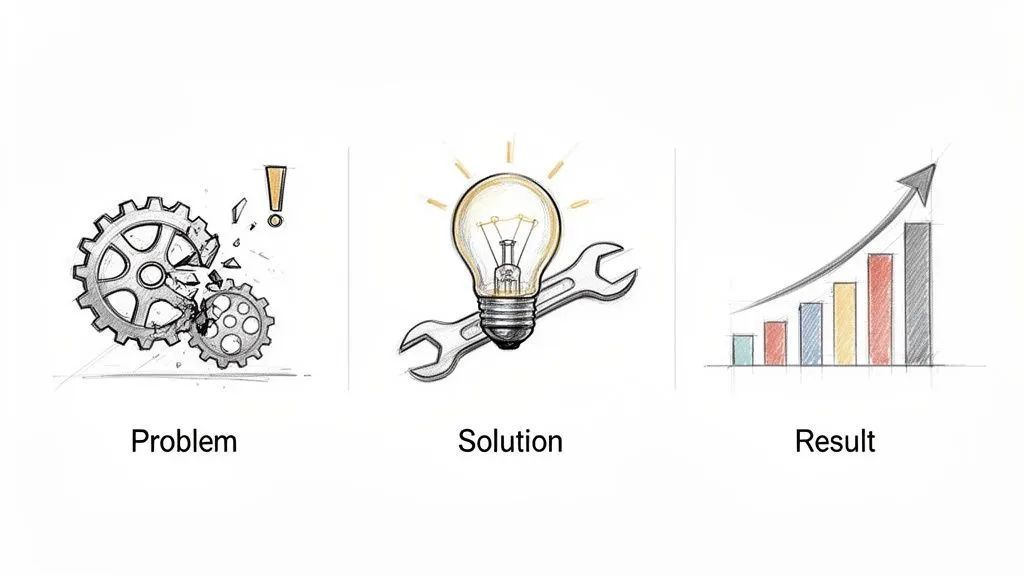
This method frames your experience as a mini-story: you identified a business pain point, you implemented a thoughtful solution, and you delivered a measurable result. It’s particularly powerful for mid-level professionals and career changers because it demonstrates how you think, not just what tasks you completed.
The Strategic Breakdown
The PSR framework immediately elevates you from a "doer" to a "strategist." Recruiters see hundreds of resumes listing duties; a bullet that outlines a business problem and your specific fix makes them stop and read. It shows you understand the big picture. To build compelling PSR bullets that truly demonstrate your impact, it's essential to continually refine how to improve problem-solving skills.
-
Before: "Managed company's supply chain and vendor partnerships." (A responsibility)
-
After: "Discovered supply chain inefficiency causing 3-week lead times; negotiated new vendor partnerships and implemented a just-in-time inventory model to cut lead times to 5 days, freeing $180K in working capital." (A strategic narrative)
The "After" example is a complete story. It presents high stakes (long lead times), showcases decisive action (negotiation, new model), and proves the value with clear financial and operational wins. It’s a full-circle demonstration of competence.
Actionable Takeaways
-
Lead with the Problem: Start your bullet by stating the business pain point. Phrases like "Identified," "Discovered," or "Recognized" hook the reader by establishing the stakes immediately.
-
Keep the Solution Concise: Focus on the what and why of your solution, not the granular how. "Built automated intake process" is better than detailing every single software integration step.
-
Connect Result to Problem: Ensure the result directly resolves the initial problem. If the problem was slow onboarding, the result must be faster onboarding. This closes the narrative loop for the reader.
-
Emphasize Transferable Skills: For career changers, this format is gold. It shifts the focus from role-specific duties to universal skills like analysis, execution, and stakeholder management.
Using PSR helps you build a narrative that goes beyond a list of tasks, which is essential when thinking about how to describe yourself on a resume in a way that truly stands out.
3. Leadership & Influence Bullets Without Direct Reports
You don't need a formal title to be a leader. Yet, resumes are obsessed with hierarchy, making it tough for individual contributors, career changers, or project leads to show their impact. This is where influence bullets come in. They prove you can drive change, build consensus, and deliver results, even without a team reporting to you.
Instead of just stating you collaborated, this method focuses on how you steered the group toward a specific, valuable outcome. It shifts the narrative from participation to proactive leadership, a critical skill that hiring managers look for at every level.
The Strategic Breakdown
This method works because it demonstrates your ability to create value through others, a core tenet of leadership. It answers the implicit question, "Can you make things happen here, even without formal authority?" By showing how you guided peers and stakeholders, you prove you're ready for more responsibility.
-
Before: "Contributed to a cross-functional project to develop a new customer feature." (A passive, vague contribution)
-
After: "Led a cross-functional working group of 8 (product, engineering, design) to scope a new customer feature; built consensus on requirements and shipped within 6 weeks, achieving a 92% customer satisfaction score." (A specific leadership story with a clear outcome)
The "After" example provides undeniable proof of influence. It specifies the scope of your leadership ("8 people"), the actions you took ("built consensus"), and the business impact ("92% CSAT"). This is one of the most effective resume bullet points examples for showcasing advanced soft skills.
Actionable Takeaways
-
Use Influence Verbs: Swap out passive words like "helped" or "assisted" for strong, influence-oriented verbs. Think: championed, persuaded, unified, mentored, or mobilized.
-
Define Your Scope: Give a sense of scale to your influence. Mentioning "across a 40-person org" or "partnered with 5 department heads" provides context and weight to your achievement without claiming a formal title.
-
Connect Influence to Outcomes: Your ability to persuade others is only valuable if it leads to a result. Always tie your leadership action to a concrete business metric: reduced costs, increased efficiency, or improved customer satisfaction.
4. Skills & Tools Bullets with Demonstrated Mastery
Your skills section is a list, but your experience section is where you prove you can actually use those tools to make things happen. Simply listing "Figma" or "Python" is like saying you own a hammer; it doesn't tell anyone if you can build a house. This approach is about showing, not just listing.
Instead of keeping skills siloed in their own section, this method weaves them directly into your achievement bullets. It connects the tool to the outcome, proving your proficiency in a way a simple list never could. The formula is: strong action verb + what you did using a specific tool + quantifiable outcome.
The Strategic Breakdown
This method is crucial for technical, operational, and data-heavy roles. Recruiters and hiring managers aren't just looking for tool proficiency; they are looking for problem-solvers who wield those tools strategically. Demonstrating mastery in context shows you understand the why behind the tool, not just the how.
-
Before: "Created dashboards for the marketing team and automated reports." (Passive and vague)
-
After: "Built a real-time analytics infrastructure using Looker and dbt; democratized data access for 150+ stakeholders, reducing custom report requests by 70%." (Proves mastery and strategic impact)
The "After" example doesn't just name-drop tools. It demonstrates a sophisticated understanding of how to build a data ecosystem that drives efficiency and empowers an entire organization. It tells a complete story of technical skill leading to a business win.
Actionable Takeaways
-
Connect Tool to Outcome: Only mention a tool if it was essential to achieving the result. Avoid a laundry list of software; focus on the one or two that were game-changers for a specific project.
-
Balance Jargon: Be specific enough to impress a technical manager but clear enough for a non-technical recruiter. "Built predictive customer churn model using Python (scikit-learn)" is a good balance.
-
Frame Your Learning: When discussing a new tool, frame it as a strategic choice. "Migrated team from Excel to Tableau" shows initiative and an understanding of how to scale operations, not just that you learned a new program.
Integrating tools into your achievements is one of the most powerful resume bullet points examples for showing practical expertise. For a deeper look at which competencies to highlight, explore our guide on what skills to put on a resume.
5. Cross-Functional Collaboration & Stakeholder Management Bullets
Modern work isn't a solo sport. It's a complex team game played across departments with different languages and conflicting priorities. Your real value often lies in your ability to be the translator, the negotiator, and the bridge that connects siloed teams. This is where stakeholder management bullets prove their worth.
Instead of just stating you "worked with other teams," this approach details how you navigated these complex relationships to achieve a specific goal. It demonstrates leadership, emotional intelligence, and strategic influence, qualities that are difficult to quantify but immensely valuable. The formula is: action verb + description of the collaboration challenge + the successful, unified outcome.
The Strategic Breakdown
This method works because it shows you can handle organizational complexity. Hiring managers know that the biggest projects fail not because of technical issues, but because of people problems and misaligned teams. Proving you can herd cats and get them all walking in the same direction is a massive advantage.
-
Before: "Worked with engineering and marketing on product launch." (Vague and passive)
-
After: "Bridged Engineering and Marketing divide on product launch timeline; negotiated an 8-week sprint plan balancing technical debt paydown with go-to-market urgency, shipping on time with 95% feature completion." (A specific story of influence and results)
The "After" example is one of the most compelling resume bullet points examples because it tells a mini-story of conflict and resolution. It proves you can manage competing interests and deliver under pressure, a skill critical in any senior role.
Actionable Takeaways
-
Name the Players: Be specific about the teams involved. Don't say "cross-functional partners." Say "partnered with Sales, Customer Success, and Engineering." Specificity adds credibility.
-
Describe the Conflict: What was the core disagreement? Was it about budget, timelines, technical approach, or customer priorities? Briefly articulating the tension makes the resolution more impressive.
-
Showcase Your Role as Translator: Highlight how you translated needs between groups. For example, "Translated technical constraints into business impact for finance leadership to secure budget." This shows you can speak multiple business languages.
6. Learning Velocity & Growth Trajectory Bullets
Experience is valuable, but in a rapidly changing industry, your ability to learn is your most critical asset. Recruiters know this. They aren't just hiring for what you know today; they're betting on how quickly you can master what's needed tomorrow. This is where learning velocity bullets shine.
Instead of focusing only on past accomplishments, this approach highlights your growth trajectory. It tells a story of adaptability and a proactive mindset, shifting the narrative from "what I have done" to "how fast I can deliver value in a new domain." This is particularly powerful for career changers or anyone re-entering the workforce.
The Strategic Breakdown
This method works because it directly addresses a hiring manager's biggest risk: ramp-up time. By showing you can get up to speed and contribute quickly, you de-risk the decision to hire you. It proves you are a low-drag, high-impact addition to any team.
-
Before: "Learned Python and SQL." (A passive statement with no context or impact)
-
After: "Self-taught Python and SQL fundamentals within 6 weeks; built first customer segmentation model that identified a $240K upsell opportunity." (A story of rapid learning leading to a direct business win)
The "After" example is a complete narrative. It demonstrates initiative (self-taught), speed (6 weeks), application (built a model), and a tangible business outcome ($240K). It's one of the best resume bullet points examples for showcasing potential.
Actionable Takeaways
-
Lead with the Timeline: Emphasize speed by starting with the time frame. Phrases like "within 8 weeks," "in the first quarter," or "by month 3" immediately frame the bullet around velocity.
-
Connect Learning to an Outcome: Never present learning in a vacuum. The skill you acquired must be tied to a project, a feature shipped, a problem solved, or a cost saved. Learning is the how, the outcome is the why.
-
Frame it as Accelerated Mastery: Especially for career changers, avoid language that sounds like you're starting from zero. "Accelerated mastery of the modern React ecosystem" sounds more confident than "learned React from scratch."
This approach turns a potential perceived weakness (less experience in a specific tool) into a demonstrated strength: your elite ability to adapt and grow.
7. Customer Impact & Satisfaction Bullets
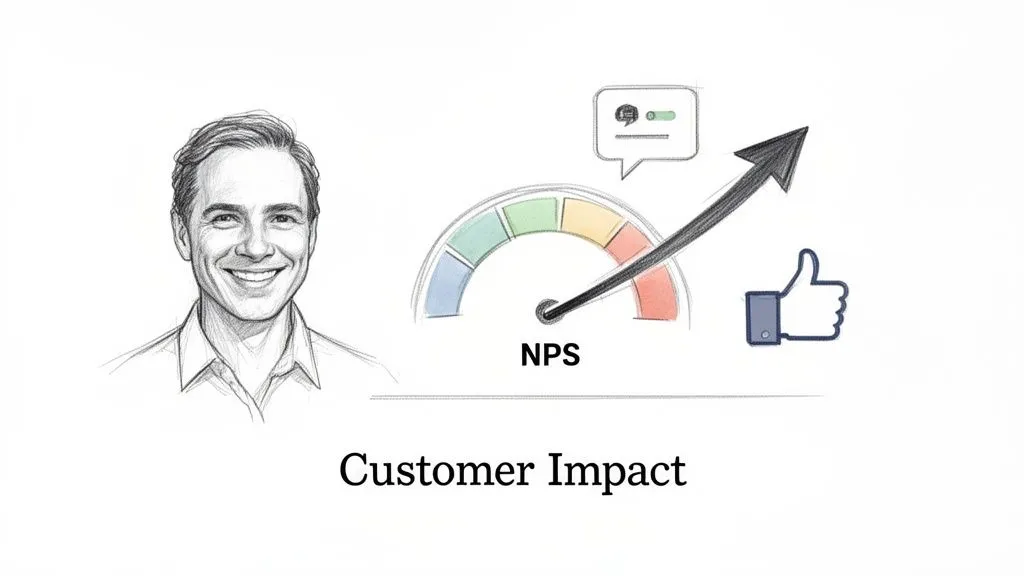
Companies live or die by their customers. Yet, resumes often focus entirely on internal processes, forgetting the people who actually pay the bills. This bullet style flips the script. It anchors your accomplishments in the real-world value you delivered to users or clients.
It shifts the focus from "what I did" to "how the customer benefited." This demonstrates not just your skills, but your empathy and business acumen-your ability to connect your daily tasks to the company's bottom line. It's a powerful way to show you understand what truly matters for business success.
The Strategic Breakdown
This method proves you're not just a cog in a machine; you're a driver of customer loyalty and growth. Recruiters look for candidates who can solve customer problems, as this directly correlates to retention and revenue. Using customer-centric metrics provides irrefutable evidence of this crucial skill.
-
Before: "Redesigned the onboarding workflow for new users." (An internal action)
-
After: "Redesigned onboarding workflow based on customer feedback, cutting time-to-first-success from 21 to 7 days and increasing new customer engagement score by 28%." (A customer-focused outcome)
The "After" example is one of the strongest resume bullet points examples because it directly connects an action to a tangible improvement in the customer experience. It proves you listen, strategize, and deliver results that keep customers happy and engaged.
Actionable Takeaways
-
Track Customer Metrics: Look for data on Net Promoter Score (NPS), Customer Satisfaction (CSAT), churn rates, retention rates, or support ticket volume.
-
Translate Technical Wins: If you're in a technical role, translate your work into a customer benefit. "Reduced API latency by 80%" becomes "Reduced API latency by 80%, enabling a real-time collaboration feature used by 40K+ daily active users."
-
Use the Voice of the Customer: Did specific feedback spark a project? Mention it. "Acted on customer feedback indicating a key feature was confusing" provides powerful context for your actions.
8. Process Improvement & Efficiency Bullets (Operational Excellence)
Companies are messy. Workflows get bloated with redundant steps, legacy systems create bottlenecks, and teams waste hours on tasks that could be automated. This is the organizational friction that quietly kills productivity. Process improvement bullets show you're the one who finds and fixes these expensive problems.
Instead of just performing your role, you actively improved it. You didn’t just follow the process; you made the process better, faster, or cheaper. This showcases systems thinking, a highly valuable skill that proves you see the big picture and can create lasting operational value.
The Strategic Breakdown
This method communicates that you are a problem-solver, not just a task-doer. Hiring managers in operations, finance, and logistics look for candidates who can optimize resources. These bullets provide concrete proof of your ability to enhance efficiency and directly impact the bottom line.
-
Before: "Managed the monthly financial close process." (A simple responsibility)
-
After: "Implemented a standardized financial close checklist and automated reporting, reducing the month-end close cycle from 10 days to 5." (A clear, impactful improvement)
The "After" version is powerful because it details a specific initiative (checklist, automation) and quantifies the direct result (a 50% reduction in time). It demonstrates initiative, technical skill, and a focus on operational excellence.
Actionable Takeaways
-
Identify the 'Before' State: Start by describing the problem. What was slow, broken, or wasteful? "Discovered a 40-hour weekly bottleneck caused by duplicate order entry."
-
Quantify Both Ends: A great efficiency bullet has a "before" and "after" metric. This could be time saved (10 days to 5), cost reduced ($50K to $35K), or quality improved (error rate from 12% to 3%).
-
Connect to Business Goals: Explain why the efficiency mattered. "Reduced fulfillment cycle time from 14 days to 3, improving on-time delivery from 78% to 98% and boosting customer retention scores."
Showcasing process improvements proves you leave every role better than you found it. For a deeper dive into articulating these kinds of wins, our guide on how to use the STAR method on your resume can help you structure these complex stories.
9. Initiative Ownership & Self-Direction Bullets
Most resumes list assigned tasks. This is fine, but it positions you as a follower, someone who waits for instructions. In a world of remote work and lean teams, managers crave people who don't just complete tickets but actively hunt for problems to solve. This is where ownership bullets shine.
They showcase your ability to identify a gap, propose a solution, and drive it to completion without being told. This is the difference between being a good employee and being a future leader. It tells a hiring manager you can operate with autonomy and think like a business owner, not just a cog in the machine.
The Strategic Breakdown
This method works because it demonstrates high-level thinking and an internal drive for improvement. It signals that you're not just looking for a job, but for an opportunity to make a tangible impact. It answers the unasked question: "Will this person make our team better on their own?"
-
Before: "Assisted with new hire onboarding." (A passive, assigned task)
-
After: "Identified gap in onboarding causing 30% first-year attrition; proposed and led the design of a new mentorship program, improving year-one retention to 94%." (A story of proactive problem-solving)
The "After" example is a complete narrative. It shows you observed a problem, diagnosed its impact, and owned the solution from conception to execution. This is a powerful signal of your readiness for more responsibility.
Actionable Takeaways
-
Start with the "Why": Begin your bullet with context like "Identified," "Noticed," or "Discovered." This immediately frames the work as self-initiated, not assigned.
-
Highlight Your Autonomy: Use phrases like "proposed and led," "independently evaluated," or "took responsibility for" to emphasize that you were the driving force.
-
Show You're Not a Rogue: Mentioning that you "received leadership approval" or "presented the plan to stakeholders" shows you can drive change while still respecting process and collaboration, a key skill in any organization.
Self-direction bullets are perfect for showing you can thrive in startup environments, remote roles, or any position where you won't be micromanaged. They prove you're a valuable asset who creates work, not just consumes it.
10. Scaling & Growth Bullets (Impact Grows with Organization)
Every company wants to grow, but few employees can prove they know how to build for it. Scaling and growth bullets demonstrate that you’re not just a doer; you're an architect. You build systems, processes, and teams that don't just work now, but will work when the company is 10 times its current size.
This approach moves beyond individual accomplishments to showcase your ability to create lasting, scalable impact. Instead of just solving today's problem, you show you were solving for tomorrow's challenges. It’s the difference between bailing water out of a boat and building a better, stronger hull.
The Strategic Breakdown
These bullet points are crucial for candidates in high-growth industries or those targeting leadership positions. They prove you think systematically and possess the foresight to prevent future bottlenecks. This is a rare and highly valued skill that signals you are ready for more responsibility.
-
Before: "Trained new team members on the onboarding process." (A routine task)
-
After: "Built a scalable customer onboarding playbook that supported growth from 3 to 200+ clients, reducing per-customer onboarding costs by 60% and enabling a 4-person team to achieve a 98% completion rate." (A strategic system with massive impact)
The "After" example is a powerhouse. It directly connects your work to organizational scale, cost efficiency, and team enablement. It tells a clear story: you created a system that allowed the company to grow without breaking. This is a core competency for any leader.
Actionable Takeaways
-
Show the Scale Explicitly: Use "from X to Y" numbers to make growth tangible. This could be customers, revenue, team size, or data volume. "Scaled the data pipeline to handle 100M daily events, up from 5M" is a clear win.
-
Highlight the System, Not Just the Task: What did you build that made the growth sustainable? Name the playbook, the automation script, the CI/CD pipeline, or the training framework. This is the "how" behind your success.
-
Demonstrate Knowledge Transfer: Great builders make themselves redundant. Mention how you documented processes, trained others, or created self-serve resources. This shows you're a force multiplier, not a single point of failure.
10 Resume Bullet Types Comparison
| Approach | 🔄 Implementation Complexity | ⚡ Resource Requirements | 📊 Expected Outcomes | Ideal Use Cases | ⭐ Key Advantages / 💡 Tip |
|---|---|---|---|---|---|
| Achievement-Focused Bullets with Quantifiable Impact | Moderate — data collection + concise framing | Low–Medium — needs metrics & documentation | Clear, measurable impact (revenue, efficiency) ⭐⭐⭐⭐ | Roles with measurable KPIs (Sales, PM, Ops, Marketing) | Strong proof of value; surface exact metrics with StoryCV |
| Problem-Solution-Result (PSR) Framework Bullets | High — craft concise three-part narrative 🔄 | Medium — requires context, cause-effect clarity | Memorable storytelling that shows strategy & judgment ⭐⭐⭐⭐ | Mid-level, career changers, roles needing decision-making evidence | Lead with the problem; keep solution concise |
| Leadership & Influence Bullets Without Direct Reports | Medium — careful attribution & scope signaling | Low–Medium — collect examples of influence | Demonstrates leadership readiness and cross-team impact ⭐⭐⭐ | ICs aiming for management, rising tech leaders | Quantify scope (teams/people) and show persuasion moments |
| Skills & Tools Bullets with Demonstrated Mastery | Low–Medium — integrate tools into outcomes | Low — examples of tool use; access to tech/data | Shows applied proficiency and tool-driven ROI ⭐⭐⭐ | Technical roles (Data, Eng, Design, BI) | Only include tools that enabled outcomes; avoid jargon |
| Cross-Functional Collaboration & Stakeholder Management Bullets | Medium — map stakeholders and negotiation steps | Medium — coordination time and alignment effort | Improves alignment, delivery, and stakeholder buy-in ⭐⭐⭐ | Product, Program, PM, Ops, Matrixed organizations | Specify involved functions and concrete alignment outcomes |
| Learning Velocity & Growth Trajectory Bullets | Low — demonstrate timeline + applied result | Low — evidence of rapid ramp / learning artifact | Signals rapid ramp and adaptability; needs business tie-in ⭐⭐ | Early-career, career changers, returners, startups | State timeframe explicitly and link learning to impact |
| Customer Impact & Satisfaction Bullets | Medium — needs customer metrics & attribution | Medium — customer data, feedback collection | Strong external-facing outcomes (NPS, retention) ⭐⭐⭐⭐ | Product, CS, Sales, Ops — customer-centric roles | Use NPS/CSAT counts; anonymize sensitive details |
| Process Improvement & Efficiency Bullets (Operational Excellence) | Medium–High — diagnose, test, and implement process change 🔄 | Medium — cross-team effort, tools, training | Quantified time/cost/quality gains; clear ROI ⭐⭐⭐⭐ | Operations, Supply Chain, Finance, Manufacturing | Show before/after metrics and sustainability steps |
| Initiative Ownership & Self-Direction Bullets | Low–Medium — document initiative and approvals | Low — individual time, possible small tooling | Signals autonomy and bias for action; strong differentiator ⭐⭐⭐ | Remote, startup roles, career changers, ICs | Emphasize "I owned"; note leadership approval to avoid sounding rogue |
| Scaling & Growth Bullets (Impact Grows with Organization) | High — systems design, documentation, and handoff 🔄 | High — training, automation, hiring, processes | Demonstrates capacity to sustain 10x+ growth; leadership-ready ⭐⭐⭐⭐ | Growth-stage companies, aspiring leaders, architects | Show before/after scale, per-unit economics, and knowledge transfer |
Stop Filling Boxes. Start Telling Stories.
You’ve scrolled through dozens, maybe hundreds, of resume bullet points examples. You’ve seen the before-and-afters, the action verbs, and the frameworks. Now what? The real work isn’t about copying and pasting a line that sounds good. It's about shifting your mindset. Stop thinking of your resume as a data entry form and start seeing it as a collection of your greatest-hits stories.
Let's be honest, writing these things is hard. It feels like an impossible task. You’re trying to compress years of complex projects, shifting priorities, and cross-functional battles into a single, sterile line. This is where most people get stuck.
The Real Pain of Writing Bullet Points
We’ve seen it thousands of time. The frustration isn't about a lack of achievement; it's about the difficulty of translation. The core challenges usually fall into four buckets:
-
Compression Overload: You’re forced to distill a six-month project with a dozen stakeholders into about 15 words. It feels reductive because it is. You lose the nuance, the trade-offs, and the critical decisions that led to the outcome.
-
Loss of Crucial Context: The bullet point format strips away the "why." It removes the backstory of a struggling project you saved or a chaotic process you streamlined. Without that context, your impressive achievement can sound like a routine task.
-
The Jargon Trap: Every company has its own language. "Project Nightingale" or "Q4 Synergy Initiative" meant everything internally, but they mean nothing to a recruiter. Translating your specific contributions into universally understood resume language is a huge hurdle.
-
Highlighting What Matters: You did a lot. You wore multiple hats. But which accomplishments actually prove you’re the right person for this specific job? Choosing what to emphasize is a strategic decision, not just a memory test.
From Static Lines to Dynamic Stories
The resume bullet points examples in this guide weren't just about better phrasing. They were about embedding a narrative. Each effective bullet point is a micro-story with a clear protagonist (you), a conflict (the business problem), and a resolution (the quantifiable result).
-
The Problem-Solution-Result (PSR) framework gives your story a plot.
-
The Leadership & Influence examples show your character and impact beyond a title.
-
The Process Improvement bullets demonstrate your ability to find a better way forward.
Notice the pattern? The best resumes don't just list what you did. They provide evidence of how you think. They connect your actions to meaningful business outcomes. They tell a story of value creation, one concise point at a time. Trying to cram your career into a generic template forces you to erase the very context that makes your work impressive. It’s a soul-crushing exercise in box-filling.
Your career is a story of impact. Don't let a bad format silence it. Use these frameworks to start thinking like a storyteller. You’ll find it’s much easier to write a resume that truly represents the value you bring to the table.
And learning how to combine your resume, cover letter, and portfolio into one document creates a seamless experience for hiring managers.
Tired of fighting with templates and trying to sound like a resume robot? StoryCV is a Digital Resume Writer, not a tool. We use a smart, conversational interview to help you uncover your best stories and articulate your impact, turning your frustrating task into a clear narrative.