Knowing what skills to put on a resume has evolved beyond a simple list of buzzwords. Today's hiring process is a two-stage challenge: first, you must satisfy the automated logic of Applicant Tracking Systems (ATS), and second, you need to capture the attention of a human hiring manager. The most effective resumes achieve both, translating your capabilities into a compelling narrative of professional value. A strong resume begins with understanding the essential skills to list in a professional CV and then strategically weaving them into your experience.
This guide moves past generic advice to provide a clear, actionable framework for showcasing your most impactful abilities. We will dissect the 10 most critical skill categories that resonate with recruiters across industries, from technology and business to operations and creative fields. You will learn not just what to list, but how to frame each skill with quantifiable achievements and context-rich examples.
Forget the keyword-stuffing tactics of the past. Instead, you'll discover how to articulate your proficiency in areas like strategic thinking, cross-functional collaboration, and customer-centric problem-solving. Whether you are a student building your first resume, a mid-level professional aiming for a promotion, or a career changer translating your experience, this listicle offers the specific tools you need. We'll provide role-specific mini-lists and phrasing examples to help you craft a resume that tells your unique story, demonstrates your true potential, and secures more interviews.
1. Technical Skills & Proficiency Areas
Technical skills are the specific, teachable abilities required to perform a job. They encompass everything from programming languages and software platforms to design tools and operational methodologies. These hard skills are often the first thing a recruiter or Applicant Tracking System (ATS) looks for, as they are objective, measurable, and directly tied to job functions.
Listing your technical skills is non-negotiable, especially for roles in tech, business, and operations. They are concrete proof of your qualifications. For an ATS, specific keywords like "Python," "Salesforce," or "Figma" act as critical filters. For a human reader, a well-organized technical skills section quickly confirms you have the foundational knowledge to succeed.
How to Showcase Technical Skills
Avoid a simple, unorganized list. Instead, group your skills logically and provide context to show not just what you know, but how well you know it.
- Group by Category: Organize skills into logical clusters. For a software engineer, this could be "Languages," "Frameworks/Libraries," and "Developer Tools." An operations manager might use "ERP Systems," "Project Management Software," and "Data Analysis."
- Indicate Proficiency: Use a simple scale like "Expert," "Proficient," or "Familiar." This adds valuable context and helps manage expectations, preventing you from being perceived as a master of a tool you've only used briefly.
- Be Specific: Instead of just "React," specify "React 18" or "React Native." Instead of "Adobe," list "Adobe Photoshop" and "Adobe Illustrator." Specificity demonstrates precision and deeper knowledge.
- Contextualize in Experience: Don't just list a skill; weave it into your work experience bullet points. For instance, write "Optimized supply chain logistics using SAP S/4HANA, reducing shipping costs by 15%."
Key Insight: A dedicated "Technical Skills" section is excellent for ATS scanning, but integrating those same skills into your work experience descriptions is what truly convinces a human reader of your expertise.
For a deeper dive into which competencies to include, explore these detailed examples of technical skills for your resume.
2. Achievement-Based Metrics & Quantifiable Results
Achievement-based metrics translate your responsibilities into measurable business outcomes using numbers, percentages, and concrete results. Instead of simply listing duties, this approach demonstrates your direct impact with data-driven evidence. This transforms vague statements into compelling proof of your value, which both ATS systems and human readers can quickly understand and appreciate.
Listing your skills is crucial, but quantifying your accomplishments shows how you applied those skills to create tangible value. For an ATS, metrics like "15%," "$250K," or "3x" act as powerful indicators of a high-achiever. For a hiring manager, these numbers provide irrefutable evidence that you are a results-oriented candidate capable of driving business success.

How to Showcase Quantifiable Results
Avoid describing your duties; instead, focus on the outcomes of your actions. Frame every accomplishment with a specific, measurable result to prove your effectiveness.
- Use the X-Y-Z Formula: A common framework is "Accomplished [X] as measured by [Y], by doing [Z]." For example, "Reduced order fulfillment time [X] by 22% [Y] by implementing an automated inventory tracking system [Z]."
- Pair Metrics with Actions: Always connect the number to the action that created it. Instead of "15% cost reduction," write "Negotiated with 3 new vendors to reduce raw material costs by 15%."
- Use Percentages and Ranges: If exact numbers are confidential or unavailable, use percentages, ranges, or comparisons. For example, "Exceeded quarterly sales targets by 10-15% consistently" or "Ranked in the top 5% of customer support representatives for positive feedback."
- Tailor to the Job Description: Scrutinize the job posting for key performance indicators (KPIs) they value, such as efficiency, revenue growth, or customer satisfaction. Prioritize and showcase the metrics on your resume that align directly with those goals.
Key Insight: A resume that lists responsibilities says what you were supposed to do. A resume filled with metrics and achievements proves what you actually did and the value you delivered.
For additional guidance on showcasing your accomplishments, see these examples of listing strengths on your resume.
3. Leadership & Management Capabilities
Leadership skills demonstrate your ability to guide teams, influence others, and drive organizational outcomes. They encompass both formal management, such as hiring and performance reviews, and informal leadership, like mentorship and cross-functional collaboration. These capabilities are crucial skills to put on a resume, as they signal to recruiters your potential for growth and your ability to amplify your impact beyond individual contributions.
For hiring managers, leadership skills are a powerful indicator of maturity, accountability, and strategic thinking. They prove you can not only execute tasks but also rally people around a common goal, making you a valuable asset for career advancement, senior roles, and positions that require significant stakeholder management.
How to Showcase Leadership Skills
Avoid vague claims like "managed a team." Instead, quantify your impact and specify the context of your leadership to create a compelling narrative of your abilities.
- Quantify Your Impact: Connect your leadership to tangible business results. Instead of "Led projects," specify, "Spearheaded company-wide digital transformation initiative, uniting 5 departments and 40+ stakeholders to achieve 92% adoption within 4 months."
- Specify the Scope: Clearly define the scale of your influence. Did you manage three direct reports or influence 30 cross-functional peers? For example, "Built and scaled an engineering team from 4 to 12 people," provides clear context.
- Show, Don't Just Tell: Detail the outcomes of your leadership. A powerful example is, "Established a formal mentorship program for 6 junior developers, contributing to 3 promotions and preventing 2 departures through growth opportunity identification."
- Highlight Informal Leadership: If you don't have direct reports, focus on influence. Mention leading a high-stakes project, mentoring a new hire, or championing a new process that was adopted by other teams.
Key Insight: True leadership isn't just about titles; it's about influence and impact. Use your resume to tell a story of how you elevated others and drove collective success, linking your guidance directly to improved team performance, retention, or business growth.
To better articulate your leadership journey, you can use a career coaching platform like StoryCV to explore how your specific management style created measurable change.
4. Problem-Solving & Strategic Thinking
Problem-solving skills demonstrate your ability to identify challenges, analyze root causes, and implement sustainable solutions. Strategic thinking elevates this by showing how you connect those solutions to larger organizational goals and anticipate downstream effects. These competencies are universally valued because they prove you are not just an executor, but a proactive contributor who drives value.
Including these skills on your resume is crucial because they shift the narrative from what tasks you performed to what impact you created. Recruiters and hiring managers look for candidates who can think critically and navigate complex situations. Highlighting your capacity to diagnose issues and develop forward-thinking solutions shows you possess the intellectual horsepower to handle ambiguity and contribute meaningfully to the company's success.
How to Showcase Problem-Solving & Strategic Thinking
Move beyond simply stating "strong problem-solver." Use your resume bullet points to tell a concise story that reveals your analytical process and strategic mindset.
- Lead with the Problem: Frame your accomplishment by first stating the challenge you identified. For example, "Diagnosed recurring production bottleneck affecting 5% of daily output through data analysis..." This immediately showcases your initiative and analytical skills.
- Quantify the Impact: Whenever possible, use metrics to demonstrate the result of your solution. Instead of "Improved efficiency," use "Designed a new workflow that cut processing time by 18% while maintaining quality standards."
- Connect to Business Goals: Show how your actions aligned with the company's strategic objectives. Instead of "Worked on strategy," write "Analyzed competitive landscape to identify an underserved market segment, developing a go-to-market strategy that resulted in $890K revenue from a new vertical."
- Explain Your Thought Process: Briefly allude to your methodology. Mentioning trade-offs considered or how you gained team buy-in reveals a sophisticated approach. For roles requiring strategic foresight, emphasize your ability to make informed choices by applying proven decision-making frameworks.
Key Insight: The most powerful problem-solving statements on a resume don't just present a solution; they reveal your ability to identify the right problem to solve and connect its resolution to a meaningful business outcome.
5. Communication & Stakeholder Influence
Communication skills go beyond simple clarity; they encompass your ability to persuade, adapt your message to different audiences, and drive action. When combined with stakeholder influence, these skills demonstrate that you can align diverse groups, navigate complex organizational dynamics, and build the consensus needed to move projects forward. These are often the soft skills that separate competent team members from exceptional leaders.
Listing "strong communication skills" is one of the most common and least effective resume clichés. To truly stand out, you must show, not just tell. An ATS might not flag this skill, but a human recruiter will actively search for evidence of your ability to influence outcomes, making it a critical area to detail when deciding what skills to put on a resume.

How to Showcase Communication & Stakeholder Influence
Instead of using generic phrases, use your experience bullet points to tell a story about how your communication led to a tangible result. Focus on the action, the audience, and the outcome.
- Connect to Business Outcomes: Always link your communication to a result. Instead of "Collaborated with stakeholders," try "Bridged misalignment between sales and operations by designing a tiered delivery model, satisfying 85% of sales requests while maintaining operational capacity."
- Specify Audience and Format: Context is key. Mentioning who you communicated with and how adds significant weight. For example, "Presented quarterly business reviews to C-suite, translating technical roadmaps into tangible business impact."
- Highlight Conflict Resolution: Show how you used communication to solve problems. Frame your experience like this: "Mediated a conflict between engineering and product teams over feature scope by facilitating structured workshops, leading to a revised project plan that met 90% of both teams' core requirements."
- Quantify Your Impact: Whenever possible, add numbers. Instead of "Wrote internal documentation," use "Authored a new onboarding wiki and communication strategy that reduced new hire ramp-up time by 25%."
Key Insight: Your ability to influence is proven not by claiming the skill, but by demonstrating how your words and ideas changed a decision, resolved a conflict, or secured critical buy-in.
Understanding the difference between these abilities and more technical ones is key. Learn more about how soft skills vs. hard skills are valued by employers.
6. Cross-Functional Collaboration & Teamwork
Cross-functional collaboration is the ability to work effectively across different departments, disciplines, and organizational boundaries. In modern workplaces, silos are liabilities; roles increasingly require coordinating with product, engineering, marketing, sales, and operations simultaneously. This skill demonstrates not just that you are a "team player," but that you can navigate complex organizational structures to drive collective success.
This is one of the most critical soft skills to put on a resume because it's a direct indicator of your potential impact. Recruiters and hiring managers look for candidates who can break down barriers and unite diverse teams toward a common goal. Showcasing this skill proves you can handle the interconnected, fast-paced nature of today's business environment and contribute beyond your immediate role.
How to Showcase Cross-Functional Collaboration
Vague claims like "team player" are ineffective. You must provide concrete evidence of your collaborative achievements, detailing the teams involved, your specific role, and the business outcomes.
- Name the Teams: Explicitly mention the departments you worked with. Instead of "worked with other teams," write "Partnered with design, engineering, and sales to launch a new product feature."
- Detail Your Role and Actions: Specify what you did to facilitate collaboration. Did you lead meetings, create shared documentation, or resolve conflicts? For example: "Coordinated a 6-week roadmap, facilitated weekly alignment meetings, and resolved scope conflicts between teams."
- Connect to Tangible Outcomes: Link your collaborative efforts to measurable results. This could be efficiency gains, successful launches, or improved team dynamics. An example is, "Shipped the project 6 weeks ahead of schedule with 40% higher than projected user adoption."
- Explain the 'Why': Briefly contextualize why the collaboration was necessary. Did you need to bridge a communication gap or combine unique expertise? This adds strategic depth to your accomplishment.
Key Insight: The most powerful collaboration stories show how you enabled others to succeed. Focus on how your actions created a shared vision, established clear processes, and amplified the contributions of every team involved.
7. Industry Knowledge & Domain Expertise
Industry knowledge and domain expertise are the deep, specialized understandings of your specific field, function, or market. This goes beyond general business acumen to include nuanced insights into market dynamics, regulatory environments, competitive landscapes, and core customer needs. These skills signal to employers that you can contribute meaningfully from day one, identify opportunities others might miss, and navigate complex, industry-specific challenges.
Listing domain expertise is crucial because it demonstrates strategic value, not just functional capability. For an ATS, keywords related to industry standards (like "HIPAA compliance" or "SaaS unit economics") are vital. For a hiring manager, this expertise proves you understand their world and can speak their language, making you a low-risk, high-impact hire.
How to Showcase Industry Knowledge
Simply stating "knowledge of the healthcare industry" is too generic. You must demonstrate your expertise with specific, quantifiable evidence of its application and impact.
- Be Hyper-Specific: Instead of "E-commerce experience," write "Expert in marketplace dynamics, seller economics, and category strategy across Amazon and Shopify." Specificity proves your knowledge is deep, not just wide.
- Quantify Your Impact: Connect your expertise directly to business outcomes. For example, "Applied deep knowledge of enterprise procurement cycles to navigate 12-18 month deals 34% faster than the team average."
- Showcase Certifications & Compliance: Mention industry-specific credentials, certifications, or experience with key regulations (e.g., "ASC 606," "GDPR," "SOX"). This provides immediate, credible proof of your specialized skills.
- Integrate into Experience: Weave your domain knowledge into your professional experience bullet points. Frame your achievements as solutions to industry-specific problems, such as, "Reduced billing errors by 19% through process redesign leveraging deep expertise in healthcare revenue cycle management."
Key Insight: Domain expertise is a powerful differentiator that elevates you from a candidate who can do the job to one who understands the business. It’s what separates a good candidate from a strategic partner.
For more ideas on weaving these competencies into your narrative, check out these guides on listing relevant skills on your resume.
8. Project Management & Execution Capability
Project management skills demonstrate your ability to plan, execute, and deliver initiatives on time and within budget. This capability isn't just for formal project managers; it shows any employer you can turn ideas into reality, manage complexity, and coordinate resources effectively. These are some of the most valuable skills to put on a resume because they signal reliability, organization, and a results-oriented mindset.
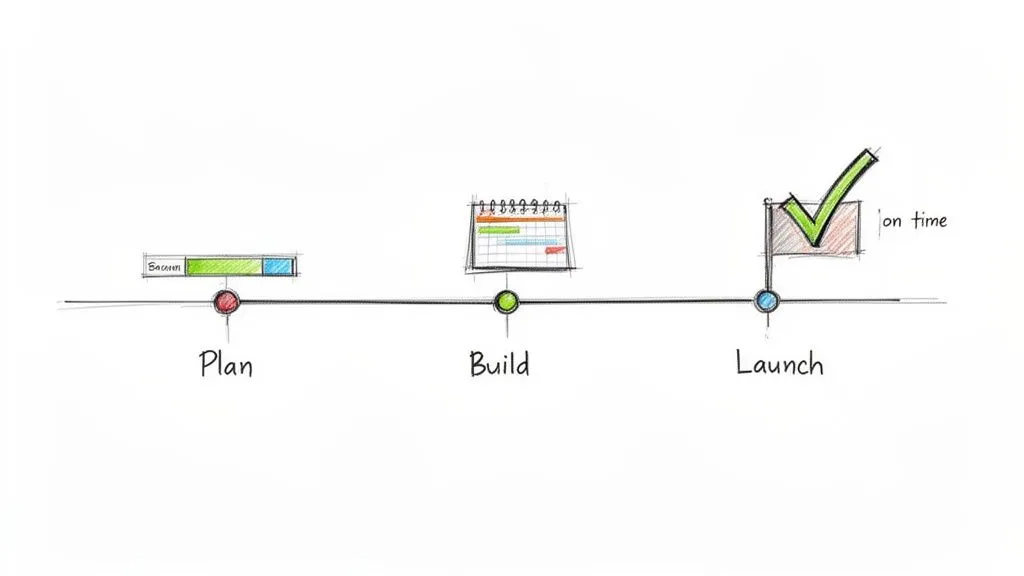
Whether you’re a marketing coordinator launching a campaign or a software developer leading a feature sprint, your ability to manage scope, timelines, and stakeholders is critical. For an ATS, keywords like "Agile," "Scrum," "PMP," and "Jira" are important. For a human reader, however, the outcome of your management is what truly matters.
How to Showcase Project Management & Execution
Go beyond stating you "managed projects." Use a narrative, data-driven approach to prove your impact and demonstrate sophistication in handling complex initiatives.
- Quantify Everything: Use metrics like budget size, team size, timeline, and business impact. Instead of "Managed a project," say "Led a $500K software implementation project, coordinating a 15-person cross-functional team and delivering 2 weeks ahead of schedule."
- Specify Your Role & Methodology: Clearly state your function (e.g., Scrum Master, Project Lead) and the framework you used (e.g., Agile, Waterfall, Kanban). This shows you understand formal processes. For example: "Served as Scrum Master for a development team, improving team velocity by 35% over 6 months by implementing daily stand-ups and retrospective action items."
- Highlight Stakeholder Management: Describe the complexity of the people involved. Mentioning you managed "cross-functional teams," "external vendors," or "executive stakeholders" shows you can navigate complex organizational dynamics.
- Focus on Outcomes, Not Just Process: The goal is the result. Instead of just listing your duties, connect them to a business win. For example, "Managed end-to-end product launch, which achieved 150% of its Q1 revenue target."
Key Insight: Even if you're not an official project manager, you can highlight execution skills. Describe how you managed your own deadlines, coordinated with colleagues on a task, or delivered a personal assignment on time and to specification. This demonstrates the core principles of project management at any level.
9. Adaptability & Learning Agility
Adaptability and learning agility are meta-skills that demonstrate your capacity to thrive in dynamic environments. They show you can quickly acquire new knowledge, adjust strategies based on new information, and stay effective during organizational change. In today's fast-paced industries, employers prize these traits as they predict long-term success and resilience.
Putting adaptability on a resume goes beyond simply stating you are a "quick learner." It's about proving you can pivot effectively and turn new challenges into measurable successes. For both an ATS and a hiring manager, skills like adaptability are validated not by claims, but by the tangible outcomes of your learning and strategic adjustments. This is a crucial skill to put on a resume to show you're a future-proof candidate.
How to Showcase Adaptability & Learning Agility
Avoid generic phrases like "flexible" or "handled change." Instead, use your experience section to tell a story of transformation, showing a clear before-and-after impact.
- Frame It as a Strategic Pivot: Don't just react to change; show you initiated or navigated it with purpose. Instead of "Was flexible," try: "Identified a market disruption and proactively designed a new service offering, building a $340K revenue stream in 9 months despite no prior services experience."
- Detail the Learning Process: Be specific about how you learned. Replace "Learned new skills" with: "Transitioned from marketing to product management by completing online certifications, teaching myself SQL and Figma, and contributing to 3 successful product launches within 18 months."
- Quantify the Outcome of Adaptation: Connect your agility to a business result. For example: "Promoted into an unfamiliar e-commerce vertical; immersed myself in industry research, which led to a seller growth initiative that increased merchant NPS by 22 points and lifetime value by 34%."
- Show Proactive Growth: Mention how you actively seek out learning. Highlight instances where you took courses, sought mentorship, or ran experiments to build new capabilities before they were officially required.
Key Insight: True learning agility isn't just about surviving change; it's about leveraging it as a catalyst for growth. Frame your adaptability as a proactive, strategic skill that drives tangible value, not just a passive ability to cope with new circumstances.
For a deeper look at how to frame your growth journey, consider platforms like StoryCV to map out career moments where you learned something under pressure and applied it successfully.
10. Customer Focus & User-Centric Thinking
Customer focus is the commitment to understanding, serving, and delighting end-users or clients. It’s a strategic mindset that prioritizes customer needs in all business decisions, from product development to service delivery. This skill encompasses user empathy, market research, feedback analysis, and the ability to design solutions around what customers truly want, rather than internal assumptions.
In today's competitive landscape, being customer-centric is a powerful differentiator. Employers value this skill because it directly correlates with higher satisfaction, loyalty, retention, and revenue. Showcasing your customer focus on a resume proves you can create value by aligning business goals with user outcomes, making you a highly desirable candidate.
How to Showcase Customer Focus
Demonstrate how you acted as the voice of the customer and translated their needs into tangible business results. Vague statements are not enough; you must connect your empathy to impact.
- Quantify the Connection: Link customer insights directly to business metrics. Don't just say you "listened to feedback." Explain how that feedback led to a specific improvement, like "Implemented a feedback loop across NPS surveys and user interviews, which identified three key pain points; sponsoring solutions led to an 18-point NPS increase and reduced churn by 12%."
- Detail Your Methods: Add credibility by specifying your research techniques. Instead of "gathered user data," write "Conducted ethnographic research with 40+ users to understand support friction." This shows a professional, structured approach.
- Show Influence and Collaboration: Explain how you used customer evidence to drive internal change. For example, "Pitched a product roadmap pivot to leadership, using customer discovery insights from 8 strategic accounts to justify the new direction."
- Tell a Story in Your Experience: Weave your customer-centric actions into your work history bullet points. Frame your accomplishments around a customer problem you identified and solved, such as "Redesigned help content and created video walkthroughs after discovering 60% of support tickets stemmed from confusing documentation, reducing ticket volume by 22%."
Key Insight: The most powerful way to show customer focus is to prove you don't just advocate for users, but you also translate their needs into measurable improvements in revenue, retention, and satisfaction.
This skill is crucial for roles in product management, UX/UI, marketing, sales, and customer success, but it’s a valuable asset for almost any position that influences the customer experience.
Top 10 Resume Skills Comparison
| Item | Implementation Complexity 🔄 | Resource Requirements ⚡ | Expected Outcomes 📊 | Ideal Use Cases 💡 | Key Advantages ⭐ |
|---|---|---|---|---|---|
| 1. Technical Skills & Proficiency Areas | Medium — structured learning & upkeep 🔄 | Tools, courses, certifications, hands-on time ⚡ | Immediate role readiness; higher ATS match 📊 | Technical hires, short ramp roles, hands-on execution 💡 | Clear, verifiable competence; easy to evaluate ⭐ |
| 2. Achievement-Based Metrics & Quantifiable Results | Medium — requires measurement & context 🔄 | Access to data, analytics skills, documentation ⚡ | Demonstrable business impact (revenue, efficiency) 📊 | Revenue/ops roles, interviews, promotions 💡 | High recruiter credibility; universal language of impact ⭐ |
| 3. Leadership & Management Capabilities | High — people dynamics + systems change 🔄 | Experience, coaching, stakeholder time, team context ⚡ | Improved team performance, retention, strategic outcomes 📊 | Manager roles, succession planning, org change 💡 | Signals promotion readiness and cross-role transferability ⭐ |
| 4. Problem-Solving & Strategic Thinking | Medium–High — diagnostic + trade-off analysis 🔄 | Cross-functional input, analysis tools, time for synthesis ⚡ | Sustainable solutions, strategic alignment, long-term gains 📊 | Transformation projects, ambiguous problems, consulting 💡 | Universal value; shows depth beyond execution ⭐ |
| 5. Communication & Stakeholder Influence | Medium — context-dependent practice 🔄 | Repeated exposure, presentation prep, feedback loops ⚡ | Faster buy-in, clearer alignment, reduced conflict 📊 | Leadership, cross-team initiatives, sales/exec briefings 💡 | Amplifies impact; converts work into decisions ⭐ |
| 6. Cross-Functional Collaboration & Teamwork | High — coordination across silos 🔄 | Meeting cadence, facilitation skills, alignment tools ⚡ | Broader initiatives delivered; faster adoption across org 📊 | Product launches, integrations, matrix organizations 💡 | Multiplier effect on outcomes; expands influence ⭐ |
| 7. Industry Knowledge & Domain Expertise | Medium — deep, evolving learning 🔄 | Years of experience, certifications, market research ⚡ | Faster onboarding, trusted recommendations, fewer mistakes 📊 | Specialized roles, advisory, regulatory environments 💡 | Immediate productivity and domain credibility ⭐ |
| 8. Project Management & Execution Capability | Medium–High — process + stakeholder control 🔄 | PM tools, timelines, budget oversight, governance ⚡ | On-time/on-budget delivery; predictable outcomes 📊 | Large programs, launches, multi-stakeholder projects 💡 | Reliable delivery and risk mitigation; scalable execution ⭐ |
| 9. Adaptability & Learning Agility | Low–Medium — behavioral & situational 🔄 | Self-directed learning, mentors, varied exposure ⚡ | Fast ramp-up, role flexibility, resilience in change 📊 | Startups, pivots, career transitions, evolving tech stacks 💡 | Future-proofs career; reduces training costs ⭐ |
| 10. Customer Focus & User-Centric Thinking | Medium — research + synthesis 🔄 | Customer interviews, analytics, UX/research time ⚡ | Higher retention, better product-market fit, revenue lifts 📊 | Product teams, customer success, UX/research roles 💡 | Direct link to retention and monetization; differentiator ⭐ |
From Skills List to Career Story: Your Next Move
You've navigated the extensive landscape of resume skills, from the hard data of technical proficiencies to the nuanced art of stakeholder influence. By now, it's clear that the question is not just what skills to put on a resume, but how to frame them as compelling evidence of your value. A simple list of capabilities is no longer enough to cut through the noise of a competitive job market. Your resume must transform from a static inventory into a dynamic narrative of your professional journey.
The most effective resumes accomplish this by treating each skill not as a standalone item, but as a building block in your career story. They answer the silent question every hiring manager asks: "Can this person solve our specific problems and help us achieve our goals?" Your ability to quantify achievements, demonstrate strategic thinking, and showcase adaptability becomes the proof.
The Shift from Listing to Proving
The core takeaway from this guide is the essential shift from listing your skills to proving your impact. A recruiter knows what project management is; what they don't know is how you used it to deliver a complex project 15% under budget and two weeks ahead of schedule. They understand the concept of cross-functional collaboration; they need to see how you used it to unite siloed marketing and engineering teams to launch a product that captured a 10% market share.
This narrative approach achieves three critical goals:
1. Contextualizes Your Abilities: It shows you can apply your skills in real-world scenarios to generate tangible business outcomes.
2. Passes the ATS Filter: It naturally incorporates essential keywords (like "project management," "data analysis," "stakeholder communication") in a meaningful context.
3. Engages the Human Reader: It tells a memorable story of success, making you stand out from candidates who simply list generic responsibilities.
Think of your resume as the trailer for your career. It needs to highlight the most exciting, impactful moments that make the audience-in this case, the hiring manager-want to see the full feature.
Your Actionable Blueprint for a High-Impact Resume
As you move forward from this guide, your next steps are not just about editing; they are about strategic storytelling. Embrace this final checklist to ensure your resume is ready to perform.
- Review and Quantify: Go through each bullet point in your experience section. Can you add a number, percentage, or dollar amount to it? Convert vague statements like "Improved team efficiency" into specific, metric-driven achievements like "Drove a 25% increase in team productivity by implementing Agile methodologies and a new project management software."
- Align with the Target Role: Re-read the job description for your target role. Use its language as your guide. If it emphasizes "user-centric design," ensure your skills section and experience descriptions reflect your expertise in customer focus and user empathy. Tailor, tailor, tailor.
- Weave in Your Soft Skills: Instead of a generic "soft skills" section, embed these capabilities directly into your achievement stories. Don't just list "Leadership"; describe how you "Led a team of 5 engineers to develop and launch a new feature that boosted user engagement by 40%." This shows leadership in action.
- Read Aloud for Narrative Flow: Once you've revised your content, read your entire resume aloud. Does it flow like a coherent story of growth and achievement? Or does it sound like a disjointed list of tasks? This simple test is incredibly effective for spotting awkward phrasing and ensuring your career narrative is clear and compelling.
Mastering what skills to put on a resume is your ticket to getting noticed. By strategically selecting, framing, and proving your abilities, you create a document that does more than list your qualifications. You build a powerful case for why you are the ideal candidate to help a company succeed.
Finding the right words to tell your career story can be the hardest part. If you're struggling to translate your experiences into high-impact, quantifiable achievements, StoryCV can help. Its AI-driven interview process uncovers your most compelling accomplishments and transforms them into a resume that truly reflects your value. Visit StoryCV to start building a resume that opens doors.