To get interviews, stop listing duties. Start showing impact.
Forget what you did. Focus on what changed because of what you did. A great bullet point answers the recruiter’s silent question: "So what?"
Why Most Resume Bullet Points Fail
Let's be blunt. Most resume bullet points are just noise. They’re a list of tasks that parrot a job description. They ramble without a point or undersell the work behind them. In both cases, the impact is unclear.
Your resume has about seven seconds to make an impression. Predictable formats get ignored.

This isn't about finding a better template. Templates are for machines. This is about changing how you think about your own value. Your bullet points fail because they fall into two traps.
The "Responsibility List" Trap
This is the most common mistake. It's a laundry list of job duties that reads like you copied it from the original job description.
It looks like this:
* Responsible for managing social media accounts.
* Conducted market research and analysis.
* Assisted with the development of marketing campaigns.
These points are passive and generic. They tell a recruiter what was on your to-do list, not what you accomplished. They create zero curiosity and make you sound like every other applicant.
The "Vague Accomplishment" Problem
Slightly better, but still dead on arrival. This is where you try to show results but offer zero proof.
- Improved user engagement on social platforms.
- Helped increase website traffic through SEO initiatives.
- Contributed to successful product launches.
These sound nice, but they're hollow. How did you improve engagement? By how much? What was your actual contribution? Without evidence, these claims are just empty boasts. Recruiters don't trust what they can't verify.
The hard truth: Recruiters don't read your resume on the first pass. They scan for signals of value—specific companies, skills, and measurable impact. If those signals are buried, they're missed entirely.
Both traps fail because they don't tell a story of cause and effect. They lack the context, action, and clear results that make someone stop and say, "I need to talk to this person."
If your resume is falling flat, it might be time to add another tool. Understanding what a digital portfolio is and how to build one can be a powerful next step. Resumes list accomplishments; portfolios show them.
The Impact-First Bullet Point Framework
Forget rigid formulas like STAR. They bury the most important part—the result—at the end. They force recruiters to read through the whole thing just to figure out what you did.
We're flipping that. It’s time for an impact-first approach.
This isn't just a template; it's a mental model for getting straight to the point. It starts with what changed because of your work, then works backward to capture the actions that made it possible.
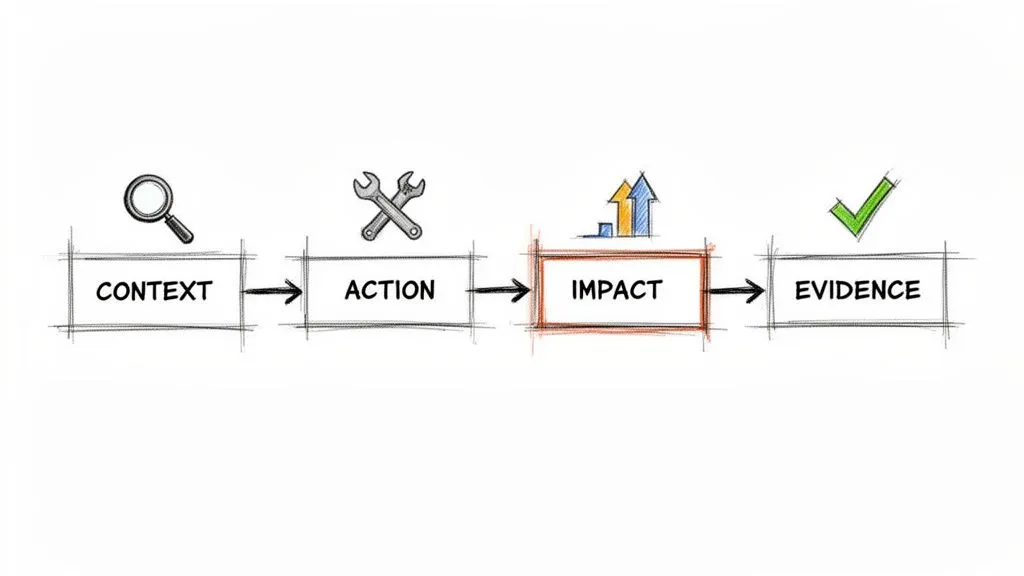
Every strong resume bullet point answers four questions, in this order:
1️⃣ Impact
What changed because of it?
This is the heart. Results, outcomes, improvement, movement. Lead with the outcome. You immediately answer "So what?" and give them a reason to care.
2️⃣ Action
What did you do?
This establishes ownership. Not the team. You. Use a strong verb to describe what you did to create that impact. This proves you were the agent of change.
3️⃣ Context
What was the situation or problem?
This anchors the reader. Without context, impact is meaningless. Briefly describe the challenge. Keep it short and sharp.
4️⃣ Evidence
How do we know it mattered?
Numbers, scope, scale, frequency, or clear signals. Not always metrics. Always proof. This is what makes your claim believable.
The old way forces the recruiter to figure out your value. The Impact-First Framework does that work for them. It presents a self-contained story of competence in a single line.
Let's see how this transforms a standard bullet point. If you want to go deeper, check out our guide on how to write achievements in your resume.
Before and After The Impact-First Framework
| Traditional Bullet (The 'Before') | Impact-First Bullet (The 'After') |
|---|---|
| • Responsible for managing the company's blog and social media channels to increase brand awareness. | • Grew organic site traffic by 45% in Q3 by launching a new SEO-focused content strategy for the company blog, resulting in a 15% increase in marketing-qualified leads. |
See the difference? The first is passive and forgettable. The second is active, specific, and proves your value from the first word. It tells the recruiter not just what you did, but why it mattered.
Putting The Framework Into Practice
Theory is one thing. Action is everything. Let's build bullet points that actually work.
First, you need to find your stories. Most people just list job duties. The gold is hidden in the work that happened between those lines.
Uncovering Your Real Accomplishments
Think of your job description as a starting point, not the finish line. Grab a notebook and ask yourself these questions about any project you’ve touched:
- What was broken or inefficient before I got involved?
- What did I actually build, fix, or improve?
- What was the hardest part, and how did I solve it?
- What did my boss or team praise me for?
- What was the final outcome that made the company better?
Don't filter. Just write. You're searching for moments of change, the clear "before" and "after" you stepped in.
Setting The Context in Ten Words or Less
Context grounds your reader. Without it, your accomplishment floats in a void.
The key is radical brevity. Keep it under ten words. Just set the scene.
Examples of lean context:
* With user churn at a record high...
* Facing a 30% drop in organic traffic...
* During a critical server migration...
This defines the problem you were hired to solve.
Using Sharp Action Verbs
Next: the Action. This is what you did. Kill passive language like "assisted with" or "was responsible for." Own your work.
Choose a verb that’s strong and precise. "Managed" is lazy. Did you "Orchestrate," "Restructure," or "Deploy"? One is vague, the others paint a picture.
- Don't say: Managed a project to update the website.
- Do say: Redesigned the entire user checkout flow.
The second one has teeth. It shows you made a specific, tangible change.
Defining Impact Clearly (Even Without Numbers)
The Impact is the heart of your bullet. It answers, "So what?"
Sometimes, the impact is a clean number. Fantastic. But often, it's not. Don't panic and invent metrics. Impact can be qualitative. Did you improve a process? Unclog a bottleneck? Create a new system?
If you can't measure it in dollars or percentages, measure it in "before" and "after." The goal is to show a clear, positive change. Before, things were slow. After, they were automated.
Qualitative impact is powerful when framed correctly. Be specific about what got better because of you. For a deeper dive, check out our guide on using metrics in your resume, even when you don't have them.
Finding Your Evidence
Finally, Evidence. This is your proof. It makes your claim credible.
- Quantitative Evidence: Hard numbers. Revenue, percentages, time saved. (e.g., "$500K in new ARR," "40% reduction in support tickets").
- Qualitative Evidence: Scope, scale, and significance. (e.g., "across a 10-person global team," "for a Fortune 500 client," "adopted as the new company-wide standard").
Let’s put it all together with a few examples.
Real-World Examples
Product Manager:
- Before: Responsible for the product roadmap and feature prioritization.
- After: Increased user retention by 25% by shipping a revamped onboarding flow that addressed key drop-off points, validated through A/B testing with 10,000 users.
Software Engineer:
- Before: Wrote code for the back-end services and maintained the API.
- After: Cut API response times by 300ms by refactoring a legacy microservice, directly improving the user experience for 1M+ daily active users.
Operations Lead:
- Before: Managed vendor contracts and purchasing processes.
- After: Reduced annual procurement costs by $150K by renegotiating three key vendor contracts and consolidating software licenses across five departments.
See the difference? Each "after" example tells a complete story. It starts with the impact, details your action, provides context, and shows evidence.
Real-World Bullet Point Examples That Work
Enough theory. Generic, copy-paste examples are a waste of time. Here's a lookbook of high-impact bullet points built with the Impact-First framework for professionals like you.
Instead of just showing you a "good" bullet point, we'll break down why it works, so you can apply the same thinking to your own career.
Examples for Tech Roles
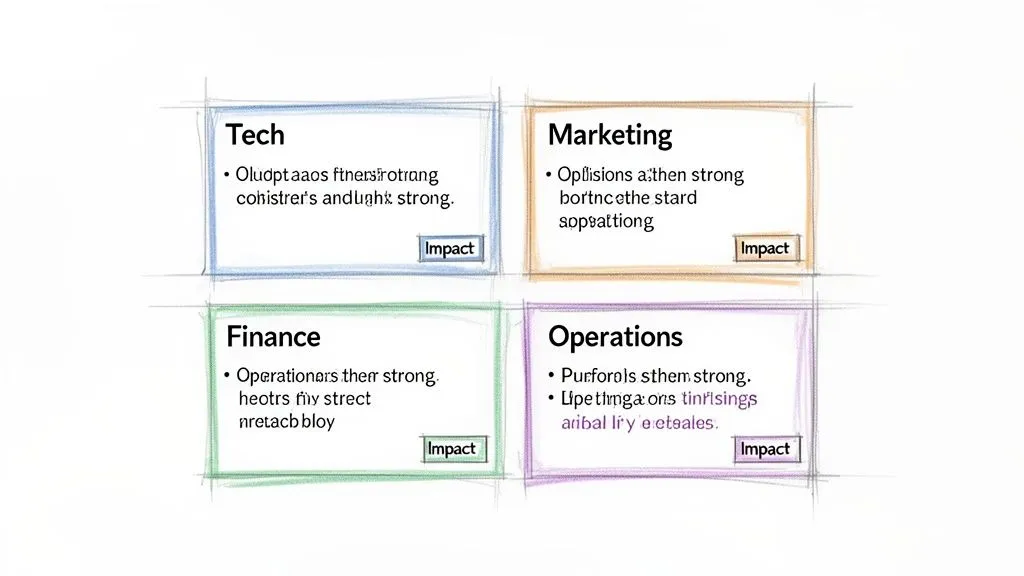
Tech resumes often get bogged down in a list of technologies. Don't fall into that trap. Focus on the business problem you solved with the code.
Senior Software Engineer
* Weak: Wrote back-end services and maintained the API using Go and Kubernetes.
* Impact-First: Reduced API latency by 40% (from 500ms to 300ms) by re-architecting a legacy data-caching service, improving platform stability for a system processing 100,000+ daily requests.
Deconstruction:
* Impact: Reduced API latency by 40%.
* Action: Re-architecting a legacy data-caching service.
* Context: Improving platform stability.
* Evidence: For a system processing 100,000+ daily requests.
IT Project Manager
* Weak: Managed the company-wide migration to a new cloud platform.
* Impact-First: Delivered a zero-downtime cloud migration for 500+ employees 2 weeks ahead of schedule by creating a phased rollout plan and coordinating three cross-functional engineering teams.
Deconstruction:
* Impact: Delivered a zero-downtime cloud migration.
* Action: Creating a phased rollout plan and coordinating teams.
* Context: For a company-wide migration.
* Evidence: For 500+ employees, 2 weeks ahead of schedule.
Examples for Marketing Roles
Marketing is a numbers game. Connect every campaign back to a measurable business outcome.
Digital Marketing Manager
* Weak: Managed social media campaigns to increase brand awareness.
* Impact-First: Generated a 45% increase in qualified leads in six months by launching a targeted content series that captured an untapped enterprise software market.
Deconstruction:
* Impact: Generated a 45% increase in qualified leads.
* Action: Launching a targeted content series.
* Context: To capture an untapped enterprise market.
* Evidence: In six months.
Content Strategist
* Weak: Responsible for blog content and SEO.
* Impact-First: Boosted organic search traffic by 70% over one year by overhauling the blog’s content strategy to focus on high-intent keywords, leading to three articles ranking on page one for competitive terms.
Deconstruction:
* Impact: Boosted organic search traffic by 70%.
* Action: Overhauling the blog’s content strategy.
* Context: To focus on high-intent keywords.
* Evidence: Over one year, ranking on page one for competitive terms.
Examples for Finance and Operations
Your job revolves around efficiency and saving money. Your bullet points should be sharp stories of optimization. Show how you turned chaos into order or waste into savings.
Financial Analyst
* Weak: Performed financial modeling and analysis for quarterly reports.
* Impact-First: Identified $250K in annual cost savings by building a new financial model that revealed redundancies in software licensing across five business units.
Deconstruction:
* Impact: Identified $250K in annual cost savings.
* Action: Building a new financial model.
* Context: To reveal software licensing redundancies.
* Evidence: Across five business units.
Operations Manager
* Weak: Oversaw warehouse logistics and inventory management.
* Impact-First: Cut order fulfillment time by 25% by implementing a new inventory tracking system and retraining the 20-person warehouse team on the updated workflow.
Deconstruction:
* Impact: Cut order fulfillment time by 25%.
* Action: Implementing a new system and retraining the team.
* Context: To improve warehouse logistics.
* Evidence: For a 20-person team.
You’ll notice a pattern: every strong bullet point is a mini-story. It presents a problem, shows your solution, and proves it worked. This is what sticks in a recruiter's mind.
How to Write Bullet Points for Hard-to-Quantify Roles
I get it. Not every role comes with clean metrics. If you’re a designer or a program manager, you can still use this framework.
The trick is to use scope and scale as your evidence. Focus on the breadth or significance of your work. The goal is the same: prove it mattered.
UX Designer
* Weak: Created wireframes and prototypes for new product features.
* Impact-First: Redesigned the core user dashboard used by 50,000+ customers, resulting in a design that was adopted as the new standard across the entire product suite.
* Evidence: The scale (50,000+ customers) and significance (adopted as the new standard) prove the impact without a conversion metric.
Program Manager (Non-Profit)
* Weak: Coordinated community outreach programs.
* Impact-First: Launched the organization's first-ever mentorship program, successfully pairing 100+ at-risk youths with professional mentors from 15 different partner companies.
* Evidence: The scale (100+ youths, 15 companies) demonstrates the scope and success of the initiative.
These aren't templates to copy. They're models to learn from. Use them to deconstruct your achievements and rebuild them as powerful stories of your impact.
Spotting (And Fixing) Common Bullet Point Mistakes
Even with a solid framework, it's easy to fall back into old habits. Think of this as a final quality check before you hit "send."
These are the most common slip-ups that make sharp professionals sound like everyone else. Let's walk through how to spot and fix them.
Ditching Weak and Passive Verbs
The fastest way to water down your accomplishments is with weak verbs. Words like "assisted," "helped," or "was responsible for" are resume poison. They signal you were a bystander, not the driver.
You didn't "assist" with a project; you executed a specific part. You weren't "responsible for" a system; you built or optimized it. Claim your work with confidence.
Your word choice directly reflects your ownership. Strong verbs create a perception of competence. Weak verbs make you sound like you were just along for the ride.
The fix is simple: hunt down every passive verb on your resume and swap it for a strong, specific action verb.
Solving "The We Problem"
Another classic mistake is "The We Problem." You attribute success to the team instead of yourself. Saying "We launched a new feature" sounds collaborative, but on a resume, it’s confusing.
A hiring manager isn't hiring your old team; they're hiring you. They need to know your specific contribution. What part of that launch did you own? If they can't see your individual role, they'll assume it was minor.
The solution is to reframe every "we" statement to focus on what "I" did.
Stop Burying The Lead
The final pitfall is burying the lead. A long, rambling sentence that hides the impressive result at the end. Recruiters scan in seconds—they don’t have time to hunt for the good stuff. If the impact isn't in the first few words, it might as well not be there.
The Impact-First Framework is the perfect antidote. Lead with the result. Grab their attention immediately.
An AI Resume Checker can act as a second set of eyes, spotting weak language before a recruiter does. Proper formatting is also crucial. Our guide on resume bullet point formatting offers more tips on making your achievements pop.
Fixing Common Bullet Point Errors
Here’s a quick before-and-after table to show you how to transform weak bullet points.
| The Mistake | Don't Do This | Do This Instead |
|---|---|---|
| Weak Language | • Assisted with the launch of a new marketing campaign that increased leads. | • Launched a new marketing campaign that increased leads by 25%. |
| Passive Voice | • The company's blog was managed by me, resulting in more traffic. | • Grew organic blog traffic by 40% by publishing weekly, data-driven articles. |
| The "We Problem" | • Our team redesigned the user interface, which improved customer satisfaction. | • Led the UI redesign for the main dashboard, which cut user-reported navigation errors by 50%. |
| Vague Contribution | • Contributed to a project that saved the company money. | • Identified and eliminated three redundant software subscriptions, saving the company $40k annually. |
| Burying the Lead | • Developed and executed a new social media strategy across three platforms by creating a content calendar and engaging with followers, which ultimately grew our audience by 15,000. | • Grew the social media audience by 15,000 by executing a new content strategy across three platforms. |
By dodging these traps, you ensure every bullet point on your resume is sharp, compelling, and ready to make an impact.
Answering Your Top Resume Bullet Questions
You’ve got the framework. You've seen what good looks like. Now, let’s tackle the nagging questions. No theory, just straight answers.
How Many Bullet Points Should I Use Per Job?
Prioritize impact over volume.
Aim for three to five powerful bullet points for your most recent and relevant roles. For older jobs, one or two is enough.
The point isn't to list everything you did. It's to showcase your biggest wins. Ten mediocre bullets dilute the power of your two best ones. Less is more, if it's focused.
What If I Don't Have Any Numbers or Metrics?
This is a common roadblock, but rarely a dealbreaker. If you can't pin down a percentage, focus on scope and scale.
Think about it this way:
- Scope: "Launched a new onboarding program that was adopted company-wide."
- Scale: "Managed a project that required coordinating across three international teams."
- Significance: "Created the first-ever design system for the product organization."
These statements anchor your work in reality. They prove what you did mattered, without a single metric. You're showing you handled significant responsibility.
Metrics are great, but a clear "before and after" story is just as powerful. Show a transformation. Before you, there was chaos. After you, there was a system. That’s impact.
How Do I Tailor Bullet Points for a Specific Job?
Stop sending the same generic resume everywhere. It's lazy. It doesn't work.
Read the job description. Hunt for the top three to five requirements. Now, go back to your resume. Re-order and re-word your bullet points to speak directly to those needs. If the job screams "lead generation," make sure your bullet about growing the sales pipeline is at the top.
Tailoring isn’t making things up; it’s strategically emphasizing the most relevant parts of your experience for that specific role.
Are Bullet Points Better Than a Paragraph?
Yes. Always. End of story.
A paragraph is a wall of text. Recruiters don't have time for it. They’ll just skip it.
Bullet points are designed for short attention spans. They're scannable, direct, and let you deliver concise, high-impact stories. This format works for human eyes and for Applicant Tracking Systems (ATS). Don’t ever choose dense prose over punchy clarity.
Tired of wrestling with bullet points? StoryCV is a Digital Resume Writer that uses a smart interview to pull your real impact out of you. No templates, no generic fluff—just your career story, told with clarity and confidence. Get your professional resume draft in minutes.