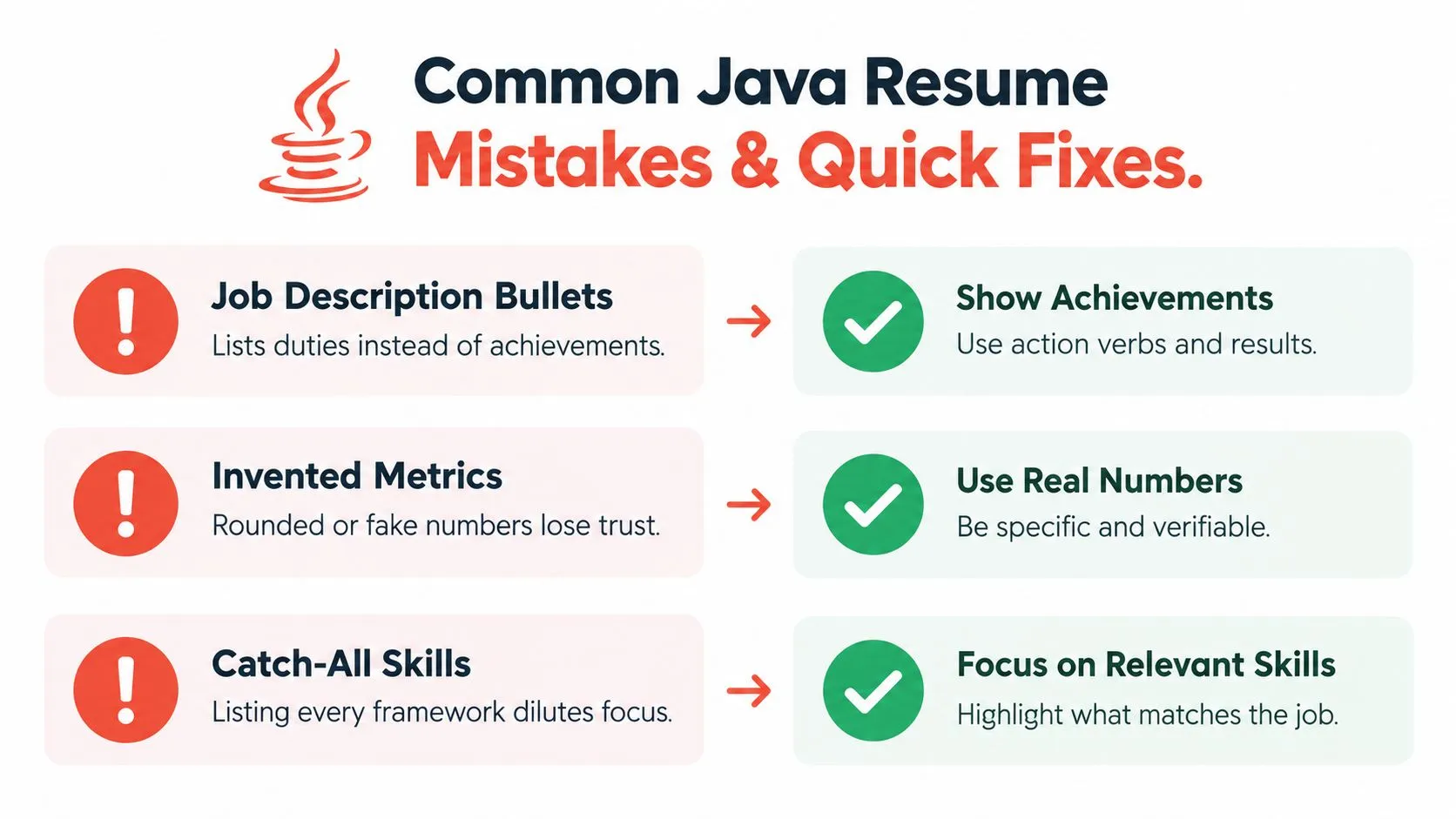

Your resume isn't a history book. It's a sales pitch. But most resumes are just boring lists of tasks. "Managed social media," "Responsible for projects," "Handled customer inquiries."
This tells a recruiter what you were assigned, not what you accomplished.
Metrics are the proof. They turn vague statements like "improved efficiency" into concrete achievements like "cut project completion time by 15%." They show your value, fast. This is how you get hired.
Your Resume Sells You, So Stop Describing Your Job

Recruiters spend seconds on your resume. They don't have time to guess your impact. You have to spell it out for them.
The difference is simple:
* A task: "Managed the company blog."
* A result: "Grew organic blog traffic by 400% in 6 months."
One is a fact. The other is proof of skill. You need to stop describing your job and start selling your results.
What is a metric in a resume?
A metric is a number that proves your work mattered. It’s a quantifiable metric in a resume that shows you delivered results. It’s the "so what?" behind every task you performed.
Think about it:
* Instead of "Improved team efficiency," say "Reduced project completion time by 15%."
* Instead of "Handled customer inquiries," say "Maintained a 95% customer satisfaction score across 50+ daily interactions."
These numbers cut through the fluff. They are objective and powerful. Both recruiters and the best talent acquisition software platforms are built to find these figures. They signal competence.
Numbers are the universal language of business. A good metric is worth a hundred adjectives.
Shift Your Mindset: From Tasks to Results
You have to stop listing what you did and start showcasing what you achieved. Every role has data. You just need to know where to find it.
Ask yourself these simple questions about every project:
* How much?
* How many?
* How often?
* By what percentage?
Answering these is the first step. This is how you turn a boring list of duties into a compelling story of your impact.
What are quantifiable metrics in a resume?
Numbers are cold, hard proof. They show you didn't just fill a seat—you made things better. Quantifiable metrics in your resume are the specific data points that prove your impact.
Your resume is one of hundreds. It has to get past software (ATS) and a tired human. Metrics are powerful signals for both. They make your accomplishments tangible and memorable.
For any professional with a few years of experience, this isn't a "nice-to-have." It's non-negotiable. Metrics are how you justify a bigger salary. They prove you think in terms of business impact, not just a task list.
The Power of Before and After
Let's make this real. Vague statements are resume killers. But a single number can transform a weak bullet point into a story of your competence.
Before and After Using Metrics in Your Resume
See how a vague responsibility becomes a powerful, metric-driven accomplishment.
| Vague Responsibility | Metric-Driven Accomplishment |
|---|---|
| Managed the company blog. | Grew organic blog traffic from 5K to 25K monthly visitors in 6 months. |
| Responsible for customer support. | Resolved ~30 support tickets daily, maintaining a 98% customer satisfaction rating. |
| Worked on improving app performance. | Shipped 3 key features that reduced app load time by 400ms, cutting user drop-off by 12%. |
| Handled vendor negotiations. | Re-negotiated contracts with 10 key vendors, resulting in $85K in annual cost savings. |
The difference is stark. The "before" column describes a job. The "after" column proves you were great at it. The "after" column sells the result of what you did.
Recruiters spend an average of 7 seconds on a resume. Metrics grab their attention instantly.
Numbers give your work context and scale. "Managed a team" is forgettable. But "Led a team of 8 engineers to deliver a project 2 weeks ahead of schedule" tells a story of leadership. This is how you stop describing your past and start selling your future.
How to include metrics in a resume (even if you think you don't have numbers)
"I'm not in sales. I don't have numbers." This is a myth. Every job creates data. You just need to know how to find it.
You don't need a fancy analytics dashboard. You just have to learn to look at your work through a new lens.
Digging for Hidden Data
Forget your official job description. Think about what actually happened. These questions will help you find the metrics in your resume that are hiding in plain sight.
- How many? How many people did you train? How many support tickets did you close each week? How many articles did you publish?
- How often? Did you run a daily standup? A weekly report? A monthly newsletter? Frequency gives a sense of scale.
- How much? Did you manage a budget? Did you reduce expenses? Did you contribute to a project that brought in revenue?
- How fast? Did you complete projects ahead of schedule? Did you make a task quicker for everyone?
This framework turns vague duties into concrete achievements. "Trained new hires" becomes "Onboarded 12 new team members over 6 months." Same activity, different impact.
Creating Defensible Estimates
What if you don't know the exact number? It's fine to estimate, as long as it's logical and defensible. An honest approximation is better than an empty statement.
The rule is simple: Never invent, but always estimate. A wild guess gets you caught in an interview. A thoughtful estimate shows you understand business impact.
Here’s how to do it right:
1. Start with a baseline. The old reporting process took 3 hours a week.
2. State your action. I built a simple automation script.
3. Calculate the result. The new process takes 30 minutes. That's a savings of 2.5 hours per week, or ~10 hours per month.
Now you have a solid metric: "Automated a weekly reporting task, saving the team an estimated 10 hours of manual work per month." You can walk an interviewer through that logic with confidence.
This is critical, especially if you're trying to figure out how to apply for a job without experience. Those achievements are your proof.
Metrics in resume examples for any profession
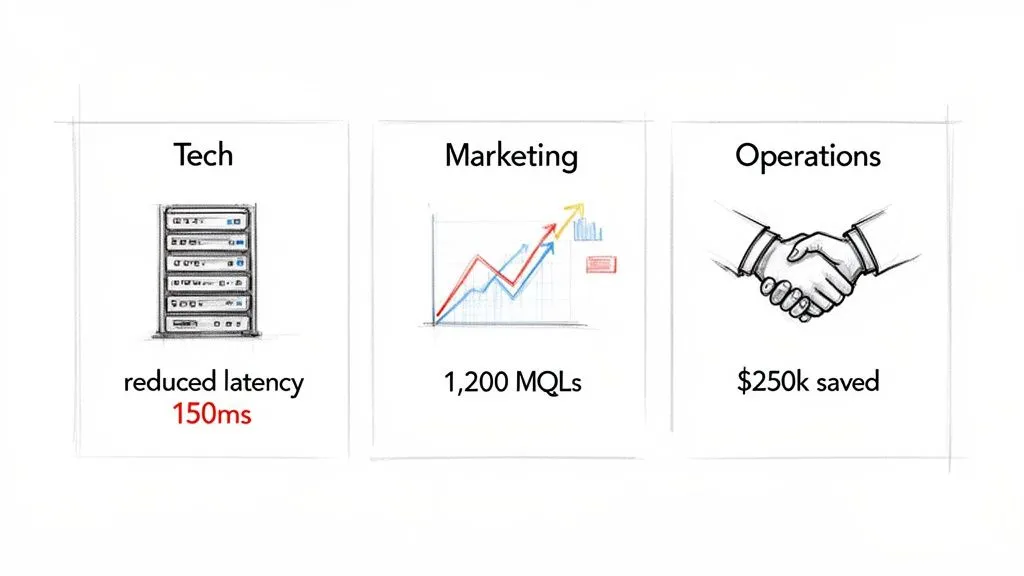
Talking about numbers is one thing. Seeing it done is another. These metrics in resume examples follow a simple formula: Action Verb + What You Did + Measurable Result.
Steal these ideas.
For Tech and Engineering Roles
Tech is swimming in data. Connect your code to a business outcome.
- Software Engineer: Refactored the payment service, reducing API latency by 150ms and cutting server costs by 12%.
- Data Scientist: Built a predictive model that identified at-risk customers with 85% accuracy, leading to a 10% reduction in churn.
- DevOps Engineer: Implemented a new CI/CD pipeline, decreasing deployment time from 45 minutes to under 5 minutes.
For Marketing and Sales Roles
Show efficiency, not just raw output.
- Digital Marketer: Managed a $50K quarterly ad budget, generating 1,200 MQLs at a 20% lower cost-per-lead than the previous year.
- Content Manager: Grew organic traffic by 300% (from 10k to 40k monthly visitors) and generated $200K in attributable pipeline.
- Sales Executive: Exceeded quota for 6 consecutive quarters, closing $1.2M in new ARR.
For Operations and HR Roles
Your metrics are about efficiency, cost savings, and process improvements.
- Operations Manager: Re-negotiated 15 vendor contracts, achieving $250K in annual cost savings.
- Project Manager: Led a team of 12 to deliver a critical software migration 3 weeks ahead of schedule and 10% under budget.
- HR Generalist: Redesigned the onboarding program, decreasing new hire ramp-up time by 30% and improving 90-day retention by 15%.
How to Add Impact to Resume Bullet Points (Even Without Metrics)
What if you genuinely can't find a number? That's fine. The goal is to show impact. Numbers are just one way to do it. When a metric isn't available, use context to show scope and strategic value.
Don't just state what you did. Frame it to show why it mattered.
Use Context to Show Significance
When you can't find a number, context is your best friend. Were you the "first" person to do something? The "only" one chosen for a task?
- Instead of: "Helped with an M&A project."
-
Try: "Selected as the sole junior analyst to support the CFO on a confidential M&A project."
-
Instead of: "Created a new workflow."
- Try: "Pioneered the first-ever content review workflow for the marketing team, establishing a new standard for brand consistency."
No numbers, but they scream impact. They show you were trusted with high-stakes work or took the initiative to build something from scratch. Exploring software engineer resume examples and templates can give you more ideas on framing achievements.
Highlight Qualitative Results
Your impact can also shine through in qualitative results. This means describing the outcome in a way that highlights its strategic importance or the recognition it earned. Think about awards or times your work became the standard.
Example: "Developed a new training manual for the customer success team that was later adopted as the official onboarding document for all 5 global offices."
This proves your work wasn't just good—it became the standard.
Example: "Received a company-wide 'Spotlight Award' from the CTO for successfully debugging a critical production issue during a peak traffic event."
These qualitative statements prove your value just as effectively as a hard metric. They turn your resume from a list of duties into a story of influence.
Tired of staring at a blank page, trying to turn your accomplishments into numbers? StoryCV is a Digital Resume Writer. We interview you, uncover your real impact, and turn your experience into a powerful narrative that gets results. Ditch the templates. Start telling your story. Get started for free at StoryCV.