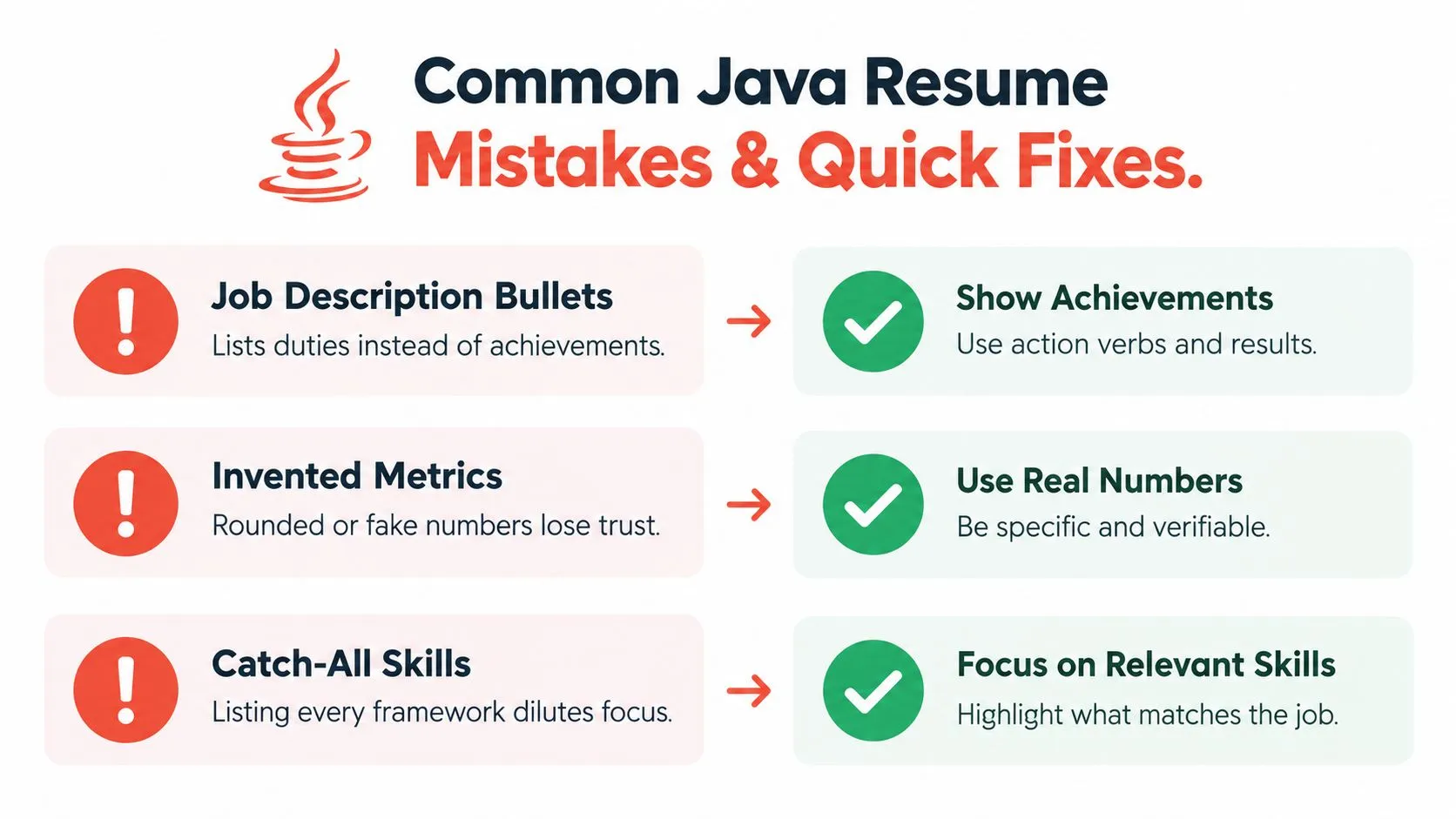

Your resume feels flat. It lists duties, not impact. It says what you did, not what happened because you did it.
This is why most teacher resumes get ignored. They read like job descriptions: "planned lessons," "graded assignments," "managed classroom behavior." This tells principals nothing. It’s like a chef listing "chopped vegetables" as a skill.
You need to show results. Prove the student growth you fostered. Talk about the problems you solved.
This guide gives you high-impact teacher resume bullet points. I'll show you how to turn responsibilities into measurable achievements. There are examples for every career stage, from student teacher resume bullet points to powerful resume bullet points for a substitute teacher.
Let's stop documenting tasks and start demonstrating worth. Get the bullet points right, and you'll be preparing for teacher interview questions sooner than you think. Let's fix your resume.
1. Quantify Student Learning Outcomes
Principals want proof of your effectiveness. Numbers provide that proof.
This shifts your resume from "I taught algebra" to "I improved student algebra scores by 18%." It’s showing, not just telling.

Grounding your work in numbers creates powerful bullet points for your teacher resume. This is critical for student teacher resume bullet points or even for a substitute teacher resume, where showing impact fast is key.
Examples of Measurable Impact
- Standardized Tests: Increased average student test scores by 18% in algebra through differentiated instruction and peer tutoring strategies.
- Proficiency Rates: Guided 92% of students to pass state proficiency exams, an improvement from a 71% baseline in the prior year.
- Targeted Intervention: Improved reading comprehension scores for 34 English language learners by an average of 2.5 grade levels within one academic year.
How to Do It
This gives concrete evidence of student growth. A number is credible and easy for a hiring committee to grasp. It answers their main question: "Can this person get results?"
Pro Tip: Numbers tell a story. Pair your metric with the action you took. (e.g., "differentiated instruction," "project-based learning").
Dig into your data. Look at pre- and post-assessments or state test scores. If you need a deeper dive, our guide on using metrics in your resume can help.
2. Show Curriculum Design and Adoption
Creating a curriculum that others adopt shows leadership potential. It positions you as a creator, not just a classroom teacher. You solve problems at a bigger scale.
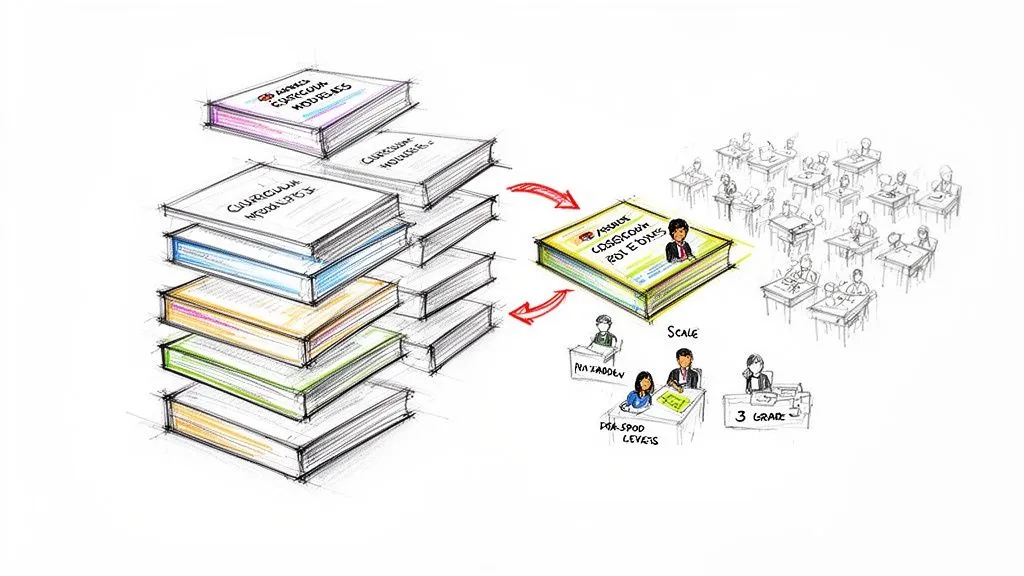
Highlighting curriculum design turns your resume into a portfolio of high-impact projects. These are excellent bullet points for a teacher resume aiming for leadership roles.
Examples of Demonstrated Adoption
- Curriculum Scaling: Designed and implemented a competency-based algebra curriculum adopted by 8 teachers across 3 grade levels, improving scaffolding consistency.
- Program Integration: Created project-based learning units in environmental science that were integrated into the 5th-grade core program, serving 120+ students annually.
- School-Wide Framework: Developed a social-emotional learning (SEL) framework implemented school-wide, training 25+ faculty members and reaching 450 students.
How to Do It
This proves you can identify a need, create a solution, and get buy-in from colleagues. Principals look for this initiative. It answers the question: "Can this candidate improve our entire system?"
Pro Tip: "Demonstrated adoption" is key. Anyone can create a lesson plan. Not everyone can create a curriculum other teachers willingly use. The adoption is the proof.
Think about materials you’ve created. Quantify the adoption: how many teachers, students, or grade levels used your work? Describe the problem you solved.
3. Evidence of Inclusive and Differentiated Instruction
Modern classrooms are diverse. Principals need educators who can teach all students. Showcasing your ability to support diverse learners isn't a bonus, it’s a core competency.
This proves your adaptability and commitment to equity. Instead of saying you "believe in inclusion," provide proof of how you create an environment where every student succeeds.
Examples of Inclusive Practices
- Differentiated Instruction: Differentiated lesson plans for 8 students with IEPs and 6 ELL students, resulting in 75% of the group meeting grade-level standards, up from a 40% baseline.
- Universal Design: Implemented Universal Design for Learning (UDL) principles, reducing the need for pullout services by 30% while increasing engagement for all learners.
- Peer Support Systems: Established peer tutoring partnerships between advanced and struggling readers, with 85% of lower-performing readers showing measurable growth in one semester.
How to Do It
These bullet points highlight critical soft skills like empathy and adaptability, backed by hard data. They show you can manage a complex classroom and are dedicated to closing achievement gaps.
Pro Tip: Connect your specific strategies (UDL, peer tutoring) directly to the positive outcomes they created for specific student populations.
Document the strategies you used for students with IEPs, 504s, or English language learners. Specify who benefited and by how much. This is crucial for showing the full scope of your abilities, bridging the gap between soft skills vs. hard skills on your resume.
4. Led Professional Development or Coached Peers
Elevating the entire school community shows leadership. Showcasing experience in leading professional development or coaching peers positions you as a catalyst for improvement.
When you lead training, you prove you have mastery worth sharing. These teacher resume bullet points show you can scale your impact beyond a single classroom.
Examples of Measurable Impact
- Professional Learning Community (PLC): Facilitated a PLC for 12 teachers on literacy instruction, implementing data-driven practices that increased reading proficiency by 12% across the grade level.
- District-Wide Workshops: Led 3 district-wide workshops on formative assessment for 60+ teachers, with 80% of participants implementing at least one new strategy.
- Instructional Coaching: Coached 5 novice teachers in reading and math, resulting in positive evaluations and a 15% average increase in student assessment performance in their classes.
How to Do It
This approach proves you can diagnose instructional needs, design effective training, and influence adults—all critical leadership skills. It shows you think systematically.
Pro Tip: Connect your training initiative directly to a school or district goal. Frame your work as a direct contribution to that objective.
Gather data on your initiatives. Track the number of teachers you trained, survey participants, and measure pre- and post-training student data from their classrooms.
5. Show Innovative Technology Integration
Principals need to see you can use tech for more than digital worksheets. Effective tech integration improves student learning and engagement.
This shifts your resume from listing tools ("Used Google Classroom") to demonstrating strategy ("Used Google Classroom to increase peer feedback and mastery").

Highlighting your ed-tech skills shows you are a forward-thinking educator. These bullet points for a teacher resume are powerful because they connect a specific tool to a specific student outcome.
Examples of Measurable Impact
- Blended Learning: Designed blended learning units using Khan Academy and Desmos, improving engagement scores by 35% and enabling differentiated pacing for 12 students.
- Workflow Efficiency: Integrated Google Classroom and formative assessment tools to provide real-time feedback, reducing administrative task time by 10 hours/week.
- Collaborative Learning: Implemented a 1:1 device program in 7th-grade ELA, resulting in a 25% increase in peer feedback participation and improved revision quality.
How to Do It
This demonstrates you're a strategic educator, not just an app consumer. It proves you can select the right technology to solve specific classroom challenges.
Pro Tip: Focus on the "why" behind the technology. The tool is the vehicle, but the student outcome is the destination. Explain how the tech facilitated better learning.
Start with a pedagogical goal (e.g., increase collaboration). Then, identify the technology you used and the measurable result.
6. Highlight Cross-Curricular Collaboration
Schools are not silos. Principals want educators who can break down walls between subjects. Highlighting your ability to coordinate cross-curricular projects shows you are a collaborator and team player.
This approach demonstrates that you can see the bigger educational picture. It shifts your resume from "I taught my subject" to "I worked with a team to build a rich learning experience."
Examples of Collaborative Impact
- Interdisciplinary Projects: Coordinated a project on climate change with science, social studies, and ELA teachers, engaging 120 students in research showcased at a school community event.
- Arts Integration: Partnered with art and music teachers to design an integrated unit on cultural expression, resulting in a school-wide exhibition and a 40% increase in parent attendance at arts events.
- Vertical Alignment: Led a cross-grade level collaboration (grades 3-5) to design a vertical literacy curriculum, ensuring a consistent approach and reducing reteaching time.
How to Do It
These bullet points prove you can manage complex projects and facilitate teamwork. They answer a key question for administrators: "Can this candidate work effectively with our existing staff?"
Pro Tip: Clearly define your role. Use action verbs like "Coordinated," "Partnered," or "Led" to show your involvement. Quantify the scope with the number of teachers and students involved.
Think about any project that involved another department. Document the planning process, the number of participants, and the outcome.
7. Detail Family Engagement Strategies
Effective teaching extends beyond the classroom. Principals look for educators who can build strong partnerships with families, as this correlates with student success.
This approach moves beyond "communicated with parents." It highlights the specific strategies you designed to build trust and create a supportive network for every student.
Examples of Measurable Impact
- Targeted Outreach: Developed a multilingual classroom newsletter, increasing parent engagement from 35% to 72% among non-native English-speaking families.
- Event-Based Engagement: Implemented monthly "Family Math Nights," resulting in a 20% improvement in assignment completion rates among participants' children.
- Student-Led Initiatives: Created student-led portfolio conferences, achieving a 95% attendance rate compared to 60% for traditional parent-teacher conferences.
How to Do It
These bullet points for a teacher resume showcase your proactive approach to building community. They provide evidence that you can engage diverse stakeholders.
Pro Tip: Connect your family engagement efforts directly to a student outcome. Show that your communication strategy was a tool to drive academic improvement.
Think about how you reached the hardest-to-reach families. What systems did you create? Document metrics like attendance at events or response rates to communications.
8. Describe Assessment Design and Data-Driven Instruction
Effective teaching isn't just delivering lessons; it's measuring what students learn and using that data to improve. Demonstrating this ability shows you are a reflective and strategic educator.
This approach proves you can diagnose student needs and respond with targeted teaching strategies. It makes for powerful teacher resume bullet points.
Examples of Measurable Impact
- Formative Assessment: Designed a formative assessment system using exit tickets, analyzing data weekly to adjust instruction, resulting in an 18% improvement in unit mastery.
- Rubric Development: Developed standards-aligned rubrics for writing tasks, enabling data analysis that showed a 22% improvement in argumentation skills across 85 students.
- Achievement Gap Analysis: Analyzed 3 years of test data, identified a 4-point achievement gap, and piloted an intervention that reduced the gap to 1.5 points in one year.
How to Do It
This highlights your analytical skills. Principals want teachers who can answer "what's next?" after an assessment. Showing how you used data to change your teaching proves you can close learning gaps.
Pro Tip: Connect your analysis directly to an action and then to a result. Show the cause-and-effect: "I saw this, so I did that, which led to this outcome."
Think about the full cycle of assessment. How did you design a test? What tools did you use? Most importantly, what instructional changes did you make based on your findings?
9. Explain Your Classroom Culture Development
A chaotic classroom undermines learning. Showcasing your ability to build a positive, safe, and productive classroom culture is non-negotiable.
Strong classroom management isn't about rigid discipline; it's about building community and respect. Effective teacher resume bullet points show you’re a skilled community builder.
Examples of Measurable Impact
- Restorative Practices: Implemented restorative justice practices, reducing office referrals by 45% and increasing student-reported sense of belonging from 62% to 88% in one year.
- Co-created Agreements: Established classroom community agreements with students, resulting in a 15% improvement in on-task behavior and a 20% reduction in conflict.
- Relationship Building: Developed positive relationship-building practices, earning identification as a trusted adult from 92% of students on a school climate survey.
How to Do It
These bullet points connect your management philosophy to tangible outcomes. A 45% reduction in referrals saves administrative time. These examples demonstrate your proficiency with effective classroom management best practices.
Pro Tip: Combine behavioral metrics (office referrals) with well-being indicators (sense of belonging). This paints a complete picture of a classroom that is both orderly and supportive.
Think about the "before and after" in your classroom. What was the challenge? What system did you introduce? What was the result?
10. Document Your Professional Growth
Schools want educators committed to their own learning. Highlighting your professional growth shows you are a proactive professional dedicated to improving your craft.
This tells a hiring manager you possess a growth mindset. You don't just teach; you actively seek out best practices and reflect on your performance.
Examples of Measurable Impact
- Advanced Degree: Earned a Master's in Curriculum and Instruction, developing a capstone project on project-based learning that was adopted district-wide, serving over 150 students.
- Specialized Certification: Completed certification in Orton-Gillingham dyslexia intervention and applied it with 6 students, who showed an average reading improvement of 1.2 grade levels in 6 months.
- Action Research: Participated in a 2-year action research study on formative assessment, presented findings at a state conference, and implemented resulting practices, improving student engagement by 25%.
How to Do It
This approach shows you invest in yourself for the benefit of your students. It’s not just about earning a credential; it’s about applying that new knowledge.
Pro Tip: Connect the learning to the outcome. Don't just list a degree. Explain how you used it and what the result was for your students.
List your degrees, certifications, and workshops. For each one, ask: "How did I apply this? What was the impact on student learning?"
10-Point Comparison: Teacher Resume Bullet Points
| Title | Implementation Complexity 🔄 | Resource Requirements ⚡ | Expected Outcomes 📊 | Ideal Use Cases 💡 | Key Advantages ⭐ |
|---|---|---|---|---|---|
| Quantified Student Learning Outcomes with Measurable Impact | 🔄 Moderate — requires systematic data collection and baseline comparisons | ⚡ Medium — assessment access and time for analysis | 📊 High — clear, verifiable student gains | 💡 Mid-level teachers seeking admin roles, career changers, competitive schools | ⭐ Demonstrates ROI, ATS-friendly, strong evidence-based credibility |
| Curriculum Design and Implementation with Demonstrated Adoption | 🔄 High — design, piloting, and stakeholder buy‑in required | ⚡ High — time, collaboration, and documentation | 📊 High — scalable adoption and district/school impact | 💡 Curriculum specialists, instructional coaches, ed‑tech/content roles | ⭐ Shows leadership, scalability, and creative problem‑solving |
| Inclusive Classroom Practices and Differentiated Instruction Evidence | 🔄 Moderate — targeted strategies and coordination with specialists | ⚡ Medium — specialized resources and collaboration | 📊 High — reduced gaps and equity-focused outcomes | 💡 Diverse/urban districts, equity organizations, special ed/ESL roles | ⭐ Demonstrates adaptability, cultural competence, equity orientation |
| Professional Development Led or Instructional Coaching Facilitated | 🔄 Moderate — PD design, facilitation, follow‑up and validation | ⚡ Medium — facilitation time and participant tracking | 📊 Medium–High — leadership signal, indirect student improvements | 💡 Administrative roles, corporate training, instructional coaching | ⭐ Shows facilitation, leadership, and peer influence |
| Innovative Technology Integration with Documented Student Engagement | 🔄 Moderate — tech setup plus pedagogical alignment needed | ⚡ Variable — from low to high depending on tools and access | 📊 Medium — increased engagement and workflow efficiency | 💡 Ed‑tech, instructional design, tech‑forward schools | ⭐ Demonstrates innovation and balanced pedagogy |
| Cross‑Curricular Collaboration and Project‑Based Learning Coordination | 🔄 High — coordination across departments and planning cycles | ⚡ High — significant planning time and stakeholder coordination | 📊 High — integrated learning experiences and higher engagement | 💡 Interdisciplinary initiatives, project management, admin roles | ⭐ Shows systems thinking, collaboration, and facilitation |
| Family Engagement and Communication Strategy Implementation | 🔄 Low–Moderate — outreach planning and sustained communication | ⚡ Medium — multilingual materials, events, and channels | 📊 Medium — higher family participation and linked student benefits | 💡 Family liaison, community engagement, client‑relations roles | ⭐ Demonstrates stakeholder management and trust‑building |
| Assessment Design and Data‑Driven Instruction | 🔄 High — assessment creation and regular data analysis | ⚡ Medium–High — analytics tools and dedicated analysis time | 📊 High — actionable insights and measurable student growth | 💡 Assessment analytics, instructional coaching, accountability roles | ⭐ Shows analytical rigor and evidence‑based practice |
| Behavior Management and Classroom Culture Development | 🔄 Moderate — consistent systems and relationship work | ⚡ Medium — training, monitoring, and feedback mechanisms | 📊 Medium–High — improved climate, fewer incidents, better well‑being | 💡 High‑need schools, organizational development, HR | ⭐ Demonstrates emotional intelligence and culture‑building |
| Reflection and Continuous Professional Growth Documentation | 🔄 Low–Moderate — credentials plus reflective practice documentation | ⚡ Medium — time and possible cost for PD/certifications | 📊 Medium — signals growth mindset and validated expertise | 💡 Career advancement, specialist certification, thought leadership | ⭐ Shows learning agility, up‑to‑date practice, and professional credibility |
Your Resume is an Argument, Not a List.
Stop logging job duties. Start making a persuasive argument for why you are the right choice.
Shift your mindset from "what I did" to "the impact I created."
Transform "Taught 9th-grade English" into "Elevated reading comprehension scores by 15% for 120 9th-grade students by implementing a project-based learning curriculum." That single sentence tells a story of capability and effectiveness.
From Duty to Impact
A well-crafted bullet point builds a case. It connects your actions to positive outcomes, giving principals the concrete evidence they need.
- Quantify Everything: Numbers cut through the noise.
- Lead with Strong Verbs: "Developed," "spearheaded," "redesigned," and "mentored" show ownership.
- Answer "So What?": Explain why your achievement matters.
Your Next Step
Open your resume. Pick three bullet points. Apply the "Problem-Action-Result" framework to each one.
- Problem: What was the challenge?
- Action: What specific thing did you do?
- Result: What was the measurable outcome?
This works for everyone. Whether you're writing student teacher resume bullet points to show potential or refining substitute teacher resume bullet points to prove your immediate value. The goal is to create bullet points for a teacher resume that are impossible to ignore.
Your resume is the first demonstration of your ability to communicate effectively. The precision in your teacher resume bullet points reflects the dedication you bring to the classroom. You're not listing tasks; you are articulating your value.
Struggling to articulate your impact? That’s what we solve. StoryCV is a digital resume writer, not a template library. We help you talk about your work, and we handle the writing. Stop staring at a blank page. Build your strongest teacher resume at StoryCV.