Applying for a job without direct experience isn't about just sending in a resume. It’s about proving your potential through projects, academics, or volunteer work.
The whole game is shifting your focus from what you haven't done to what you have accomplished. You have to translate those achievements into the skills a hiring manager desperately needs. This means your application needs to tell a story of your capability, not just your history.
The Real Problem with No-Experience Job Applications
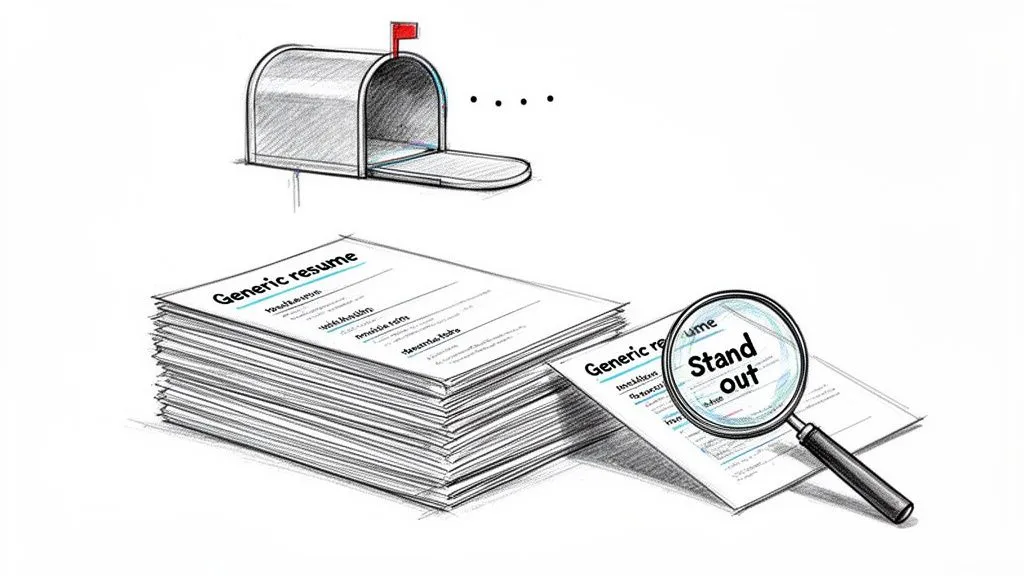
You’re trapped in the classic loop. You need experience to get a job, but you need a job to get experience. So, you fire off resumes into the void and hear nothing back. The silence is deafening.
The problem isn’t your lack of potential. It’s that your application looks and sounds exactly like everyone else’s. It lists some classes, a GPA, maybe a part-time gig scooping ice cream. It's generic, and generic gets ignored.
When you have no formal experience, your resume can't be a simple list of past duties. That's a losing strategy. It has to become a marketing document—a compelling argument for why you are a smart hire, despite your unconventional background.
Why Your Current Approach Fails
Hiring managers spend seconds on each resume, not minutes. They aren't looking for someone who checks every single box on a wish list; they're looking for proof of competence and drive. A resume that just says "hard worker" or "quick learner" offers zero proof. It’s just noise in a very crowded room.
Entry-level job openings received an average of 36 applicants per opening last May. That's a 22% jump from the 29 applicants the year before. For anyone without traditional experience, this means a basic resume is guaranteed to fail.
You don't get hired for what you've done. You get hired for what you can do for them. Your application is the first and only chance to prove it.
The solution is to stop thinking like an applicant and start thinking like a problem-solver. Every project, every volunteer role, and even every tough academic assignment is a story of you solving a problem. That’s your experience. Your job is to translate it. On top of this, understanding the bigger picture, like how many jobs AI will replace, can help you aim for roles with a future.
Shifting from Tasks to Accomplishments
Forget the old rules that say your resume must be a chronological list of jobs. That framework doesn't work for you. It's time to build a new one based on evidence.
Here's the mental shift you need to make:
- From "I was responsible for..." to "I achieved X by doing Y." Responsibility is passive. Achievement is active and proves your impact.
- From listing courses to showcasing projects. A course name is meaningless. A project that shows you applying knowledge is concrete proof of your skills.
- From using generic templates to telling a targeted story. Your application has to speak directly to the company's needs, using their language.
So, how do you reframe your non-work experience into something that screams "hire me"? It's all about finding the professional skill hidden inside the everyday task.
From Generic Task to Compelling Proof
This table shows you how to connect what you did with the value a company is looking for.
| Your Experience (What You Did) | The Hidden Skill (Why It Matters) | How to Frame It (The Impact) |
|---|---|---|
| Organized a student club event | Project Management & Budgeting | Coordinated a 75-attendee campus event, managing a $500 budget and securing 3 sponsorships. |
| Tutored a classmate in statistics | Communication & Problem-Solving | Clarified complex statistical concepts for a peer, resulting in a 20% grade improvement. |
| Built a personal website | Technical Proficiency & Initiative | Taught myself HTML/CSS to build a personal portfolio website, implementing 5 pages with responsive design. |
| Managed a group class project | Leadership & Collaboration | Led a 4-person team on a semester-long research project, creating a timeline that ensured 100% on-time delivery. |
See the difference? One is a task, the other is proof. You're not just listing things you've done; you're showing a future employer what you can do for them.
The rest of this guide will show you exactly how to do this. We'll walk through finding your hidden skills, building a resume that proves your value, and networking your way past the digital gatekeepers. It’s time to build an application that can’t be ignored.
Find Your Value Beyond Job Titles
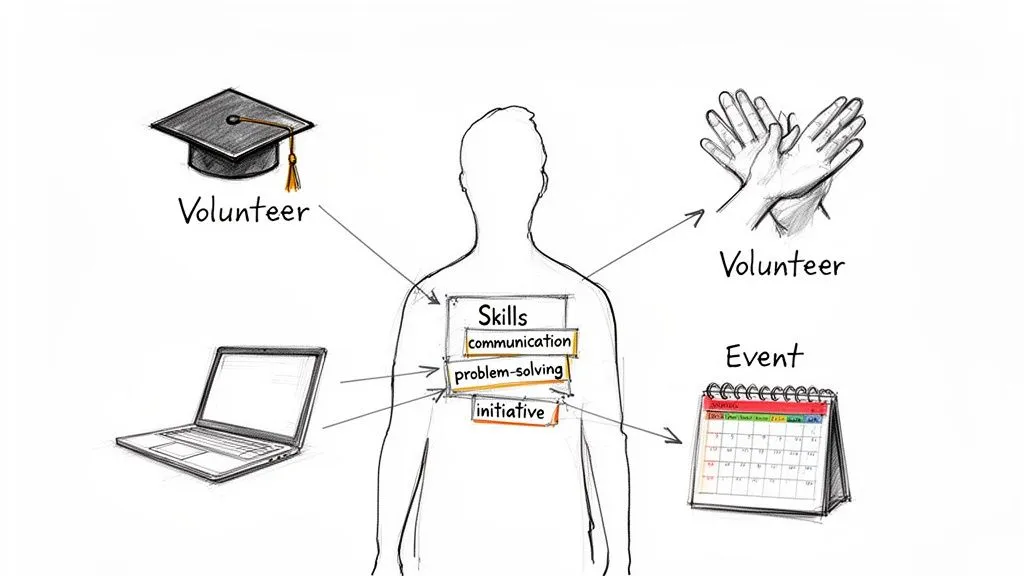
Here's a myth that's holding you back: "experience" only comes from paid, full-time jobs. It doesn’t. Your real value is buried in your history—in academic projects, volunteer work, side hustles, and personal challenges you’ve already tackled.
Stop thinking in job titles. Start thinking in problems you’ve solved. You need to become an auditor of your own life and dig for those resume-worthy accomplishments hidden in plain sight.
This isn’t about fluffing up your resume. It’s about building an honest inventory of your capabilities before you even think about writing a single word.
Uncovering Your Transferable Skills
Transferable skills are the currency of the modern job market. Think communication, project management, and problem-solving—abilities that work everywhere, no matter the role. You already have them; you just need to learn how to spot and frame them.
The hiring landscape has gotten tougher for new grads. Entry-level job postings saw an 11.2% drop from Q1 2021 to Q2 2024. This means you have to be much smarter about reframing what you do have—like that tough class project or your weekend side hustle—into professional gold. You can read more about these entry-level hiring trends to get ahead of the curve.
Start by looking at the experiences you've probably dismissed as "not real work."
- Academic Projects: Did you lead a four-person team for a semester-long research paper? That’s not just schoolwork. That’s leadership, collaboration, and deadline management. You delegated tasks, navigated disagreements, and delivered a final product.
- Volunteer Work: Did you help organize a local fundraiser? That's event coordination, stakeholder communication, and resource management. You almost certainly worked with a budget, promoted the event, and handled logistics.
- Side Hustles & Personal Projects: Did you build a personal website or start a small online store? That’s initiative, technical implementation, and user-focused design. You found a need, taught yourself something new, and created something from nothing.
Your resume isn't a confessional of your job history. It's an argument for your future potential, backed by evidence from your entire life.
Each of these scenarios is a goldmine. Your job is to extract the value and present it in language a hiring manager understands. Don't just list what you did; articulate the skill it proves.
Quantifying Your Achievements
Once you've identified the skills, you have to back them up with numbers. Numbers cut through the noise. They provide concrete proof of your impact and make your accomplishments feel real, not just like empty claims.
Think about the results of your actions.
- Did you manage the social media for a student club? Don't just say you ran the account. By how much did you grow the follower count? "Increased Instagram followers by 40% over six months."
- Did you streamline a process for a volunteer organization? How much time did that save? "Developed a new volunteer sign-up form, reducing administrative time by 5 hours per week."
- Did you tutor a fellow student? What happened? "Provided weekly tutoring in advanced calculus, helping a peer improve their final grade from a C to a B+."
See the difference? These numbers transform a simple task into a measurable achievement. They show you’re not just a participant but someone who delivers tangible results.
Building Your Accomplishment Inventory
Before you touch a single resume template, open a blank document. Call it your "Accomplishment Inventory." For every significant project, volunteer role, or side hustle you can think of, write down these three things:
- The Challenge: What was the problem? (e.g., "Our student organization had low attendance at events.")
- The Action: What specific things did you do? (e.g., "I designed a promotional flyer, posted it on three campus forums, and personally emailed 50 members.")
- The Result: What was the measurable outcome? (e.g., "Event attendance increased by 30% compared to the previous semester.")
Try to do this for at least five different experiences. This document is the raw material for your entire job application. It's your proof. With this inventory in hand, you are no longer someone with "no experience." You're a proven problem-solver with a track record of getting things done.
Build a Resume That Shows Potential
Let's get one thing straight: your resume isn’t a list of chores. It’s a marketing document. It’s supposed to sell your future value, not just document your past. When you don't have a traditional career path, that distinction is everything.
Forget the soul-crushing templates you find online. They’re just boxes designed for people with a decade of corporate history, forcing you into a format that doesn't fit your story. Your goal is to build a narrative, and good narratives don't fit into pre-made layouts.
We’re going to frame your resume around skills and projects, not a weak chronological history. This approach turns your lack of formal experience from a glaring weakness into an irrelevant detail.
Start with a Sharp Summary
The very top of your resume is prime real estate. Please don't waste it with a generic "Objective" statement like, "Seeking a challenging role where I can contribute my skills." It’s a complete waste of space and tells the hiring manager absolutely nothing.
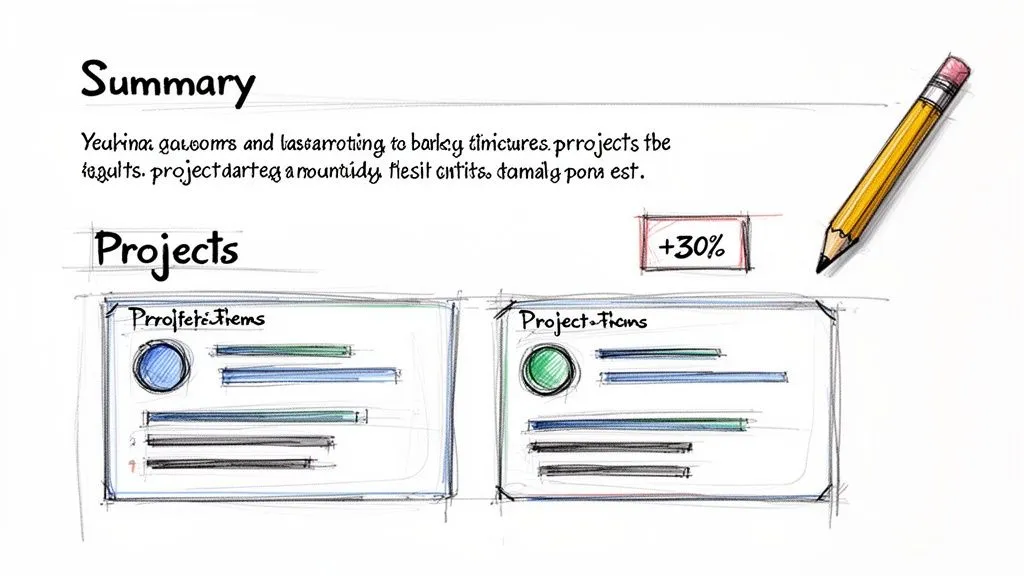
Instead, write a concise, confident Professional Summary. This is your 2-3 line pitch that clearly states your ambition and highlights your most relevant skills. It tells the reader exactly who you are and what you want to do, right from the start.
Example Summary (for a junior marketing role):
Driven and analytical problem-solver with hands-on experience in content creation and community management through academic and personal projects. Eager to apply skills in SEO, social media strategy, and data analysis to help a mission-driven company expand its digital footprint.
This summary works because it’s direct. It uses keywords from the industry (SEO, social media, data analysis) and cleverly frames project work as "hands-on experience." It’s all about the future and the value you plan to bring.
The Projects Section is Your Proof
This is where the magic happens. For you, the "Projects" section is the most important part of your resume. It's where you prove your skills in a real-world context, effectively replacing the traditional "Work Experience" section as the core of your entire document.
Don’t just list a project title and call it a day. Treat each project like a mini-job entry. Use bullet points to detail your specific contributions and—most importantly—the results.
Here’s a simple structure to follow for each project entry:
- Project Title: Give it a professional-sounding name. "My Personal Blog" becomes "Content & SEO Project."
- Affiliation & Date: (e.g., University Course Project, Personal Initiative | Jan 2024 – May 2024)
- Tech/Skills Used: Briefly list the key tools or skills (e.g., WordPress, Google Analytics, SEMrush, Ahrefs).
- Impact Bullets: 2-3 bullet points describing what you did and what happened because of it.
Writing Bullet Points That Show Impact
Generic bullet points are resume killers. Starting with "Responsible for..." is a red flag for any recruiter. It only tells them what you were supposed to do, not what you actually accomplished.
To write great bullets, go back to the Challenge-Action-Result framework you built earlier. Focus on metrics, numbers, and specific outcomes.
Before (Weak):
* Responsible for recruiting new members for the student coding club.
* Managed the club’s budget.
* Wrote articles for a personal website.
After (Strong):
* Increased student coding club membership by 30% in one semester through targeted on-campus outreach and a revamped social media campaign.
* Managed a $2,000 annual budget, reallocating funds to secure two new software licenses and a guest speaker event.
* Published 15 long-form articles on a personal tech blog, achieving a first-page Google ranking for 3 keywords and growing monthly traffic to 500+ visitors.
See the difference? The "after" examples are powerful because they use action verbs and quantify the impact. They provide concrete evidence of what you can do. When you're figuring out how to apply for a job without experience, your proof has to be undeniable.
Think of your resume as an argument. Every bullet point is a piece of evidence. Make sure your evidence is strong, specific, and impossible for a recruiter to ignore.
A well-structured resume is a great first step, but you also need to ensure its contents are perfectly aligned with the job you want. For a deeper dive, our guide on tailoring your resume to a job description provides more actionable steps.
Keep It ATS-Friendly and Human-Readable
Applicant Tracking Systems (ATS) are the robotic gatekeepers that scan your resume before a person ever sees it. To get past them, you need to use standard section headings ("Projects," "Skills," "Education") and sprinkle in keywords from the job description.
But don't just stuff keywords in for the sake of it. The resume still needs to impress a human. Keep your formatting clean and simple. Use a standard font like Arial, Calibri, or Helvetica. Absolutely avoid graphics, columns, or tables that can confuse the ATS.
Your goal is a document that is both machine-scannable and compelling to a person. By focusing on a strong narrative, impact-driven bullet points, and a clean layout, you create a resume that proves your potential and makes a powerful case for why you deserve that interview.
Write a Cover Letter That Actually Gets Read
Think of it this way: your resume shows a hiring manager what you can do. A great cover letter tells them why you want to do it for them, specifically. It’s your only real chance to connect the dots and show some personality.
Most cover letters are, frankly, a waste of everyone's time. They’re stuffy, formal, and filled with tired old phrases like, "I am writing to express my keen interest..." Nobody wants to read that. It’s an instant trip to the trash folder.
So, let's kill the traditional cover letter. A modern one isn't about begging for an interview; it’s about starting a conversation. It shows you respect the reader's time and, most importantly, proves you’ve done your homework.
Use the Direct Three-Paragraph Approach
Forget the five-paragraph essay from high school English class. A cover letter that gets read is punchy, direct, and gets straight to the point. It has three simple parts: the hook, the pitch, and the close. That's it.
- The Hook: Start with why you’re interested in this company and this role. Get specific. Show you've been paying attention.
- The Pitch: Connect one or two of your key experiences or projects directly to what they need. Show them, don't just tell them.
- The Close: End with a confident, clear call to action. No "hope to hear from you soon."
This structure forces you to be concise. It cuts the fluff and proves your value immediately, which is exactly what a busy hiring manager needs.
Before and After: A Real Example
Let's see this in action. Here’s a typical, stuffy cover letter opener for a Junior Analyst role versus one that actually makes an impact.
Before (Stuffy and Generic):
"Dear Hiring Manager, I am writing to apply for the Junior Analyst position I saw advertised on LinkedIn. With my academic background in economics and strong analytical skills, I am confident I would be a valuable asset to your team. I have always admired your company's commitment to innovation."
This is boring. It’s so generic it could be sent to a hundred different companies. It says nothing personal and shows zero real interest. Delete.
After (Punchy and Specific):
"Hi [Hiring Manager Name], I've been following [Company Name]'s work on sustainable supply chains since your Q3 report on carbon footprint reduction. Your approach to data modeling inspired me to apply for the Junior Analyst role, as my own project on optimizing delivery routes for a local nonprofit showed me the direct impact of smart logistics."
See the difference? This version is sharp. It shows genuine interest, references a specific company initiative, and immediately links it back to a relevant project. It makes the reader lean in and think, "Tell me more about that nonprofit project." And that’s the entire point.
Your cover letter's only job is to make them re-read your resume with more interest. It's the appetizer, not the main course.
By focusing on a direct connection and proving you understand their world, you transform from just another applicant into a potential colleague. For more guidance, check out this excellent sample cover letter for a job application that breaks down this modern approach even further.
Once you’ve written something compelling, you need to make sure it actually gets delivered and opened. Don't let a great letter die in a spam folder; learn how to send the perfect email to get the response you want.
How to Network Without Being Awkward
Relying on the 'Easy Apply' button is a losing game. It’s like buying a lottery ticket—a long shot at best. To get ahead when you're starting out, you need to bypass the digital slush pile and get your application in front of a real person.
This isn’t about schmoozing or begging for a job. It's about being strategic. Networking, when done right, is just gathering information and making genuine connections. It’s about creating your own opportunities instead of waiting for them to appear.
Ditch the "Can I Have a Job" Mindset
The single biggest mistake people make is treating networking like a transaction. They find someone on LinkedIn and immediately ask for a job referral. This is the fastest way to get ignored. It's awkward, desperate, and puts the other person in a completely uncomfortable position.
Instead, you need to shift your goal from "getting a job" to "gathering intelligence." Your new mission is the informational interview. You aren’t asking for a favor; you’re asking for advice. This one change flips the entire dynamic.
People generally like to talk about their work and share what they've learned. When you approach them with genuine curiosity about their journey, they’re far more likely to engage.
Here’s a simple script you can adapt for a LinkedIn connection request or an email:
"Hi [Name], I came across your profile and was really impressed by your work in [specific area] at [Company Name]. As someone looking to break into the [Industry] field, I'd love to hear more about your experience. Would you be open to a brief 15-minute chat in the coming weeks?"
This approach is respectful of their time and focuses on their expertise, not your immediate needs.
Create Your Own Experience and Network Organically
The best way to meet people is by doing the work. Instead of just looking for a job, start creating the experience you wish you had. This naturally puts you in the same circles as the people who can hire you, making networking a side effect of your efforts.
- Contribute to an open-source project. If you're a developer, find a project on GitHub that interests you. Making even small contributions puts you in direct contact with experienced engineers.
- Volunteer for a cause you care about. Nonprofits always need help with marketing, operations, or event planning. This is a fantastic way to build a real project portfolio while working alongside dedicated professionals.
- Take on small freelance gigs. Use platforms like Upwork or Fiverr to find projects. A single successful project can lead to testimonials, referrals, and a much stronger network.
When you're actively involved in a community, you stop being a "job seeker" and start being a "contributor." The conversations you have are no longer awkward asks; they become peer-to-peer discussions about shared interests.
Stop Chasing Jobs and Start Solving Problems
Ultimately, companies hire people to solve their problems. This is more true now than ever. Many hiring managers are worried about the readiness of new entrants to the workforce.
In fact, a staggering 84% believe most high school graduates aren't prepared for the professional world, favoring practical skills over credentials alone. The full new hire readiness report makes it clear what employers are truly looking for.
This is your opening.
By networking to understand a company's challenges and building your own experience to prove you can solve problems, you align yourself with what employers actually need. You’re not just another applicant with "no experience." You’re a proactive problem-solver who has already started doing the work.
That’s a story no 'Easy Apply' button can ever tell.
Nail the Interview Without Traditional Experience
Getting the interview is often the hardest part. Now you're in the room, and you have to prove your potential without a long job history to lean on. This isn't about memorizing canned answers. It's about having your proof ready.
The key is to prepare 3-5 compelling stories from your hidden experience—those projects, volunteer roles, or side hustles. These stories are your evidence. They need to directly demonstrate the core skills the job requires, like problem-solving, learning agility, and drive.
Tell Stories That Prove Your Value
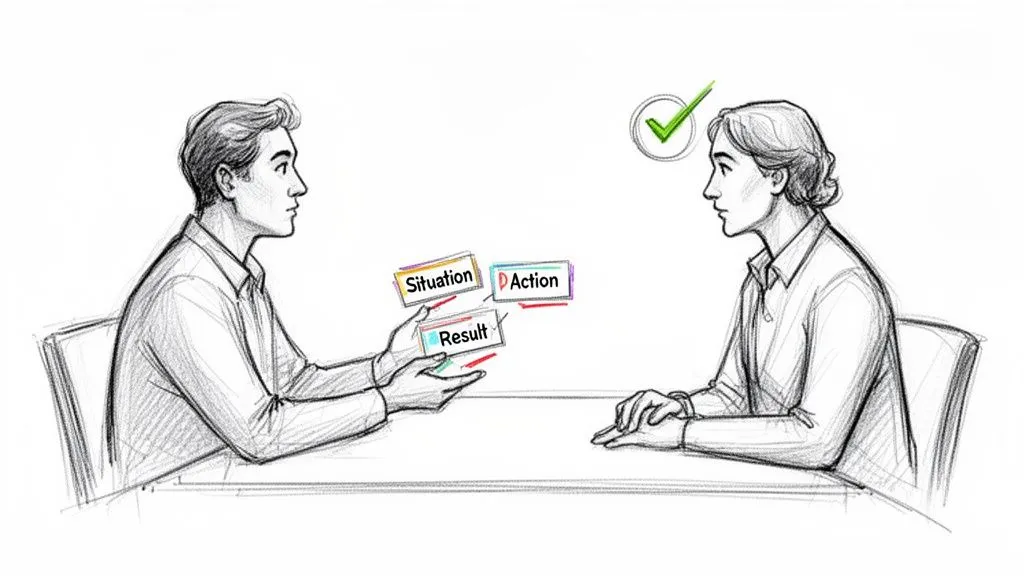
Forget reciting your resume. When they ask a question, tell a story using the STAR method. It’s a dead-simple framework for turning your experience into a narrative with a clear point.
- Situation: Briefly set the scene. What was the context?
- Task: What was your goal or the problem you needed to solve?
- Action: What specific steps did you take? Focus on your personal contribution.
- Result: What was the outcome? Use numbers and metrics whenever possible.
This structure forces you to be direct and show impact. It stops you from rambling and gives the interviewer a crisp, clear picture of what you can actually do. You can find more practical tips in our guide on how to answer "tell me about yourself".
A Sample STAR Answer in Action
Let’s say you’re asked, "Tell me about a time you had to learn something quickly."
Weak Answer:
"In college, I had to learn a new software for a class project. It was challenging, but I figured it out and we got a good grade."
This is vague and forgettable. It tells the interviewer nothing.
Strong Answer (using STAR):
(S) For a university marketing project, our team decided to analyze social media sentiment, but none of us knew how to use data visualization tools. (T) I was tasked with learning Tableau and creating three dashboards to present our findings in one week. (A) I spent the first two days going through online tutorials, then built a prototype dashboard with a small data set to test my skills. I got feedback from my professor, iterated on the design, and then built the final dashboards. (R) As a result, we presented clear, data-backed insights that earned our team an A, and my professor used our dashboards as an example for future classes.
See the difference? This answer is specific, shows initiative, and proves a valuable skill—learning on the fly. It's a story, not just a statement.
Ask Questions That Show You Think
The interview isn't just about you answering questions. It's your chance to show you’re thinking about their challenges and how you fit into the solution.
Instead of asking generic questions about company culture, ask something that proves you’ve done your homework.
- "I saw you launched [New Product] last quarter. What has been the biggest customer feedback challenge so far?"
- "Your job description mentions scaling [a specific process]. What does success look like for that initiative in the next six months?"
Smart questions shift the focus from your lack of experience to your abundance of potential. They prove you’re not just looking for a job—you’re looking to contribute.
Alright, let's tackle some of the tough questions that always come up when you're trying to land a job with a resume that feels a little… empty.
Should I Put Personal Projects on My Resume?
Yes. Do it. A well-framed project is worth more than a dozen generic "responsibilities" from a part-time job. It's tangible proof you can actually do the work.
But how you frame it is everything. Don't just list "Personal Blog." That sounds like a hobby. Instead, call it something like "Content & SEO Project."
Then, get specific about what you did and what happened. Mention the tools you used (WordPress, Google Analytics) and any results you can point to, like growing traffic to 500 monthly visitors. See the difference? One is a diary, the other is a demonstration of skill.
How Do I Answer Salary Questions with No Experience?
This is where a little homework goes a long way. Before you even get to an interview, you need to research the typical salary for an entry-level position in your city. Use sites like Glassdoor or Levels.fyi to get a realistic baseline.
When the question inevitably comes up, don't throw out a single, rigid number. It can make you seem inflexible or, worse, totally off-base.
Instead, give a thoughtful range.
"Based on my research for similar entry-level roles in this area, I'm targeting a range of $X to $Y."
This is the perfect answer. It shows you're prepared, you have reasonable expectations, and you're ready to have a professional conversation. It moves things forward without selling yourself short.
Can I Apply for Jobs That Ask for 1 to 2 Years of Experience?
You absolutely can, and you often should. Think of a job description as the company's ultimate wish list, not a set of non-negotiable demands carved in stone.
If you meet 60-70% of the other requirements and have projects that show you can handle the work, go for it.
Your job is to make such a compelling case for yourself that the "years of experience" line item becomes irrelevant. You need to convince them that your hands-on project work and your drive to learn are more valuable than someone else's year of just warming a seat.
Your resume isn't just a piece of paper; it's the opening argument for your career. At StoryCV, we help you shape your projects and potential into a story that proves your value, even when you're just starting out. Stop wrestling with templates and start telling a story that gets you hired. Build your high-impact resume today.