Your answer to "tell me about yourself" should be a tight, 90-second story connecting your past, your present, and the future you want with this company. Forget recapping your resume. This is your strategic pitch—a chance to showcase your best skills, most relevant wins, and genuine excitement for the role. Nail it, and you set a confident tone for the entire interview.
Why Your Answer to Tell Me About Yourself Matters

This question isn't just a warm-up. It's the most critical moment in the first few minutes of your interview. It’s your one and only chance to frame your professional story entirely on your own terms.
A rambling, unfocused answer signals you're unprepared. A sharp, compelling one establishes your confidence and relevance from the very first word.
First Impressions Are Formed Instantly
Interviewers often make up their minds within the first 27 seconds. That means your opening line carries a ton of weight. They've already read your resume, so a chronological walk-through is a waste of everyone's time.
Your mission is to deliver a story that immediately connects your value to what the company needs.
A well-crafted response elevates you above the estimated 70% of candidates who just recite their job history or talk about hobbies. You instantly become a more memorable, serious contender.
This is especially true in a competitive market. Standing out is everything. A great answer doesn't just list what you've done; it shows off your communication skills and how you think strategically.
Setting the Stage for Success
Your answer sets the tone for the entire conversation. By strategically highlighting specific achievements, you can subtly guide the interviewer toward your strongest selling points. It's a proactive move that shows you get what the role is about and you’re ready to prove you can deliver.
For students and recent grads, this is the perfect time to frame academic projects and internships as real-world professional experience. If you need help with that, our guide on building a powerful https://story.cv/student-resume/ shows you exactly how to present your background.
Learning how to introduce yourself professionally in any setting is a smart move. But a masterful response here accomplishes three key things:
-
It demonstrates confidence. You sound prepared, articulate, and sure of what you bring to the table.
-
It highlights relevance. You immediately tie your experience directly to the job description.
-
It creates engagement. You drop a compelling hook that makes the interviewer lean in and want to know more.
Using the Present Past Future Framework
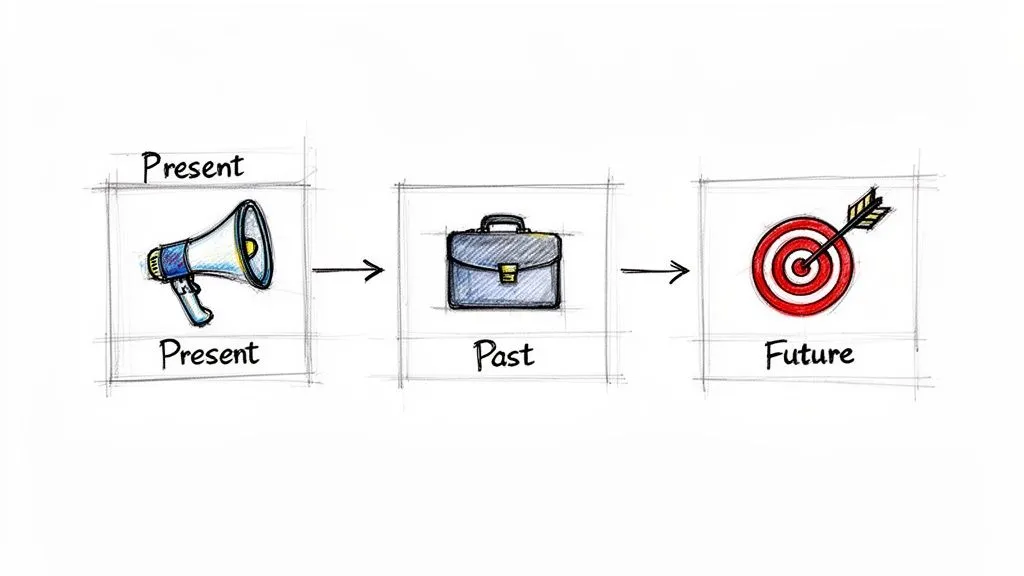
The best way to answer "tell me about yourself" is to follow a simple but incredibly powerful structure: the Present-Past-Future framework. This isn't a script you memorize. Think of it as a storytelling tool that guides the interviewer through your career journey in a way that feels logical, compelling, and—most importantly—natural.
It’s the secret to keeping your answer focused. It stops you from rambling and makes sure every single sentence you say has a purpose. Using this model, you can turn a vague, open-ended question into the perfect pitch for why you're the right person for the job.
The structure works because it’s how our brains already process information. We start with what's happening now, look back for context, and then look ahead to what's next. It’s the key to an answer that sounds prepared but not rehearsed.
Start with Your Present
Your first few sentences are your hook. You need a tight, punchy summary of your current role that immediately highlights a key achievement directly relevant to the job you’re interviewing for. This is the headline for your professional story.
Don't just state your job title. Frame it with impact.
For example, instead of, "I'm a project manager," try something with more teeth: "Currently, I’m a project manager at TechSolutions, where I recently led a cross-functional team to deliver a major software update 30% faster than our projected timeline."
See the difference? That second one immediately establishes your value. The interviewer gets a clear picture of who you are right now and a tangible result that makes them lean in.
Connect It to Your Past
Next, you'll briefly touch on your past experiences. The goal here isn’t to walk them through every job you've ever had. That’s what your resume is for. Instead, you need to strategically pick one or two experiences that built the specific skills needed for this role.
This is where you connect the dots for the hiring manager. You're showing them how you became the professional sitting in front of them today.
Think of it like this:
-
Experience 1: Mention a past role where you developed a core skill they listed in the job description.
-
Experience 2: Highlight a project that gave you expertise in a specific area the company is known for.
For instance, you might say, "Before this, I was at Innovate Corp, where I really honed my skills in agile methodologies and client communication while managing a portfolio of six enterprise accounts." This shows a clear, logical progression and quietly reinforces your qualifications.
By curating your past experiences, you control the narrative. You’re not just reciting a resume; you're building a case for why you are the perfect fit for this specific opportunity.
This approach proves you've actually thought about the position and understand what it takes to succeed there.
Close with Your Future
The final piece of your answer connects everything to the future—specifically, the future you want to have with this company. This is your chance to show genuine, informed enthusiasm and align your own ambitions with the organization's goals.
You should clearly state why you’re excited about this role and what you want to achieve with them. It shows the interviewer you’re not just looking for any job; you’re looking for this job.
A strong closing could sound something like this: "I’m really excited about this opportunity at your company because I’m passionate about using data to drive user engagement, and I see a clear path to contribute to your team's innovative work in that area."
This conclusion brings your story full circle. It leaves the interviewer with a clear understanding of your present capabilities, your relevant history, and your future potential. Getting this right is a game-changer. In fact, candidates who tailor their responses to highlight specific, role-relevant impacts see a 40% higher rate of advancement than those who just talk through their resume. You can dig into more data on why this kind of targeted communication matters in the PARWCC 2026 U.S. Job Market Outlook.
Sample Answers For Any Career Stage
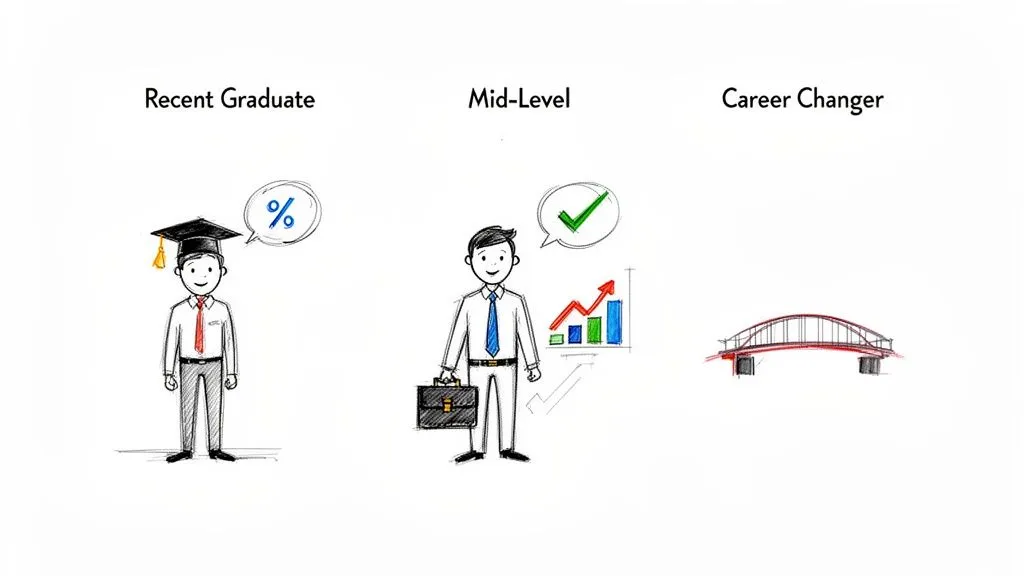
Knowing the Present-Past-Future framework is one thing. Seeing it in action is another. The real magic of this model is how it adapts. It works whether you have twenty years of experience under your belt or are just stepping into the professional world.
The trick is to shift the focus of each part—Present, Past, and Future—to match where you are in your career. Below, I’ve broken down annotated examples for three common situations: the recent grad, the mid-level pro, and the career changer.
Think of these less as scripts and more as blueprints. They show the strategic thinking behind the words, so you can build your own authentic and powerful answer.
The Recent Graduate Answer
For new graduates, the game is all about translating academic work into professional value. Your "Present" isn't a job title; it's a snapshot of your education and core skills. Your "Past" should zero in on impactful projects, internships, or even tough coursework that proves you can apply what you've learned.
Let's walk through an example for a computer science grad gunning for a Junior Software Engineer role at a fintech startup.
The Answer:
"I just graduated from State University with my Bachelor's in Computer Science, where I really dug into machine learning and data structures. For my capstone project, I developed a predictive model for stock market trends that hit 82% accuracy, which is what got me hooked on applying algorithmic thinking to real financial data.
Before that, I interned at a cloud services company. I was part of the team that refactored a legacy Python codebase, and we managed to boost system efficiency by 15%. That experience was huge for me—it taught me how to work in a collaborative dev environment and the value of writing clean, scalable code.
I’ve been following your work on making investment tools more accessible, and I’m really excited to bring my Python skills and my passion for fintech to a role where I can help build products that make a real difference for people."
Why It Works:
-
Present: It kicks off by establishing their academic focus and immediately drops a hard number from their capstone project (82% accuracy). This frames them as a results-driven person, not just a student.
-
Past: The internship is a strategic choice. It highlights a measurable win (15% improvement) and proves they understand core engineering practices like teamwork and writing good code.
-
Future: The ending shows they’ve done their homework on the company's mission ("democratizing investment tools") and neatly connects their skills to the company's bigger goals.
For more on framing your academic work, our guide with a student resume template and real examples is a great resource.
The Mid-Level Professional Answer
If you're a mid-level professional, your story needs to show a clear pattern of growth and impact. Your answer should be tight but powerful, proving you're not just executing tasks but thinking strategically and delivering results. The focus shifts to leadership, numbers, and a sharp understanding of the industry.
Here’s an example for a Marketing Manager with five years of experience who's aiming for a Senior Marketing Manager job.
The Answer:
"I'm currently a Marketing Manager at InnovateTech, where I own the digital marketing strategy for our B2B software line. For the past two years, I’ve been focused on overhauling our content and SEO strategy. That work led to a 45% increase in qualified organic leads and added $2 million to our sales pipeline.
Before this, I was at a smaller agency managing multi-channel campaigns for tech clients. That role was where I cut my teeth on project management and learned how to deliver big results on a shoestring budget.
I’m now looking to take that next step into a role that's tackling bigger challenges in the enterprise space. Your company's recent push into AI-driven analytics is exactly the kind of innovation I want to contribute to, and I’m confident my experience in lead generation and team leadership can help drive that growth."
This answer lands because it’s loaded with metrics that prove value. The interviewer isn't just told the candidate is a solid marketer; they are shown the direct business impact of their work.
Why It Works:
-
Present: It opens with a confident summary of their current role and immediately backs it up with impressive, concrete numbers (45% increase, $2 million growth).
-
Past: Mentioning the agency role shows a clear career progression, calling out budget and project management skills—both crucial for a senior position.
-
Future: The close is perfectly tailored. It references a specific company initiative ("AI-driven analytics") and positions the candidate as someone who can step in and contribute from day one.
The Career Changer Answer
When you're changing careers, your main job is to build a bridge from your past to your future. You have to connect your transferable skills to the new role so artfully that your unique background becomes an obvious asset, not a question mark.
Take this example of a former high school teacher applying for a Corporate Trainer position at a tech company.
The Answer:
"For the last eight years, I've been a high school English teacher, where my world revolved around developing engaging curriculum and personalized learning plans for over 150 students a year. I recently led a district-wide project to integrate new educational software, which boosted student engagement by 30%, according to our feedback surveys. That project is really what sparked my passion for adult learning and technology.
That experience was a crash course in communication, instructional design, and breaking down complex topics for different audiences. I also just completed a certification in Corporate Training and Development to build on that foundation with principles specific to a business environment.
I’m so excited about this Corporate Trainer role because it's the perfect intersection of my deep experience in education and my newfound passion for tech. I'm ready to apply my knack for creating effective learning programs to help your teams master new tools and grow in their careers."
Why It Works:
-
Present: They reframe their teaching experience using business language ("developing curriculum," "personalized learning plans") and include a solid metric (30% boost) to show impact.
-
Past: They explicitly name the key transferable skills—communication and instructional design. Adding the recent certification shows they are serious and proactive about this career switch.
-
Future: The closing statement connects all the dots. It makes a compelling case for why a teacher's background is the ideal foundation for success as a corporate trainer in this specific company.
Key Components of a Powerful Answer
To help you structure your own story, here's a quick breakdown of where to focus your "Present," "Past," and "Future" sections based on your career stage.
| Career Stage | Focus of 'Present' | Focus of 'Past' | Focus of 'Future' |
|---|---|---|---|
| Recent Graduate | Recent degree, key academic focus, and a major project with a quantifiable result. | A high-impact internship, relevant coursework, or part-time job that shows practical skills. | Connects academic skills directly to the company's mission or a specific team's goals. |
| Mid-Level Professional | Current role, scope of responsibility, and a major, metric-driven accomplishment ($, %, or X). | A previous role that shows skill progression, leadership, or a different kind of challenge. | Shows ambition and links experience to a specific, high-level company objective or challenge. |
| Career Changer | Current or recent role, reframed in business terms, with a quantifiable achievement. | Highlights transferable skills and mentions proactive steps taken to bridge the gap (e.g., certifications). | Explicitly connects the "old" career's strengths to the needs of the "new" role and company. |
Use this table as a cheat sheet. It’s a simple way to make sure you’re hitting the right notes for your experience level and telling the most relevant, compelling story possible.
Common Mistakes That Can Cost You the Job
Even a brilliant, perfectly qualified candidate can get rejected in the first two minutes. Why? A fumbled introduction. Answering "tell me about yourself" is less about following a perfect script and more about avoiding the common traps that instantly raise red flags.
These missteps aren't just awkward—they signal a lack of preparation, focus, or genuine interest. They paint a negative picture before the real interview even gets going. Understanding why these mistakes are so damaging is the key to sidestepping them entirely.
Mistake 1: Reciting Your Resume
The interviewer has your resume. They're looking right at it. Reading it back to them is the fastest way to waste a golden opportunity and show you haven't prepared.
When someone asks you to tell them about yourself, they aren't asking for a chronological list of your jobs. They want the story behind the bullet points. What drove your career moves? What impact did you actually make? That’s the stuff they can’t get from a PDF.
Instead, think like a storyteller. Pick one or two key achievements from your past that directly relate to this new role. Connect them to what you're doing now and where you want to go. This proves you can synthesize your own story and identify what truly matters.
Mistake 2: Rambling Without a Clear Point
Nerves happen. We get it. But letting your answer drift for three or four minutes is a huge red flag. A long, wandering response suggests you lack clarity and can't communicate concisely—two skills that are critical in almost any job.
It also burns through valuable interview time. A sharp, focused pitch should land in about 90 seconds. It’s respectful of the interviewer’s time and keeps the conversation moving forward.
This isn't just a feeling; it's a high-stakes moment backed by data. With 85% of recruiters prioritizing strong communication and storytelling, a weak, rambling opener can lead to a 62% rejection rate in a tough market. You can dig into how storytelling shapes hiring in the Indeed 2026 U.S. Jobs Report.
Mistake 3: Getting Too Personal
You want to be authentic, but this isn't the time to share your entire life story, personal struggles, or quirky hobbies. Crossing professional boundaries too early makes interviewers uncomfortable and can make them question your judgment.
Your goal here is to establish yourself as a capable professional who can solve their problems. Save the personal anecdotes for later, once you’ve built a natural rapport.
Common personal traps to avoid:
-
Talking about your marital status or kids.
-
Discussing personal finances or health issues.
-
Detailing hobbies with zero connection to the job (e.g., your passion for stamp collecting when you're applying for a finance role).
Mistake 4: Failing to Connect Your Story to the Role
This is probably the most critical mistake of all. A generic, one-size-fits-all answer screams that you haven't done your homework. It tells the interviewer you aren't that interested in this company or this position.
Every single part of your answer needs to be tailored. You have to draw a straight line from your skills and experiences to the specific needs mentioned in the job description. This shows them you see yourself as the solution to their challenges.
Here’s how to do it:
-
Break Down the Job Description: Find the top three to five required skills or responsibilities they mention.
-
Map Your Story to Their Needs: Pick moments and achievements from your career that directly prove you have those skills.
-
Craft Your Closing: End by explicitly stating how you see yourself using those specific skills to help the company achieve its goals.
Dodging these common pitfalls is a massive step toward mastering this crucial interview question. By staying professional, prepared, and laser-focused on the role, you make sure your first impression is a powerful one.
How to Practice and Perfect Your Delivery
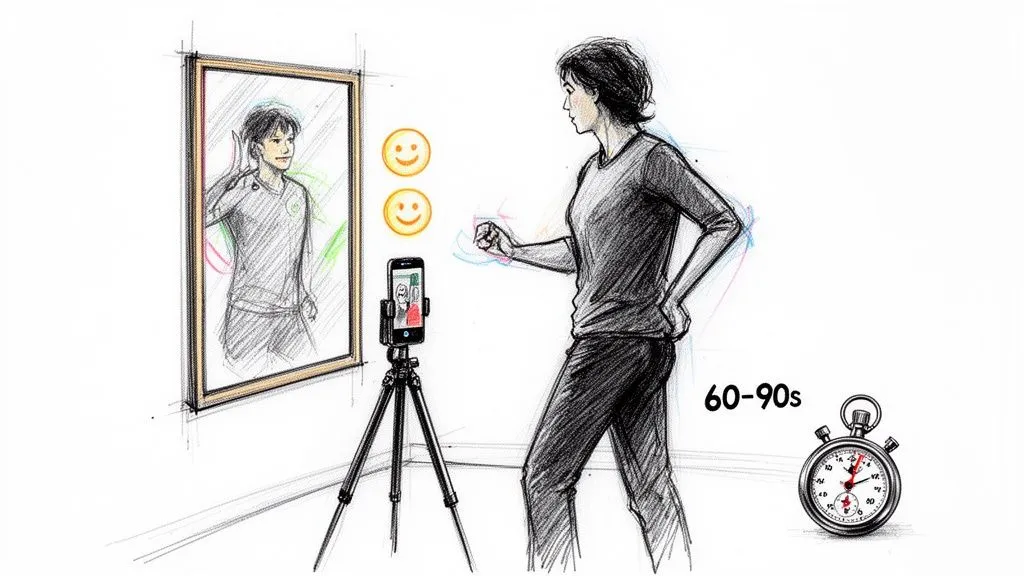
A perfectly crafted story can fall flat without a confident, natural delivery. The final step is moving your answer from the page to your memory. But the goal isn't to sound like a robot reciting a script—it's to know your story so well that it flows with genuine poise.
Think of it like an actor learning their lines. They don’t just memorize words; they understand the motivation behind them. That’s your goal: to internalize your narrative so thoroughly that you can share it with authentic enthusiasm.
Find Your Ideal Timing
Your answer should land in the 60-to-90-second sweet spot. This respects the interviewer’s time and shows you can communicate key points efficiently. Go much longer, and you risk losing their attention. Too short, and you can come across as unprepared.
Use the stopwatch on your phone and run through your answer a few times. Don't rush; just speak at a natural, conversational pace. If you're consistently breaking the two-minute mark, it's a clear signal to trim some details and focus only on the highest-impact moments of your story.
Ditch the Script and Use Bullet Points
Memorizing your answer word-for-word is a recipe for sounding stiff and robotic. A much better approach is to boil your narrative down to a few key bullet points. This gives you a mental map to follow without trapping you in a rigid script.
Your outline might look something like this:
-
Present: Current role, leading the team that boosted leads 45%.
-
Past: Agency side, managed big projects on small budgets.
-
Future: Excited by their AI analytics push; I can drive that growth.
This method allows for a more spontaneous delivery. It ensures you hit your main points while leaving room for your personality to shine through.
Practicing with a simple outline instead of a full script helps you transition from reciting facts to telling a story. It’s the key to sounding prepared, not rehearsed.
Record and Review Yourself
This might feel awkward at first, but it's one of the most effective ways to get better, fast. Set up your phone and record yourself delivering your answer. When you play it back, you're not just listening to the words; you're observing your entire delivery.
Pay close attention to a few specific things:
-
Filler Words: How often do you say "um," "like," or "uh"? Just noticing these habits is the first step toward eliminating them.
-
Pace and Tone: Do you sound energetic and engaged, or are you monotone and rushed? Your vocal intonation says a lot about your confidence.
-
Body Language: Are you making eye contact (with the camera)? Is your posture open and confident? Non-verbal cues play a huge role in how your message lands.
After you review it yourself, ask a trusted friend or mentor for their take. An outside perspective can catch nuances you might miss and offer invaluable advice. If you're serious about polishing your interview presence, it's worth the effort to enhance your overall communication skills with targeted practice. This commitment is what turns a good answer into a great one.
Answers to Your Most Common Questions
Even with a solid framework in your back pocket, you're going to run into tricky situations. Those little "what if" scenarios are what separate a good answer from a great one.
Think of this as the final layer of polish. We'll tackle the most common curveballs people face when answering "tell me about yourself" so you can walk in ready for anything.
How Long Should My Answer Be?
Keep it between 60 and 90 seconds. That's the sweet spot.
It's just enough time to hit your key points without the interviewer's eyes glazing over. Anything under a minute can feel rushed or unprepared. Go over two minutes, and you're officially rambling. Time yourself a few times—you'll get a feel for the right rhythm.
How Do I Handle a Gap in My Employment History?
Address it head-on, with confidence, and move on. Don't apologize for it. The trick is to frame it as a productive period, not a void.
For instance, you might say: "After my role at Company X, I took a planned year to focus on professional development, earning certifications in project management and data analytics. That time really helped me zero in on this kind of opportunity."
See what that does? It shows you're proactive and strategic. You then immediately pivot back to your relevant skills and why you're excited about this role, keeping the conversation focused on the future.
Should I Mention Personal Hobbies or Interests?
For this specific question, almost always no. Your first 90 seconds should be laser-focused on one thing: establishing your value for this job. Hobbies often sound like filler.
The only exception? When your hobby directly connects to the job or the company's culture. If you're interviewing at a fitness apparel brand and you run marathons, that's a perfect detail to mention. It builds an immediate, authentic connection.
Otherwise, save the personal stuff for later if you build a natural rapport during the interview.
What if I Was Laid Off from My Last Job?
State it as a business fact, without any negative emotion. Layoffs are incredibly common, and recruiters understand they're not a reflection of your performance. There's no reason to be defensive.
Keep it short and neutral. Something like this works perfectly: "My role at Company X was part of a wider company restructuring that unfortunately eliminated our entire division."
The most important part is your immediate follow-up. Pivot straight to the future: "I'm really grateful for the experience I gained there in [specific skill], and I'm excited to apply that to the challenges you're facing here."
Handling it this way shows you're resilient and professional—a quiet but powerful demonstration of your character. For more ideas on how to frame your professional journey, check out the articles on the Story.CV blog.
Ready to turn your experiences into a compelling resume that gets noticed? StoryCV acts as your personal career storyteller, guiding you through a smart interview process to uncover and articulate your real impact. Stop wrestling with templates and start building a narrative that opens doors. Create your first role for free and see the difference a great story makes. Get started at https://story.cv.