Your resume isn't a list of duties. It's a highlight reel of your best work. As a fresh graduate, you have more accomplishments than you realize. The problem is turning projects, internships, and part-time jobs into proof of your skills.
Phrases like "Responsible for..." or "Assisted with..." are resume killers. Hiring managers don't care what you were assigned. They care about what you achieved.
This guide skips the fluff. We'll show you how to write powerful, metric-driven resume bullet points for fresh graduates. You'll stop listing tasks and start showing results. Before we get into formulas, it's good to know how to write a resume that will actually get a recruiter's attention. Understanding the big picture makes the details work.
We'll cover eight types of bullet points that frame your experience for impact, even if it's limited. You'll see before-and-after examples and learn the logic. Forget soul-crushing templates. Let's build bullet points that tell your story.
1. Quantified Impact Bullets (Metric-Driven Accomplishments)
Numbers cut through the noise. Other graduates describe duties. You show your impact. Quantified bullets use numbers, percentages, or money to prove you made a difference. This is the best way for fresh grads to translate academic work into business results.
Instead of saying you "helped with social media," you show a clear outcome. You bridge the gap between limited history and proven skill.
How It Works: The "Before and After"
Here’s a common example for a recent grad.
Before (Duty-Focused):
* Managed the company’s social media accounts.
* Implemented a new project management system for a capstone project.
After (Impact-Focused):
* Increased social media engagement by 145% over three months by creating and executing a targeted content strategy for a B2B SaaS client.
* Reduced project delivery time by 3 weeks (from 10 to 7) by implementing an agile framework for a 5-person academic team.
The "After" examples work. They answer "How much?" and "So what?" They show not just what you did, but how well you did it.
Key Insight: Metrics are your proof. Anyone can claim to be a hard worker. Few can back it up with a 145% increase in a key metric.
Tips for Finding Your Numbers
You can find metrics even if your role wasn't tied to sales. Think about speed, scale, and quality.
- Velocity: Did you save time? "Reduced data entry time by 25% by creating Excel macros" shows a direct efficiency gain.
- Scale: How many people did you present to? "Presented market research to a 15-person cross-functional team" provides context and shows confidence.
- Quality: Did you improve a score or reduce errors? "Improved customer satisfaction scores from 7.2 to 8.8/10 in 6 months by resolving support tickets 20% faster than the team average" is powerful.
Start with the result first, then add context. This makes your resume bullet points for fresh graduates much stronger.
2. Problem-Solution-Result Bullets (Action-Oriented Narratives)
This format tells a mini-story. Instead of listing a task, you frame your work as a solution to a problem. This shows critical thinking and initiative, rare for fresh graduates. It makes your work more memorable than isolated facts.
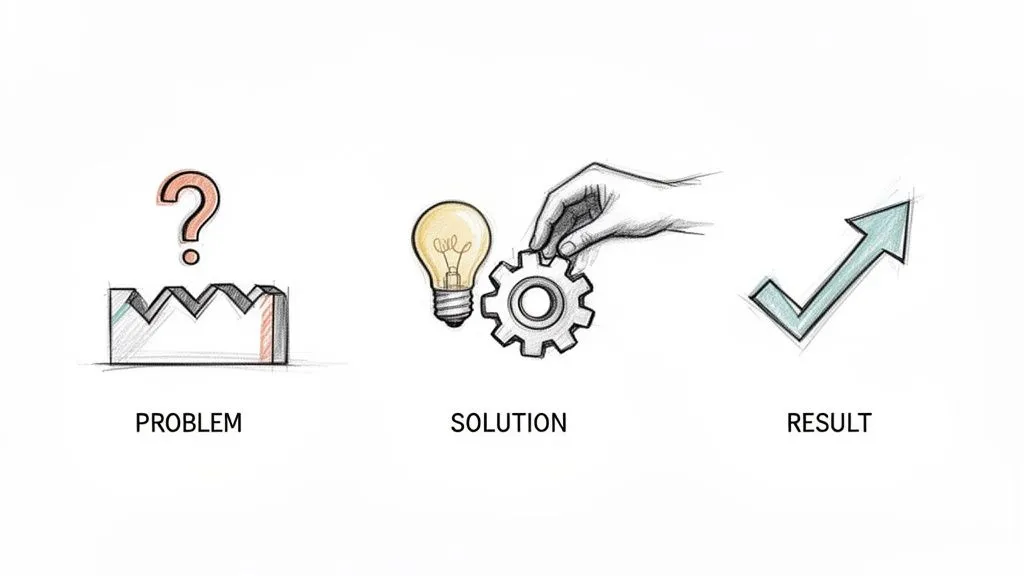
This approach proves you can spot problems, propose solutions, and deliver results. It shows you're a proactive team member, not just a task-doer.
How It Works: The "Before and After"
Here’s a typical scenario for a recent grad’s project.
Before (Task-Focused):
* Created analytics reports for the team.
* Responsible for data entry.
After (Problem-Solution-Result Focused):
* Identified incomplete team analytics due to missing data from 5 sources; built a dashboard that enabled accurate, data-driven decisions.
* Saw customer support spent 4+ hours daily on manual data entry; built a template system that cut entry time by 70% and improved data accuracy.
The "After" examples show a clear narrative. You understood the "why" behind your work, not just the "what." This storytelling makes your resume bullet points for fresh graduates stand out.
Key Insight: Framing your work as a solution proves you think like a problem-solver. Businesses hire people to solve problems.
Tips for Building Your Narrative
You can use this structure even if you weren't a formal "problem-solver."
- Lead with the Problem: Start your bullet with the business pain point. Not "Built a workflow," but "Noticed a bottleneck in client onboarding."
- Keep the Solution Concise: Briefly state what you did. "Designed a new workflow" or "created a new template" is enough.
- Connect to a Business Goal: Why did your solution matter? Did it save money or reduce errors? Tie it to a meaningful outcome.
3. Skill-Building & Growth Bullets (Learning & Development Focus)
You might lack professional experience, but you have a drive to learn. Skill-building bullets show you’re not waiting for a job to develop expertise. They highlight certifications and self-study, proving your commitment to growth. For a fresh grad, this shows initiative and bridges the gap between your degree and the tools a company uses.

These bullets work best when you connect the new skill to an outcome. Don't just list a certificate. Show how you put that knowledge to work. This tells a hiring manager you don't just learn theories; you apply them. Your resume bullet points for fresh graduates should reflect your years of hard work and personal growth.
How It Works: The "Before and After"
Here’s how to frame learning as an accomplishment.
Before (Passive & Unproven):
* Completed a Google Project Management course.
* Interested in Agile methodologies.
After (Applied & Impactful):
* Earned Google Project Management Certificate and immediately applied its framework to reduce team sprint planning time by 4 hours per cycle.
* Completed AWS Solutions Architect Associate certification; designed and deployed scalable cloud infrastructure for a university club’s website, saving an estimated $1,200 in annual hosting fees.
The "After" examples don't just say "I learned a thing." They prove it by answering, "And then what did you do with it?"
Key Insight: A certificate alone is a receipt. A certificate paired with a result is a business case for hiring you.
Tips for Framing Your Growth
Always connect learning to action.
- Pair Learning with Application: The formula is simple: "Learned [Skill/Certification], then applied it to achieve [Result]."
- Prioritize Relevant Skills: Research job descriptions for in-demand certifications (like Scrum Master, AWS, or HubSpot).
- Quantify the Impact: "Obtained Scrum Master Certification and facilitated team's transition to agile, improving sprint velocity by 35%."
- Show Self-Sufficiency: Independent learning shows a strong work ethic. It proves you can fill knowledge gaps on your own.
4. Collaboration & Leadership Bullets (Team & Influence Focused)
No one works in a vacuum. Companies hire people who amplify a team's output. For fresh grads, showing you can collaborate, influence peers, and lead small initiatives is a powerful signal of your potential.
Many grads just state they "worked in a team." This is a missed opportunity. Focus on your specific role and the outcome your team produced. This shifts the narrative from passive participation to active influence.
How It Works: The "Before and After"
Let's turn a vague team task into a compelling leadership statement.
Before (Duty-Focused):
* Worked with a cross-functional team on a project.
* Helped newer interns get used to their roles.
After (Impact-Focused):
* Coordinated a 6-person cross-functional team (design, engineering, marketing) to launch a key product feature on an aggressive timeline.
* Mentored 3 new interns on customer support documentation, creating a standardized template that was adopted company-wide.
The "After" versions define your contribution and its result. They answer: "Who did you work with?" "What was your role?" and "What happened because of you?" This detail makes your resume bullet points for fresh graduates stand out.
Key Insight: Leadership isn't a title. It's initiative. Mentoring a peer, facilitating a meeting, or organizing a project are all acts of leadership.
Tips for Finding Your Influence
Even in academic projects, you can show leadership.
- Define Your Role: Did you lead, coordinate, or facilitate? Use strong action verbs like "Led an initiative..." or "Facilitated weekly syncs...".
- Specify the Team: Mention the size and makeup. "Collaborated with 4 departments" shows you can handle complexity.
- Focus on the Outcome: Connect teamwork to a business result. "Collaborated with 5 team members to document 12 key processes, reducing new hire ramp-up time by 40%."
5. Efficiency & Process Improvement Bullets (Optimization Focus)
Companies hate waste. These bullets show you're the person who finds and eliminates it. They demonstrate systematic thinking and an ability to make things faster, cheaper, or easier. This is a great way for fresh grads to prove value beyond assigned tasks.
Instead of just saying you were "organized," pinpoint a specific workflow you improved. This skill is universally valuable.
How It Works: The "Before and After"
Let's look at a common internship scenario.
Before (Duty-Focused):
* Helped with inventory tracking.
* Created monthly reports using Excel.
After (Impact-Focused):
* Redesigned inventory tracking system, reducing manual data entry by 12 hours per week and decreasing discrepancies from 3% to 0.2%.
* Automated a monthly reporting task with Excel macros, freeing 6 hours weekly for higher-value analysis.
These resume bullet points for fresh graduates show you don't just complete work; you improve it. You can spot a bottleneck and implement a solution with a measurable benefit.
Key Insight: The best process improvement stories show you understand the "cost of doing nothing." Saving 6 hours a week is 6 hours that can now be spent on growth.
Tips for Finding Your Numbers
Even small changes can lead to big gains.
- Look for Consolidation: "Consolidated 8 spreadsheets into one database, improving data accuracy and cutting report generation from 4 days to 2 hours."
- Focus on Retrieval: "Implemented a new filing system, reducing document retrieval time from 30 minutes to 3 minutes."
- Highlight the "Why": Frame the improvement around the problem it solved. "Reduced report generation from 4 days..." instantly shows the scale of your impact.
To see how to frame these improvements in an interview, this video offers great advice.
Quantify the time saved and the new process metric (like fewer errors). This paints a complete picture.
6. Customer/User-Focused Outcome Bullets (Impact-Driven Results)
Great resumes show you understand who the business serves: the customer. These bullets demonstrate that your work improved the user experience. For fresh grads, this is a powerful way to show empathy and business sense, especially for roles in product, customer success, or marketing.
This approach shifts focus from your tasks to the external impact. It proves you think about how your work affects the end user.
How It Works: The "Before and After"
Here's how to reframe a common experience from a user-centric view.
Before (Duty-Focused):
* Answered customer questions in a part-time job.
* Worked on a user research project.
After (Impact-Focused):
* Reduced new user support tickets by 40% by creating three clear video tutorials explaining core product features.
* Identified a critical customer pain point through 15 user interviews, leading to a feature redesign that increased user adoption from 22% to 51%.
The "After" examples connect your actions to a tangible user improvement. They show you are driven by solving customer problems. These are strong resume bullet points for fresh graduates who want to stand out.
Key Insight: Proving you care about the customer experience is a massive differentiator. Happy customers lead to growth. Showing you can influence that is a huge plus.
Tips for Finding Your Numbers
Even if you weren't in a "customer success" role, you likely impacted users.
- Look for Feedback Loops: "Implemented a customer feedback survey, influencing the product roadmap with the top 3 requested features."
- Focus on Reduced Friction: "Redesigned a customer onboarding workflow, decreasing setup time by 50% and improving satisfaction scores from 7.2 to 9.1/10."
- Highlight Education: "Authored 10+ knowledge base articles, resulting in a 35% decrease in repeat support inquiries."
Focus on improving customer outcomes, not just managing them.
7. Scope & Complexity Expansion Bullets (Scaling & Ownership Focus)
Ambition is hard to prove on a resume, but growth isn't. These bullets demonstrate your trajectory and potential. They show you master tasks and actively seek greater challenges. For fresh grads, this proves you can grow beyond your initial job description.
This approach tells a story of progression. You started with one task and expanded your ownership to more complex responsibilities. It’s a powerful narrative that signals you are a high-potential hire.
How It Works: The "Before and After"
Here’s how to show this evolution, even from a short internship.
Before (Duty-Focused):
* Posted updates to social media accounts.
* Contributed to a group data analysis project.
After (Impact-Focused):
* Expanded role from social media posting to developing a content strategy, managing a $500 monthly ad budget, and launching an influencer partnership.
* Progressed from contributor to leading a 4-person team on a data analysis project, managing quarterly reporting for a mock executive presentation.
The "After" examples show a clear path from A to B. You earned the trust to take on more. This is one of the most compelling resume bullet points for fresh graduates because it directly counters the "lack of experience" concern.
Key Insight: Growth is a result. Showing your responsibilities expanded is proof you performed well, learned quickly, and were trusted with more.
Tips for Finding Your Growth Story
Even if your title never changed, your responsibilities likely did.
- Map Your Evolution: Think about Day 1 of your internship versus the last day. What new tasks did you own? "Grew from managing one client account to overseeing a portfolio of 12" makes this clear.
- Explain the 'Why': "Took on project management duties after identifying process gaps, coordinating 3 product updates affecting 50+ stakeholders." This shows initiative.
- Connect to Outcomes: "Initially handled data entry; expanded role to include data validation, reducing reporting errors by 18%."
8. Industry Knowledge & Domain Expertise Bullets (Specialization Focus)
Knowing a subject is good. Applying it is everything. These bullets show you understand the rules and challenges of a specific field. For a fresh grad, this proves you’ve moved beyond generic theory and can operate within real-world frameworks.
Instead of just listing "knowledge of HIPAA," connect that knowledge to an action and outcome. This shows you understand its practical importance, separating you from other applicants.
How It Works: The "Before and After"
Let’s examine how to frame specialized knowledge.
Before (Awareness-Focused):
* Learned about lean manufacturing principles.
* Familiar with SaaS metrics.
After (Application-Focused):
* Applied lean manufacturing principles to a student project workflow, reducing assembly defects by 28% and improving throughput by 12%.
* Gained expertise in SaaS metrics (LTV:CAC, Churn); used this knowledge to identify underperforming user cohorts and recommend changes that improved unit economics by 18%.
The "After" versions ground theoretical knowledge in a tangible result. They answer: "Can you use what you know to solve our specific problems?"
Key Insight: Your domain expertise is a differentiator. Companies want people who "get it" from day one. Prove you already speak their language.
Tips for Finding Your Industry Knowledge
Even academic projects operate within specific industry constraints.
- Reference a Standard: "Developed understanding of HIPAA compliance and implemented protocols in a simulated healthcare app, ensuring 100% data privacy."
- Use Industry Jargon Correctly: "Contributed to a fintech compliance framework for a new payment feature, expediting a simulated product launch by 6 weeks."
- Connect Learning to Business Impact: "Mastered the A/B testing framework, leading to a UI change proposal that boosted user sign-ups by 9% in a class project."
This is effective for resume bullet points for fresh graduates entering specialized fields like finance, healthcare, or engineering.
8-Point Resume Bullet Comparison for Fresh Graduates
| Bullet Type | Implementation Complexity 🔄 | Resource Requirements ⚡ | Expected Outcomes 📊 | Ideal Use Cases 💡 | Key Advantages ⭐ |
|---|---|---|---|---|---|
| Quantified Impact Bullets | Low–Moderate — needs accurate metrics and context | Moderate — access to data/analytics and verification time | High — clear, verifiable impact and ATS visibility | ROI-focused roles, analytics, business/operations internships | Highly scannable; proves ROI and credibility |
| Problem–Solution–Result Bullets | Moderate — craft concise narrative with context | Low — time and writing skill; some stakeholder context | Moderate–High — demonstrates problem-solving and initiative | Product, strategy, leadership-track roles, diverse projects | Shows reasoning and initiative; memorable mini-stories |
| Skill-Building & Growth Bullets | Low — list skills; pairing with application increases complexity | Moderate–High — requires training or certifications | Moderate — signals potential and up‑to‑date skills; ATS friendly | Career changers, fresh grads, fast‑moving tech roles | Demonstrates learning mindset and technical currency |
| Collaboration & Leadership Bullets | Moderate — describe role, scope, and influence clearly | Low–Moderate — examples from team projects or internships | Moderate — highlights soft skills and culture fit | Cross‑functional roles, mentorship, operations, business | Differentiates candidates; shows leadership readiness |
| Efficiency & Process Improvement Bullets | Moderate — needs baseline metrics and clear before/after | Moderate — access to processes, tools, and measurement | High — measurable time/cost/quality improvements | Operations, finance, manufacturing, process roles | Demonstrates systems thinking and tangible savings |
| Customer/User-Focused Outcome Bullets | Moderate — requires user data or feedback to validate | Moderate — user research, analytics, or support metrics | High — improves retention, satisfaction, product adoption | Product, UX, customer success, support roles | Shows empathy and direct business/customer impact |
| * Scope & Complexity Expansion | Moderate-High | Low-Moderate | High | Fast-growth companies, leadership tracks | Shows ownership, trajectory, scalability |
| Scope & Complexity Expansion Bullets | Moderate–High — must show clear progression and context | Low–Moderate — evidence of increased responsibility | High — signals growth potential and readiness for more | Fast‑growth companies, leadership tracks, account growth | Demonstrates ownership, trajectory, and scalability |
| Industry Knowledge & Domain Expertise Bullets | Moderate — must connect knowledge to outcomes | High — specialized training, certifications, domain exposure | High for specialized roles — improves credibility and fit | Regulated/specialized industries (finance, healthcare, legal) | Differentiates in niche fields; strengthens ATS matching |
Final Thoughts
The distance between a resume that gets ignored and one that lands an interview is short. It's not about having decades of experience. It's about articulating the experience you do have with precision. The right resume bullet points for fresh graduates are less about listing tasks and more about telling a story of your potential.
Your resume is a sales pitch. Your bullet points are the core argument. Transforming "Helped with social media" into a metric-driven narrative changes a hiring manager's perception. This isn't about exaggerating. It's about excavating. Dig into your projects and jobs to find the real value you created.
Your Path from Theory to Action
Information without action is useless. Your next steps are straightforward.
- Stop Listing, Start Proving: Review your resume. Find every bullet that just lists a duty. Challenge it. Ask "So what?" The answer is where your metric is hiding.
- Translate Your Experience: Don't dismiss your academic projects or your cafe job. Your group project shows collaboration. Your customer service role shows problem-solving. Frame them using the Problem-Solution-Result model.
- Focus on the "How": Recruiters want to know how you did it. Was it through a specific tool? A process you created? Detailing your method signals competence.
Key Takeaway: The most effective resume bullet points for fresh graduates are miniature case studies. Each one should present a problem, detail your action, and showcase a clear result.
From Graduate to Candidate
Mastering this is a foundational career skill: the ability to articulate your value. This will serve you in performance reviews, promotions, and every future job search. You are learning to think like a high-performer.
Make the recruiter's decision easy. When they see a resume filled with specific, quantified accomplishments, they don't see a "fresh graduate." They see a proactive problem-solver. They see a safe bet.
Your experience is valid. Your contributions matter. Now, write a resume that proves it. Your career starts not on your first day of work, but with the first bullet point you write.
Tired of trying to turn your experience into compelling bullet points? StoryCV is a digital resume writer that uses editorial judgment, not just templates, to help you articulate your accomplishments. We guide you to uncover the metrics and stories that make recruiters take notice. Stop guessing and start telling your best career story at StoryCV.