Hiring managers do not care that you answered phones and ordered toner. They care whether the office ran better because you were there.
That is the difference between a weak office manager resume and one that gets interviews. The weak version lists duties. The strong version proves impact. It shows that you kept budgets under control, fixed messy processes, supported leadership, and made daily operations easier for everyone else.
Office management is broad by nature. That is exactly why vague resumes fail. If your experience spans scheduling, vendors, records, team support, and workplace operations, your job is to translate that range into results people can picture. Lower supply costs. Faster onboarding. Fewer scheduling errors. Cleaner documentation. Better follow-through.
Skip the template-library mindset. This article is a teardown of why certain office manager resumes work. You will see how to present your real value, not just stuff your background into resume boxes. If you want more examples of how administrative experience can be framed around outcomes, study these administrative resume examples that show impact clearly.
Start with one rule. Every bullet should answer a simple question: what improved because you did the job?
1. Entry-Level Office Manager Resume
Entry-level office manager resumes fail for one simple reason. They read like support work with a nicer title.
That is a mistake.
If you do not have a direct office manager title yet, your job is to prove you already handled pieces of office operations. Scheduling. Records. Vendor coordination. Front-desk communication. Event logistics. Team support. Employers hire for that reality, not for the label on your last role.
A lot of early-career candidates undersell the experience that matters. Internships count. Volunteer work counts. Military logistics counts. Campus leadership counts. If people relied on you to keep work organized and moving, put that on the page like it mattered, because it did.
What to lead with
Start with a short summary that makes the fit obvious. Drop the bland career-objective nonsense.
A recent graduate example:
Organized campus event logistics, coordinated vendors, handled scheduling across student teams, and kept operations on track under tight deadlines.
That works because it shows function, pressure, and scope. "Motivated graduate seeking opportunity" says nothing and wastes space.
Here's a solid structure that early-career office manager candidates can use:
- Professional summary: State the operational work you already know how to handle and the kind of environment you support well.
- Skills section: Put relevant tools and functions near the top. Administrative support, scheduling, customer service, records coordination, calendar management, Microsoft Office, and communication are common starting points if they match the job posting.
- Experience section: Treat internships, volunteer roles, campus jobs, and military service like real operating experience. Because they are.
Example bullets that actually work
Weak bullet:
- Helped with office tasks and supported staff
Stronger bullets:
- Coordinated meeting schedules, vendor communication, and event logistics for a student organization
- Maintained shared files and updated records so team information stayed accurate and easy to find
- Managed front-desk communication and email triage during a high-volume internship
- Supported onboarding paperwork and calendar coordination for new student volunteers
Notice what changed. The stronger version names the system, the action, and the result people can picture.
If your background is adjacent rather than direct, study administrative resume examples that show how to frame support work around results. Copy the logic. Do not copy the phrasing.
Three entry-level angles that work
- Business graduate: Turn class projects, student group leadership, and event planning into proof of coordination, follow-through, and organization.
- Administrative intern: Claim ownership where you earned it. If you ran scheduling, say you ran scheduling.
- Military service member: Translate logistics, documentation, communication, and process discipline into office operations language.
Use this rule when you edit. If a bullet could fit a retail associate, receptionist, project coordinator, and ten other jobs with no changes, it is too vague. Rewrite it until a hiring manager can see you keeping an office under control.
2. Mid-Level Office Manager Resume
Once you have several years behind you, your resume has one job. Show progression.
Not effort. Not busyness. Progression.
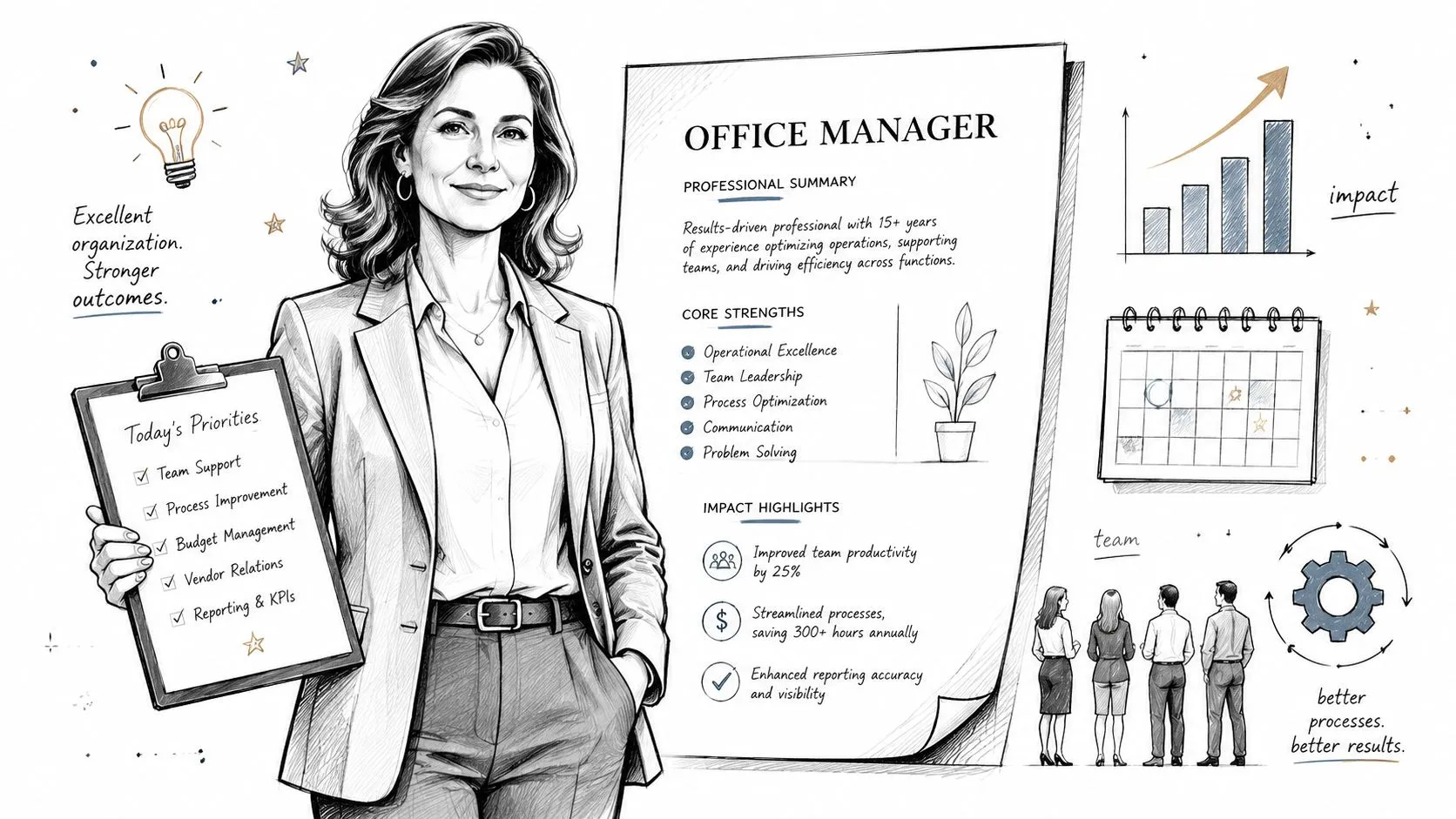
Mid-level office manager resumes should make it obvious that your scope got bigger. More ownership. More systems. More cross-functional work. More leadership.
A hybrid resume format works well here because employers want both software proficiency and proof of progression, and candidates with under 10 years of experience are generally advised to keep the resume to 1 page in Teal's office manager resume guidance.
What hiring managers want to see
Your bullets should answer these questions fast:
- Did you improve a process?
- Did you control costs?
- Did you support leadership?
- Did you manage people, vendors, or facilities?
- Did you make the office run better, not just run?
One real example from office manager resume guidance shows a new inventory tracking system that reduced supply costs by 20%. That's why metrics matter more than task lists. A recruiter can judge that in one second.
Example of a strong mid-level story
Say you moved from administrative coordinator to office manager. Your bullets might look like this:
- Oversaw scheduling, vendor coordination, records management, and day-to-day office support for a growing team
- Partnered with finance, HR, and IT to improve onboarding and equipment setup
- Introduced cleaner inventory tracking and purchasing processes to cut waste and improve consistency
- Managed office policies, supply ordering, and facilities requests while reducing operational friction for staff
That reads like a person who owns operations.
Keep the format tight
Most guidance for this role recommends 3 to 5 accomplishment bullets per job. Good. Stay inside that range. If you need 11 bullets to explain yourself, the problem isn't your experience. It's your editing.
3. Senior Office Manager or Operations Manager Resume
At senior level, stop writing like an administrator. Write like an operator.
That means bigger scope, stronger judgment, and clearer business impact. Your resume should show that you didn't just keep the lights on. You built systems people relied on.
Show enterprise thinking
Senior resumes office manager candidates submit should sound less like support and more like leadership. You want bullets that reflect policy, consistency, scale, and executive trust.
A strong example for multi-site coordination:
Experience Specialist / Regional Office Manager
Multi-Site Operations: Orchestrated daily administrative operations and facility management across 3 regional office hubs (Singapore, Hong Kong, and Sydney), supporting a total headcount of 250+ employees while ensuring standardized workplace policies.
That works because the scope is obvious. Multi-site. Headcount. Standardization.
Another strong example for team leadership:
Supervised and mentored a high-performing administrative support team of 5 direct reports, including receptionists, office assistants, and data entry clerks, implementing weekly syncs and a cross-training framework that improved internal ticketing resolution times by 30%.
That bullet has management, system design, and operational payoff.
The bullets that earn attention
Use examples like these when your experience supports them:
- Built standard operating procedures across multiple offices to improve consistency
- Partnered with executives on workplace operations, budgeting, and team support priorities
- Led office relocation planning, vendor coordination, and internal communications
- Introduced systems that reduced repeat admin work and improved reporting quality
If you're crossing into broader operations roles, sharpen your bullet writing with these operations manager resume bullet point examples.
One more thing. If your resume says "responsible for improving efficiency," that means nothing. Explain the mechanism. You standardized workflows, reduced handoff confusion, or improved visibility. That kind of framing aligns with the logic behind standardizing workflows for better output.
Senior-level resumes should make a recruiter think, "This person reduces chaos."
4. Office Manager Resume for Tech Industry
Tech companies move fast and break basic office processes all the time. That's your opening.
Your resume should show that you bring order without becoming bureaucratic. In tech, the best office managers support velocity. They don't slow everyone down with process theater.

What matters in a tech resume
Show comfort with tools, remote coordination, and changing priorities. Mention real systems if you used them. Slack. Notion. Google Workspace. Envoy. Airtable. Asana. Rippling. Whatever was part of the workflow.
This process-improvement example is strong because it shows the old mess, the fix, and the result:
The office used a fragmented Excel system for visitor logs, courier dispatches, and meeting room bookings. The improvement was implementing Envoy as a centralized workplace platform. The result was automated visitor check-in and inventory tracking, cutting weekly administrative processing time by 12 hours and reducing scheduling conflicts to zero.
That sounds like a tech office manager. You diagnosed friction and fixed it.
Strong example angles for tech roles
A good tech-office resume might show:
- Support for remote onboarding and distributed teams
- Tool rollouts that reduced repetitive admin work
- Workplace systems that helped engineering or product teams focus
- Faster coordination across time zones, departments, and vendors
If the company is a startup, your resume should also show tolerance for ambiguity. You built systems without waiting for perfect instructions.
A useful way to present that:
- Created lightweight office and onboarding processes for a fast-changing team
- Coordinated facilities, equipment, vendor support, and employee requests across hybrid workflows
- Maintained clear communication channels so technical teams could stay focused on delivery
Here's a quick video if you want another angle on office manager resume thinking:
Don't overdo the tech jargon
You're not applying to be an engineer. Mention tools in context. The tool is not the achievement. The improved workflow is.
5. Office Manager Resume for Healthcare and Medical Organizations
In healthcare, an office manager is not just keeping the place organized. You are protecting flow, accuracy, privacy, and trust at the same time. Your resume should make that obvious in the first few lines.
Generic admin language fails here. Hiring teams want proof that you can keep a medical office running without dropped details, confused patients, or avoidable scheduling chaos. That means your resume should show how your work supported care delivery, not just office upkeep.
Start with the pressure points that matter in medical settings:
- Patient scheduling and front-desk coordination
- Insurance, billing, and referral support
- Records accuracy, confidentiality, and secure document handling
- Staff scheduling and provider calendar support
- Vendor, inventory, and medical supply coordination
- Process consistency in regulated environments
If you handled HIPAA-related workflows, audit prep, intake documentation, or sensitive patient communication, state it plainly. Do not hide the serious parts of the job under filler like “general administrative support.”
A weak bullet lists duties. A strong bullet shows control and impact.
Weak:
- Managed administrative tasks in a medical office
Strong:
- Coordinated front-desk operations, appointment scheduling, patient communication, and records handling to keep daily clinic flow organized and support clinical staff
Better:
- Managed scheduling, intake coordination, and records workflows for a busy medical office, reducing front-desk confusion and helping clinicians stay on schedule
That is the difference that matters. This article is not a template dump. The resumes that work in healthcare show why the office trusted you with pressure, privacy, and process reliability.
Your summary should do the same job. Skip buzzwords. Tie your work to patient experience and staff efficiency in one clean statement.
For example:
Office manager with experience supporting medical teams through accurate scheduling, secure records handling, and steady front-office coordination that helps patients move through the office with fewer delays.
One practical rule. Certifications, compliance training, and medical software familiarity deserve space when the role asks for them. Put them where they are easy to find. Do not make a hiring manager hunt for relevant credentials.
If your background is partly outside healthcare, translate it hard and fast. Show the overlap in documentation, scheduling, confidentiality, and process control. This guide on how to write a resume for a career change helps with that. For another useful angle on repositioning experience, see Access Courses Online's career change guide.
Keep your claims clean. Do not say you improved patient outcomes unless you directly influenced a measured clinical result. Say what you controlled. Scheduling accuracy. Communication. Records handling. Compliance support. Systems that made the office easier to run.
6. Career Changer Office Manager Resume
Career changers need a different strategy. Not a different level of honesty. A different strategy.
Don't pretend your past was office management if it wasn't. Translate it. That's the move.

A lot of office manager advice assumes you already held the title. That's a real gap. Few sources explain how adjacent experience gets turned into a credible office-manager narrative, which is exactly the issue called out in Indeed's office manager resume guidance.
Translate the work you already did
Teachers, retail supervisors, military veterans, customer service leads, and executive assistants often have stronger office-manager material than they think.
Examples:
- Teacher: scheduling, documentation, parent communication, materials coordination, policy enforcement
- Retail manager: staffing, inventory, vendor communication, customer conflict handling, process consistency
- Military veteran: logistics, coordination, reporting, procedural discipline, support operations
- Executive assistant: calendar ownership, cross-functional communication, executive support, meeting logistics, discretion
Your summary should say the pivot out loud. Not apologetically. Directly.
For example:
Operations-focused professional transitioning into office management after years of coordinating schedules, people, documentation, and day-to-day logistics in fast-paced environments.
That works because it sounds intentional.
Example bullets for a career changer
A retail supervisor could write:
- Coordinated staff schedules, supply ordering, and daily operational issues across a high-traffic location
- Trained team members on procedures, customer service standards, and task prioritization
- Worked with vendors and internal stakeholders to keep operations consistent and responsive
A teacher could write:
- Managed complex scheduling, documentation, and communication across students, families, and staff
- Built repeatable classroom systems that improved organization and reduced administrative friction
If you're making a pivot, this career change resume guide is useful for framing the transition without sounding scattered. Another outside perspective on reframing experience comes from Access Courses Online's career change guide.
Your past job title matters less than the systems, coordination, and ownership you can prove.
7. Office Manager Resume for Non-Profit and Mission-Driven Organizations
Non-profit office management isn't "lighter" operations. It's leaner operations. Usually with less margin for waste.
That means your resume should show resourcefulness, board support, volunteer coordination, grant-related discipline, and calm execution in messy environments.
Mission matters, but proof matters more
If you care about the mission, great. Put that in the summary. Then back it up with operational evidence.
Strong bullets in this sector often show:
- Volunteer coordination
- Program support
- Grant documentation or reporting support
- Board meeting logistics
- Purchasing discipline
- Office systems that help small teams do more
A good example:
- Coordinated office operations, volunteer scheduling, and board meeting logistics while maintaining accurate records and supporting program delivery
That says mission-driven without becoming sentimental.
Show efficiency without sounding corporate
Plenty of people write non-profit resumes like they're trying to impress a donor. Wrong audience. The hiring manager wants to know if you can keep things stable.
So write bullets like this:
- Managed administrative workflows for a lean team, improving consistency in scheduling, documentation, and day-to-day support
- Supported leadership with meeting prep, records organization, and vendor coordination so program staff could stay focused on delivery
- Maintained organized processes for communications, files, and recurring administrative tasks in a resource-constrained environment
If you helped a mission-driven organization serve more people, mention that. If you managed grants or reporting support, mention that too. Just don't hide weak office experience behind strong values language.
7-Point Office Manager Resume Comparison
| Resume Type | Implementation Complexity 🔄 | Resource Requirements ⚡ | Expected Outcomes 📊 | Ideal Use Cases 💡 | Key Advantages ⭐ |
|---|---|---|---|---|---|
| Entry-Level Office Manager Resume (Recent Graduate) | 🔄 Low, narrative-focused, needs curated examples | ⚡ Low, time to extract academic/volunteer metrics | 📊 Moderate, highlights potential; may need ATS tweaks | 💡 New grads, first-time admins, career starters | ⭐ Shows transferable skills, growth mindset |
| Mid-Level Office Manager Resume (5–10 Years) | 🔄 Moderate, quantify impact and progression | ⚡ Moderate, collect metrics, team and project details | 📊 High, demonstrates measurable value and readiness for advancement | 💡 Candidates seeking senior administrative or ops roles | ⭐ Balanced leadership + technical competence |
| Senior Office Manager / Operations Manager Resume (10+ Years) | 🔄 High, distill extensive experience into concise strategy | ⚡ High, gather enterprise metrics, certifications, thought leadership | 📊 Very High, positions for executive/operations leadership | 💡 Senior leaders, executives, consultants | ⭐ Enterprise impact, strategic credibility |
| Office Manager Resume for Tech Industry | 🔄 Moderate, emphasize tools, remote processes, culture | ⚡ Moderate, document platform proficiencies and automations | 📊 High, signals fast fit for tech environments | 💡 Startups, scale-ups, remote/hybrid tech teams | ⭐ Technical literacy and culture alignment |
| Office Manager Resume for Healthcare/Medical Organizations | 🔄 Moderate–High, must demonstrate compliance and clinical workflows | ⚡ Moderate, include EHR, HIPAA experience, regulatory examples | 📊 High, conveys compliance and patient-facing operational competence | 💡 Clinics, medical practices, hospitals | ⭐ Compliance expertise and patient-centered operations |
| Career Changer Office Manager Resume (Non‑Traditional Background) | 🔄 Moderate, craft a clear pivot narrative and transferable skills | ⚡ Low–Moderate, map past achievements to office tasks | 📊 Moderate, opens doors if transition is well-framed | 💡 Professionals pivoting from teaching, military, retail, etc. | ⭐ Highlights diverse perspective and adaptability |
| Office Manager Resume for Non-Profit / Mission-Driven Organizations | 🔄 Moderate, emphasize mission impact and resourcefulness | ⚡ Low–Moderate, gather impact metrics, grant/volunteer experience | 📊 High, resonates with mission-focused employers | 💡 Non-profits, social enterprises, educational orgs | ⭐ Demonstrates resourcefulness and mission alignment |
Stop Filling Boxes. Start Telling Your Story.
Templates are overrated. Hiring managers do not care which layout you picked. They care whether your resume proves you can run an office without chaos.
That is the standard.
Strong office manager resumes make responsibility easy to see. They show where you owned the work, what improved because of you, and how your decisions saved time, money, or frustration. The format matters far less than the clarity. A clean reverse-chronological or hybrid structure works because it keeps the evidence easy to scan. Short bullet sets work because they force you to cut the fluff.
This is the mistake that kills a lot of office manager resumes. People describe motion instead of impact.
“Managed calendars.” Fine. For whom? At what volume? What got better because you handled it well?
“Ordered supplies.” Weak. Did you cut waste, avoid stockouts, or standardize purchasing?
“Supported the team.” Meaningless. Did you improve onboarding, fix scheduling gaps, or keep projects from stalling?
That is the core function. You reduce friction. You keep records usable. You coordinate vendors. You protect budgets. You keep teams moving. Your resume should make that visible in plain English.
If you do not have the office manager title yet, that does not disqualify you. Administrative coordinators, executive assistants, receptionists, supervisors, teachers, and operations-heavy professionals often have the right experience. They just undersell it. They hide ownership behind soft language and bury results inside task lists.
Stop doing that.
Use your summary to frame your value in one clear sentence. Use your bullets to prove it with outcomes. Match the job description where it is honest, especially for tools, systems, budgets, scheduling, compliance, or team support. Keep it tight. One page is enough for many candidates. A second page only earns its place if the added experience shows bigger scope, stronger leadership, or more complex operations.
If you need help pulling stronger material out of messy experience, StoryCV can help. It works as a digital resume writer, using a guided interview to draw out context, achievements, and clearer language. That is useful if you know you have done solid work but your resume still reads like a duty log.
Your resume also has to match the rest of your job search. Clean up your online footprint and build a professional online presence that supports the story your resume tells.
Stop filling boxes. Write the case for why your work makes operations run better.
If you're tired of generic bullets and blank templates, try StoryCV. It helps turn your experience into a sharper, more credible resume narrative without making you write the whole thing from scratch.