“You increased sales by 30%” is popular resume advice. It's also useless if your work didn't touch sales, or if nobody ever handed you a dashboard with neat numbers. The common issue isn't a writing problem. It's a remembering problem.
Your resume feels flat because you're trying to describe your job. Stop. A great resume isn't a list of tasks. It's a highlight reel of decisions and results. Recruiters spend only 6 to 8 seconds on each resume, so vague bullets die fast.
Good achievements to put in a resume don't start with responsibility. They start with impact. Money made. Time saved. Problems prevented. Teams aligned. Systems launched. People developed.
That's the shift.
You're not “responsible for client onboarding.” You built an onboarding checklist that cut errors. You're not “worked with product and sales.” You got two teams to agree on one launch plan. You're not “managed operations.” You removed friction that kept work moving.
The fastest way to write stronger bullets is to sort your work by impact type, not by job title. That gives you better raw material and makes your achievements legible to hiring managers in any industry.
Use the categories below to pull your work out of memory and turn it into proof. If you have hard numbers, use them. If you don't, use concrete outcomes, scope, and change. Either way, stop narrating duties. Start showing what changed because you were there.
1. Quantified Business Impact (Revenue, Cost Savings)
Money talks first.
If your work increased revenue, protected revenue, cut spend, improved margin, or stretched a budget further, lead with it. This category translates across industries because every hiring manager understands business impact fast.
The mistake is obvious. People write as if they own the entire company result. Don't. Name the specific lever you changed, then show the financial effect.
Write the financial delta
Strong examples:
- Vendor strategy: Restructured vendor contracts, reducing procurement spend by $240K annually while maintaining quality standards.
- Retention work: Launched customer retention campaign that decreased churn by 18% and added $1.2M in retained annual value.
- Operational lift: Optimized warehouse logistics, cutting fulfillment time from 4 days to 2 days and reducing overtime costs by 32%.
Weak examples:
- Vague ownership: Helped improve company revenue.
- Task language: Responsible for budget management.
- No outcome: Worked on cost-saving initiatives.
Good bullets make one thing clear. The business was better off because of your action.
Show your lever, not just the number
Revenue and savings bullets fail when they skip the mechanism. A hiring manager wants to know what you changed. Pricing. Contracts. Forecasting. Renewal process. Inventory flow. Channel mix. Staffing model.
Use a simple structure: action, metric, business result.
A sharper version looks like this:
- Renegotiated freight contracts across 12 vendors, cutting annual shipping costs by 14% and saving $310K.
- Revised renewal outreach sequence for at-risk accounts, increasing renewals by 11% and protecting $850K in ARR within two quarters.
- Reworked paid search budget allocation by intent stage, lowering cost per acquisition by 27% while keeping lead volume flat.
That works because the bullet shows judgment, not luck.
Make the number credible
Add a timeframe. Show the before state. Keep your scope honest.
“Reduced overtime costs by 32% in six months” is believable. “Saved the company millions” sounds inflated unless you can prove exactly how. If your metrics are fuzzy, tighten them before they hit the page. This guide on how to use metrics in a resume helps you turn rough results into clean, defensible bullets.
If you need more models, study these resume achievement writing examples. The pattern is simple. State what you changed. Show the financial result. Make your contribution impossible to miss.
2. Process Improvement or Efficiency Gain
Efficiency is business value in plain clothes.
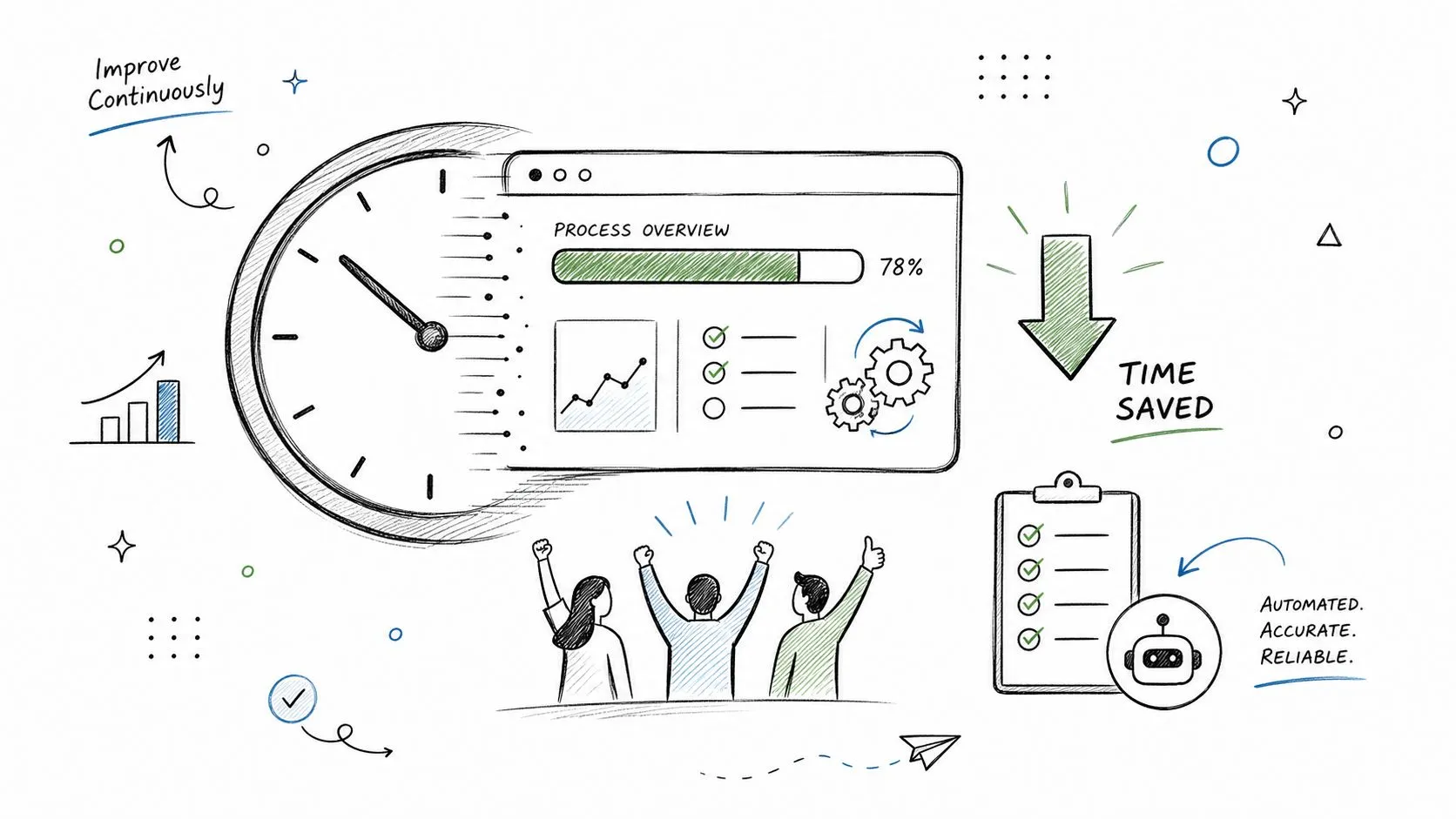
If you made work faster, cleaner, or harder to break, put that on the resume. Hiring managers read process wins as proof of operating judgment. You saw friction, fixed it, and made the team better at execution.
Show the friction you removed
Good bullets do not say “improved operations.” They show what was slowing the work down and what changed.
Strong examples:
- Automation: Built an automated reporting dashboard, cutting weekly status prep from 6 hours to 30 minutes for the ops team.
- Workflow redesign: Combined three approval paths into one system, reducing project-to-launch cycle time from 8 weeks to 5 weeks.
- Error reduction: Created an intake template and onboarding checklist, reducing contract setup errors by 94% and cutting onboarding time by 40%.
These bullets work because they translate effort into impact. Not revenue impact. Process impact. That still matters. In a lot of roles, process is the value.
Make the improvement concrete
Name the fix. Name the users. Name the lasting effect.
Use specifics like dashboard, SOP, CRM automation, intake form, approval flow, Jira workflow, or Excel model. Then show who benefited. Ops team, support reps, finance, managers, new hires. Last, prove it held. Adopted across the team. Used as the standard process. Rolled out to another function.
That last part matters. A one-off shortcut is less impressive than a repeatable system.
If the process improvement came with bigger ownership, show that too. It often supports a promotion story. This guide on how to show a promotion on a resume helps you present that clearly.
If you are struggling to find the right proof, start with time saved, error reduction, cycle time, backlog cleared, or handoffs removed. This guide to resume metrics that actually matter can help you turn that work into a sharp bullet.
Faster gets noticed. Faster, cleaner, and repeatable gets interviews.
3. Scope Expansion or Promotion Within Role
A promotion matters. Expanded trust matters too.
A lot of mid-career professionals undersell this. They write “took on additional responsibilities,” which says nothing. Say what changed. Say who trusted you with more. Say how much more complex the role became.
For mid-level resumes, keep each role to 3 to 5 bullet points. One of those bullets should often be the scope-growth story.
Prove that your lane got bigger
Examples:
- Portfolio growth: Started as account manager for 8 clients; expanded portfolio to 23 enterprise accounts while maintaining 98% retention rate.
- Role elevation: Began as junior copywriter; promoted to own product marketing for three product lines and manage two freelance writers.
- Broader ownership: Hired as customer success rep; added responsibility for partner integrations, reducing partner support tickets by 45% through proactive onboarding.
That reads as trust. And trust is a hiring signal.
What to include
- Original scope: Team, client count, region, product line, function.
- Expanded scope: New business unit, more headcount, larger accounts, added technical ownership.
- Performance continuity: You didn't just inherit more. You handled more and kept results strong.
If you were promoted, show it clearly instead of burying it under one date range. This guide on how to show a promotion on a resume gets the formatting right.
Don't write “assisted with strategic initiatives.” Write the actual expansion. More budget. More people. More products. More complexity.
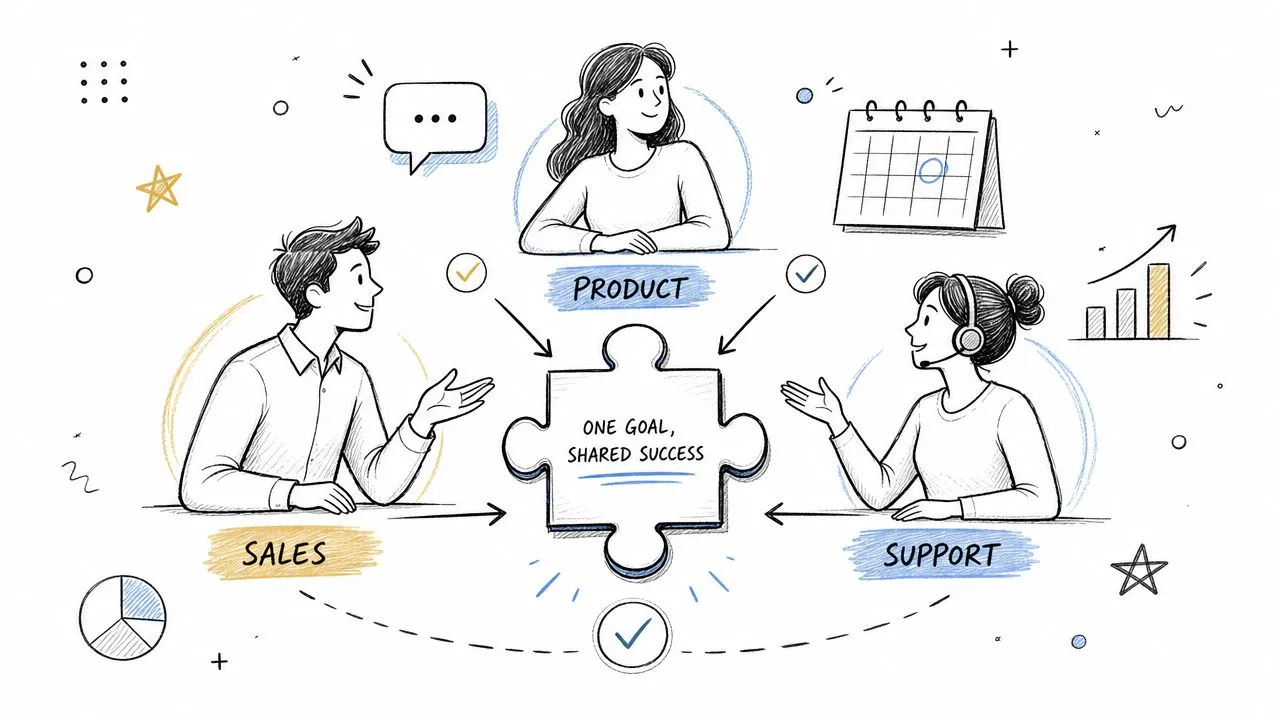
4. Cross-Functional Collaboration or Alignment
“Collaborated with cross-functional teams” is one of the weakest lines in modern resumes. Everyone writes it. Almost nobody proves it.
Real collaboration means something was misaligned, blocked, political, or slow. Then you helped people move together anyway. That's valuable because companies run on coordination failures.
Name the gap you closed
Examples:
- Roadmap conflict: Facilitated alignment between engineering and design on new feature roadmap; resolved a 6-month disagreement through monthly workshops, resulting in on-time launch.
- Lifecycle handoff: Bridged sales and customer success teams to create unified onboarding flow; reduced post-sale churn by 22% and improved NPS by 11 points.
- Shared priorities: Negotiated shared KPIs across marketing and product; aligned three previously siloed teams around one quarterly goal, increasing feature adoption by 34%.
Make collaboration concrete
Don't say “worked cross-functionally.” Say:
- Who was involved: Sales, Product, Support, Finance, Legal, Ops.
- What was broken: Conflicting KPIs, duplicate handoffs, roadmap tension, launch delays.
- What changed: Faster launch, cleaner onboarding, better adoption, lower churn.
Shared work still counts. If credit was shared, use “worked with” or “partnered with.” You don't need to fake solo heroics.
This category is gold for managers, PMs, operators, senior ICs, and anyone who gets work done through influence instead of formal authority.
5. Customer or User Satisfaction Metric (NPS, CSAT, Retention)
Plenty of candidates talk about being customer-focused. Very few show what changed for the customer.
That's a miss. Satisfaction metrics are strong achievements to put in a resume because they connect experience quality to business value. People renew, stay, expand, and refer when the experience improves.
Use the customer signal, then the business result
Examples:
- Lifecycle messaging: Redesigned post-purchase communication series; improved customer NPS from 32 to 51 and repeat purchase rate by 27% within 6 months.
- Voice-of-customer work: Led customer feedback program that identified pain points; implemented top 5 product improvements, resulting in 89% customer satisfaction, up from 71%.
- Account health: Developed proactive support model for high-risk accounts; reduced churn in segment from 18% to 6% annually while increasing expansion revenue by 12%.
These work because they don't stop at “customers were happier.” They show why that mattered.
Don't fake softness into vagueness
If you work in support, customer success, product, UX, operations, healthcare, education, or service delivery, this category is especially useful.
Use this structure:
- Metric first: NPS, CSAT, retention, repeat purchase, renewal rate.
- Action second: Communication redesign, support model, feedback analysis, product fix.
- Business tie-in last: Expansion, lower churn, more referrals, stronger retention.
Even if you don't have formal scores, you can still write outcome-based bullets. Shorter response times. Fewer escalations. Better onboarding completion. Clearer handoffs. Just keep it concrete.
6. Technical Implementation or Launch
Shipping matters. Launches are visible. Systems either went live or they didn't.
This category is obvious for engineering and product. It also works for operations, marketing, HR, finance, and customer teams. If you implemented a CRM, launched a self-serve knowledge base, migrated data, rolled out a new workflow, or introduced a tool people now rely on, that counts.
A projects section can be powerful when it includes real impact, such as a tool used by 800+ users or an error rate reduced to less than 0.3%.
Here's the visual version of that lifecycle.

Launch bullets that work
Examples:
- API rollout: Architected and launched customer API; now integrated by 47 third-party partners, generating $2.3M in annual partnership revenue.
- Internal tooling: Built internal knowledge base and search system from scratch; adopted by 94% of support team, reducing average ticket resolution time by 18%.
- Migration work: Implemented new CRM and migration workflow for 8,000+ existing contacts; on-time launch with 99% data integrity and zero unplanned downtime.
The pattern is simple. Say what you launched. Say who uses it. Say what changed because it exists.
Scope, adoption, constraints
The best launch bullets include three things:
- Scope: Product, feature, system, migration, integration.
- Adoption: Users, teams, partners, usage rate, transaction volume.
- Constraints: Legacy system, fixed deadline, compliance requirement, budget limit.
For project management roles, specificity is especially strong. A PM example like leading a cross-functional team of 15 developers on a $500K mobile app project that increased user engagement by 30% is cited as a strong benchmark in LinkedIn's project achievement guidance.
A short explainer helps if you want to think about launches from the hiring side.
7. Leadership, Mentoring, or Team Building
Leadership belongs on a resume only when it changed team output.
Hiring managers do not care that you were supportive, collaborative, or well-liked. They care that people ramped faster, performed better, stayed longer, or grew under your guidance. That is business impact. In this section, the impact shows up through people.
Show leadership as team performance
Examples:
- Team building: Built and mentored junior developer team from 2 to 7 people. 5 of 6 junior hires earned promotions or moved into stronger roles within 2 years.
- Enablement system: Created onboarding curriculum for customer success hires. Reduced time-to-productivity from 8 weeks to 4 weeks and improved first-year retention by 31%.
- Coaching cadence: Set weekly feedback and career-pathing process for direct team. 89% of team received a promotion, raise, or expanded scope within 18 months.
These bullets work because they tie leadership to measurable outcomes. Better hiring. Faster ramp. Stronger retention. More promotions.
Leadership without direct reports
Plenty of strong leadership bullets come from individual contributors. If your work made other people more effective, it counts.
Use this category if you:
- Mentored newer teammates
- Built onboarding or training materials
- Ran team rituals that improved execution
- Created documentation that cut repeated questions
- Helped other teams solve problems faster
For mid-career resumes, include concrete leadership signals such as team size, budget ownership, or business results. Some career experts also suggest targeting a high ATS keyword match rate, including the 90%+ benchmark referenced in these impact-driven resume tips for mid-to-senior professionals.
The strongest leadership bullet leaves a system behind. Training program. Hiring process. Feedback rhythm. Documentation set. Something that kept working after you stepped away.
“Mentored team members” is vague. “Built onboarding curriculum used by every new hire” is resume material.
8. Risk Mitigation, Quality, or Compliance Achievement
Some of the best work never becomes a celebration. It becomes a non-event. No outage. No fraud loss. No failed audit. No broken release.
That still belongs on your resume.
In finance, healthcare, security, legal, operations, and enterprise tech, prevention is business value. Quiet value, but real value.
Write the downside you prevented
Examples:
- Transaction control: Implemented data validation rules that caught $1.4M in erroneous transaction attempts before processing; prevented customer fund loss and regulatory exposure.
- Audit readiness: Established security audit schedule and remediation process; passed SOC 2 compliance audit on first attempt with zero findings.
- Quality discipline: Built quality assurance framework for product releases; reduced production defects by 67% and associated support tickets by $840K annually.
That gets attention because the stakes are obvious.
Use the CAR method
The cleanest way to write bullets in this category is the CAR framework. Challenge, Actions, Results. It forces you to name the problem, your response, and the outcome in one line, as outlined in UMass Global's guide to accomplishment statements.
Try it like this:
- Challenge: Audit risk, release defects, bad data, compliance exposure.
- Actions: Built controls, redesigned checks, created schedule, implemented review gates.
- Results: Errors caught, audit passed, defects reduced, exposure avoided.
This also helps people in less obviously measurable roles. If you can't show revenue, show risk reduction, turnaround time, satisfaction, quality, or project volume. Executive resume guidance makes the same point with examples like projects delivered 3 days ahead of deadline, 95% positive feedback, or 10+ initiatives with zero delays.
8-Point Resume Achievement Comparison
| Achievement | Complexity 🔄 | Resources ⚡ | Expected outcomes 📊 | Ideal use cases 💡 | Key advantages ⭐ |
|---|---|---|---|---|---|
| Quantified Business Impact (Revenue, Cost Savings) | Medium, requires data isolation and causal attribution | Medium, access to finance/analytics and stakeholder validation | High, clear $/%, time-bound revenue or cost deltas | Senior roles, P&L owners, revenue- or cost-focused functions | Instant credibility with hiring managers; ATS-friendly |
| Process Improvement or Efficiency Gain | Medium, process design plus change management | Low–Medium, tooling and modest cross-team effort | Medium, time saved, fewer errors, recurring efficiency | Operations, support, PMs, anyone optimizing workflows | Demonstrates problem-solving and tangible operational value |
| Scope Expansion or Promotion Within Role | Low–Medium, documenting growth and responsibilities | Low, internal evidence (accounts, teams, projects) | Medium, increased scope metrics (users, accounts, projects) | Career narratives, internal moves, ICs showing growth | Signals promotability and employer trust |
| Cross-Functional Collaboration or Alignment | High, stakeholder negotiation and orchestration | Medium–High, multiple teams, meetings, facilitation | Medium–High, faster launches, reduced churn, shared KPIs | Product, program management, change initiatives | Shows leadership potential and organizational savvy |
| Customer or User Satisfaction Metric (NPS, CSAT, Retention) | Medium, survey design and attribution work | Medium, data collection, product/service changes | Medium, improved NPS/CSAT, retention, referral lift | Customer success, product, service design roles | Credible human-centered impact; ties to long-term value |
| Technical Implementation or Launch | High, engineering, integrations, strict timelines | High, dev resources, QA, migration and adoption efforts | High, live product/feature with adoption and usage metrics | Engineering, product management, technical PMs | Concrete, demo-able outcome that proves execution ability |
| Leadership, Mentoring, or Team Building | Medium, people development and program design | Medium, time, frameworks, mentorship systems | Medium, promotions, faster ramp, improved retention | Managers, senior ICs, talent development leads | Signals scalability and readiness for higher responsibility |
| Risk Mitigation, Quality, or Compliance Achievement | High, frameworks, audits, prevention systems | Medium–High, tooling, controls, audit preparation | High, avoided losses, fewer defects, compliance success | Finance, healthcare, security, regulated industries | Reduces liability and is highly valued in risk-aware firms |
Stop Describing. Start Proving.
A resume is a sales document. If your bullets read like a task list, they fail.
Recruiters are not hiring you to "manage schedules," "support operations," or "assist with projects." They are hiring for outcomes. Revenue gained. Time saved. Risk reduced. Teams aligned. Customers retained. That is why this framework works. It translates your experience into business value, no matter your title.
Use the eight categories above as filters. Sort your work by impact type, not by department or seniority.
- Quantified business impact
- Process improvement
- Scope expansion
- Cross-functional collaboration
- Customer or user satisfaction
- Technical implementation
- Leadership and mentoring
- Risk mitigation, quality, or compliance
Then write bullets that prove something happened. Start with the action. Add the context only if it sharpens the point. End with the result.
Perfect metrics are helpful. They are not required.
If you work in HR, education, administration, support, or an early-career role, hard numbers may be incomplete or unavailable. Use other proof. Show that you improved turnaround time, increased adoption, expanded ownership, reduced errors, strengthened quality, or made a process easier to run. That is still evidence. Discussions like this resume thread on writing achievements without measurable data show how common this problem is.
Non-traditional experience counts too. Volunteer leadership, freelance work, internal initiatives, academic projects, and side projects all belong on a resume if they show real execution and a clear result. The test is simple. Did the work create value for someone? If yes, it can earn a bullet. If you need a structure for turning raw experience into stronger statements, these skills-first STAR resume examples are a useful reference.
Tailoring matters. Generic resumes get ignored because generic resumes force the recruiter to do the translation work. Do it yourself. Pull the key outcomes from the job posting. Then match each requirement to one of your strongest proof points from the eight categories.
If you want help turning rough experience into sharper bullets, StoryCV is one option. It is an online resume writer that uses a guided interview to surface context, outcomes, and stronger evidence-based language.
Stop listing what you were responsible for. Show what changed because you were there.
If your experience is stronger than your resume, StoryCV helps close that gap. It interviews you, pulls out the context behind your work, and turns it into sharper, evidence-based resume bullets without forcing you into dead templates.