Yes, a little. ChatGPT can improve your resume the way a good copyeditor improves a memo. Cleaner sentences. Fewer clunky verbs. Less puffed-up nonsense. Useful. Limited.
That matters more than people admit. In a 2023 survey covered by CNBC, 70% of job candidates reported a higher response rate when they submitted an AI-generated resume rather than a non-AI version. If you're already optimizing resumes with AI, that instinct isn't foolish. It just has a ceiling.
The ceiling is the point. ChatGPT improves wording. Most resumes don't fail on wording. They fail because the bullets are thin, generic, and forget the only part a hiring manager needs: what changed because you were there. If you're weighing ChatGPT against a fuller writing process, this distinction matters more than another prompt tweak. StoryCV's own take on that trade-off is worth reading in this breakdown of AI resume writer vs ChatGPT.
So, Can ChatGPT Improve My Resume?
Yes, but mostly in the same way a sharp editor improves a draft. The sentences get cleaner. The wording gets tighter. The rough edges come off.
That is useful. It also gets oversold.
If your resume reads like it was written at 11:47 p.m. after three rounds of "just one more tweak," ChatGPT can help fast. It fixes awkward phrasing, trims bloated bullets, and swaps out tired verbs without asking you to pretend this is a good use of your evening.
That kind of help is real. It just lives on the surface.
What the honest yes actually means
ChatGPT does well with editing tasks that are visible on the page:
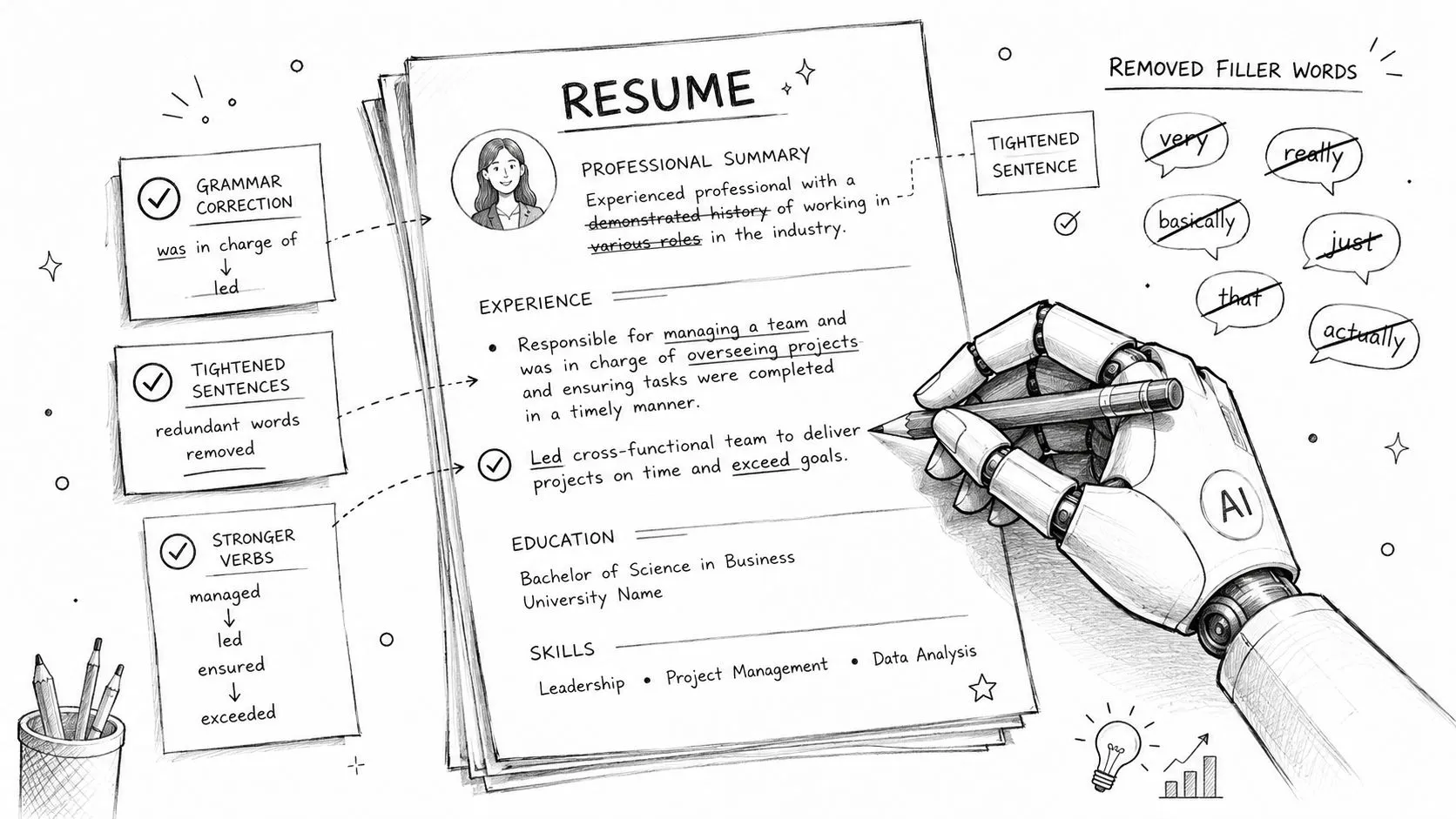
- Cleaning grammar: It catches obvious errors and clumsy syntax.
- Tightening bullets: It cuts filler and shortens long sentences.
- Refreshing verbs: It gives repetitive language a little range.
- Improving keyword fit: It can mirror the language in a job description so your resume reads closer to the role.
That last one is why people keep optimizing resumes with AI. Fair enough. If the wording is weak, AI can improve the wording.
The catch is simple. Resume wording is rarely the whole problem. Strong phrasing cannot rescue thin evidence, vague ownership, or bullets that never explain what changed because you did the work. If you want a clearer look at that trade-off, StoryCV breaks it down well in this comparison of AI resume writer vs ChatGPT.
ChatGPT can improve the language. It cannot remember the project you forgot to mention, the conflict you handled, or the messy win hidden inside a bland bullet. That part still depends on you.
The Limits of Polish
Polish isn't fake. It has value. A resume full of small errors can die before anyone gets to the second bullet. According to Flair's roundup of resume statistics, spelling or grammar errors lead to rejection by approximately 77% of hiring professionals. So yes, fixing the sentence matters.
Where ChatGPT earns its keep
Use it for the parts humans are bad at after the tenth revision:
- Error checking: It spots grammar, agreement, and awkward phrasing.
- Compression: It cuts a bullet from rambling to readable.
- Verb variety: It helps when every line starts with "managed" or "responsible for."
- Removing filler: It strips phrases that sound important and say nothing.
A lot of resumes also need better length discipline. One analysis of 176,220 resumes found that 69% fell between 200 and 400 words, which tells you most resumes are not novels: resume word count analysis. Another benchmark cited by StandOut CV says resumes between 475 and 600 words are statistically the most effective for securing interviews: resume statistics benchmark. The exact target depends on your level, but the broad lesson is simple. Brevity matters. So does saying enough.
What polish cannot repair
Polish doesn't change the underlying material.
If a bullet says, "Managed cross-functional teams to deliver strategic initiatives," ChatGPT can make it smoother. It still won't tell me what you did. It won't tell me what the project was, what trade-off you made, or why your work was any different from the next candidate's.
Practical rule: Use ChatGPT after you've decided what the bullet means, not before.
That's the line. Editing is not the same thing as thinking.
Words Versus Substance
A resume bullet carries a claim about your judgment.
That gets lost in a lot of advice about whether ChatGPT can improve your resume. The advice treats the problem like a wording issue. For plenty of candidates, it is a memory issue. The details that make a bullet persuasive are usually still trapped in your head, buried under meetings, launches, and half-forgotten fire drills.
The substance gap
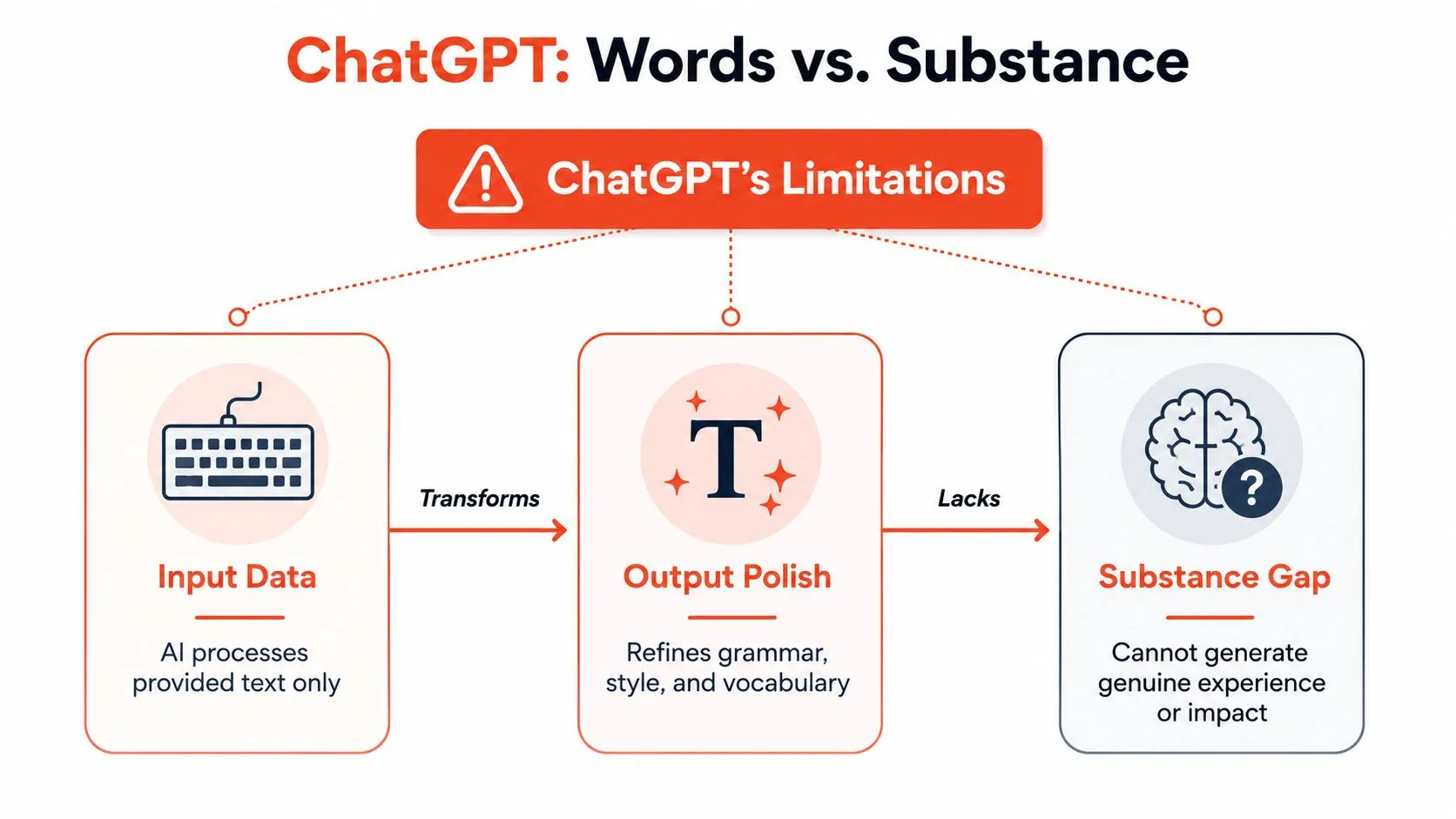
ChatGPT can only work with the draft in front of it. Fair enough. If the draft is thin, the rewrite stays thin. Cleaner words do not supply missing context.
The missing context usually looks like this:
| Missing substance | What hiring managers actually want |
|---|---|
| The problem | What was broken, delayed, risky, or unclear |
| Your call | What you changed, chose, or pushed through |
| The trade-off | What you cut, protected, simplified, or accepted |
| The result | What improved because of your work |
That is the fundamental limit. AI has no access to your memory of the project, the messy constraint, or the decision you made when two decent options were on the table. It can rewrite the sentence. It cannot remember the work for you.
This matters most once you are past entry level. At that point, hiring managers are not buying tidy phrasing. They are buying evidence of judgment. If you need help identifying the proof points, this guide on how to use metrics in a resume will do more for your bullets than another pass of polished paraphrasing.
Substance is what makes a bullet credible
A job title tells me your lane. A strong bullet tells me how you operated in it.
"Owned roadmap planning" is grammatical and useless. It gives me no problem, no choice, no pressure, no consequence. It could describe excellent work or ceremonial calendar maintenance.
A good bullet makes a case. It shows what needed fixing, what you did, and why that mattered. The wording can stay plain. Plain is fine. Plain with specifics beats stylish fog every time.
The same problem shows up in other AI outputs. Tools can generate realistic AI images. They still cannot tell whether the face matches the person who did the work. Resume writing has the same split. Surface accuracy is possible. Lived context is not.
Your best bullet usually comes from better recall, not better vocabulary.
An Example of Fluent Emptiness
This is easier to see than to explain.
Before, after, and actually useful
Original bullet
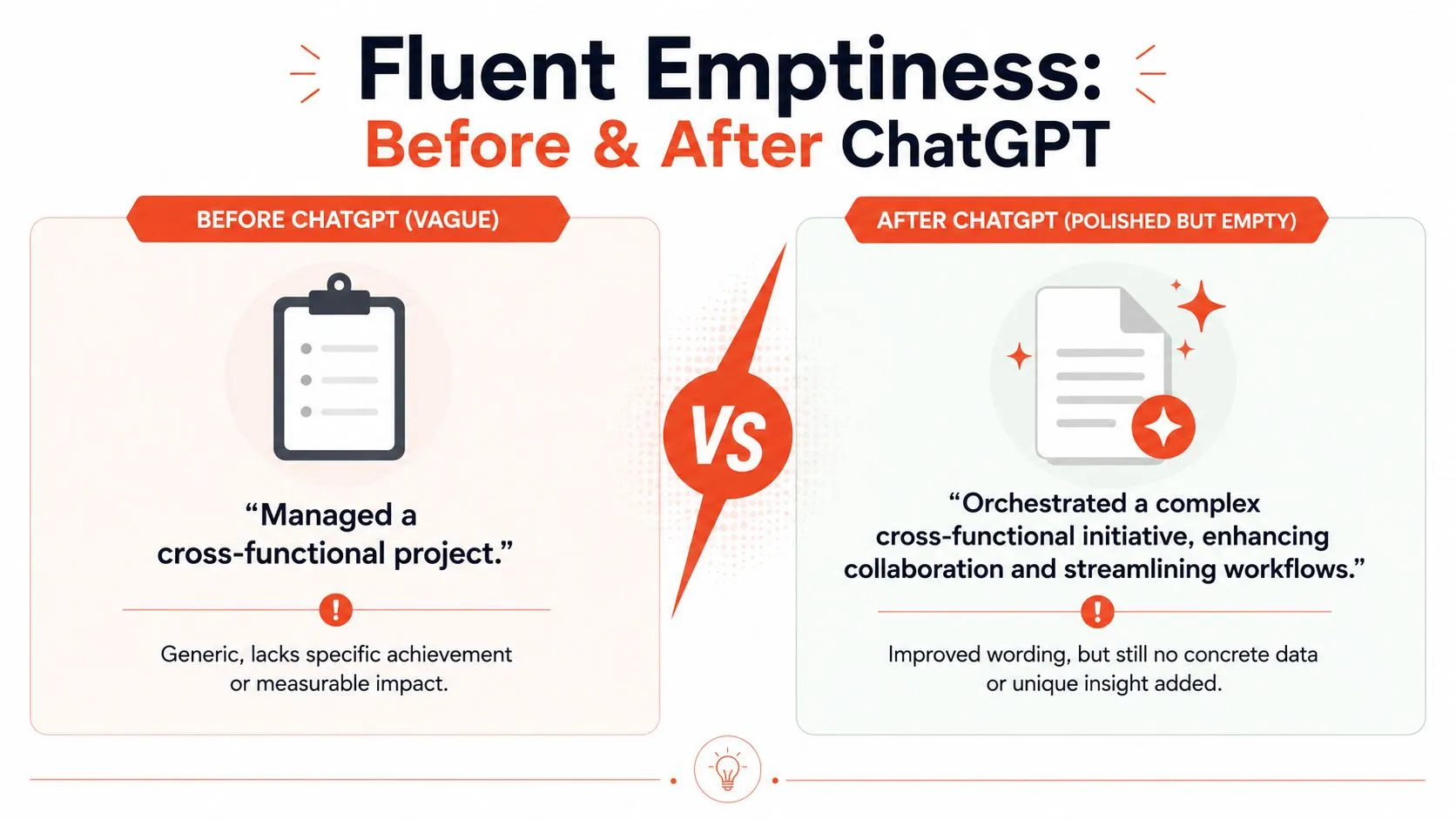
- Vague draft: Managed a cross-functional project team.
ChatGPT version
- Polished draft: Spearheaded a cross-functional project team to drive key initiatives and improve collaboration across stakeholders.
Looks nicer. Says almost nothing.
Human version with memory
- Substantive draft: Led engineering, design, and operations to simplify the onboarding flow after support issues piled up; cut steps, resolved ownership gaps, and shipped the revised process on schedule.
That last bullet works because it contains a situation, a decision, and a result in plain English. No fireworks. Just signal.
The risk of plausible fiction
This is also where AI gets slippery. Guides often skip the context gap, which is the part where a model fills missing detail with something that sounds right. The MEPIS discussion on AI resume advice calls out that problem directly: AI can invent plausible but false achievements when it lacks your hidden work history.
That matters because the bad version isn't always obviously bad. It's like those tutorials on how to generate realistic AI images. They can look convincing from a distance. Then a hand has too many fingers and the illusion collapses. Resume bullets fail the same way. Smooth first impression. Weirdly empty under one follow-up question.
If you want to see how that "too smooth" problem shows up in resumes, this piece on how to tell if a resume is AI generated is a useful companion.
Fluent isn't the same as credible.
That's why "make this sound more professional" is a dangerous instruction. It often trades plain truth for polished fog.
Writing Starts with Remembering

If you want real improvement, don't start by rewriting. Start by recalling.
The useful questions are plain:
- What was the mess? What problem existed before you stepped in?
- What did you decide? Not the team. You.
- What changed course? What got cut, fixed, clarified, accelerated, or saved?
- What happened next? What moved because of that work?
The work before the writing
Most resume bullets need more than a tune-up. According to StoryCV's analysis, effective resumes often require rewriting 70% to 80% of their bullet points to mirror job descriptions and include measurable achievements: why resume rewriting takes judgment.
That's not a formatting problem. That's an editorial problem.
A chatbot starts with your existing text. A real resume-writing process starts with the missing context behind it. That's also why adjacent prep work helps. If you're preparing stories for interviews too, this guide on AI guidance for behavioral interviews is useful because it pulls on the same thread: decisions, trade-offs, outcomes, not decoration.
A better order of operations
Try this sequence instead:
- List the moments that mattered: launches, fixes, turnarounds, handoffs, process changes.
- Name your role in plain language: what you chose, pushed, resolved, or protected.
- Only then edit: use ChatGPT to compress, sharpen, and clean.
That's the part many people skip because it feels slower. It is slower. It also produces bullets that survive contact with an actual interviewer.
The Argument for Your Work
ChatGPT can improve your resume's sentences. It can't improve your memory, your judgment, or your evidence. Those are the resume.
StoryCV is an online resume writer built for the part ChatGPT can't do well: turning half-remembered work into a clear argument for why you should be hired. It starts with your story, not your existing text. Then it writes like an editor, at software speed.