Most business analyst resume advice is wrong. It tells you to list tools, add keywords, and polish formatting. Fine. None of that fixes the underlying problem.
Your business analyst resume usually gets rejected because it reads like an IT task log instead of a business case. “Built dashboards.” “Gathered requirements.” “Analyzed data.” That's activity. Hiring managers want the translation layer. What changed because you did that work?
Why Your Business Analyst Resume Gets Ignored
A weak business analyst resume doesn't fail because you forgot one keyword. It fails because it speaks the wrong language.
Hiring teams don't buy tasks. They buy outcomes. If your resume says you used SQL, Tableau, Excel, Python, or an ERP system, that's not impressive on its own. Those are tools. A screwdriver isn't the renovation. Your resume has to show what the tool helped achieve.
That matters even more because demand is strong. Employment in business analyst roles is projected to grow by 14% through 2030, according to the business analyst resume guide citing U.S. Bureau of Labor Statistics projections. More demand sounds good, and it is. It also means more applicants who know the basic resume playbook.
The language problem
A hiring manager reads two bullets:
- Version one: Built Tableau dashboards for sales reporting
- Version two: Built Tableau dashboards that gave sales leaders weekly visibility into pipeline changes and helped them spot underperforming regions faster
Same work. Different value.
Most resumes stop at version one. That's where good candidates lose.
Your resume isn't a record of what you touched. It's an argument for why your work mattered.
What recruiters actually scan for
They scan for business relevance fast. Not eventually. Fast.
They want to see whether you can:
- Frame a problem in plain language
- Show your method with the right tools or analysis approach
- Connect your work to efficiency, revenue, cost, risk, delivery, adoption, or decision quality
If your bullet could fit any analyst at any company, it's too generic. “Managed stakeholders” means nothing. Which stakeholders? Around what decision? What moved because of that work?
The fix
Stop writing from the perspective of your job description. Write from the perspective of business impact.
That means replacing:
- technical activity with business effect
- responsibility with change
- software names alone with tool-plus-outcome phrasing
If your current resume feels flat, the issue usually isn't experience. It's translation.
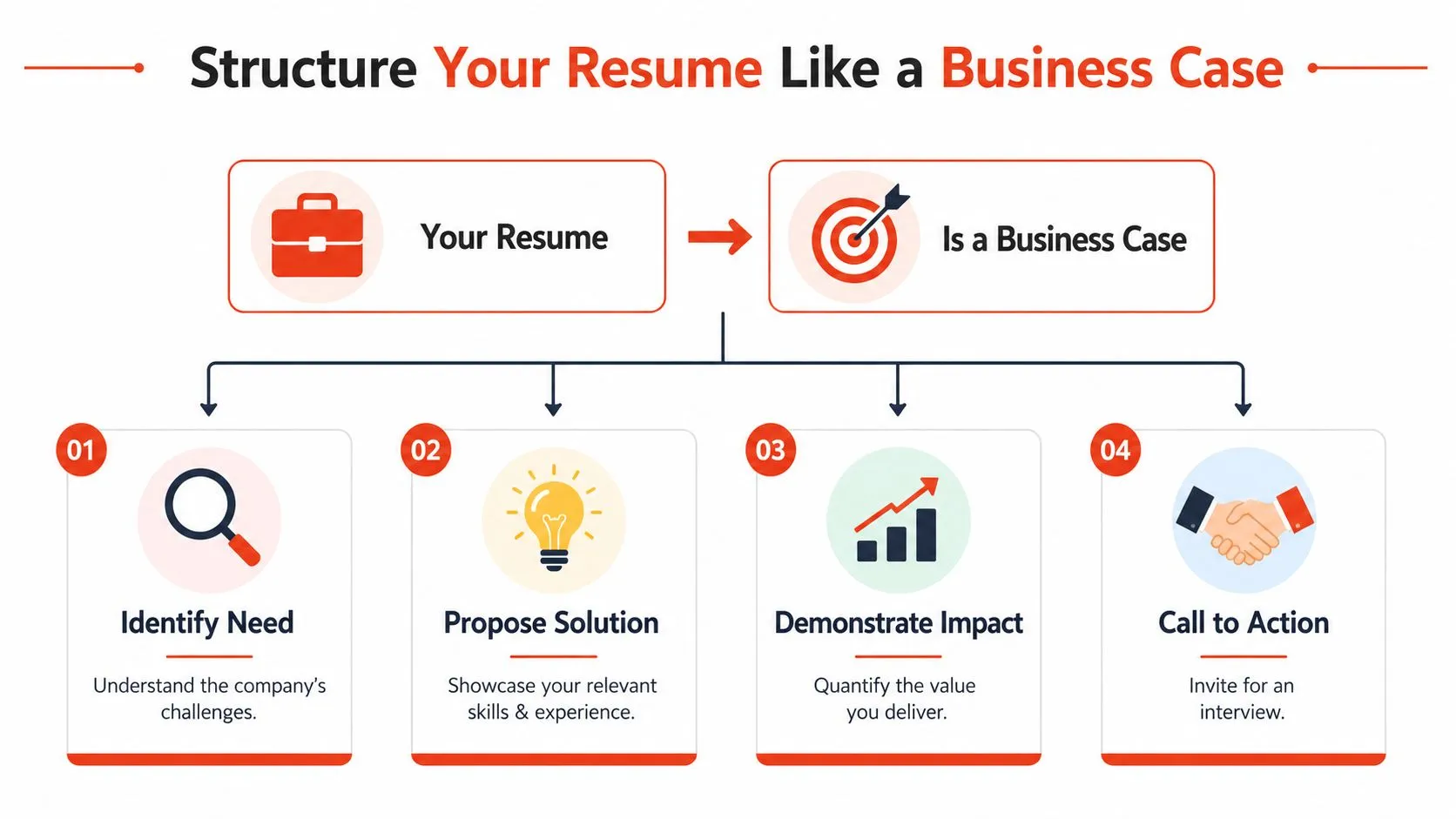
Structure Your Resume Like a Business Case
A business analyst resume should read like a decision memo. Short summary. Clear evidence. Relevant tools. No clutter.
That's the right mental model. Not “How do I fill all the sections?” but “How do I make the hiring manager say yes?”
Start with an executive brief
Your top summary should do the work of an executive summary. Drop the old objective statement. It wastes space and says nothing.
Use two or three lines that answer:
- who you are
- what business problems you solve
- which tools or domains matter most
- what kind of impact you usually drive
Good summary:
Business Analyst with experience improving reporting, operational workflows, and stakeholder decision-making across finance and operations. Strong in SQL, Excel, Tableau, and requirements gathering. Known for turning messy process problems into clear recommendations and measurable improvements.
That works because it sounds like a person who solves business problems, not a person who completed a course.
If you want a useful outside reference on framing value clearly, Chicago Brandstarters' value prop insights are worth reading. The core idea applies directly to resumes. Your value has to be obvious, fast.
Make experience the proof section
For mid-to-senior candidates, the resume is made or broken here. Mid-to-senior business analysts with 3+ years should use 3 to 4 key achievements per role, pairing what was done, how it was done, and the quantified impact, as shown in this career transition guidance for business analyst resumes.
That structure is excellent because it forces you to answer the only question that matters. So what?
Use this order inside each role:
1. Job title, company, dates
2. One short line of context if needed
3. Three or four bullets with impact
Example pattern:
- Identified the issue with weekly MIS reporting delays
- Fixed it by automating Excel-based reporting workflows
- Created the outcome of saved time and faster decisions across departments
You can also sharpen your section order by reviewing strong resume category examples and stripping out anything that doesn't support your case.
Keep skills in support, not in charge
The skills section should back up your evidence, not replace it.
A short, focused list beats “tool soup.” Group tools by relevance:
- Analysis tools SQL, Excel, Tableau, Python
- BA work requirements gathering, process mapping, stakeholder management, UAT
- Business strengths storytelling, KPI design, cross-functional communication
Here's the rule. If a tool never appears in your work examples, it probably doesn't belong near the top of the list.
What a strong structure looks like
| Section | Purpose | What belongs there |
|---|---|---|
| Summary | Your business case in brief | Role, domain, tools, value |
| Experience | Evidence | 3 to 4 impact bullets per role |
| Skills | Support | Relevant tools and BA capabilities |
| Education and certifications | Validation | Brief and clean |
A resume isn't a biography. It's a recommendation memo with your name on it.
Write Bullets That Show Impact Not Activity
Most business analyst resumes collapse at this stage.
The common advice says, “Quantify your achievements.” True, but incomplete. A number without context is decoration. The key upgrade is this: show the problem, action, and result in one line.
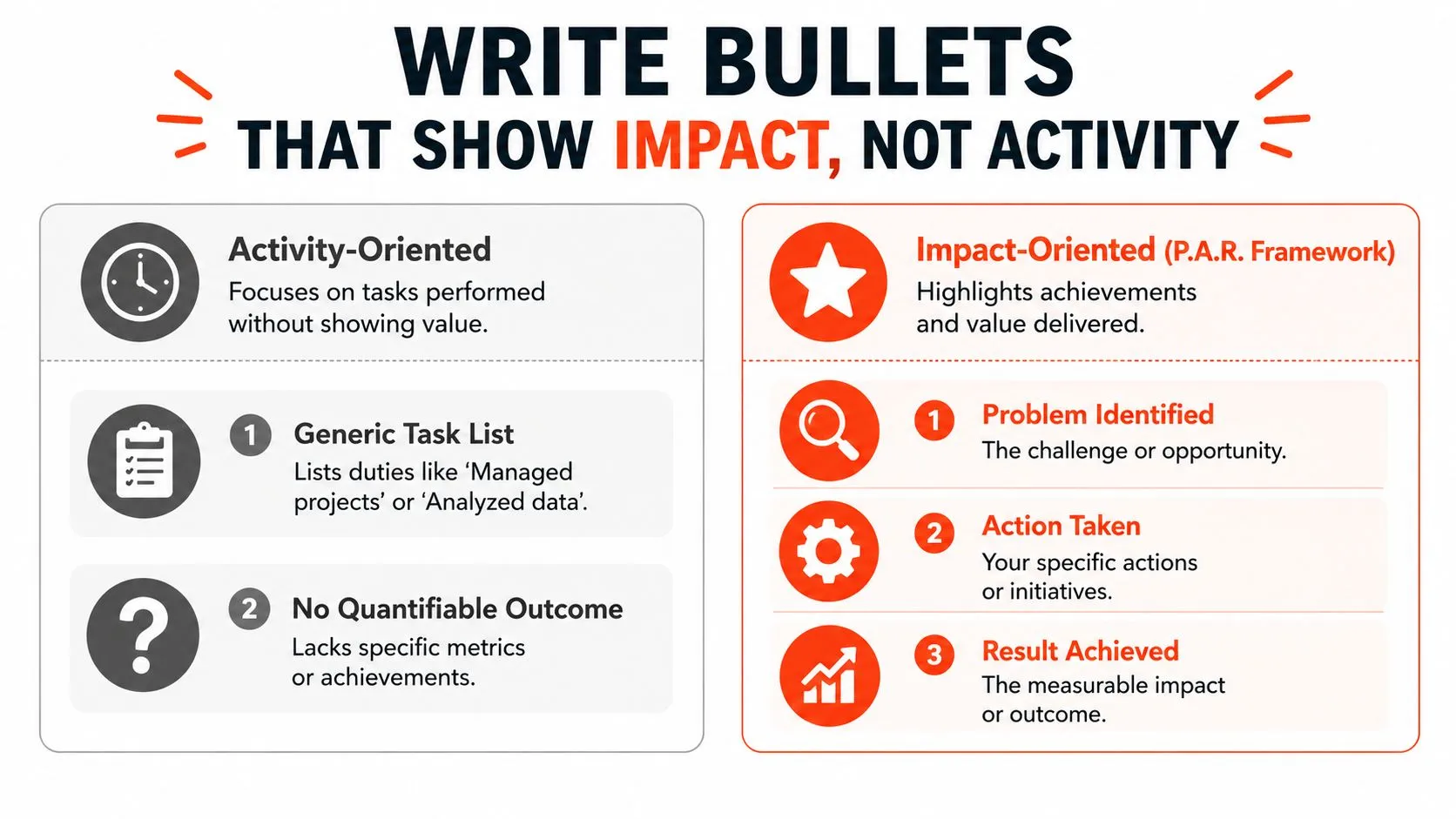
A useful walkthrough of resume bullet mechanics sits in this guide to better bullet points in a resume. The principle is simple. Bullets need movement, not job-description sludge.
The test every bullet must pass
If your bullet only tells me what you did, it fails.
70% of BA resumes fail not due to lack of experience, but because experience isn't communicated clearly, according to this discussion of the responsibilities-versus-impact gap in BA resumes.
Here's the difference:
| Weak bullet | Better bullet |
|---|---|
| Conducted data analysis | Analyzed customer and transaction data in SQL to identify reporting gaps that were slowing weekly performance reviews |
| Built dashboard for leadership | Built a Tableau dashboard that gave leadership a shared view of KPI trends and reduced dependence on manual reporting |
| Gathered business requirements | Gathered and clarified requirements across operations and finance teams, reducing confusion during handoff to developers |
| Supported UAT activities | Coordinated UAT test scenarios with business users to catch workflow issues before release and improve launch readiness |
Notice what changed. The better bullets explain the point of the work.
Practical rule: Every bullet should answer three things. What was wrong, what you did, and what changed.
Use the Problem Action Result pattern
You don't need a fancy framework name. You need a repeatable sentence structure.
Try this:
-
Problem
Reporting delays, data quality issues, process bottlenecks, unclear requirements, low adoption, inconsistent KPI definitions -
Action
Designed, analyzed, automated, mapped, facilitated, validated, standardized, rebuilt -
Result
Faster reporting, cleaner handoffs, fewer errors, better visibility, clearer decisions, stronger adoption
Now turn that into bullets.
Before and after examples
Bad
- Created SQL queries for reporting
- Worked with stakeholders on requirements
- Developed Tableau dashboards
- Helped improve processes
Better
- Created SQL queries that replaced manual spreadsheet pulls and made recurring reporting more reliable for business users
- Worked with operations and finance stakeholders to define requirements clearly before build, reducing rework during delivery
- Developed Tableau dashboards that gave managers a consistent view of KPI performance across teams
- Mapped approval workflow gaps and recommended process changes that simplified handoffs between departments
That's the translation layer. Same work. Better framing.
Here's a short video if you want another angle on sharpening resume writing:
Where to find metrics when you think you have none
A lot of analysts say, “I didn't own revenue, so I don't have metrics.” Usually false. You have metrics. You just haven't unpacked the work.
Ask these questions:
- Time: Did your work reduce reporting cycles, approval lag, or manual effort?
- Quality: Did it reduce errors, duplicates, missed requirements, or confusion?
- Decision-making: Did leaders get faster, clearer, or more consistent information?
- Process: Did handoffs improve? Did teams stop doing work twice?
- Adoption: Did more people use the dashboard, workflow, or system after your changes?
If you need help thinking through measurable output, this practical guide for tracking work output is a solid prompt list.
Plain business language beats technical showing off
Don't write for other analysts. Write for the hiring manager, recruiter, and future boss.
“Built SQL views and ETL logic for reporting layer” might be accurate. It's still incomplete. What did that enable? Monthly forecasting? Better inventory planning? Faster executive reporting? Say that.
“Enabled executives to track KPIs in real time” lands harder than “built a dashboard.”
Your resume should sound like someone who understands the business side of analytics, not someone reciting a tooling checklist.
BA Resume Examples for Every Career Stage
Theory is nice. Examples are better.
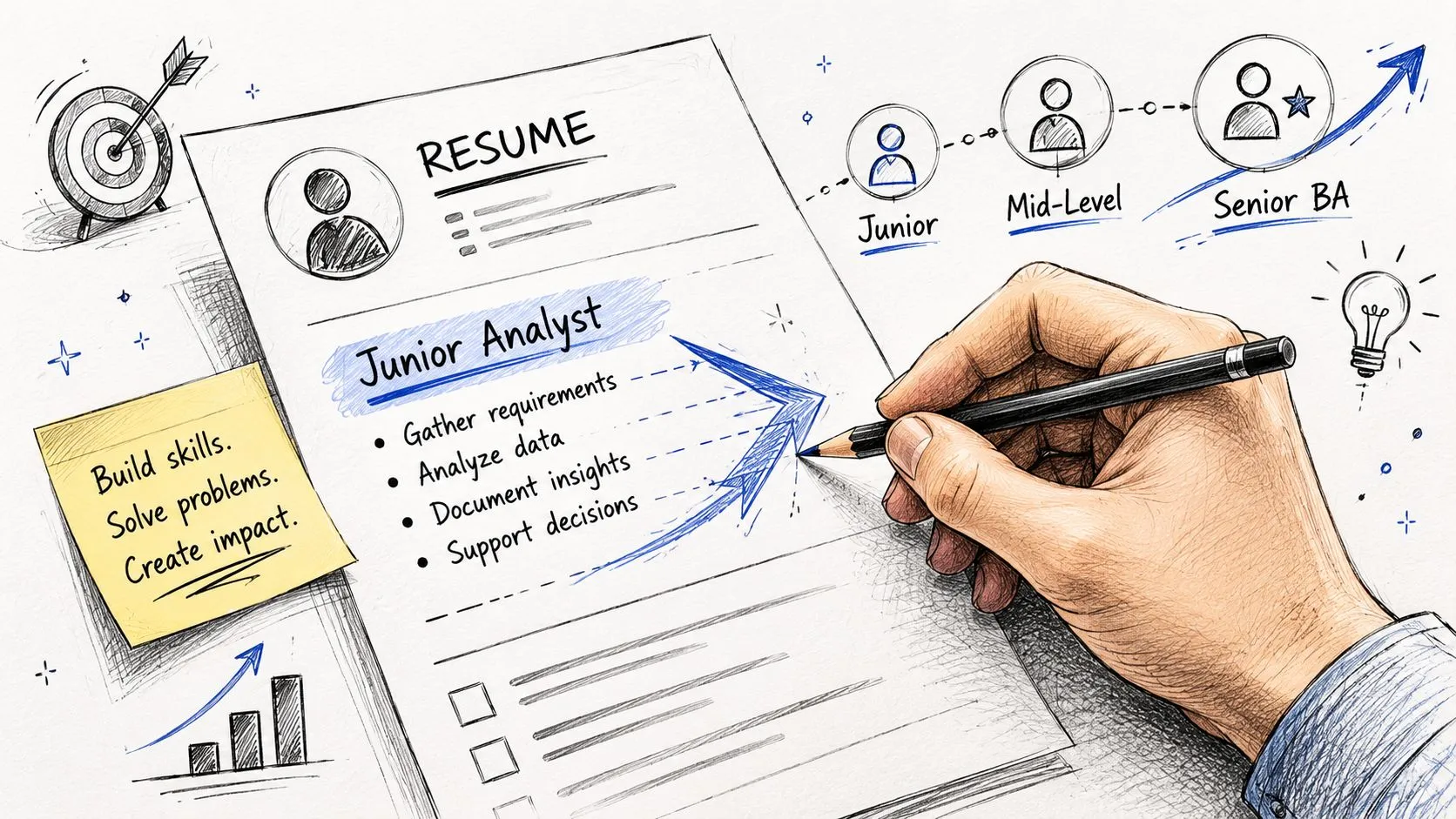
A lot of candidates use the same bullet style forever. That's a mistake. Senior BA resumes need leadership and strategic motivation, not just technical proficiency, and 60% of junior candidates still use the same bullet structure when applying to senior roles, according to this senior business analyst resume guidance.
If you want to see how this kind of career story works across roles, these narrative resume examples are useful. The point is progression. Your bullets should evolve as your scope evolves.
Junior business analyst example
At junior level, you won't win by pretending to be strategic. Show contribution, learning speed, and support work that mattered.
Weak
- Assisted senior analysts
- Created reports in Excel
- Helped with testing
- Attended stakeholder meetings
Better
- Supported senior analysts in documenting business requirements for process changes across operations workflows
- Built recurring Excel reports that gave team leads a clearer view of weekly exceptions and follow-up items
- Prepared UAT test cases and logged defects so project teams could resolve workflow issues before release
- Captured stakeholder feedback in meetings and turned it into organized requirements and action items for delivery teams
That sounds junior, but useful. Good.
Mid-level business analyst example
Ownership matters. Show that you drove work, not just supported it.
Stronger mid-level bullets
- Mapped an order-to-cash workflow across sales, finance, and operations, identified bottlenecks, and recommended changes that simplified handoffs
- Built SQL and Excel reporting that replaced fragmented manual updates and gave managers a more consistent view of weekly performance
- Led requirement workshops with cross-functional stakeholders, clarified scope early, and improved alignment between business users and developers
- Redesigned KPI definitions with team leads so reporting reflected actual business priorities rather than disconnected legacy metrics
These bullets signal someone who understands process, communication, and business meaning.
Senior business analyst example
Senior resumes need a shift. Less “I built.” More “I led, aligned, influenced, standardized, coached.”
Weak senior bullet
- Built dashboards and analyzed trends for leadership
Better senior bullets
- Led the redesign of executive reporting across multiple functions, aligning KPI definitions and improving confidence in performance discussions
- Coached junior analysts on requirement quality and stakeholder communication, raising the consistency of project documentation across the team
- Partnered with department leaders to prioritize analysis efforts based on business risk, operational friction, and reporting gaps
- Translated complex system and process issues into business cases that helped leadership make clearer sequencing decisions
That's senior because it shows how influence creates advantage.
Career changer example
If you're coming from operations, marketing, customer success, or project coordination, stop apologizing for not having “formal BA experience.” Translate the work.
From operations to BA
- Analyzed recurring fulfillment issues, documented root causes, and worked with internal teams to improve process consistency
- Created weekly Excel tracking for service exceptions, giving managers a clearer way to monitor backlog and follow-up actions
From marketing to BA
- Reviewed campaign and customer response data to identify drop-off points and improve reporting clarity for leadership
- Worked across sales and marketing teams to standardize definitions for lead stages and performance reporting
From customer support to BA
- Documented recurring ticket themes and workflow failures, helping product and operations teams prioritize fixes
- Turned support trends into actionable reports that highlighted where customers were getting stuck
A hiring manager doesn't need your previous title to match perfectly. They need proof that you already think like an analyst.
Common Mistakes That Kill Your Chances
These are unforced errors. Fix them.
Tool soup
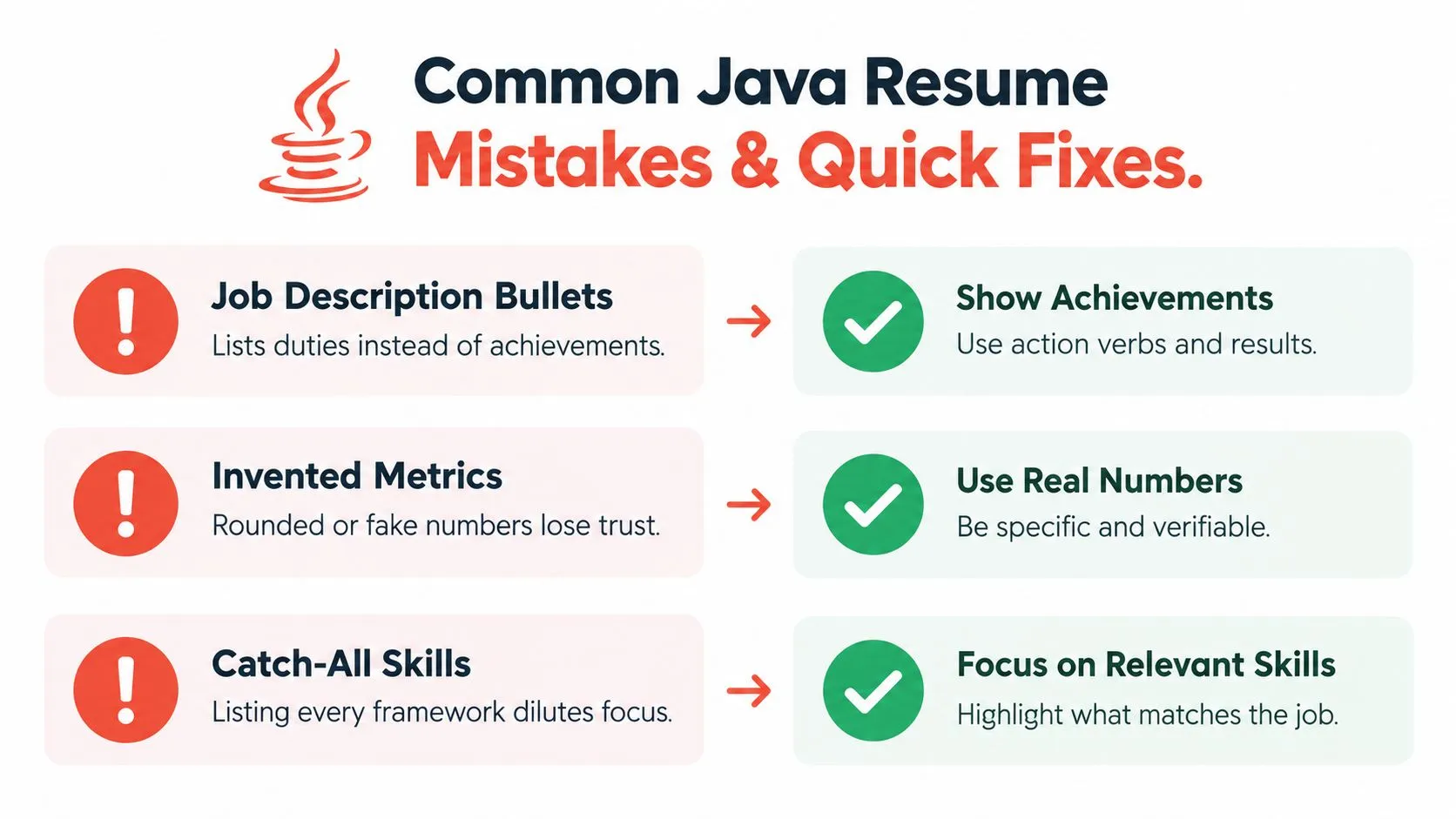
Listing every platform you've ever opened doesn't make you look versatile. It makes you look unfocused.
Bad:
- SQL, Tableau, Power BI, Excel, Python, R, Jira, Confluence, SAP, Salesforce, Visio, Miro, Figma, Alteryx, Snowflake, Asana, Trello
Better:
- Lead with relevance: Put the tools tied directly to the target role first
- Back tools with proof: If Tableau is listed, there should be a bullet showing what it helped achieve
- Cut vanity tools: Old, minor, or rarely used platforms can go
Fluffy summary
“Results-driven professional with strong communication skills seeking a challenging role” says nothing.
Write a summary that names your domain, your strengths, and your business value. If it could belong to a project manager, operations manager, or data analyst with no edits, rewrite it.
Passive language
“Was responsible for” is weak. So is “involved in.” So is “helped with,” unless you were in a support role.
Use verbs that show motion:
- Analyzed
- Redesigned
- Standardized
- Facilitated
- Automated
- Clarified
Dense formatting
A business analyst resume should be easy to scan. Tight walls of text signal poor judgment.
If I need to decode your resume, I won't assume you'll simplify business problems for stakeholders.
Keep enough white space. Use clean section titles. Keep bullets tight. Don't bury your strongest work halfway down page two.
Business language missing
This is the killer. You wrote what you did technically, but not why it mattered operationally.
“Built dashboard” is incomplete.
“Built dashboard that gave operations managers visibility into delayed orders” is credible.
That extra clause handles the core work.
The Final Pre-Send Resume Checklist
A good business analyst resume feels obvious in hindsight. Clear summary. Strong proof. Business language throughout.
Run this check before you apply.
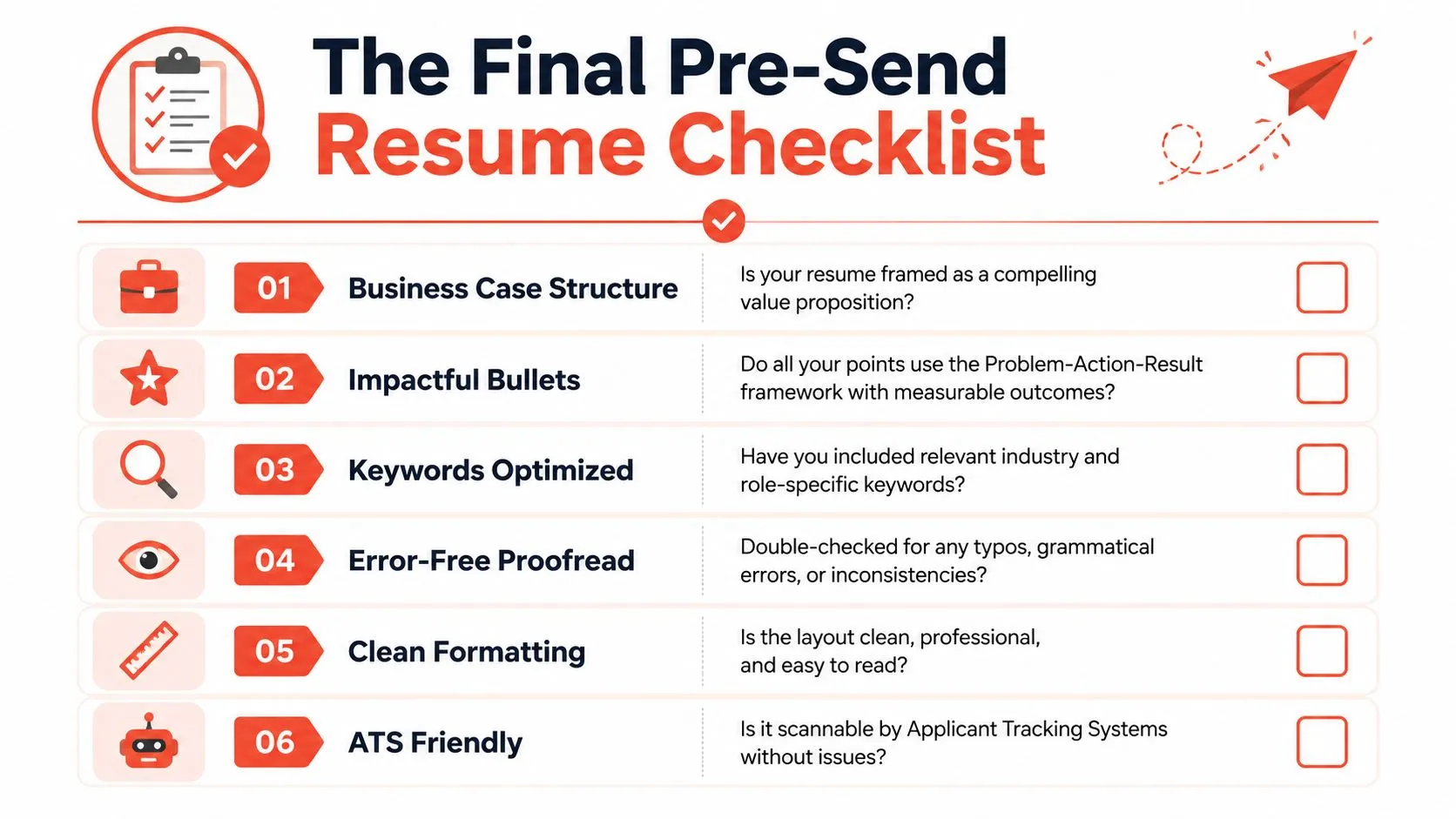
- Summary passes the test: Does the top section state your value in plain English, fast?
- Bullets show change: Does every bullet explain what improved, clarified, reduced, enabled, or influenced?
- Tools are tied to outcomes: Do SQL, Excel, Tableau, Python, Jira, or ERP references appear in context, not as decoration?
- Scope matches your level: Junior shows contribution. Mid-level shows ownership. Senior shows influence and leadership.
- Formatting helps scanning: Is it readable, balanced, and free of visual clutter?
- Language sounds commercial: Does it talk about decisions, efficiency, process, risk, delivery, and performance, not just tasks?
If a bullet doesn't answer “so what?”, cut it or rewrite it.
Most resumes fail in translation. StoryCV is an online resume writer that helps you turn real work into clear, credible business value without sounding robotic or generic. It uses guided editorial judgment at software speed, so you can stop listing tasks and start presenting a case worth interviewing.