You’ve spent an hour trying to compress a career pivot into one bullet. “Moved from finance to nonprofit program strategy.” Technically true. Totally dead on arrival. It reads like a random jump when you know it was a deliberate move.
So you search for narrative resume examples. Reasonable instinct. Something is missing. But most examples you’ll find are just generic summaries inflated into paragraphs. Same vagueness, worse skimmability.
That marks the key distinction. Many individuals don’t require a narrative resume format. They need a narrative. Those are different things.
If your path includes pivots, gaps, lateral moves, contract work, startup chaos, or returning after time away, bullet points can flatten the logic. But prose won’t save weak thinking. If you can’t explain what you kept choosing, what changed, and what you’re building toward, a paragraph just hides the problem inside more words.
A narrative resume works when the writer has a point of view about their own career. Not a slogan. A through-line. Once you have that, you can use bullets, a hybrid layout, or selective prose and all of it lands better. Let’s start there.
1. The Achievement-Focused Narrative Resume
This one works for mid-career professionals who already have substance, but their resume still reads like a job description. You don’t need more adjectives. You need clearer proof.
Strong narrative resume examples in this category don’t say “responsible for cross-functional coordination.” They show what changed because you were there. In professional statistician and data analyst resume examples, narrative bullets with specific metrics showed a 20-30% average improvement in key performance indicators, with examples like improving data quality by 20%, revenue growth of 15%, and reducing processing time by 30% in these statistician resume examples.
What it sounds like
Weak version:
- Managed product roadmap and worked with engineering
- Oversaw campaign performance
- Improved operational processes
Better version:
- Reframed a stalled roadmap around activation friction, aligned engineering and design on the first three fixes, and turned a vague product mandate into a launch sequence tied to user behavior
- Took over underperforming campaigns, cut the reporting noise, and focused the team on the channels that drove qualified demand
- Stepped into an operations mess nobody owned, identified the bottlenecks, and rebuilt the handoff process so the team could move faster with fewer errors
Notice what changed. The better version still stays concise. But each line implies context, judgment, and consequence.
Practical rule: If a bullet can apply to a thousand other people with your title, it’s not an achievement. It’s a category label.
How to build it
Start with the moments where you changed direction, fixed something broken, or created an advantage.
- Name the problem first: What was messy, slow, unclear, blocked, or underperforming?
- Name your intervention: What decision did you make, not just what task did you perform?
- Name the business effect: Revenue, speed, quality, trust, alignment, adoption, approvals. Pick the one that mattered.
If you’re struggling to get there, read these resume achievement examples and writing patterns. They force the right question. Not “what did I do?” but “what changed because I did it?”
2. The Career-Changer's Narrative Resume
Career changers usually think their problem is credibility. It’s not. It’s translation.
If you’re moving from one field to another, the hiring manager isn’t confused by your ability to work. They’re confused by your story. Why this move? Why now? Why should they believe the jump is coherent instead of random?
That’s why the best narrative resume examples for career changers don’t just repackage old work with new buzzwords. They explain the bridge.
A before and after that actually matters
Before:
After leaving my role in finance, I transitioned into the nonprofit sector where I worked on community development initiatives, leveraging my analytical background to support program evaluation and fundraising strategy.
After:
I left finance because I wanted to work on problems where the outcome was visible, not just a number on a report. In nonprofit program evaluation, I used the same analytical discipline in a setting where resources were tighter and the stakes were more concrete. That shift taught me I’m at my best when I turn messy field data into decisions people can act on. That’s the thread I’m carrying into operations strategy.
The first version describes a path. The second explains it.
What to put on the page
If your background is non-linear, build around capabilities first and chronology second. Public advice on this is thin. A significant gap is connecting disparate roles into a coherent story instead of listing transferable skills and hoping someone else does the stitching, as noted in this analysis of non-linear career paths and resume storytelling gaps.
Use a short bridge statement near the top:
I started in sales, moved into customer research, and kept getting pulled toward product decisions. The titles changed. The pattern didn’t. I’ve been translating customer behavior into better decisions the whole time.
Then prove it with evidence from multiple contexts.
For concrete patterns, these career change resume examples are useful because they force intentionality instead of apology.
3. The Early-Career Narrative Resume
If you’re early in your career, don’t fake seniority. Build momentum.
Most student resumes fail because they sound passive. “Assisted.” “Helped.” “Supported.” That language tells the reader you were near the work, not inside it. A narrative approach fixes that by focusing on contribution, learning speed, and judgment.
Resume examples from recent statistician guides show entry-level narrative bullets can still carry weight, including examples like improving dataset quality by 20% through cleaning and structured analysis in these 2025 statistician resume examples. You don’t need a huge title. You need evidence that you can make something better.
Here’s a visual way to think about what counts:
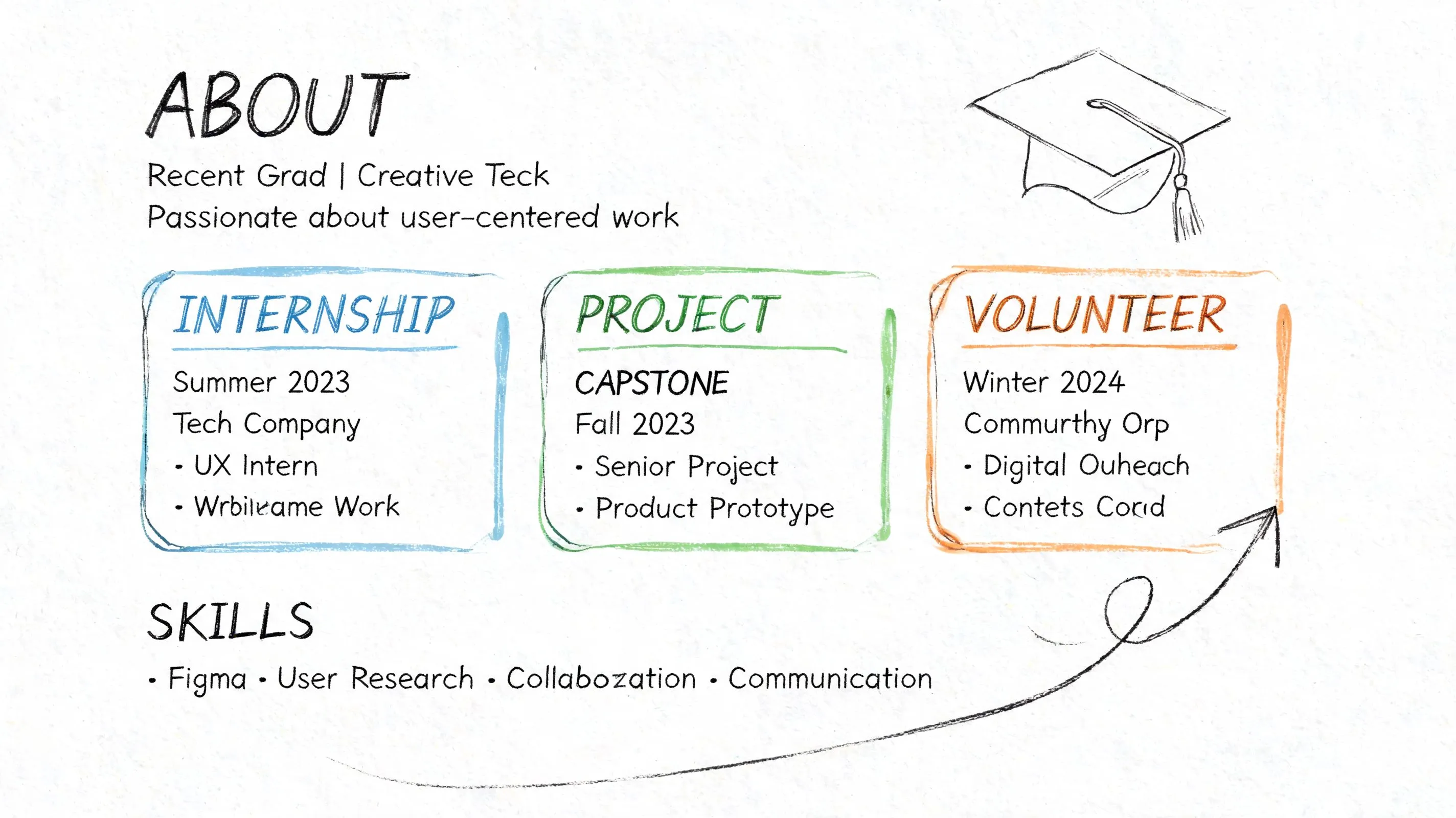
What early-career narrative looks like
Weak version:
- Assisted with data analysis during internship
- Worked on class project with team
- Volunteered at alumni fundraiser
Better version:
- Cleaned inconsistent records in a live internship dataset and made the analysis usable for the team’s reporting cycle
- Led the final synthesis on a capstone team project, turning scattered research into a recommendation the client could use
- Ran communications for a volunteer fundraising effort and kept the moving pieces coordinated when deadlines tightened
That’s not exaggeration. It’s framing.
Your lack of years isn’t the problem. Your vague verbs are.
What belongs on the page
For students and recent grads, internships, capstones, volunteer leadership, and self-directed projects can all count if they prove relevant skills.
- Internships: Show the problem you touched, not just the department you sat in.
- Projects: Treat them like work if they had constraints, collaborators, and outcomes.
- Volunteer roles: Include them when they show ownership, coordination, or communication under real conditions.
If you’re starting from a blank page, these student resume examples with no work experience help because they treat your experience like evidence, not filler.
4. The Technical Narrative Resume
Technical people get bad resume advice from both sides. Recruiters say “simplify it.” Engineers say “just list the stack.” Both are incomplete.
A strong technical narrative resume does two jobs at once. It proves technical depth and explains why the work mattered. If you only list tools, you sound interchangeable. If you only tell a polished story, technical readers assume you’re hiding the hard part.
Here’s the balance to aim for:
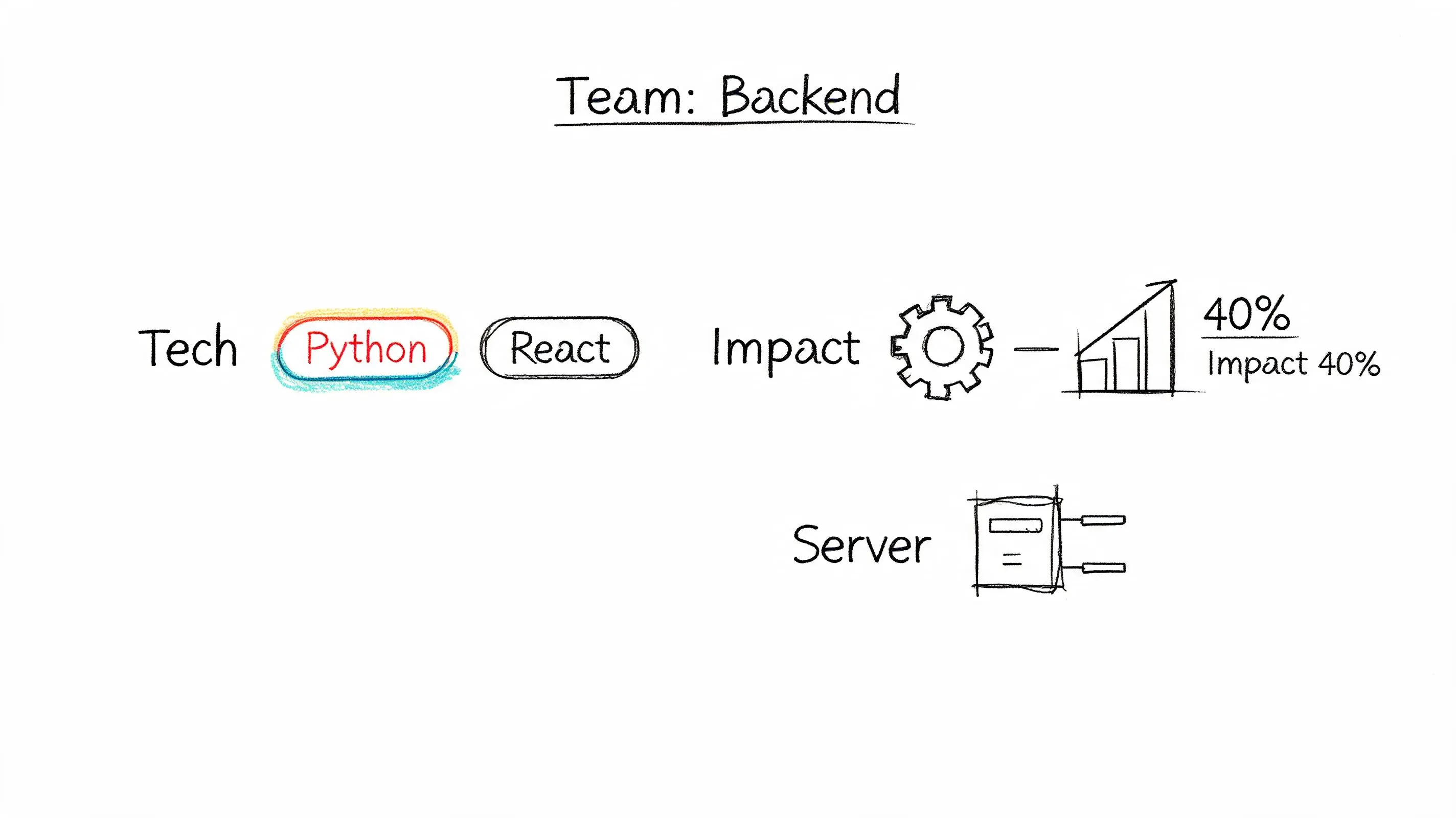
Write for two readers
A backend engineer might write this poorly:
- Used Python, Docker, PostgreSQL, and AWS to support backend systems
That says almost nothing.
A better version:
- Inherited a backend service that was slowing releases and creating avoidable incidents, mapped the failure points, and rebuilt the deployment flow so the team could ship with less friction
Now the hiring manager sees judgment. The technical lead sees systems thinking. Both get what they need.
You should still include the stack. Just don’t stop there.
- Lead with the problem: Legacy monolith, brittle deployment, noisy data pipeline, weak observability
- Show your role in the fix: Designed, refactored, debugged, automated, introduced, aligned
- Translate the outcome: Better reliability, faster reporting, clearer decisions, fewer manual steps
One real-world storytelling example outside tech makes the point well. A generic marketing bullet was rewritten in STAR format and tied to a 30% increase in brand visibility, 20% increase in engagement, and 15% increase in conversion in this piece on resume storytelling and narrative structure. Same principle applies to engineering. You’re not listing tasks. You’re making the impact legible.
If your work sits between technical detail and hiring clarity, this guide on how to optimize your technical F1 resume is a useful companion.
5. The Chronological-Narrative Hybrid Resume
This is the safest strong option for most operations and business professionals. You keep the familiar reverse-chronological structure, but each role gets a short narrative frame instead of a pile of disconnected bullets.
Why it works is simple. ATS can still parse it. Humans can still skim it. And you get enough room to explain context.
The shape is simple
For each role, use:
- A one-line context statement: What kind of environment, mandate, or problem did you step into?
- Two to four high-value bullets: Outcomes first, not duty lists
- A progression signal: What got bigger, messier, or more strategic over time?
Example:
Operations Manager
Regional services company
Boring version:
- Managed operations across teams
- Improved workflows
- Reported on KPIs
Hybrid version:
Joined during a period of uneven service delivery and unclear ownership across teams.
- Consolidated scattered workflow decisions into one operating model that managers could effectively use
- Rebuilt reporting around the few metrics leaders needed to make weekly staffing decisions
- Became the default owner for cross-team issues that didn’t fit neatly inside one function
That reads like someone who solves organizational problems, not someone who occupied a seat.
When to choose this over full narrative prose
Use the hybrid when software is likely to read first, or when the hiring manager is skimming a large stack. That balance matters because public advice on storytelling often says “be human” but skips the hard part: how to stay machine-readable while still sounding like a person. This gap is called out directly in Indeed’s discussion of storytelling resumes and the ATS trade-off.
If a recruiter has seconds, dense prose loses. Structured narrative wins.
This format works especially well for finance, biz ops, operations, program management, and analyst roles where clarity beats flair.
6. The Functional-Narrative Resume
Most functional resumes are bad. Not because the structure is bad in itself, but because people use it to dodge chronology instead of clarify capability.
Used well, though, it’s one of the best narrative resume examples for non-linear careers. It lets you organize around what you can do across different roles, contracts, industries, or life phases.
When it earns its place
Use it if your timeline is messy on paper but coherent in reality:
- Career changes across industries
- Several short contracts
- Returning after a long gap
- Military to civilian transitions
- Portfolio careers with overlapping roles
The rule is simple. Don’t hide the path. Reframe it.
Example headings might be:
- Process Improvement
- Stakeholder Communication
- Team Leadership
- Research and Analysis
- Program Delivery
Under each one, pull evidence from different contexts.
For a returner, that could look like this:
Team Leadership
Led volunteer coordination for a community initiative during a career break, keeping contributors aligned across moving priorities and limited resources. Earlier in my career, I managed internal coordination across support and operations teams, which is where I built the habit of translating ambiguity into action.
That works because it connects the dots instead of pretending the gap doesn’t exist.
The one rule you can’t ignore
Always include a brief chronological section at the bottom. Company, title, dates. Keep it clean. Transparency is part of the pitch.
A functional resume without chronology feels evasive. A functional resume with chronology feels intentional.
This format is useful when your strongest story is capability across contexts, not progression inside one lane.
7. The Startup Scale-up Narrative Resume
Startup resumes often read like chaos logs. “Did a bit of everything.” “Wore many hats.” “Worked in a fast-paced environment.” None of that helps.
Hiring managers know startup work is messy. They want to know what you owned, what existed before you, and what changed after you showed up.
The better frame
Don’t write this:
- Supported growth across marketing, ops, and customer success at early-stage startup
Write this:
- Joined when customer onboarding was still ad hoc, built the first repeatable onboarding flow, and became the person founders relied on when revenue-impacting work crossed team boundaries
That sentence does a lot. It gives context, ownership, and consequence.
For growth-stage professionals, the strongest narrative usually follows a before-and-after pattern:
- Before you: Scrappy, unclear, manual, founder-led, inconsistent
- What you built: Process, system, insight, launch motion, customer rhythm
- After you: More repeatable, easier to scale, less founder-dependent
What startup people should stop doing
Stop assuming the title tells the story. “Chief of Staff,” “Founding Ops,” “Growth Lead,” and “Product Generalist” can mean almost anything.
Spell out the facts:
- What stage was the company in?
- What business problem landed on your desk?
- What did you own end to end?
- What got less fragile because of your work?
If you’re targeting a more structured company next, add one sentence that shows maturity. Something like: I like zero-to-one work, but the part I value most is turning improvisation into systems a larger team can rely on.
That tells the corporate reader you’re not addicted to chaos. You just know how to operate inside it.
8. The Portfolio-Linked Narrative Resume
If your work is easier to show than describe, your resume should act like a trailer, not the whole film.
This is common for designers, developers, writers, content strategists, researchers, and hybrid product people. The resume’s job isn’t to tell every detail. It’s to create enough clarity and interest that the hiring manager clicks.
Use the page like this:
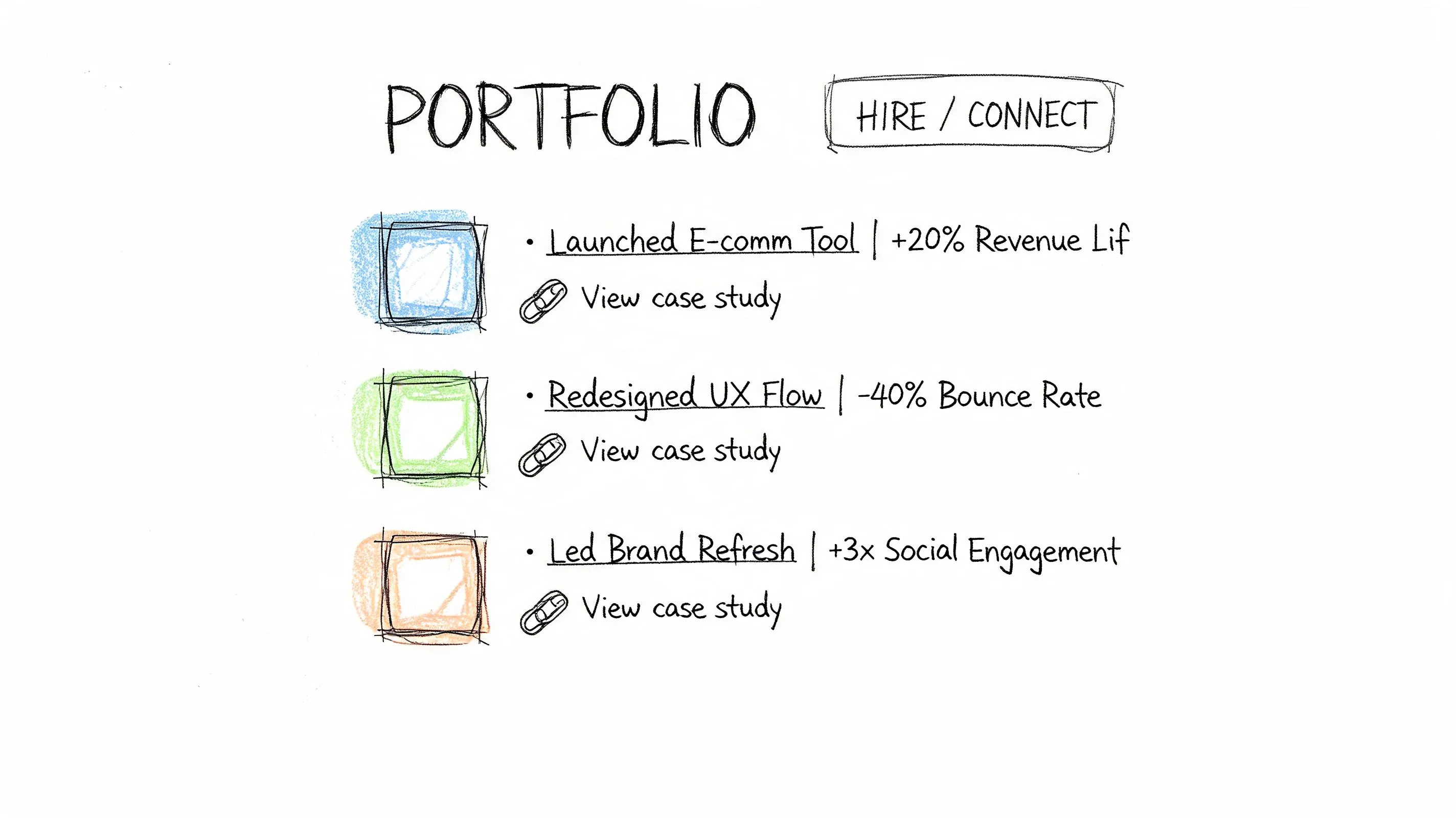
Make the click feel necessary
Bad version:
- Designed onboarding flow for mobile app
- Built analytics dashboard
- Wrote blog content and newsletters
Better version:
- Reworked a confusing onboarding flow that users were abandoning early, simplified the first-run experience, and documented the tradeoffs in a case study
- Built a dashboard for teams that needed live visibility, then published the implementation details so technical reviewers could inspect the architecture
- Turned scattered content requests into a coherent editorial system, with samples that show how strategy translated into finished work
The bullet gives the reason to care. The portfolio proves it.
What to link and what to leave out
Link to work that demonstrates judgment, not just output. Case studies beat galleries. Repos with context beat code dumps. Writing samples with rationale beat screenshots of published pieces.
A short explainer before the video helps anchor what the reader’s about to see.
Use only your strongest few projects. More links don’t make you look deeper. They make you look less edited.
The Format Follows the Story
When people say their career doesn’t fit into bullet points, they’re usually saying something smarter than they realize. They’re saying the paper version of their path looks more random than the lived version felt. A pivot that made perfect sense to them looks disjointed to someone else. A gap with real purpose looks like absence. A lateral move with a clear reason looks like drift.
That instinct is correct. Something is missing.
But the missing piece usually isn’t a narrative resume format. It’s the sentence that explains the path. Once you can say, clearly, what you kept choosing, what changed, and what that now points toward, the resume gets easier fast. You might choose a hybrid layout. You might use a functional structure. You might even go back to bullets. The difference is that now the bullets carry meaning.
That’s also the answer to the usual objection that narrative resumes are risky or unprofessional. The risk isn’t prose. The risk is vagueness. Plenty of people hide weak thinking inside polished paragraphs and call it storytelling. That fails for the same reason generic bullet points fail. It says what happened without explaining why it matters.
The strongest summary on a resume has a position embedded in it. It doesn’t just say you’ve worked across marketing and operations or product and engineering. It says what job you’ve really been doing across all those titles. Maybe you’ve spent your career fixing the parts of organizations nobody owns. Maybe you’ve kept choosing roles where technical depth had to meet people leadership. Maybe you’ve moved toward environments where analytical rigor matters more because resources are tighter and tradeoffs are sharper. That’s the through-line.
Once you have it, format becomes a tactical decision.
Use more narrative when a human is likely to read first, when your path needs context, or when voice and judgment matter. Use more structure when ATS is heavy, the pipeline is rigid, or the recruiter is moving fast. Most professionals will land in the middle. Not a wall of prose. Not a dead list of tasks. A resume with structure and a point of view.
Trying to write a narrative resume is still useful even if you never send one. The attempt forces the necessary work. It makes you explain yourself. And once you can do that, the document finally sounds like a person with a career, not a pile of jobs.
8 Narrative Resume Types Compared
| Resume Style | 🔄 Implementation Complexity | 💡 Resource Requirements | 📊 Expected Outcomes | Ideal Use Cases | ⭐ Key Advantages |
|---|---|---|---|---|---|
| Achievement-Focused Narrative (Mid-Career) | Medium–High, distill metrics & craft impact openings | Access to performance metrics, time to quantify results, editing | 📊 Higher visibility for senior roles; stronger interview rates | Mid-career managers and leaders seeking promotion | ⭐ Demonstrates measurable business impact; ATS-friendly storytelling |
| Career-Changer's Narrative (Skills Translation) | High, reframe experiences into target-industry language | Research target roles, supportive projects/certifications, cover letter | 📊 Makes pivots strategic; reduces hiring skepticism when well-evidenced | Career changers, veterans, returners | ⭐ Positions transferable skills; signals intentionality and fit |
| Early-Career Narrative (Students & Recent Grads) | Medium, creative framing of limited experience | Academic projects, internships, volunteer examples, concise editing | 📊 Boosts callbacks by showcasing potential and relevant outcomes | Students, recent graduates, entry-level applicants | ⭐ Highlights growth, coachability, and early impact on one page |
| Technical Narrative (Tech & Engineering) | High, balance technical detail with business impact | Code samples/portfolio, technical metrics, knowledge of stack | 📊 Shows technical depth + product impact; aids technical screening | Engineers, data scientists, technical PMs | ⭐ Conveys technical credibility and measurable system/product outcomes |
| Chronological-Narrative Hybrid (Operations & Business) | Low–Medium, structured with short context statements | Clear timeline, role context, quantifiable bullets, consistent format | 📊 ATS-friendly; clearly shows progression and responsibility | Operations, finance, analysts in corporate settings | ⭐ Familiar format with added storytelling, safe and scannable |
| Functional-Narrative (Non-Linear Paths) | High, reorganize by competencies, curate cross-role evidence | Time to map skills, compile examples, strong cover letter | 📊 Highlights capabilities while de-emphasizing gaps; ATS risk | Career changers, freelancers, returners with gaps | ⭐ Focuses on transferable strengths across varied experiences |
| Startup/Scale-up Narrative (Growth-Stage) | Medium, emphasize ownership, speed, and company context | Company stage details, growth metrics, examples of end-to-end ownership | 📊 Positions candidate as high-agency and adaptable; transferable to scale | Early employees, growth-stage professionals, founders | ⭐ Shows ownership and rapid impact; ⚡ signals fast execution ability |
| Portfolio-Linked Narrative (Creative & Technical) | Medium, concise hooks plus linked case studies | High-quality portfolio/GitHub, maintained case studies, link hygiene | 📊 Converts interest into proof; clearer assessment of craft quality | Designers, developers, writers, creators | ⭐ "Show, don't tell", direct evidence of work; depends on portfolio quality |
If your resume feels flat, the issue usually isn’t the template. It’s that nobody helped you find the through-line. StoryCV is a Digital Resume Writer that pulls that story out of you through a short guided interview, then turns it into a sharp, structured draft that works for both humans and ATS. Start with one role for free and see what your experience sounds like when it’s written well.