You’re staring at the send button. Resume attached. Email body cleaned up. Then you look at the subject for job application and freeze, because “Application for Marketing Manager” sounds flat, and every “better subject line” article either gives you a stiff template or tells you to “stand out” like that helps.
It does matter. Not because you need to be clever, but because the subject line is your first chance to say something true about fit instead of just announcing a transaction.
That Subject Line Is Costing You Interviews
The subject line is often treated like admin work. Confirm the role, hit send, move on. That’s the mistake.
If your subject line only says “Application for Marketing Manager,” you’ve told the recruiter what you’re doing, not why they should care. That’s the same bad habit people bring into resume bullets. They describe the process, not the value.
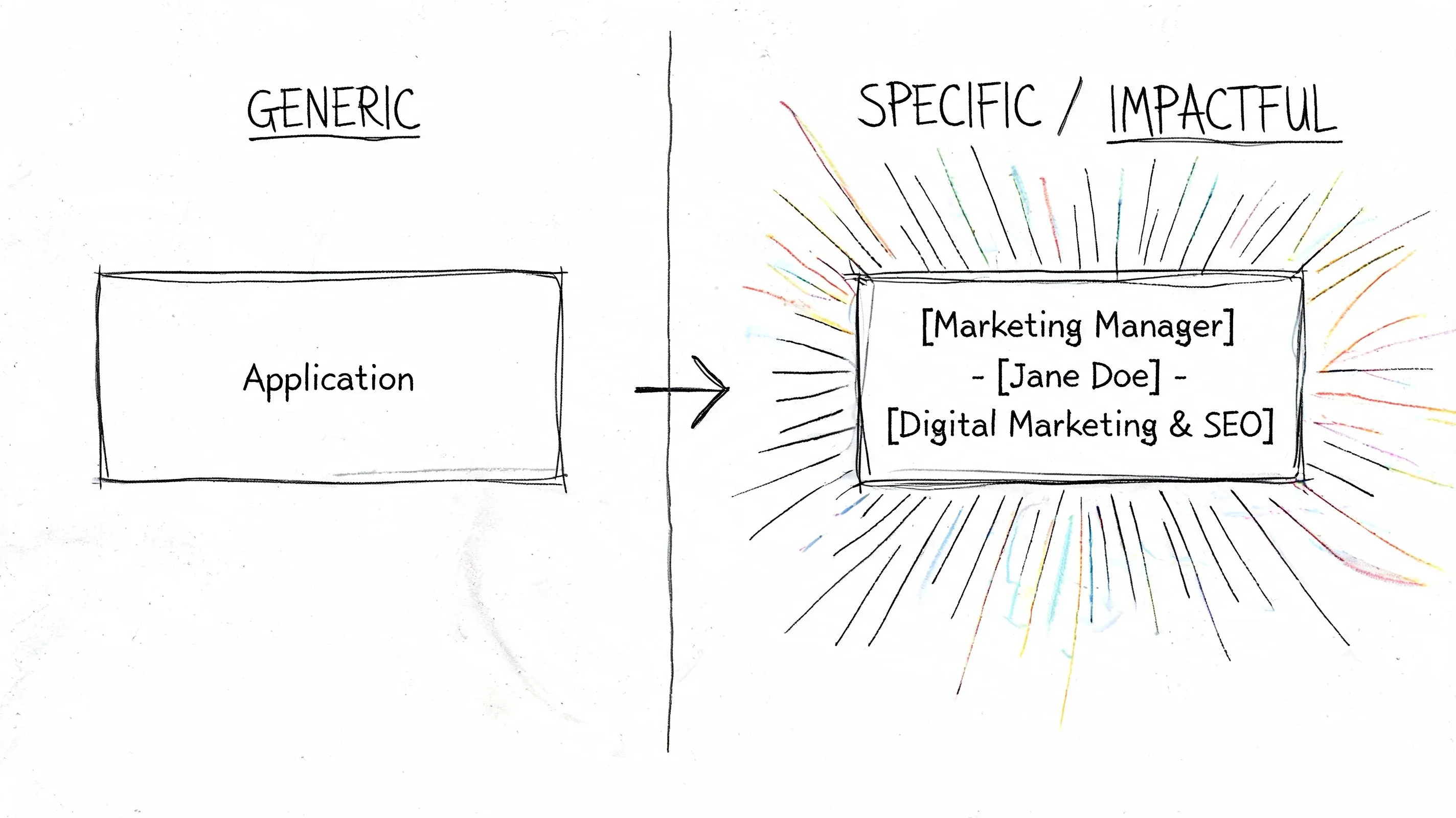
A lot of existing advice overlooks the primary function of a subject line. It treats subject lines as either informative or attention-grabbing, but not as a first narrative signal that gets a hiring manager to read your application as a person instead of just another file, as noted in Indeed’s discussion of job application subject lines. That gap matters if you’re tired of robotic job search advice.
Your subject line isn’t the label on the package. It’s the first sentence of your case.
If you want a bigger-picture view of what gets attention, read StoryCV’s guide on how to stand out in job applications. Same principle. Stop leading with the paperwork and start leading with the signal.
What weak subject lines get wrong
Here’s the pattern:
- They state the action: “Application for Senior PM”
- They hide the person: your name is missing or buried
- They waste the best real estate: no referral, no relevant credential, no useful context
A good subject for job application should do one extra job. It should tell the recruiter something true before they even open the email.
The Recruiter’s Inbox and The One-Second Rule
The common excuse goes like this: recruiters barely look at subject lines, so don’t overthink it.
Wrong frame.
They may scan fast, but scanning fast is exactly why the subject line matters. Recruiters spend only 6-10 seconds reviewing resumes that make it through the initial filter, and 75% of applicants never receive any response, which is why clarity at the inbox stage matters more than people admit, according to CareerKit’s breakdown of how ATS works.
They don’t want clever. They want useful.
A recruiter going through a crowded inbox is sorting. Routing. Prioritizing. Looking for anything that makes the next click easier.
If they’ve already seen forty versions of “Application: Senior Product Manager,” the one that says something real gets a second look:
- Senior Product Manager | Alex Kim
- Senior Product Manager | Alex Kim | Referred by Dana Holt
- Senior Product Manager | Alex Kim | B2B SaaS pricing experience
That last part is the difference. It gives the recruiter a reason to think, “Okay, this one might fit.”
Practical rule: Don’t try to win the inbox with personality. Win it with usable information.
This is the same basic logic behind email performance more broadly. If you want a wider marketing view on what makes people open messages, Natural Write has a useful guide on improve email open rates. Different context, same truth. Specific beats vague.
The one-second test
Read your subject line once and ask:
| Question | Bad answer | Better answer |
|---|---|---|
| Can they route it instantly? | “Hello” | “Finance Manager Application” |
| Can they identify you fast? | no name | “Finance Manager |
| Can they see a reason to care? | nothing | “Finance Manager |
If your current line fails the third column, it’s leaving value on the table.
The Only Subject Line Formula You Need
Open your sent folder. If your subject lines read like placeholders, you’re sending the same weak signal as everyone else.
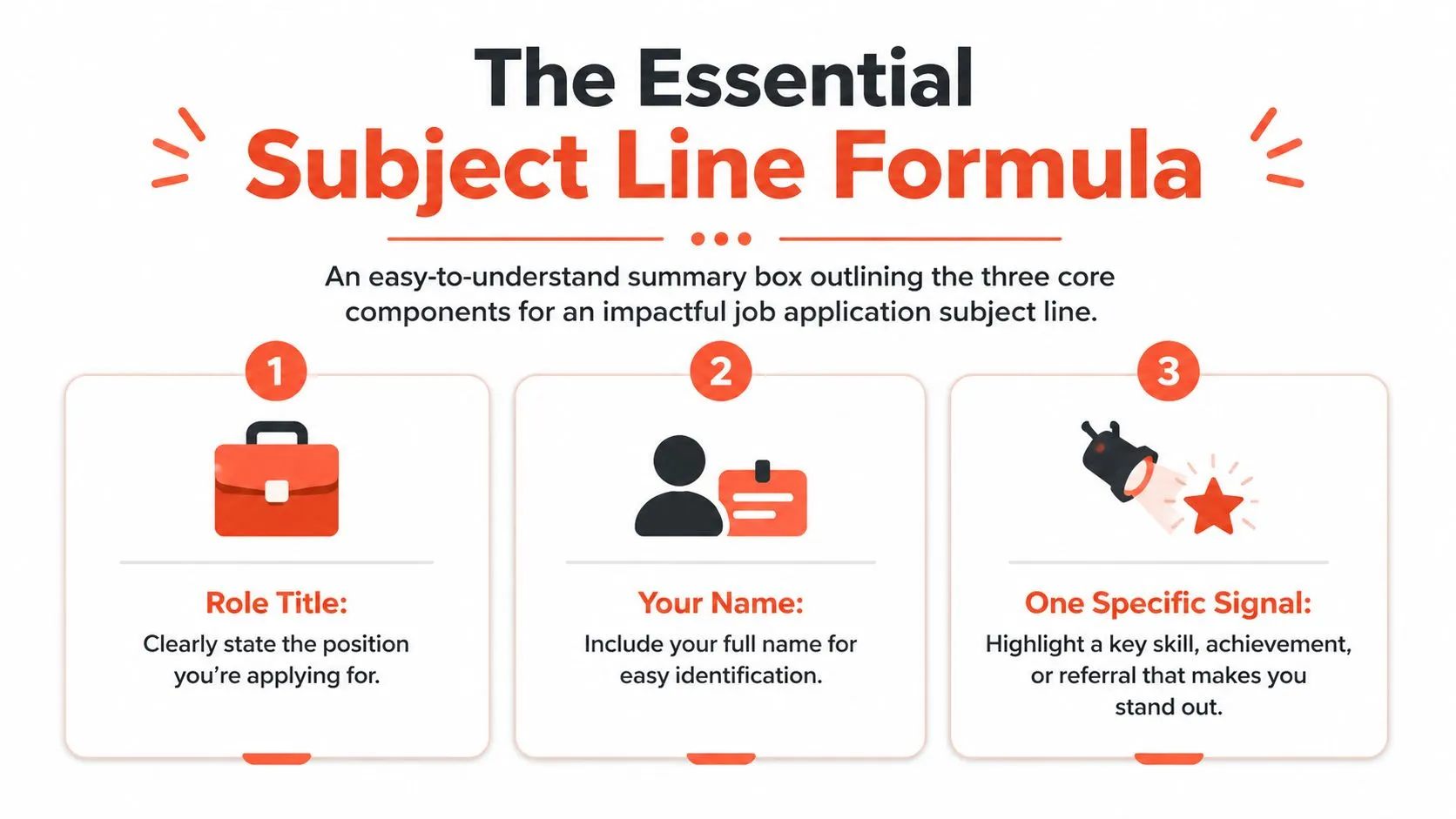
Use this formula:
[Role Title] | [Your Name] | [One Specific Signal]
That’s the whole thing. A good subject line does the same job as a good resume bullet. It shows fit fast instead of announcing effort.
Start with the role
Put the title first. That gives the recruiter the routing label immediately.
Good:
- Head of Operations | Priya Nair | Referred by Tom Reyes
- Marketing Director | Jordan Lee | B2B SaaS demand gen
Bad:
- Interested in joining your team
- Experienced leader applying
- Application from Priya Nair for Head of Operations role
Buried titles waste attention. Lead with the job you want.
Put your name second
Your name belongs in the subject line because inboxes get searched, forwarded, filtered, and revisited. If your email gets passed to a hiring manager, your name should stay attached to it without anyone opening the message.
End with one specific signal
At this point, applicants either prove relevance or fall back on filler.
Use one concrete signal that helps someone decide, fast:
-
Referral
Senior Product Manager | Jordan Lee | Referred by Sarah Chen -
Relevant current role or company
Marketing Director | Maya Shah | Currently at Acme Health -
Directly relevant skill, domain, or scope
Data Analyst | Chris Gomez | SQL and Tableau reporting
Pick one. More than that turns the line into clutter.
What counts as a strong signal
A strong signal is short, true, and tied to the job. It should answer the recruiter’s silent question: why should this application move first?
| Signal type | Use it when | Example |
|---|---|---|
| Referral | someone inside the company knows your work | Head of Operations | Priya Nair | Referred by Tom Reyes |
| Current role | your title already maps well to the opening | Senior PM | Alex Kim | Leading platform roadmap |
| Domain relevance | your background matches the company or problem | Marketing Director | Maya Shah | B2B SaaS demand gen |
| Career pivot bridge | you need to make the fit obvious fast | Operations Manager | Daniel Cruz | Supply chain background |
If your signal takes a full sentence to explain, it’s too soft for a subject line. Save the context for the email body or your sample cover letter for a job application.
StoryCV also works as a digital resume writer that uses a guided interview to turn messy experience into clearer, role-aligned language. Useful when your background is solid but your wording keeps sounding generic.
From Generic to Specific Subject Line Examples
Theory is cheap. Rewrites are better.
A strong subject for job application doesn’t sound louder. It sounds more precise.
Example one with current relevant experience
Before
Application for Marketing Director Position
After
Marketing Director application | 8 years B2B SaaS, currently at [Company]
Why it works: the second version tells the recruiter something useful before the email is opened. It signals relevant context, not just intent.
Example two for operations
Before
Application for Operations Lead
After
Operations Lead | Nina Patel | 6 years in logistics, currently at [Company]
Why it works: “operations” is broad. “6 years in logistics” narrows the fit fast.
Example three for product or tech
Before
Senior Product Manager Application
After
Senior Product Manager | Alex Kim | Marketplace and pricing experience
Why it works: a PM recruiter may be hiring for a specific product problem. “Marketplace and pricing experience” gives them a hook.
Example four for a career changer
A lot of subject line advice completely skips this case. That’s a real gap. Current guidance often fails to help career changers or veterans signal transferable skills quickly, which matters when they need to answer “Why this person for this role?” right away, as highlighted by Robert Walters’ commentary on subject lines.
Before
Application for Customer Success Manager
After
Customer Success Manager | Elena Brooks | Client retention background from account management
Why it works: it bridges the gap instead of pretending there isn’t one.
Don’t hide the transition. Frame it.
If you also need the email body to carry the same clarity, this sample guide to a cover letter for job application helps keep the message aligned with the subject line.
A quick walkthrough helps here:
Transactional versus specific
Here’s the clean comparison:
| Transactional | Specific |
|---|---|
| Application for Finance Manager | Finance Manager | Leah Morris | FP&A and board reporting |
| Job Application for Director Role | Director of Operations | Samir Khan | Multi-site logistics |
| Applying for HR Business Partner | HR Business Partner | Talia Reed | Org design and manager coaching |
| Resume for Software Engineer | Software Engineer | Victor Chen | Backend Python and API work |
The pattern is simple. The weak version tells them you applied. The strong version tells them why your email is worth opening.
Handling Common Scenarios and ATS Forms
You send the application. The portal strips away your formatting, your resume joins a queue, and the only custom field left is a tiny text box. That is not admin work. It is your first chance to prove you understand the job and can signal fit fast.
If you were referred
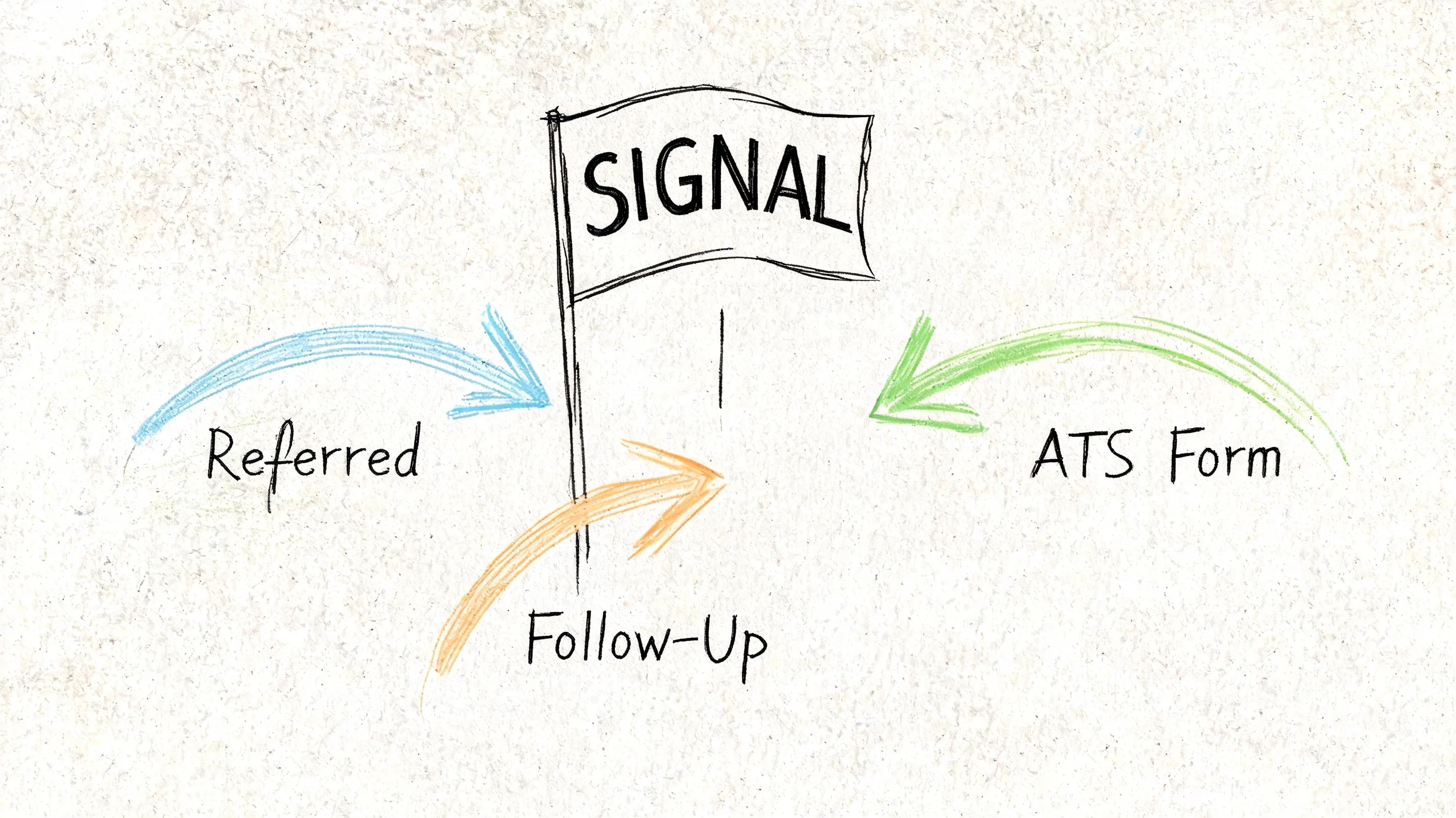
Lead with the referrer’s name. Recruiters scan for usable context, and a verified referral is usable context.
Good:
- Head of Operations | Priya Nair | Referred by Tom Reyes
- Staff Data Analyst | Ben Ortiz | Referred by Alicia Park
That works because it gives the recruiter a shortcut. Your subject line stops being a transaction and starts carrying proof.
If you’re following up
A follow-up subject line needs a reason to exist. Tie it to the role and prior contact so it signals continuity, not inbox clutter.
Try:
- Following up on Senior PM application | Jordan Lee
- Product Marketing Manager | Ava Cole | Following our conversation
If it’s an internal move
Internal candidates get this wrong all the time. Familiarity inside the company does not remove the need for context.
Use:
- Internal application | Strategy Manager | Marcus Hill | Currently in Revenue Ops
That line helps the reviewer place you immediately. It also shows you know how to frame your current value, not just your current title.
If it’s an ATS form with an optional message field
Use the message field. ATS workflows are built to collect applications at scale, so any blank space you can control should carry a clear signal for the human reviewer.
If there’s no formal email subject line, write the first line like one:
- Applying for Senior Analyst. Currently leading forecasting in retail operations.
- Applying for Customer Success Manager. Account management background with retention focus.
Keep it plain. Keep it specific. Do not paste a mini cover letter into a box nobody wants to read.
For a practical breakdown of how these systems sort, parse, and surface applications, Go Hires has a guide on comprehensive ATS understanding. For the short version on why formatting and signal both affect whether a person ever sees your application, read this explanation of the ATS filter 90 10 rule.
Your Subject Line Is Your First Story
The best subject lines aren’t clever. They’re specific.
That’s the whole game. Confirm the role. Name yourself. Add one true signal that helps the recruiter understand why you belong in the pile worth opening.
This matters beyond email. It’s the same skill behind strong resumes, sharp interview answers, and clean positioning during a career pivot. If you’re navigating job search communication with different support needs, including neurodivergent candidates who may want more structured help, this resource on support for autistic individuals in careers may be useful.
Write the subject line the same way you should write the resume. Don’t describe the transaction. Signal the fit.
If your experience is real but your wording keeps flattening it, StoryCV helps turn that experience into clear, specific language you can use in resumes, cover letters, and the subject line you’ve been overthinking.