The self-assessment form shows up two weeks before your review. You open it. Blank box. Blank brain.
Then the usual spiral starts. Everything you write sounds wrong. Too self-congratulatory. Too flat. Too much like a job description you could’ve copied from your own profile. So you procrastinate, then rush it, then submit something polite and forgettable.
That’s normal. It’s also fixable.
The problem is often perceived as writing. It isn’t. It’s thinking. You’re trying to type before you’ve reconstructed what mattered about your year. That’s why the whole thing feels fake.
The Blank Box Problem and Why You Hate Writing Self-Assessments
Self-assessments are annoying for a reason. They usually arrive as a form, so people treat them like admin. Fill the boxes. Sound professional. Move on.
That approach kills the only thing that makes a review useful. Reflection.
Only 14% of employees find performance reviews helpful for driving improvement, according to Gallup research cited by Lattice’s guide to strong self-evaluations. That number tells you the system is ineffective for many individuals. Not because employees are lazy. Because the process often turns into paperwork instead of a real look at contribution, judgment, and growth.
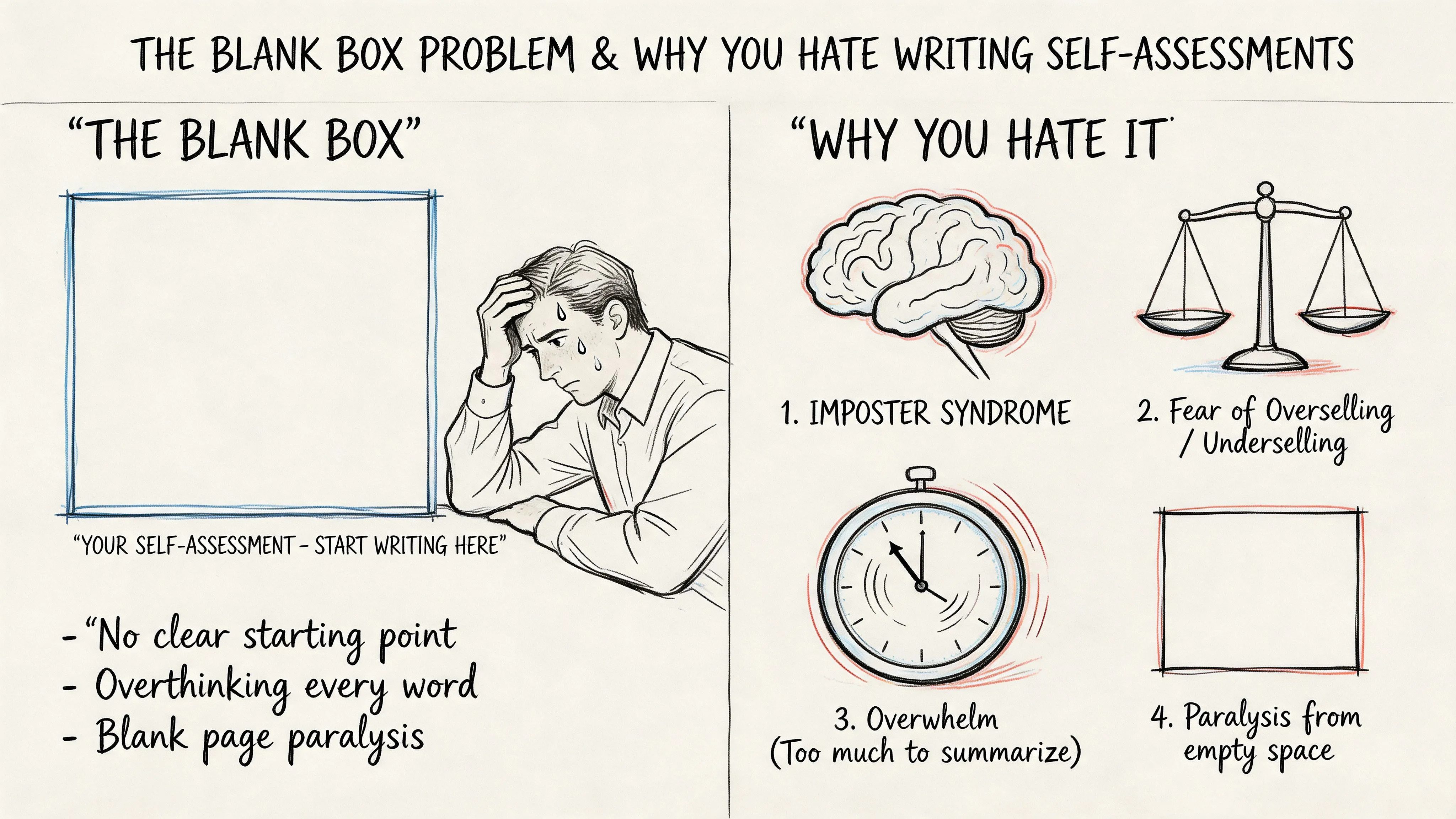
Why the blank box wins
The blank box is a trap because it demands polished language before you’ve done the harder work of remembering and interpreting.
You’re not just recalling tasks. You’re trying to answer much messier questions:
- What mattered most: Which projects changed something, not just consumed time?
- What was uniquely yours: Where did your judgment, push, or decision change the outcome?
- What belongs in the review: Which details support your case, and which are just activity?
Many bypass that and begin typing immediately. The result reads like a sanitized weekly update.
Practical rule: If your first draft sounds like “responsible for,” you started too early.
This is the same problem people have with resumes
Mid-career professionals usually know they did solid work. They just can’t package it cleanly for someone who wasn’t inside the project every day.
That’s the fundamental friction. Translation.
A self-assessment asks you to turn lived experience into evidence. That’s why it feels awkward. You remember the chaos, the meetings, the dead ends, the compromises. Your manager reading the form only sees a few lines of text. If you don’t choose the right details, your work shrinks on the page.
So stop trying to sound impressive. Start trying to remember accurately.
That’s how to write self-assessment for performance review without sounding like a robot or a blowhard.
Why Your Self-Assessment Sounds Like a Job Description
Most self-assessments fail because they describe what you were assigned, not what changed because you were there.
That sounds subtle. It isn’t.
“Managed quarterly planning.” That’s a responsibility.
“Turned quarterly planning from a messy two-day exercise into a half-day decision process leadership could use.” That’s impact.
Memory is a terrible system
When people write from memory alone, they default to generic task language. That’s predictable. According to workplace productivity research cited by Business News Daily’s self-assessment article, employees who spend just 10 seconds daily documenting an accomplishment accumulate far more data than needed for a review. The point isn’t to worship note-taking. The point is that year-end memory is weak, and weak memory produces vague writing.
You forget the constraint.
You forget the trade-off.
You forget the argument you had to make.
You forget what was hard because, once it worked, it started looking obvious.
Responsibilities are not evidence
A weak self-assessment usually has three problems.
| Weak pattern | What it sounds like | Why it fails |
|---|---|---|
| Responsibility language | “Led roadmap planning and coordinated stakeholders” | Could describe almost anyone in the role |
| Task completion language | “Delivered projects on time and supported cross-functional teams” | Says you were busy, not useful |
| Outcome without context | “Improved process efficiency” | Gives no sense of what you changed or how |
The missing ingredient is context.
Not corporate context. Real context.
What constraint were you dealing with?
What was broken before?
What decision did you make that another person might not have made?
What friction did you remove?
What risk did you reduce?
What got easier, faster, clearer, or less fragile because of your work?
The manager doesn’t need your task list. They need your judgment, your effect, and your trajectory.
The sentence test
Take any line from your draft and ask this:
Could three other people on my team claim this exact sentence?
If yes, it’s too generic.
Here’s the difference in plain terms:
- Task-based: “Collaborated with engineering and design to launch features.”
- Impact-based: “Resolved recurring launch delays by tightening handoff points between design and engineering, which gave the team a cleaner release rhythm and fewer last-minute scope debates.”
The second one works because it implies something real. There was friction. You identified it. You changed the way work moved.
That’s what a good manager wants to see. Not that you participated. That you mattered.
The Real Work Happens Before You Write a Single Word
Don’t open the form first. Talk first. Walk and talk. Voice memo. Messy notes in Apple Notes, Notion, Google Docs, whatever you use. The format doesn’t matter.
What matters is getting out of performance-review voice.
If you start with polished prose, you’ll censor yourself too early. You’ll flatten the year into safe corporate phrases. Start rough instead. Reconstruct what happened.
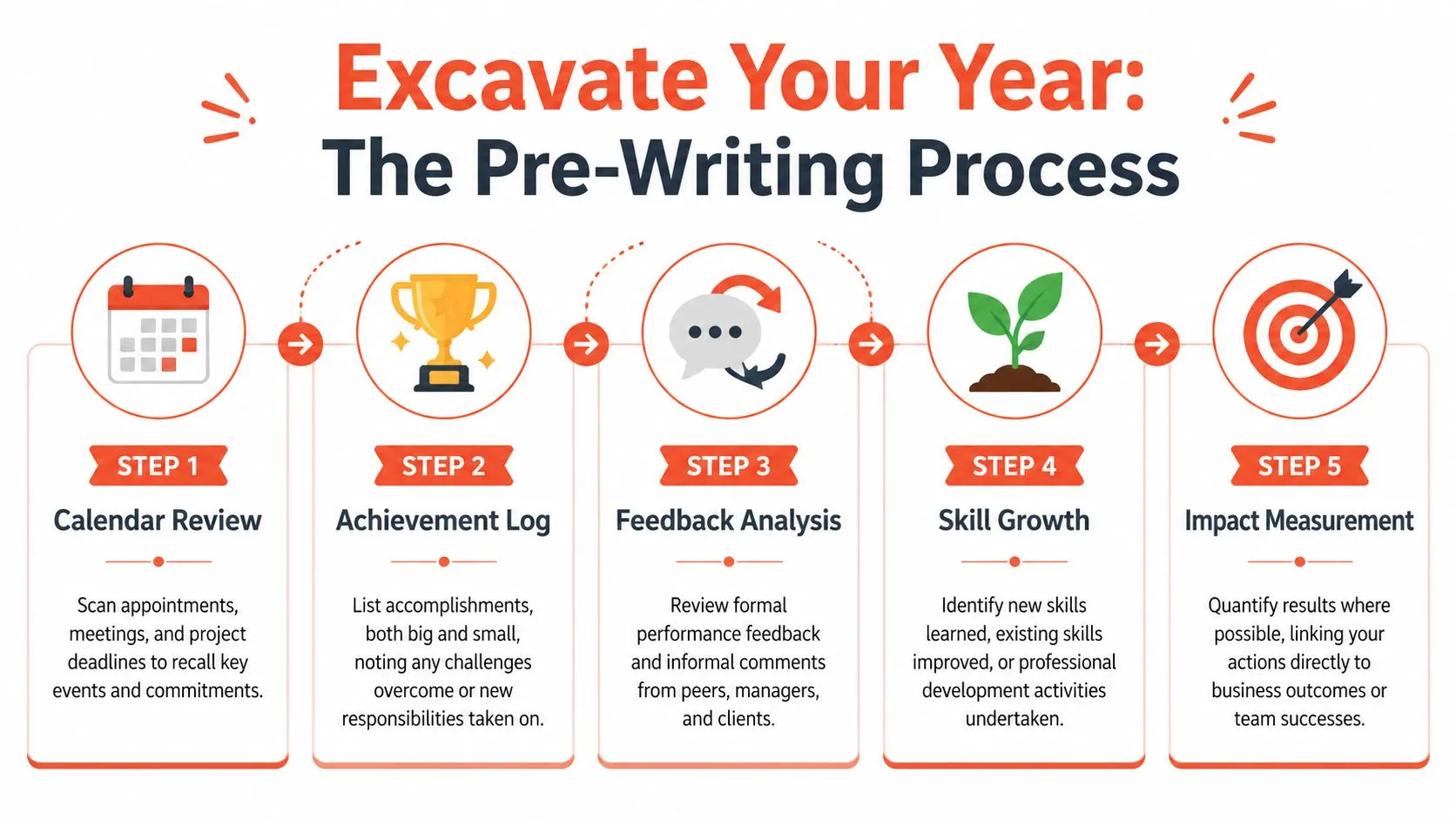
Excavate the year before you summarize it
Use your calendar, Slack, email, Jira, Asana, Linear, docs, and meeting notes. You’re not looking for everything. You’re looking for the moments where your presence changed the shape of the work.
Start with a rough list:
- Major projects
- Messy problems you helped untangle
- Decisions you owned
- Praise, feedback, or repeated asks
- Things that got better after your intervention
Then take each major item and answer three questions.
The three questions that actually matter
What changed because I did this?
This forces you out of activity language. Don’t write “owned onboarding redesign.” Write what changed. Was it faster? Clearer? Less error-prone? Easier to prioritize? Less dependent on heroics?
What would have been different if I hadn’t been here?
This sounds arrogant until you try it. Then it becomes useful. It helps you identify your actual contribution instead of the team’s general output. Maybe the project still would’ve shipped, but later, with more confusion, more rework, or less alignment.
What did I decide that wasn’t inevitable?
This is the big one. It gets at judgment. Maybe you cut scope. Maybe you changed sequencing. Maybe you pushed for a simpler workflow instead of a flashy one. Maybe you escalated early instead of letting a dependency drift.
That’s where your value lives. Not in the fact that work happened. In the fact that you made choices inside uncertainty.
Ask better questions and your writing gets better by accident.
A simple flow that doesn’t waste your time
Use this order:
| Step | What to do | What you’re trying to extract |
|---|---|---|
| 1 | Review your calendar and project trail | Raw memory |
| 2 | List notable projects and moments | Candidate stories |
| 3 | Answer the three questions for each one | Real contribution |
| 4 | Pull out metrics or visible outcomes | Credibility |
| 5 | Edit into review language | Clarity |
If you need help spotting stronger evidence, this short guide to metrics in resume writing is useful because the logic is the same. The metric itself matters less than the chain from action to outcome.
Don’t write a victory lap
A strong self-assessment isn’t pure chest-thumping. A solid benchmark is a 70/30 split, with 70% focused on achievements and 30% on development areas, as noted in monday.com’s self-evaluation guidance. That balance works because it shows two things at once. You can advocate for your work, and you can see your own gaps.
Your development section should be clean and specific.
Not this:
“I sometimes care too much.”
Write this kind of thing instead:
- Observed friction: “I noticed I was holding too many project details myself during cross-functional launches.”
- Why it mattered: “That made some handoffs slower than they needed to be.”
- What you changed: “I started using a tighter owner-decision-risk format in project updates.”
- What happens next: “I want to keep improving delegation and clearer pre-read communication.”
That reads like an adult wrote it.
From Vague Tasks to Verifiable Impact A Before-and-After
Enough theory. Here’s what the rewrite looks like.
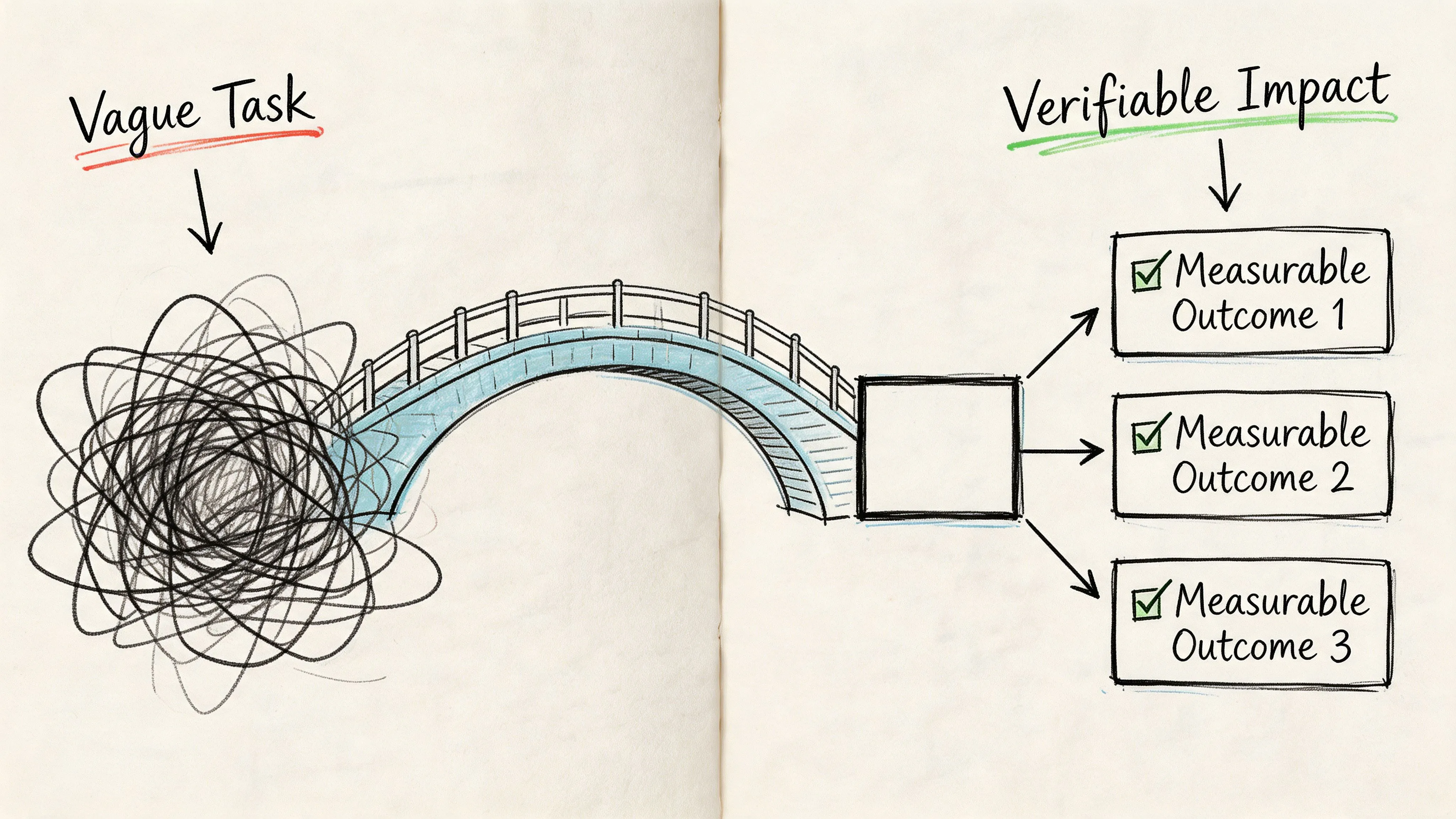
A mid-level operations example
Weak version
Led the team’s quarterly planning process and ensured all deliverables were completed on schedule.
That sentence is dead on arrival. It tells me your role. Not your impact.
Stronger version
Rebuilt quarterly planning from a two-day scramble across disconnected spreadsheets into a half-day structured process with clear owners and trade-offs. This reduced planning overhead for the team, gave leadership a clearer view of priorities, and removed repeat confusion around who was making final scope calls.
Now the manager can see the before, the intervention, and the result.
Why it works:
- “Two-day scramble across disconnected spreadsheets” gives context.
- “Half-day structured process” shows change.
- “Clear owners and trade-offs” signals judgment.
- “Removed repeat confusion” explains why the work mattered beyond the task itself.
Keep it tight or people will skim
According to Culture Amp’s guidance on writing self-evaluations, 62% of self-reviews fail due to over-explanation, which leads managers to skim and miss the point. That’s why frameworks only help after you’ve done the excavation. They should compress the story, not replace it.
Here’s a useful benchmark in practice:
| Version | What happens |
|---|---|
| Too short | You sound generic |
| Too long | Your manager skims |
| Tight and specific | Your impact survives the page |
Here’s a quick walkthrough if you want to see the same principle applied in spoken form before you edit your draft:
Two more mini rewrites
Software engineer
Weak:
Worked on service reliability improvements and supported incident response.
Stronger:
Reduced recurring incident noise by tightening alert thresholds and documenting a cleaner escalation path, which made on-call handoffs less chaotic and let the team focus on real failures instead of false alarms.
Marketing manager
Weak:
Managed campaign execution across channels and collaborated with stakeholders.
Stronger:
Simplified campaign delivery by standardizing briefing and approval flow across content, design, and paid channels, which cut back-and-forth and made launches more predictable for every team involved.
If you want more help turning raw work into cleaner proof, this article on how to write achievements in a resume is worth reading. Same core move. Stop listing duties. Show what changed.
How to Frame Your Impact for Different Roles and Levels
The story you tell should match the level you’re operating at.
A mid-level self-assessment should usually emphasize execution, problem-solving, reliability, and judgment inside projects. A senior one should emphasize amplifying impact. Better decisions, stronger team output, clearer prioritization, less thrash, more alignment.
Mid-level versus senior sounds different
If you’re a product manager, operations lead, engineering manager, or functional lead, don’t write as if all impact looks the same.
Mid-level framing
“I improved how the work moved.”
Senior framing
“I improved how people decided, prioritized, and executed at scale.”
That distinction matters. Senior people often undersell themselves by still writing like individual contributors. They describe the project, not the system they shaped around it.
A more senior role means your impact often shows up through other people’s clarity, speed, and decision quality.
Career changers, returners, and veterans need a different lens
Most self-assessment advice is written for linear careers. That’s lazy.
A 2025 LinkedIn Workforce Report noted that 28% of professionals are career switchers, yet only 12% of typical self-assessment guidance addresses transferable skills, as cited by Leapsome’s article on self-assessments. That gap is real. It leaves a lot of smart people writing weaker reviews than they deserve.
If your path isn’t neat, don’t apologize for it. Translate it.
Use language like this:
- Career changer: “I brought process discipline from operations into a product environment, which helped the team clarify ownership and reduce ambiguity during launches.”
- Returner: “After returning, I prioritized rebuilding context quickly and focused on stabilizing execution in my core area before taking on broader ownership.”
- Veteran: “I applied planning, coordination, and risk management experience to improve cross-functional execution and make dependencies more visible earlier.”
The trick is simple. Don’t frame your background as a detour. Frame it as a source of judgment.
Your Self-Assessment Is Your Next Resume Draft
A good self-assessment is not just for your review. It’s raw material for your next move.
That’s why it’s worth doing properly.
If you’ve already done the hard thinking, your resume bullets are mostly sitting there waiting. You know what changed. You know what you decided. You know which outcomes matter. You know which stories are yours.
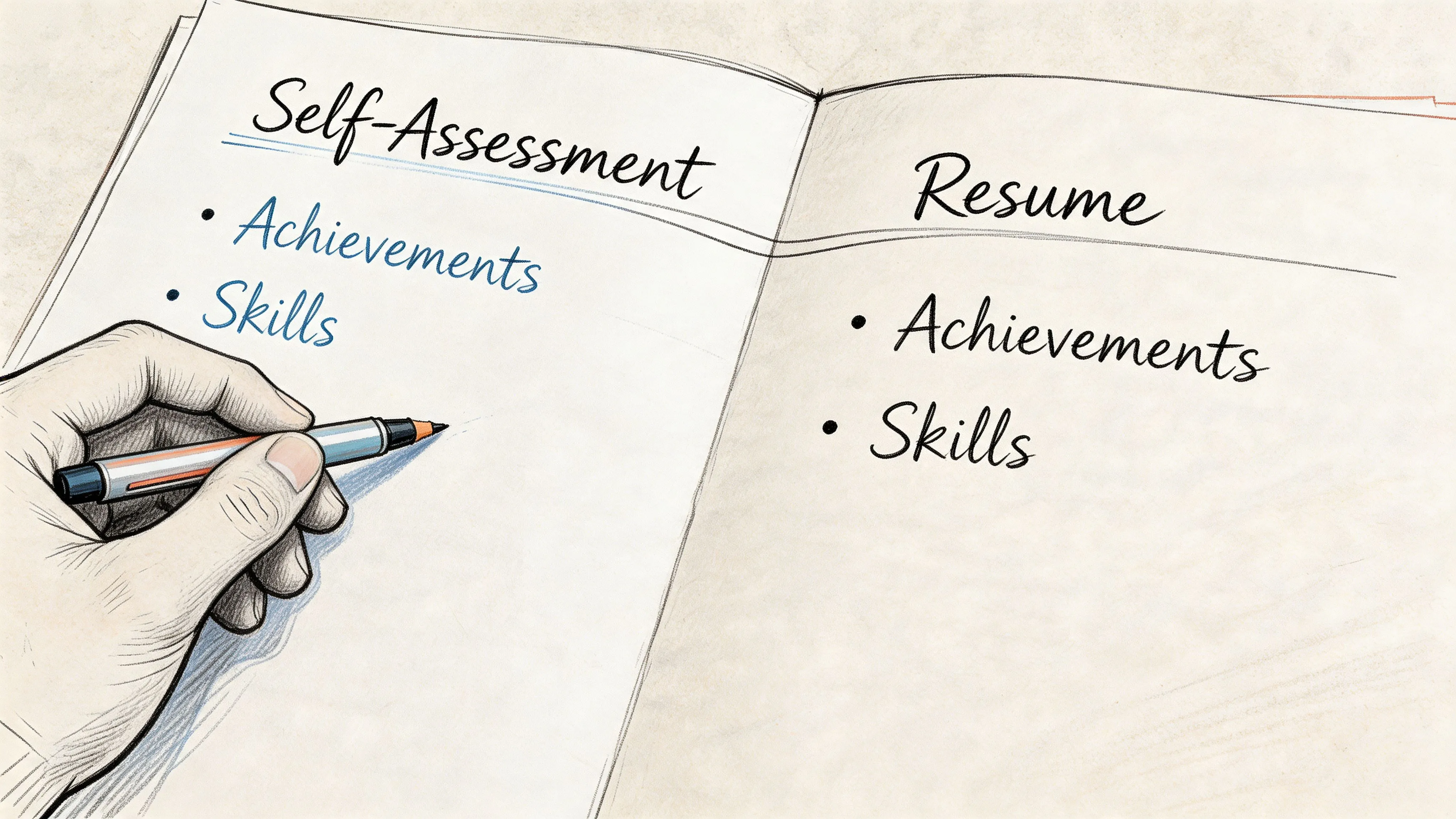
The overlap is bigger than people think
A self-assessment asks:
What did I contribute this year?
A resume asks:
What should a stranger know about my contribution?
Same excavation. Different edit.
That’s why people who do one well usually find the other much easier. They’ve already done the uncomfortable part. They’ve named their value without hiding behind generic role language.
A strong review also makes promotion conversations easier, because you’re not walking in with vibes. You’re walking in with evidence, decisions, and outcomes. If that’s the next step you’re aiming for, this guide to securing your promotion is a useful follow-on read because it shows how to turn strong performance into a stronger ask.
Keep the output somewhere useful
Don’t let your review vanish inside HR software.
Pull the strongest lines into a private doc. Keep a running bank of:
- High-signal accomplishments
- Projects with visible change
- Decisions that show judgment
- Development points you acted on
That becomes the source material for future reviews, promotion cases, and resume updates. If you need a clean way to shape those into sharper lines later, this guide to bullet points in a resume helps with the editing side.
The short version is this. If you want to know how to write self-assessment for performance review, stop trying to sound polished too early. Reconstruct the year. Find the moments where your presence changed the outcome. Then write that down plainly.
That’s not corporate polish. That’s career clarity.
If your self-assessment still sounds like a job description, the problem usually isn’t effort. It’s that you’re too close to your own work to frame it cleanly. StoryCV helps you do the hard part: turning messy lived experience into sharp, credible career narratives with editorial judgment at software speed.