Most engineering manager resume advice is backwards. It tells you to add keywords, polish formatting, and sprinkle in metrics. Fine. Do that. But that’s not why strong candidates get ignored. They get ignored because their resume reads like an HR archive instead of a hiring argument.
An engineering manager resume should make one thing obvious fast.
What scope you’ve handled, how you lead, how you influence technical decisions, and what changed because you were there. If that story isn’t clear, the rest is decoration.
Your Resume Is a Business Case
A hiring manager is not trying to admire your career. They are trying to decide whether to spend time on you.
Treat your resume like a decision memo. Every line should help a reviewer answer one question fast. Why should this person trust you with a team, a roadmap, and a messy set of technical and organizational tradeoffs? That is the standard. If you want a sharper model for that kind of argument, read how to persuade with a winning business case.
Engineering managers miss this because they write from memory instead of strategy. They dump in responsibilities, operating rituals, and every platform migration that crossed their desk. That creates volume, not conviction. A stronger resume makes a narrow case for the role you want next, then backs it up with proof.
The test is simple. If a bullet only says what your job was, rewrite it. If it shows the scale you handled, the judgment you used, and the result you produced, keep it.
Here’s what that means in practice:
-
Show scope clearly: team size, org shape, product area, platform surface, hiring ownership, cross-functional reach
-
Show impact clearly: delivery speed, reliability, headcount growth, quality, roadmap execution, org health
-
Show fit clearly: the kind of engineering environment you are targeting, not a generic management profile
-
Show technical credibility clearly: architecture involvement, technical decision-making, platform tradeoffs, incident leadership, engineering standards
That last point matters more than many resume guides admit. Plenty of engineering managers are not writing production code every week. Fine. The job is still technical. Your resume needs to show that you can assess tradeoffs, challenge weak proposals, and lead strong engineers without hiding behind process. If your bullets only talk about ceremonies and people management, you look operational, not technical.
A weak resume says, “Managed sprint planning, stakeholder communication, and performance reviews.”
A strong one says, “Led a 14-engineer platform team through a reliability reset, tightened incident review and service ownership, and restored delivery predictability across three product squads.”
Same role. Completely different case.
Section order matters too, because your argument gets read top-down. If you need help choosing the right resume section categories and order, use that structure to support the story you are making, not to stuff in more history.
Cut anything that could describe any engineering manager. Keep what proves why you should get this interview.
Structure Your Resume to Tell a Leadership Story
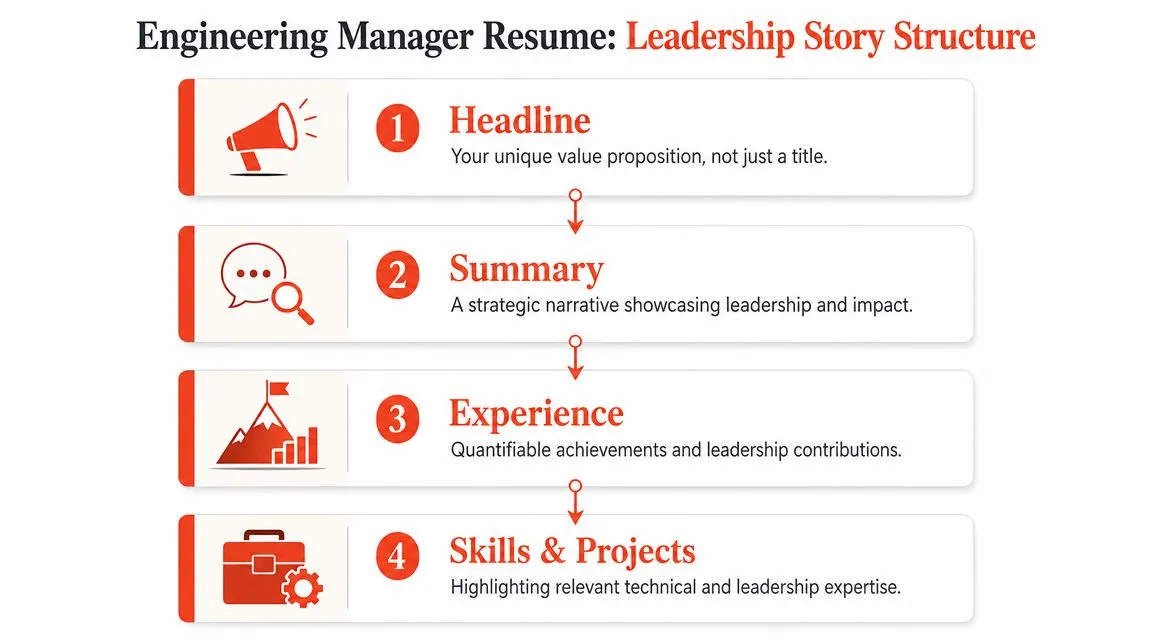
Hiring managers do not read your resume like a biography. They read it like a risk assessment. In a few seconds, they want answers to four questions: What level are you operating at, what kind of problems have you led through, how broad was your scope, and why should they trust you with their team?
That is why structure matters. The order of your sections changes the case you make.
Build the top half like an executive summary
Start with a headline that defines your lane. "Engineering Manager" says almost nothing. "Engineering Manager for platform reliability, org scaling, and multi-team delivery" gives the reader a frame immediately.
Then write a summary that connects the dots across your career. Do not list traits. State the pattern.
For example:
-
Weak summary: Engineering manager with experience leading teams and delivering projects.
-
Better summary: Engineering manager who has scaled teams, tightened execution, and led platform and product groups through hiring, reliability, and delivery inflection points.
The goal is not to sound polished. The goal is to make your level and fit obvious before anyone reaches your experience section.
If you need help choosing the right resume section categories and order, use that framework to support the story you are telling, not to cram in more history.
Calibrate your scope to the role
A lot of engineering manager resumes fail for a simple reason. They describe real work at the wrong altitude.
The same achievement can read as strong, ordinary, or under-scoped depending on the role you want. Improving page load time may be a meaningful win for a first-time manager who inherited a messy system. It is less persuasive for a Senior EM candidate if that is the biggest proof of impact. At that level, reviewers expect signs of broader ownership, stronger systems thinking, and influence beyond one team.
Use that filter when you choose examples:
| Target role | What your resume should emphasize |
|---|---|
| First EM role | Team leadership, execution consistency, mentoring, delivery coordination |
| Senior EM | Multi-team planning, manager coaching, hiring systems, org-wide delivery and quality improvements |
| Staff or higher leadership path | Operating model decisions, technical direction, platform strategy, cross-org influence |
Many candidates undersell themselves by operating at one level and writing their resume for another. Or they overstate scope and trigger skepticism.
Be precise. If you led one team, say one team. If you influenced three adjacent teams through architecture reviews, incident leadership, or platform standards, say that too. Strong framing does not inflate your title. It makes your actual level legible.
A hiring manager should not have to infer your scope from scattered bullets. Your structure should make it obvious.
From 'Managed Team' to 'Drove 20% Velocity Gain'
Hiring managers do not need a transcript of your responsibilities. They need proof that your leadership changed outcomes.
That is why weak bullets fail. They describe motion, not impact.
“Managed a team of 8 engineers.”
“Owned roadmap delivery.”
“Worked cross-functionally with product and design.”
Those lines say you were present. They do not say you were effective. A strong engineering manager resume makes the causal link obvious. What did you change, across what scope, and what improved because of it?
The rewrite formula
Use a simple structure:
-
Your leadership action
-
The scope or constraint
-
The result
That format works because it shows judgment, not just activity. It also helps you frame managerial work in a way that reads at the right altitude. “Ran sprint planning” is task-level noise. “Reset planning and staffing for a struggling platform team, improving release predictability and reducing carryover work” shows leadership.
Before and After rewriting engineering manager bullets
| Weak Bullet (Before) | Impactful Bullet (After) |
|---|---|
| Managed the search team | Scaled the search and discovery team during a period of rapid growth, building a structured hiring loop that improved hiring consistency and team capacity |
| Led hiring across engineering | Hired across multiple teams and time zones, then built a hiring process that improved retention and reduced decision lag |
| Improved the interview process | Redesigned the technical interview loop, cutting time-to-offer while improving candidate experience |
| Worked on product initiatives with partners | Led a cross-functional initiative with product and design that improved a core business metric and increased user engagement |
| Helped improve team performance | Reset planning, ownership, and execution around measurable delivery goals, improving throughput, quality, or both |
If you need help turning vague responsibilities into proof, this guide on how to write impact statements will help.
Pull numbers from the right places
Engineering managers often claim they have no metrics. Usually they are ignoring the metrics that reflect management work.
Look in three places:
-
People outcomes: hiring volume, retention, internal promotions, onboarding ramp time, offer acceptance
-
Delivery outcomes: cycle time, release reliability, incident rate, roadmap predictability, blocked work removed
-
Business outcomes: conversion, engagement, revenue impact, customer experience, efficiency gains
Use numbers where they sharpen the story. Do not force them into every bullet. A resume full of random percentages looks manufactured. A resume with a few strong, well-placed outcomes looks credible.
Cut activity bullets hard
Remove bullets that only describe routine management work:
-
Ceremonies: sprint planning, retros, roadmap reviews
-
Expected manager tasks: one-on-ones, stakeholder syncs, status updates
-
Tool usage: Jira, Confluence, Slack, unless the tool directly matters to the result
Keep the bar high.
Every bullet should answer one question: why should this person trust you with larger scope?
If it only describes what was on your calendar, delete it. If it shows how you improved a team, a system, or a business outcome, keep it. That is the difference between a resume that sounds busy and one that gets interviews.
Solving the Technical Credibility Paradox
A lot of engineering managers worry about the same thing. “I’m not coding every day anymore. How do I prove I still have technical credibility?”
Good question. Bad resumes answer it by pretending to be more hands-on than they are.
That’s a mistake.

Many guides don’t address this well. For managers who are no longer hands-on, technical authority should come through things like code review strategy, architectural tradeoff decisions, and mentoring senior ICs, not fake current coding fluency, as noted by IGotAnOffer.
What technical credibility looks like now
If you haven’t written production code recently, don’t lead with a giant skills dump of stale languages. Show technical judgment in context.
Stronger ways to frame it:
-
Architecture influence: Guided architectural tradeoffs for a high-traffic system, aligning senior engineers on reliability, speed, and maintenance cost
-
Engineering quality: Led code review standards and incident follow-up practices that improved engineering decision quality
-
Technical mentorship: Coached senior engineers through system design decisions, on-call readiness, and design review rigor
-
Debt and platform judgment: Prioritized technical debt reduction based on delivery drag, reliability risk, and team capacity
If you want examples of how to present technical capabilities cleanly, this list of examples of technical skills in resume can help, especially if you’re balancing management and technical depth.
Don’t cosplay as a staff engineer
If a company expects hands-on depth, be honest about how current yours is. But don’t undersell the actual technical work of management.
An engineering manager who can challenge a shaky migration plan, sharpen a service boundary, or spot where process is hiding architecture problems is still technical. The resume should show that through decisions and influence, not keyword theater.
Your job isn’t to prove you still code like an IC. Your job is to prove engineers trust your judgment when the technical stakes are high.
That’s a more believable story, and usually a stronger one.
Beat the Bots Without Sounding Like One
Stop writing for resume scanners as if they make the hiring decision. They do not. The software only decides whether a human gets to see your resume. The human decides whether your leadership story makes sense for the role.
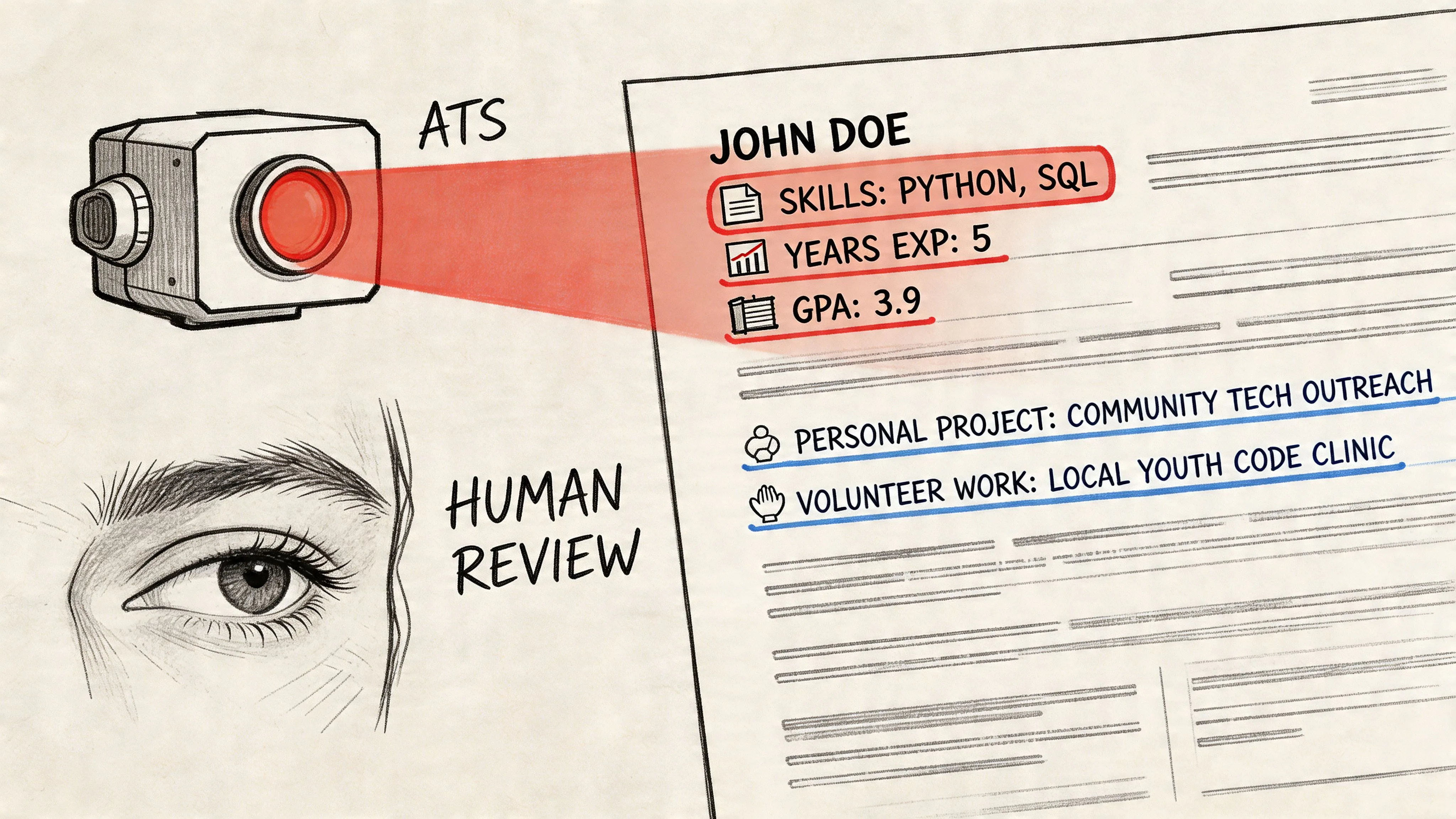
That means your resume has to do two jobs at once. It must parse cleanly, and it must read like an experienced engineering leader wrote it. As noted earlier, recruiters often give a first pass only 6 to 10 seconds. You do not win that scan with keyword stuffing. You win by making your scope, outcomes, and technical context obvious fast.
The no-BS ATS checklist
-
Use a single-column layout: Keep core content out of tables, sidebars, headers, and footers so parsing tools can read it correctly.
-
Match the job description with judgment: Reuse the terms that matter, especially around team size, platform ownership, architecture, reliability, cloud, hiring, and delivery. Do it where it reflects real work.
-
Keep section names boring: Experience, Skills, Education, Summary. Clear labels get read.
-
Submit as PDF unless the application says otherwise: Clean formatting beats clever formatting.
-
Expand important acronyms once: Write the full term, then the abbreviation if recruiters or hiring managers may search for it.
The mistake is treating ATS optimization like the main event. It is hygiene. If your resume reads like a scraped job description, you may pass the filter and still lose the interview.
A strong engineering manager resume sounds specific. It shows what you owned, how broad your scope was, what technical environment you operated in, and what changed because of your decisions. That is what both the scanner and the reviewer are trying to infer.
Use the language of the role. Keep the voice human. If you want a practical way to pressure-test whether your resume is setting up the conversations you need next, review these questions on cracking engineering manager interviews. If your resume does not prepare you to answer those well, fix the resume.
A Great Resume Is a Story You Tell
The best engineering manager resume doesn’t feel stuffed. It feels coherent.
A reviewer can see the arc. You led at a certain scope. You made better technical and organizational decisions over time. You improved hiring, delivery, product outcomes, or operating quality. The story holds together.
That matters because a narrative-driven approach works better than generic keyword packing. Benchmarks from ATS platforms show that integrating quantified achievements into a natural narrative can increase pass rates by 40-60%, according to VBeyond.
Your resume also needs to set up the next stage. If you want help preparing for that, this set of questions on cracking engineering manager interviews is a practical follow-up because it exposes the same gaps weak resumes usually hide.
What makes this hard isn’t formatting. It’s memory and framing. You’ve done the work, but translating that work into crisp proof is a different skill.
That’s why blank templates are a bad answer. Professionals don’t need more boxes. They need better questions.
StoryCV is built for exactly that. It acts as a Digital Resume Writer, not a template builder, using an interview-style process to pull out your real scope, technical judgment, and measurable impact. If your experience is strong but your resume still reads flat, StoryCV helps turn it into a clear hiring story that sounds like you and gets you taken seriously.