
Templates trained people to build resumes like tax forms. That is why so many of them fail.
A resume has one job. Make a clear, credible case for an interview. Every category on the page either strengthens that case or wastes space. Treating sections as mandatory boxes is lazy. Treating them as evidence is how you stand out.
Recruiters do not reward effort. They reward proof. Enhancv's resume findings show a lot of candidates still skip measurable impact, which is exactly why vague resumes blend together instead of competing. Skills matter too, but they only help when they show up as believable evidence tied to results, not as a keyword dump.
That changes how you should think about categories for resume writing. Work Experience is not just history. Education is not just a credential line. Projects can prove initiative. Certifications can reduce hiring risk. A summary can frame a career change before a recruiter makes the wrong assumption. Each category plays a role in your argument.
That also means you do not earn points for including everything. You earn points for choosing the right categories, ordering them well, and writing them to support one career story.
If your bullets still read like task lists, fix that first. This guide on writing impact statements that show results will help.
Stop filling boxes. Start building a case.
1. Work Experience
If you only get one section right, get this one right.
Work Experience is the spine of the resume. It's where hiring managers decide whether your past maps to their present problem. Don't treat it like a job description archive. Treat it like a record of outcomes.
A weak entry says what you were assigned. A strong entry says what changed because you were there. That's the standard.
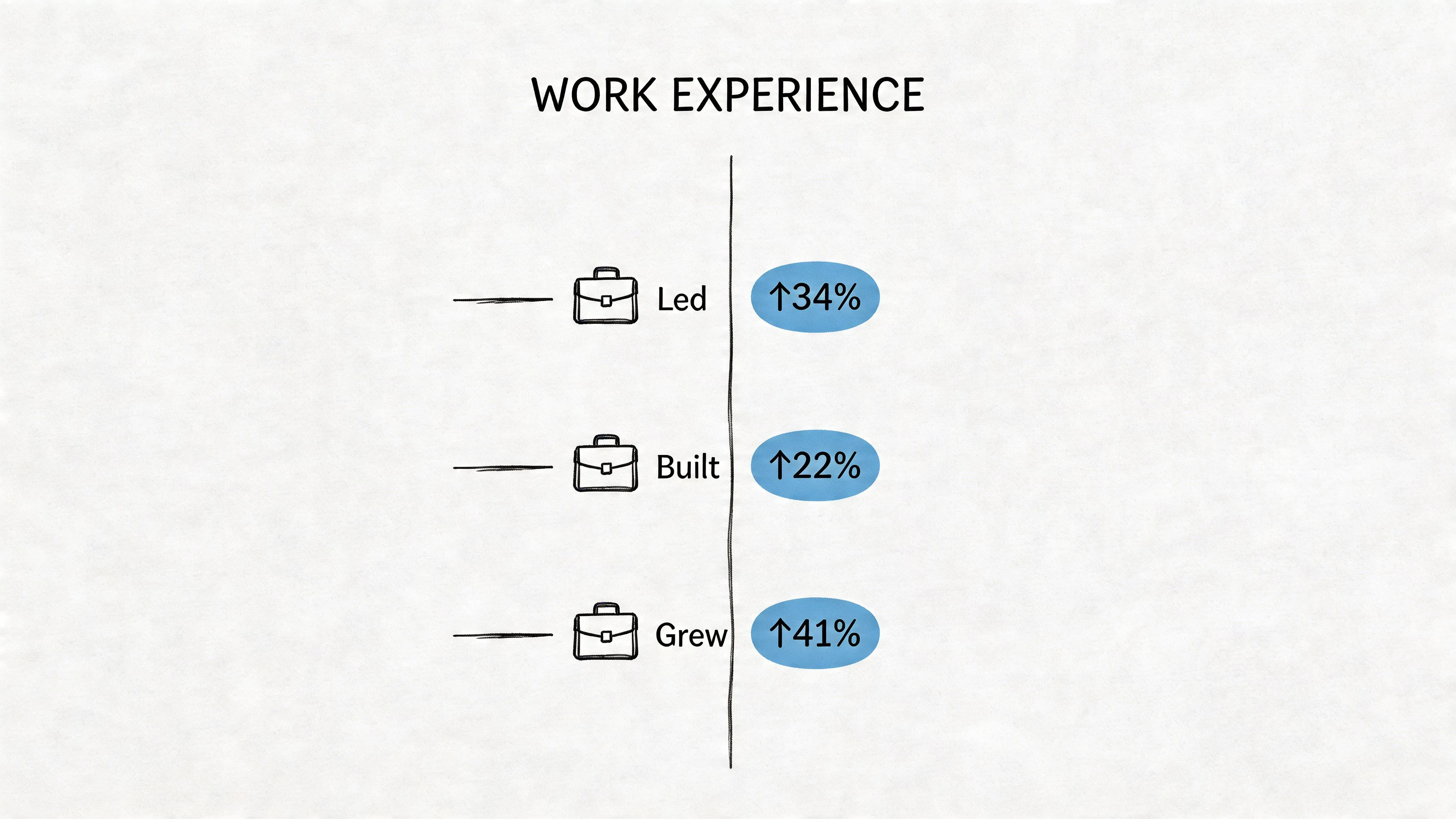
Write the before and after
Bullets are often written like this:
- Managed vendor relationships
- Supported product launches
- Worked with cross-functional teams
That says almost nothing. Replace duties with movement.
- Led a cross-functional engineering team to redesign the payment flow, cutting transaction failures and reducing dispute costs
- Reworked supply chain handoffs, shrinking fulfillment time and improving order accuracy
- Closed enterprise accounts in a new segment and finished above quota in year one
You don't need inflated language. You need contrast. What was messy before. What you changed. What improved after.
If you're stuck, use this sequence:
- Problem: What wasn't working
- Action: What you did
- Result: What changed
- Relevance: Why that matters for the next role
For help tightening those bullets, use StoryCV's guide to writing stronger impact statements.
Practical rule: If a bullet could belong to ten other people with the same title, rewrite it.
Cut the obvious
Recruiters already know a senior operations manager manages operations. They know an account executive handles accounts. Don't spend prime space stating the title again in sentence form.
Use that space for specifics:
- Systems
- Scope
- Team size
- Market complexity
- Revenue responsibility
- Process ownership
- Change delivered
Use present tense for your current role. Use past tense for older roles. Keep the formatting clean and consistent.
For career changers, translate the win instead of dragging in industry jargon. "Reduced onboarding friction across a multi-step service process" works even if the old job was in hospitality and the new one is in SaaS. Good employers hire for transferable proof, not just familiar labels.
2. Education
Education matters. Just not equally for everyone.
If you're early in your career, Education can carry real weight. If you've been working for years, it becomes supporting evidence. That's the move. Put it in proportion.
A lot of mid-career resumes give Education too much space and Experience too little. That's backwards.
What belongs here
Keep the section clean:
- Degree and field: Bachelor of Science in Computer Science
- School name: Use the full institution name
- Graduation year: Or expected graduation
- Relevant extras: Coursework, honors, thesis, capstone, academic distinction, if they help your case
Examples:
-
Bachelor of Science in Computer Science, Stanford University, 2023
Relevant Coursework: Machine Learning, Distributed Systems, Software Engineering -
MBA, University of Chicago Booth School of Business, 2021
Focus: Sustainable Business and Operations Strategy -
Bachelor of Arts in Communications, University of Michigan, 2015
Master's Certificate in Data Analytics, Coursera, 2023
Use Education as a bridge
For career changers, Education is often credibility glue. If you're moving from operations into product, or marketing into analytics, relevant study helps explain the jump fast.
Put the most job-relevant learning first inside the section. That could be a degree. It could be a recent certificate program. It could be a specialized credential from Google or Coursera if it's directly tied to the role.
Don't include high school once you have college or post-secondary credentials. It's dead weight.
You can also use Education to surface serious academic projects when work experience is thin. A machine learning capstone. A market research thesis. A system design project. That's fair game if it shows applied skill.
Keep this section short if you've got more than five years of strong experience. At that stage, Education should confirm your foundation, not carry your story.
One more thing. Be precise with naming. Write the full degree, the school, and the year. Sloppy education entries create avoidable doubt, especially in regulated or credential-sensitive roles.
3. Skills
The Skills section gets abused more than any other part of a resume.
People treat it like a storage bin for every tool they've touched and every trait they want to claim. That weakens your case fast. This section should act like evidence. It should tell a hiring manager, in seconds, what kind of problems you can solve and what lane you belong in.
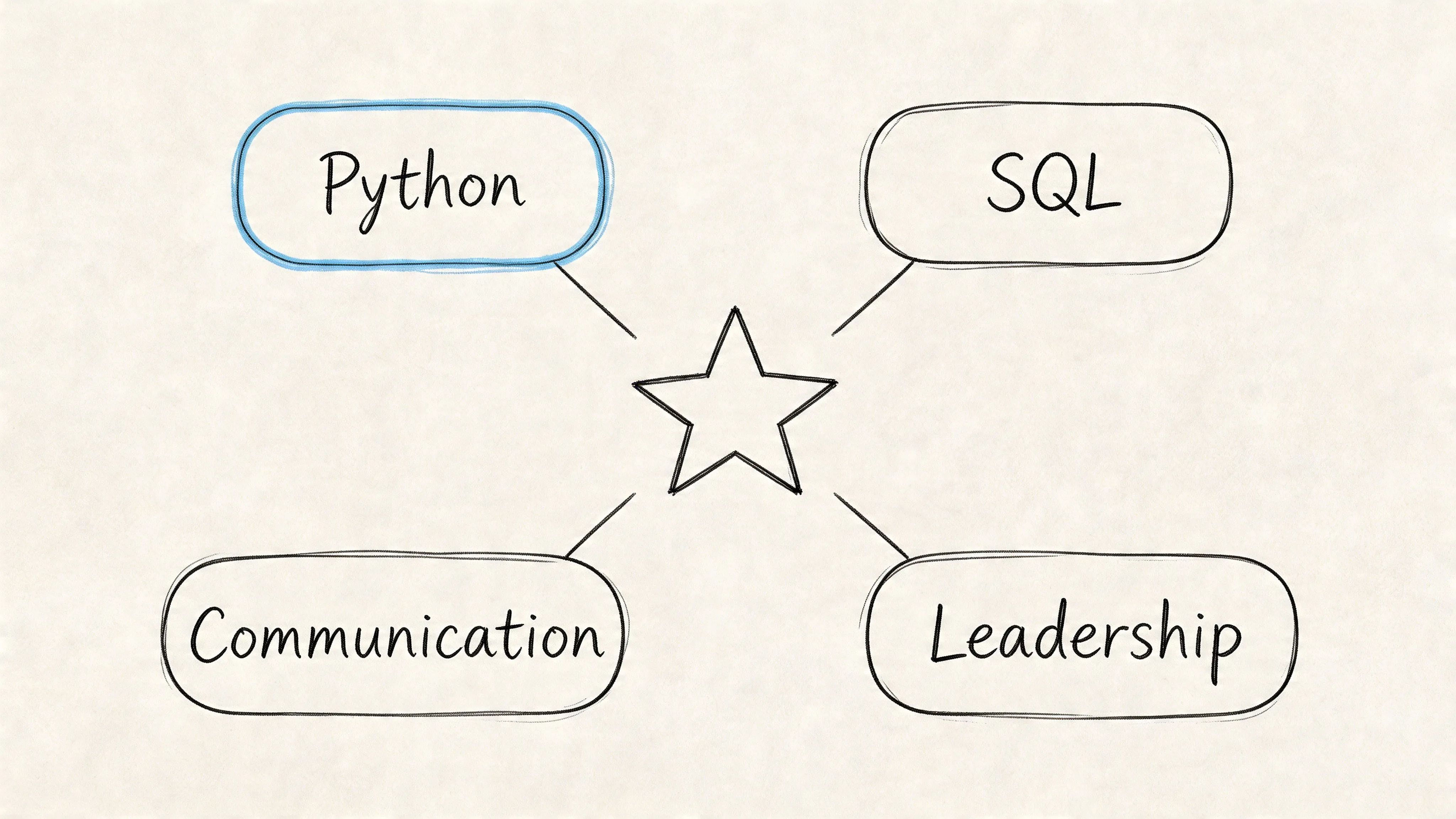
Hiring teams scan for match, not effort. Job descriptions are packed with specific terms, tools, and domain language. If your resume uses vague labels or hides relevant skills in a wall of text, you create friction for both recruiters and applicant tracking systems.
Group skills by the story you need to prove
Skill categories are not formatting tricks. They are narrative choices.
Use them to frame your value clearly:
- Technical Skills: Python, SQL, Tableau, Power BI, AWS, Docker
- Operational Skills: Process Improvement, Forecasting, Inventory Planning, Lean
- Product and Business Skills: Roadmapping, Stakeholder Management, User Research, Pricing
- Leadership Skills: Hiring, Coaching, Cross-Functional Leadership, Executive Communication
That structure helps the reader place you fast. A data analyst with SQL, Python, dashboarding, and experimentation skills tells one story. A product manager with prioritization, research, and stakeholder management tells another. Stop mixing both unless the role truly needs both.
For research, analytics, or specialist roles, tighter subcategories improve readability. Separate methods, tools, and domain knowledge. For example, a UX researcher might use Research Methods, Tools, and Insights Communication. A compliance candidate might use Regulatory Knowledge, Systems, and Audit Skills.
List skills you can prove under pressure
If it's on the page, expect questions.
Keep the bar high:
- Use real tools and methods: SAP beats "enterprise systems." Qualtrics beats "survey tools."
- Order for relevance: Put the skills tied to the target role first.
- Cut empty traits: "Hardworking," "go-getter," and "team player" waste space.
- Match your actual level: Don't claim Python if you can only tweak one script.
Specificity wins because it sounds true.
For a sharper breakdown of categories, tools, and examples, read StoryCV's guide on what skills to put on a resume. If you're trying to connect your current skill base to a smarter next step, this piece on effective career development plans is also worth your time.
Career changers need a stricter structure. Split this section into categories like Technical Skills, Transferable Skills, and Industry Knowledge. That does more than organize information. It helps recruiters see the bridge between your past work and your target role without making them figure it out themselves.
4. Certifications and Licenses
This section does one job. It lowers perceived risk.
A respected certification tells an employer that someone else has already verified part of your capability. In some fields, that's optional. In others, it's table stakes.
If you're in cloud, project management, compliance, finance, healthcare, security, or engineering, this category can punch above its size.
Put the important details in plain view
List certifications like an adult, not like a badge collection.
Use:
- Credential name: AWS Certified Solutions Architect
- Issuing body: Amazon Web Services
- Date issued: Month and year
- Expiration or renewal status: If relevant
- License number or certificate ID: If standard in your field
Examples:
- AWS Certified Solutions Architect, Amazon Web Services, Issued March 2023
- Project Management Professional, Project Management Institute, Issued June 2021
- Six Sigma Green Belt, American Society for Quality
- Google UX Design Professional Certificate, Coursera, Issued November 2023
Relevance beats volume
Five random certifications don't make you look stronger. They make you look unfocused.
Prioritize:
- Role relevance: Cloud certs for cloud jobs, not generic business courses
- Current status: Expired credentials usually don't help
- Industry recognition: PMP means more than a vague internal workshop certificate
- Recent learning: Useful for pivots and returners
If you're changing careers, this section can become a credibility bridge fast. A recent UX certificate, data analytics program, or industry license shows real motion. It says you're not just "interested." You've done the work.
A certification can't save a weak resume. But it can remove doubt from a strong one.
If a credential is still in progress, be explicit. Write "In progress" only when there's a real completion timeline. Otherwise it reads like wishful thinking.
5. Summary or Professional Headline
Skip the fluffy opener. Your summary is not there to sound polished. It is there to frame the evidence that follows.
This category works like an argument in miniature. In two to four lines, tell the reader what lane you belong in, what you are good at, and what lens they should use when reading the rest of the resume. If you do that well, every later category gets easier to understand.
Strong examples:
A full-stack engineer with six years building cloud systems for fintech products. Strong in AWS, system design, and technical leadership. Led a legacy migration that improved latency and development speed.
An operations leader transitioning into product management after years improving B2B SaaS workflows. Brings customer process insight, cross-functional leadership, and recent product training.
A marketing strategist returning after a career break. Brings prior experience in digital growth, budget ownership, and campaign strategy, plus current analytics training.
The summary matters most when the story is not obvious on first scan. Career changer. Returner. Generalist. Candidate with strong experience that looks scattered because the titles do not tell the whole story.
Write the angle, not the adjectives
Recruiters should not have to guess what your resume is arguing. Write the thesis plainly.
Use patterns like these:
- Career changer: "Operations leader transitioning into product management"
- Returner: "Finance professional re-entering the workforce after a caregiving break"
- Specialist: "Data analyst focused on customer insights and BI reporting"
- Manager: "Sales leader building enterprise pipeline and coaching account teams"
That is stronger than "motivated professional" or "results-driven leader" because it gives the reader a category and a point of view. Those generic phrases say nothing. They waste prime space.
If you want sharper models, use these professional summary examples for resume writing.
Keep this section tied to proof. Do not claim you are strategic, inventive, or high-performing unless the rest of the resume backs it up with actual outcomes, scope, or specialization. The summary sets the reading frame. Your work history has to cash the check.
Write it last. Build the resume first. Then look for the pattern. The best summary is a conclusion drawn from evidence, not a slogan pasted on top.
6. Projects and Portfolio
Sometimes your best evidence didn't happen inside your job title.
That's why Projects can be one of the smartest categories for resume strategy, especially in tech, design, data, product, and career transitions. A strong project shows initiative, practical skill, and applied thinking. It proves you can do the work, not just talk about it.
Start with work that directly supports the role you're targeting.
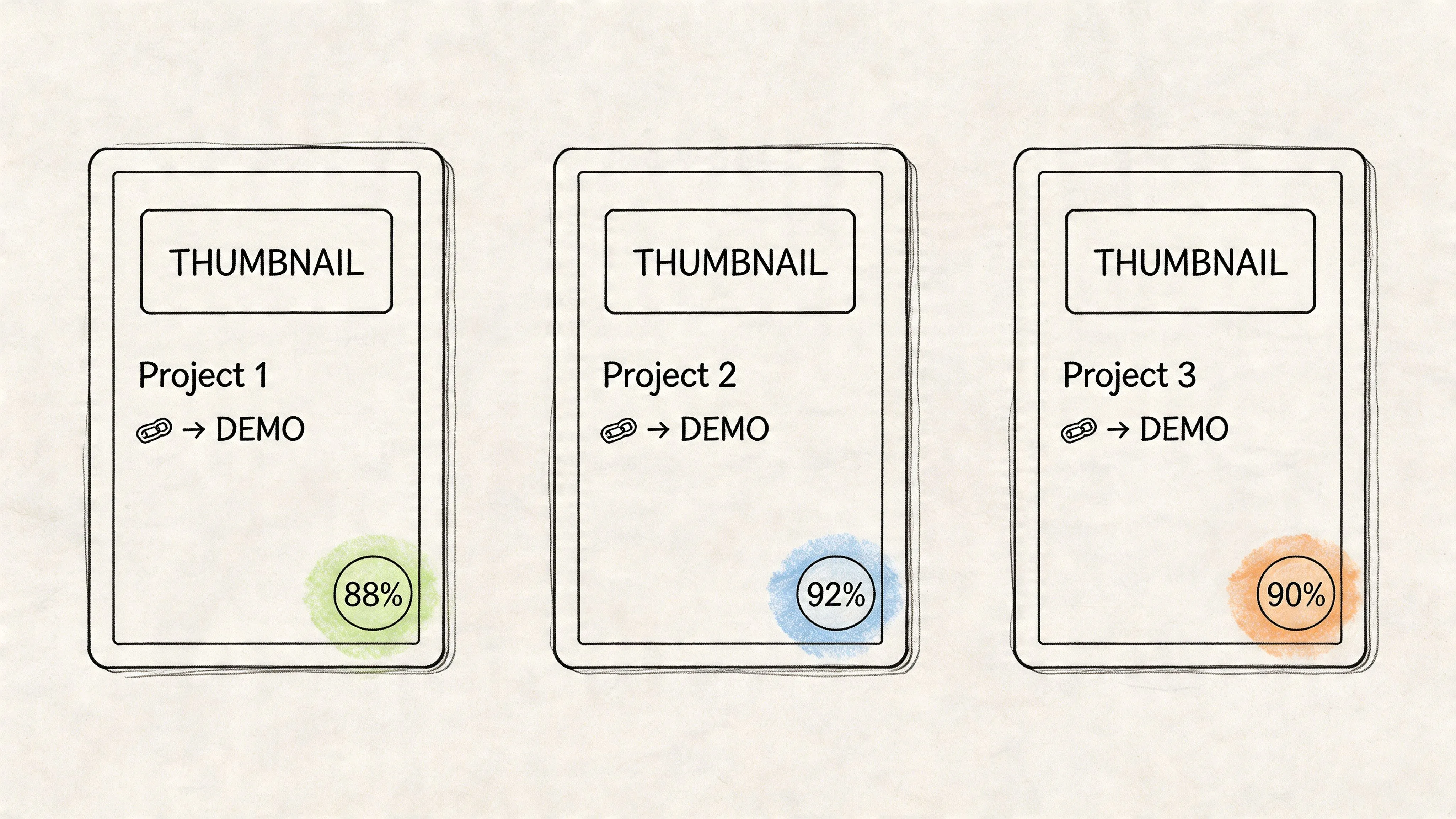
Good projects prove applied skill
Examples:
-
NYC Taxi Demand Forecasting, Python, SQL, Tableau
Built a forecasting model on historical trip data and visualized demand trends in a dashboard -
Healthcare App Redesign, Figma, User Research
Reworked onboarding based on interview findings and produced a case study with annotated design decisions -
Open Source Contribution, React, JavaScript
Submitted merged pull requests focused on accessibility and performance improvements
The key is context. Don't just name the project and drop a link. Explain the problem, your role, the tools, and the result.
A project entry should answer:
- What was built
- Why it mattered
- What you owned
- Which tools you used
- Where someone can verify it
Links matter more than promises
If you include a portfolio, GitHub repo, case study, or live demo, test every link before you send the resume. Broken links don't make you look scrappy. They make you look careless.
For proprietary work, anonymize the client and describe the challenge. You can still show strategic thinking without violating an NDA.
This kind of evidence matters because a standalone achievements section or proof-based category can improve scanning when used well. One overlooked-sections guide notes that standalone achievements sections can improve ATS parse rates by 28%. Projects often serve the same purpose when they're tightly framed around outcomes instead of vague side-hustle energy.
A quick explainer helps if you're building this section from scratch:
If you're switching fields, Projects may carry more persuasive weight than older job titles. They show current direction. That's what recruiters want to see.
7. Volunteer Experience and Community Involvement
This section is underrated because people frame it like charity. That's the wrong lens.
Volunteer work can show leadership, ownership, consistency, and values. It can also fill real narrative gaps for career changers, returners, and professionals whose best people-management examples happened outside paid work.
If it strengthens your case, include it. If it doesn't, leave it out.
Treat it like real experience
Write volunteer entries with the same standard you use for paid roles.
Weak:
- Helped with events
- Supported community initiatives
- Assisted board members
Better:
- Organized a volunteer calendar across multiple teams
- Built a donor follow-up process
- Led curriculum design for a mentoring program
- Recruited and coordinated volunteers for a community rollout
Examples:
-
Board Member, Teach for All
Mentored volunteer educators and helped shape program delivery -
Founder, School Community Garden Initiative
Organized parents, built partnerships, and ran school-based programming -
Tech Volunteer, Code2040
Mentored early-career engineers and spoke on technical topics
Use it to explain continuity
A resume gap isn't always a problem. An unexplained gap is.
Volunteer work can show that you stayed active, led people, built things, or stayed close to a mission while outside traditional employment. That's useful context. Especially for returners.
Volunteer work belongs on the resume when it proves capability, not when it only proves kindness.
For career changers, volunteer entries can carry transferable evidence. A nonprofit board role can demonstrate governance, fundraising, stakeholder management, and strategy. A community operations role can show logistics and execution. A mentorship role can show coaching and leadership.
Keep the section concise. Use it to support your story, not distract from it.
8. Awards, Honors, and Recognition
Third-party validation matters.
If someone else recognized your work, that's useful evidence. It tells the reader your impact wasn't only self-reported. But this section can go bad fast if it's stuffed with small, stale, or irrelevant wins.
Be selective.
Only keep recognition that sharpens your case
Good examples:
- Employee of the Year, XYZ Corporation, 2022
- Rising Star Award, Business Technology Association, 2022
- Patent holder in cloud infrastructure optimization
- Innovation Award for process redesign work
Bad examples:
- Participation awards from years ago
- Academic prizes that no longer relate to your target role
- Internal shout-outs with no context
- Generic "top performer" lines without explanation
Add the award, the issuer, and the year. If needed, add one short note explaining why it matters.
For example:
- Employee of the Year, XYZ Corporation, 2022. Recognized for leading a cross-functional process redesign initiative
- Innovation Award, Industry Leaders Association, 2023. Awarded for operational improvement work
This section isn't mandatory
Mid-career and senior professionals should use this section only when the recognition is meaningful. Recent grads can get more mileage from academic honors, scholarships, or selective programs. Senior candidates should be tougher on themselves.
One reason this category matters is speed. Recruiters spend little time on initial scans, and evidence that gets understood instantly wins. That's also why an achievements-first framing works so well for candidates whose experience titles don't fully capture their value.
If you don't have formal awards, don't fake importance around weak recognition. You can build stronger proof through work achievements, projects, or a sharp summary instead.
9. Languages and International Experience
Language skills are either relevant or decoration. Know which one you're dealing with.
If the role involves global customers, regional teams, expansion markets, or multicultural collaboration, this section can help. If not, keep it short. Don't oversell it.
What matters is credibility. "Conversational Spanish" means different things to different people. Be clear.
State proficiency in plain English
Use labels people understand:
- English, native
- Spanish, professional working proficiency
- French, advanced
- German, basic
If language use showed up in your actual work, mention that in Experience too. That's stronger than dropping it here without context.
International experience also belongs here when it proves adaptability or cross-border execution. Examples:
- Managed projects across US and European stakeholders
- Studied abroad in a market tied to your industry focus
- Worked with distributed teams across time zones
- Supported multilingual customers or regional launches
Keep it practical
For globally relevant roles, this section can subtly strengthen your case. It signals cultural fluency, communication range, and operational flexibility.
For everyone else, don't force it. A weak language section doesn't make a resume look polished. It makes it look padded.
One more thing. If your international experience is a major part of your story, don't bury it here alone. Surface it in your summary or work experience too. Use this section as reinforcement, not the only mention.
9-Category Resume Comparison
| Item | Implementation Complexity 🔄 | Resource Requirements ⚡ | Expected Outcomes 📊 | Ideal Use Cases 💡 | Key Advantages ⭐ |
|---|---|---|---|---|---|
| Work Experience | High, needs contextualization & quantification | Moderate–High, time to gather metrics and tailor | Very high, primary driver for ATS & recruiters | Mid‑career/senior roles, direct hiring assessments, career changers who can show impact | Clear evidence of capability, progression, measurable impact |
| Education | Low–Medium, straightforward but strategic placement | Low, factual listing, occasional transcripts | Moderate, screening filter, critical for entry/regulatory roles | Recent graduates, regulated professions, career changers needing credibility | Foundational credentials, academic differentiation |
| Skills | Medium, selection & keyword strategy required | Low–Moderate, update and validate claimed skills | High, boosts ATS matches and quick recruiter scans | Technical roles, keyword-driven hiring, career changers showing transferables | Concise capability snapshot; improves discoverability |
| Certifications & Licenses | Low–Medium, list with verification details | Moderate, include IDs, dates, renewal status | High in technical/regulatory roles; credibility enhancer | Regulated industries, cloud/data roles, career switchers needing proof | Verifiable proof of specialization; signals currency |
| Summary / Professional Headline | Medium, craft concise, tailored narrative | Low, writing and targeted edits per role | Moderate–High, frames resume; increases engagement | Career changers, returners, complex career paths, quick scanners | Positions value quickly; humanizes and differentiates candidate |
| Projects & Portfolio | High, document outcomes, links, demos | High, build, maintain links, prepare case studies | Very high for creative/technical hires, shows applied skill | Developers, designers, data scientists, early‑career, career changers | Tangible proof of work; demonstrates initiative & results |
| Volunteer & Community Involvement | Low–Medium, frame with achievement language | Low, collect role details and impact metrics | Moderate, explains gaps; signals values and skills | Returners, career changers, cultural‑fit focused employers | Shows leadership, values alignment, transferable skills |
| Awards, Honors & Recognition | Low, selective listing with context | Low, document title, issuer, year, context | Moderate, strong differentiator when external/credible | Mid‑senior candidates, those with notable recognitions | Third‑party validation; highlights exceptional performance |
| Languages & International Experience | Low–Medium, specify proficiency framework | Low–Moderate, include scores/certificates and context | Moderate, opens global roles; signals adaptability | Multinational companies, roles requiring cross‑cultural work | Expands opportunities; demonstrates cultural competence and flexibility |
Stop Listing. Start Arguing.
A resume is not a form. It is an argument.
That single shift fixes a lot of bad resume writing. Categories are not boxes to fill because a template left space for them. They are evidence types. Each one should prove something a hiring manager needs to believe about you.
Use them that way.
Work Experience proves you delivered in professional contexts. Skills give a fast read on capability. Certifications and licenses reduce perceived risk. Projects prove applied ability, especially when your title undersells you. Volunteer work can support a story about leadership, continuity, or values. Awards add third-party credibility. Languages and international experience widen your range when the role calls for it.
Placement matters as much as content. Put your strongest proof first. Senior candidates should not lead with old academic detail. Career changers often need a sharper summary and stronger project section near the top. Licensed professionals should feature credentials early, because those credentials decide whether the rest of the resume even gets read.
Templates are weak at this. They treat every section as equal. Real resumes are not equal. One category should carry the case. Another should support it. A third may need to disappear.
The same rule applies to keywords. Yes, ATS screening still shapes who gets seen. As noted earlier, employers rely heavily on these systems. That does not excuse lazy writing. A machine may parse the file, but a person still decides whether your case is convincing.
Length matters for the same reason. Resumes fail when they are bloated, thin, or full of filler. The problem is rarely the number of sections. The problem is weak evidence inside them. Adding another category will not save vague bullets.
Use a simple test for every section:
- Does this help prove I'm a fit for this role?
- Does it add evidence instead of background noise?
- Does it make my value easier to grasp fast?
- Can I defend every line if asked about it in an interview?
If a section fails that test, cut it.
If it passes, tighten it. Add outcomes. Add context. Name the tool, scope, stakeholder, or decision that makes the claim credible. Replace soft claims with proof someone can picture.
This describes the fundamental role of resume categories. They shape the reader's conclusion. You are choosing what kind of proof appears, what gets priority, and what stays out. That is not formatting. It is strategy.
StoryCV is built for that strategy. A Digital Resume Writer should do more than shuffle content into preset boxes. StoryCV pulls out context, evidence, and specifics, then turns them into resume writing that sounds sharp instead of generic.
StoryCV is a Digital Resume Writer for people who've done meaningful work and are tired of sounding bland on paper. It asks smart questions, pulls out the evidence, and turns your experience into clear, credible resume content without the usual template sludge. Start free with one fully written role, then keep building a stronger career story as your next move takes shape.