Changing careers? Your resume isn’t the problem. The story is.
You’ve done real work. Led projects. Fixed messy systems. Kept teams moving. But your old resume still reads like a document for your last industry, not your next one. Recruiters skim it, see a mismatch, and move on.
Most advice tells you to stuff in keywords or use a functional template. That’s bad advice. Rearranging bullets doesn’t solve a positioning problem. A career change resume has one job: make your past experience feel obviously relevant to a new buyer.
That’s why the top resume writing tools for career changers aren’t just formatters. They help you translate, frame, and argue. Some are good at keyword matching. Some are good at structure. A few are particularly adept at narrative.
Resume tools solve three different problems, and most people buy the wrong category.
-
Template and formatting tools (Enhancv, Kickresume, Zety, Canva) fix presentation.
-
ATS and keyword tools (Jobscan, Resume Worded) fix keyword matching.
-
Writing tools: structured writers like StoryCV fix the content itself.
Diagnose which problem you have before you pay for anything: if you don't yet know what to say, no template or scanner will fix that.
One quick side note before the list. If you’re also considering a headshot on your resume, think twice. In most cases, content matters more than cosmetics.
1. StoryCV
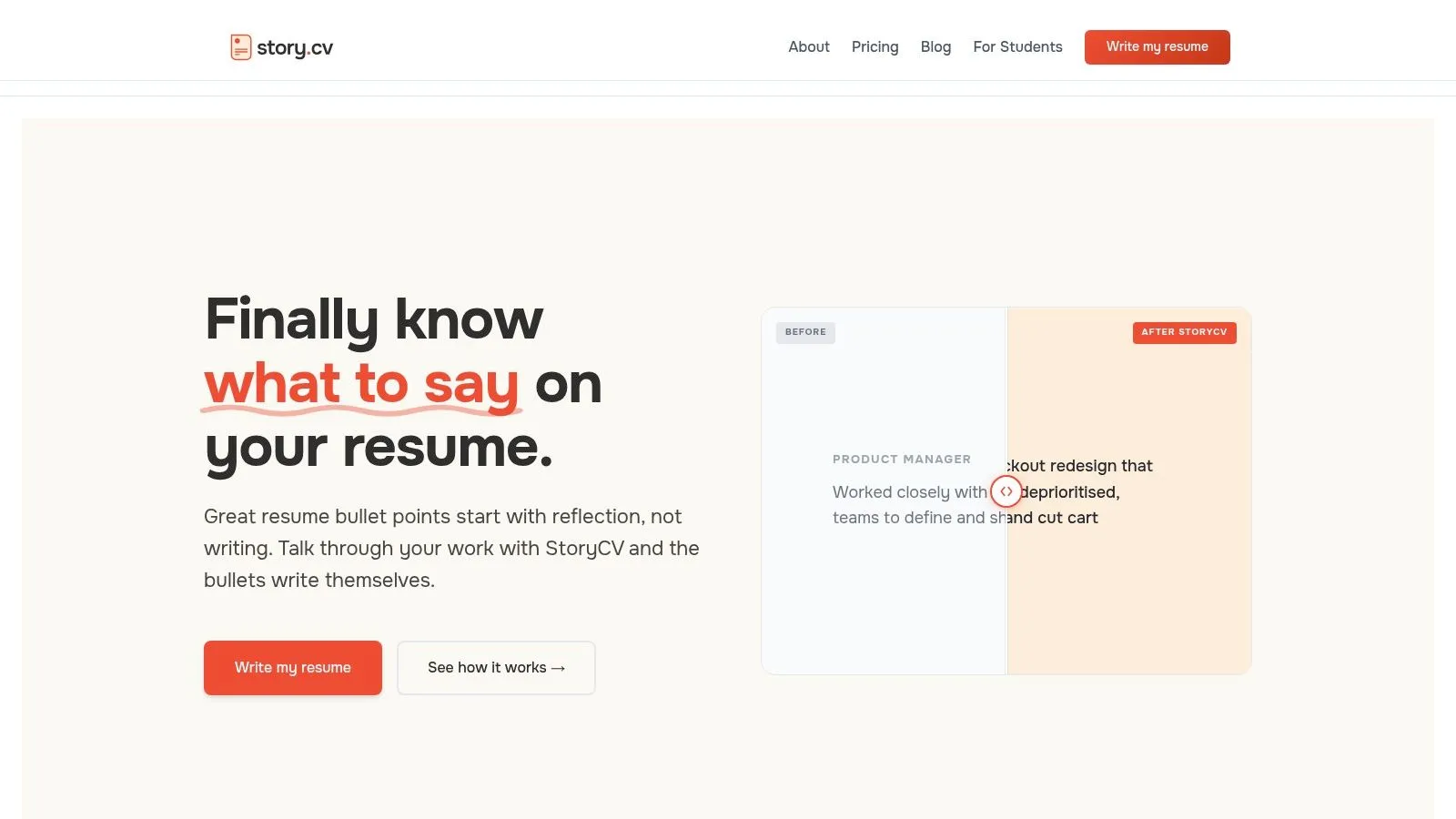
StoryCV is the best pick if your real problem is blank-page paralysis.
Most resume tools hand you boxes and ask you to perform. That’s backwards. Career changers usually don’t need more fields to fill in. They need help pulling the signal out of years of work and turning it into a convincing new narrative. StoryCV does that with a guided interview, not a template-first workflow.
It asks better questions. What changed because you were there? What decisions did you make? What tradeoffs did you manage? What did you own, improve, launch, fix, or steady? That context is what generic builders usually miss.
Why it works for career changers
StoryCV sits in the middle ground between DIY builders and expensive human writers. That’s the sweet spot. You get editorial judgment at software speed, without awkward calls or slow back-and-forth.
A significant challenge for career changers is articulating impact across industries. That gap shows up in a lot of resume advice, which leans hard on ATS tricks and template swapping while missing the deeper storytelling problem, as discussed in Zapier’s review of resume builders.
Practical rule: If your experience is strong but your bullets sound generic, you don’t have a formatting problem. You have a narrative extraction problem.
StoryCV is especially strong for people in tech, business, operations, military transitions, and mid-career pivots where your work is real but hard to summarize cleanly. It writes with enough nuance to make your old experience feel transferable, not random.
Best for
-
Non-linear careers: You’ve done meaningful work, but it doesn’t fit neat resume-builder boxes.
-
Mid-level pivots: You need to sound credible in a new field without pretending you’re entry level.
-
People who hate prompting: The guided flow does the heavy lifting.
It’s not a visual resume builder. That’s fine. Design isn’t the hard part. Substance is.
If you want to see what that looks like in practice, these career change resume examples from StoryCV make the difference obvious. You can also try the platform directly at StoryCV.
2. Jobscan
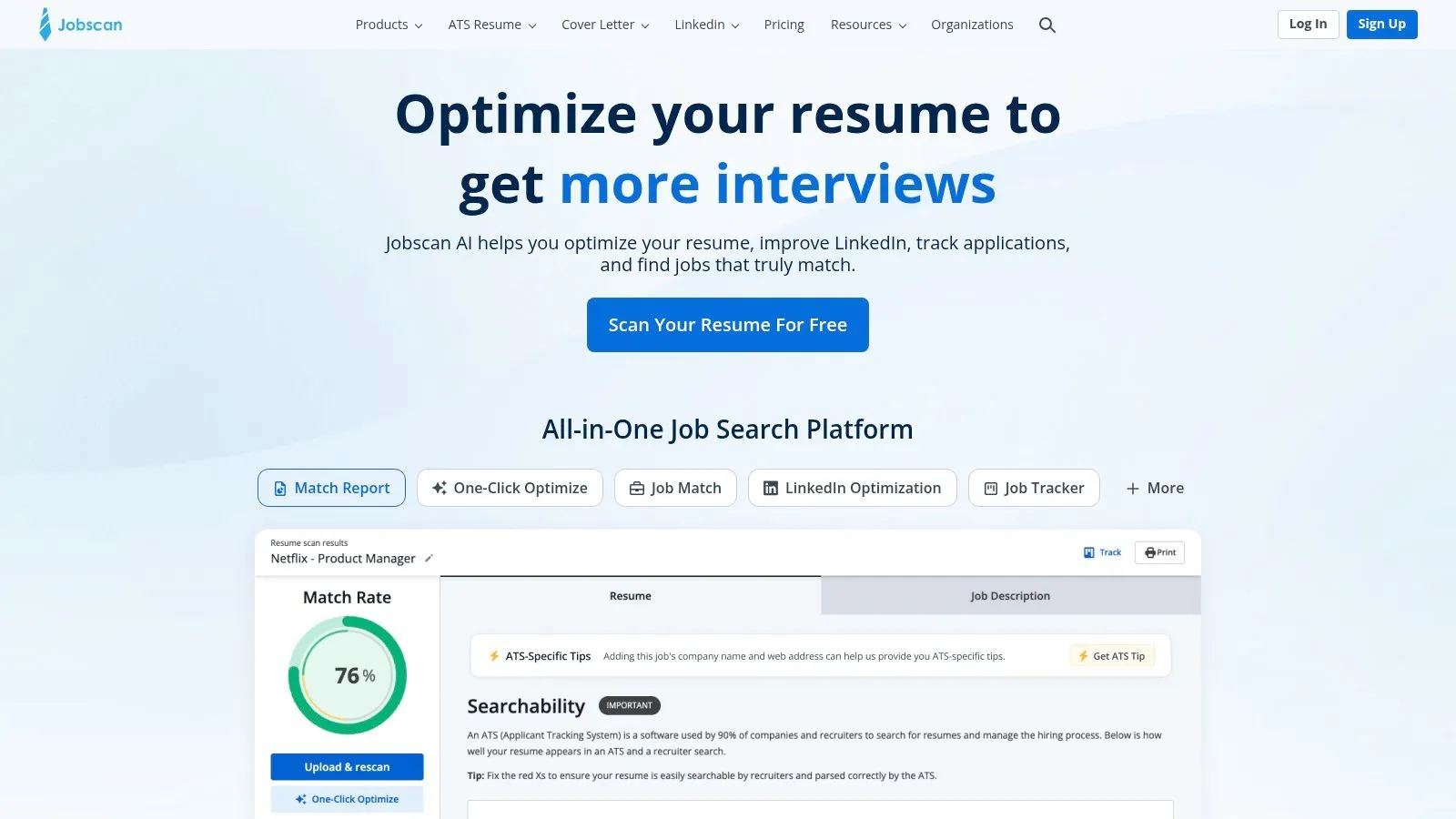
Jobscan solves a narrow problem. That’s exactly why career changers should use it.
A pivot usually breaks in two places. First, your resume fails to explain why your past work matters. Second, it uses the wrong language for the role you want. Jobscan helps with the second problem. It does not build your story from scratch. It checks whether your resume speaks the hiring manager’s language.
That matters more than people think. A strong candidate can still look off-target if their resume says “managed cross-functional projects” while the job description wants “product delivery,” “stakeholder communication,” or “customer onboarding.” Jobscan makes those gaps obvious.
Where Jobscan earns its keep
Paste in the job description. Upload your resume. Review the missing terms, skills, and phrasing. Then edit with judgment.
That last part matters.
If you use Jobscan too early, you get a keyword-stuffed draft with no spine. If you use it after you’ve clarified your positioning and identified the transferable skills that actually matter for your target role, it becomes useful fast. It helps you translate, not distort.
This is the tool for targeted applications. One resume. One role. One pass to tighten the fit before you hit submit.
Use Jobscan to sharpen relevance. Don’t ask it to invent credibility.
Best for
-
Role-by-role tailoring: You’re applying selectively and want each resume to match the posting more closely.
-
Skill translation: Your experience is relevant, but your wording still sounds like your old field.
-
Final-pass checks: You already have a solid draft and want to improve ATS alignment.
If you’re comparing scanners and AI writers, this guide to top AI resume writer options helps clarify where a matcher like Jobscan fits. The platform itself is at Jobscan.
3. Teal AI Resume Builder
Teal is for career changers who need a system, not another blank document.
That distinction matters. StoryCV helps you build the story. Jobscan helps you tune a resume to a specific posting. Teal handles the messy middle. It keeps multiple versions organized, ties them to live job opportunities, and makes tailoring easier when you are applying across a few related roles instead of chasing one perfect title.
Its real value is workflow. If your pivot involves testing different angles, operations to customer success, teaching to L&D, marketing to product marketing, Teal keeps those versions separate so your applications do not blur together.
The editing prompts and job-match features help, but the bigger win is control. You can save role-specific resumes, track where each one went, and keep refining without losing the thread. For a career changer, that is often the difference between a focused search and a pile of half-finished drafts.
Use Teal after you know what skills you are trying to prove. If that part is still fuzzy, review these transferable skills that matter in a career change first. Then bring that material into Teal and build versions around clear targets.
Where Teal earns its spot
Teal is strongest when your problem is process. You already have relevant experience. You already know your target is plausible. What you need is a clean way to manage variations, track applications, and keep improving without rebuilding from scratch every time.
It is weaker if you need deep narrative extraction. It can help rewrite and organize. It will not do the hard thinking for you.
Teal is the operating system for the resume process, not the source of your positioning.
Best for
-
Multi-track career changes: You are targeting a few adjacent roles and need separate resume versions for each.
-
Organized applicants: You want one place for resume edits, job tracking, and iteration.
-
Repeat tailoring: You are sending thoughtful applications regularly and need a system that keeps up.
Teal’s platform is at Teal.
4. Resume Worded
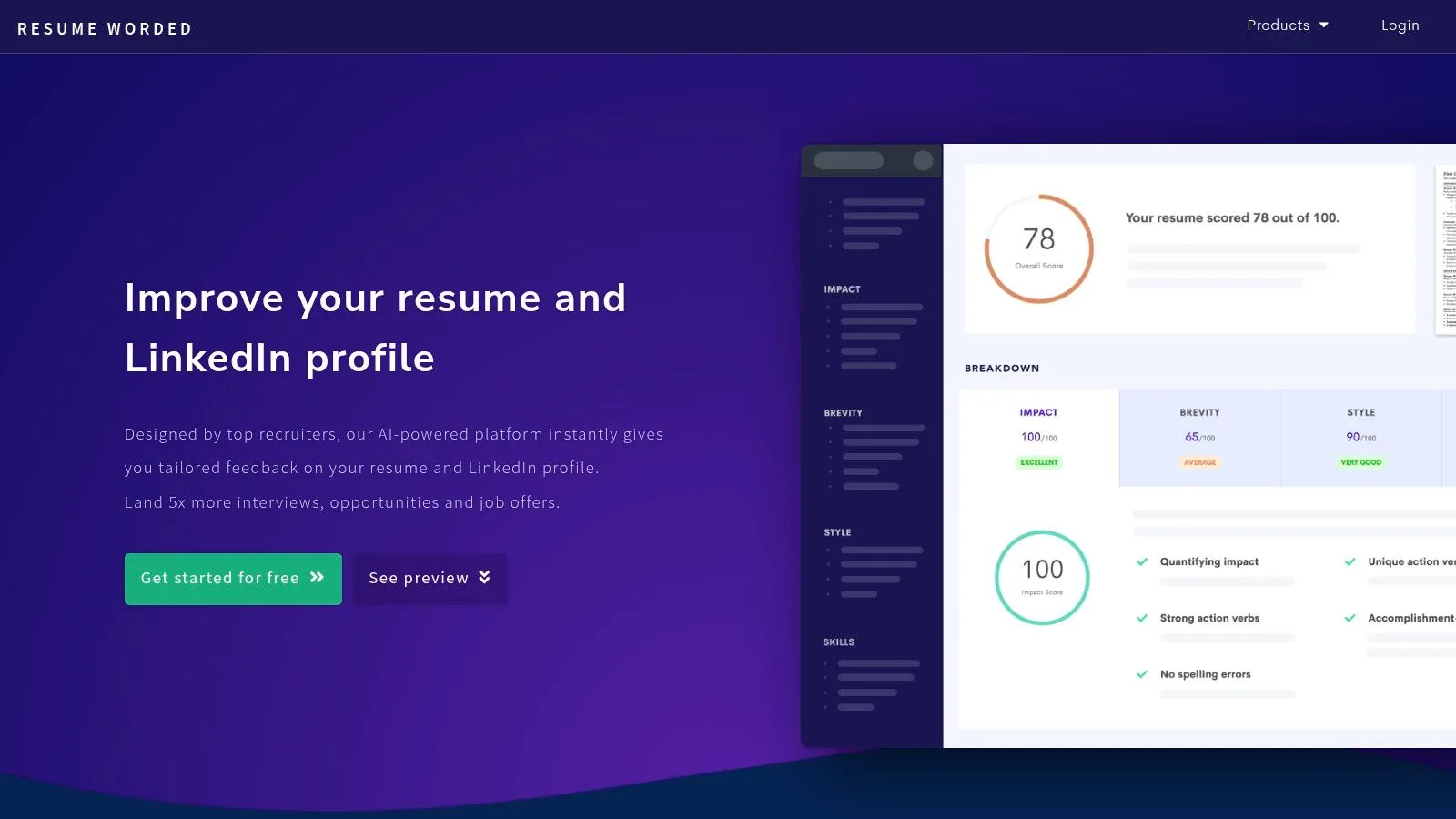
Resume Worded is for people who want line-by-line feedback.
That’s its edge. It doesn’t just give you a blank builder. It scores what you wrote and points at weak spots. If your draft is decent but fuzzy, repetitive, or too tied to your old field, this kind of granular feedback can help you sharpen it fast.
Career changers often need that. A lot of them aren’t lacking experience. They’re lacking phrasing. Apollo Technical notes that 62% of career changers struggle with framing experience in surveys. Resume Worded attacks exactly that problem by making the draft more explicit, more direct, and more target-aware. I’m not linking that source again here because it was already cited earlier, but the point stands.
Where it fits
This tool is strongest when you already have material and need to improve clarity, tone, and emphasis. It’s weaker if you need deep narrative extraction from scratch. It can tell you a line is weak. It can’t always uncover the missing story behind it.
A score is useful. It isn’t strategy.
Use Resume Worded when you want iterative improvement. Rewrite. Rescore. Tighten. Repeat. That loop works well for professionals who can self-edit once the tool shows them where the problem is.
Best for
-
Self-editors: You can improve a draft once someone points to the problem.
-
LinkedIn cleanup: You want your profile and resume to sound like the same person.
-
Generalists going narrower: You need your language to feel more role-specific.
You can check it out at Resume Worded.
5. Rezi
Rezi is the tool for one job. Get an ATS-friendly resume built fast.
That makes it useful for career changers who already know the direction they’re pursuing and need execution, not soul-searching. If StoryCV helps you build the new story and Jobscan helps you translate it to a target role, Rezi helps you package it into clean, readable versions without wasting time on layout problems.
What Rezi is good at
Speed matters during a pivot. You may apply to several adjacent roles before one lane starts working, and Rezi handles that kind of version-heavy process well. Its scoring, templates, and export flow make it easier to produce multiple drafts that stay structured and easy to parse.
That’s the upside.
The limit is obvious too. Rezi helps with formatting discipline and keyword coverage. It does less for the harder part of a career change, which is making your case believable. If your resume still reads like a list of old responsibilities from the wrong field, a high score won’t fix it.
Use Rezi when the story is mostly there and the packaging is the bottleneck. Skip it as your first tool if you still need help figuring out what your transition narrative is.
Best for
-
ATS-first applicants: You want a clean resume with low parsing risk.
-
Fast iteration: You’re testing several role targets and need quick version control.
-
People with solid raw material: Your experience is real. You just need a cleaner container for it.
Visit Rezi.
6. Enhancv
Enhancv is the best choice if you want more voice and structure than a sterile template gives you.
Some resume builders feel like tax software. Enhancv doesn’t. It leans harder into presentation, profile framing, and hybrid layouts that can work well for career changers who need to surface transferable strengths early.
That matters because a straight chronological resume can bury the point. If your old titles don’t match your target role, structure matters a lot. Enhancv is one of the few tools that makes it easier to create a resume that feels forward-looking instead of trapped in your old industry.
Why it stands out
It’s not just about looking nicer. It’s about controlling what the reader notices first. If your pivot depends on leadership, cross-functional work, client ownership, or systems thinking, Enhancv gives you more room to foreground that.
The caution is obvious. More design freedom creates more chances to overdo it. Keep it simple. Career change resumes need clarity, not decoration.
The best-looking resume in the pile still loses if the story is muddy.
Best for
-
Story-first structure: You want more control over what gets emphasized first.
-
Hybrid resumes: You need a combination approach instead of a plain timeline.
-
Professionals with strong but broad backgrounds: You want your range to feel intentional.
You can explore it at Enhancv.
7. SkillSyncer
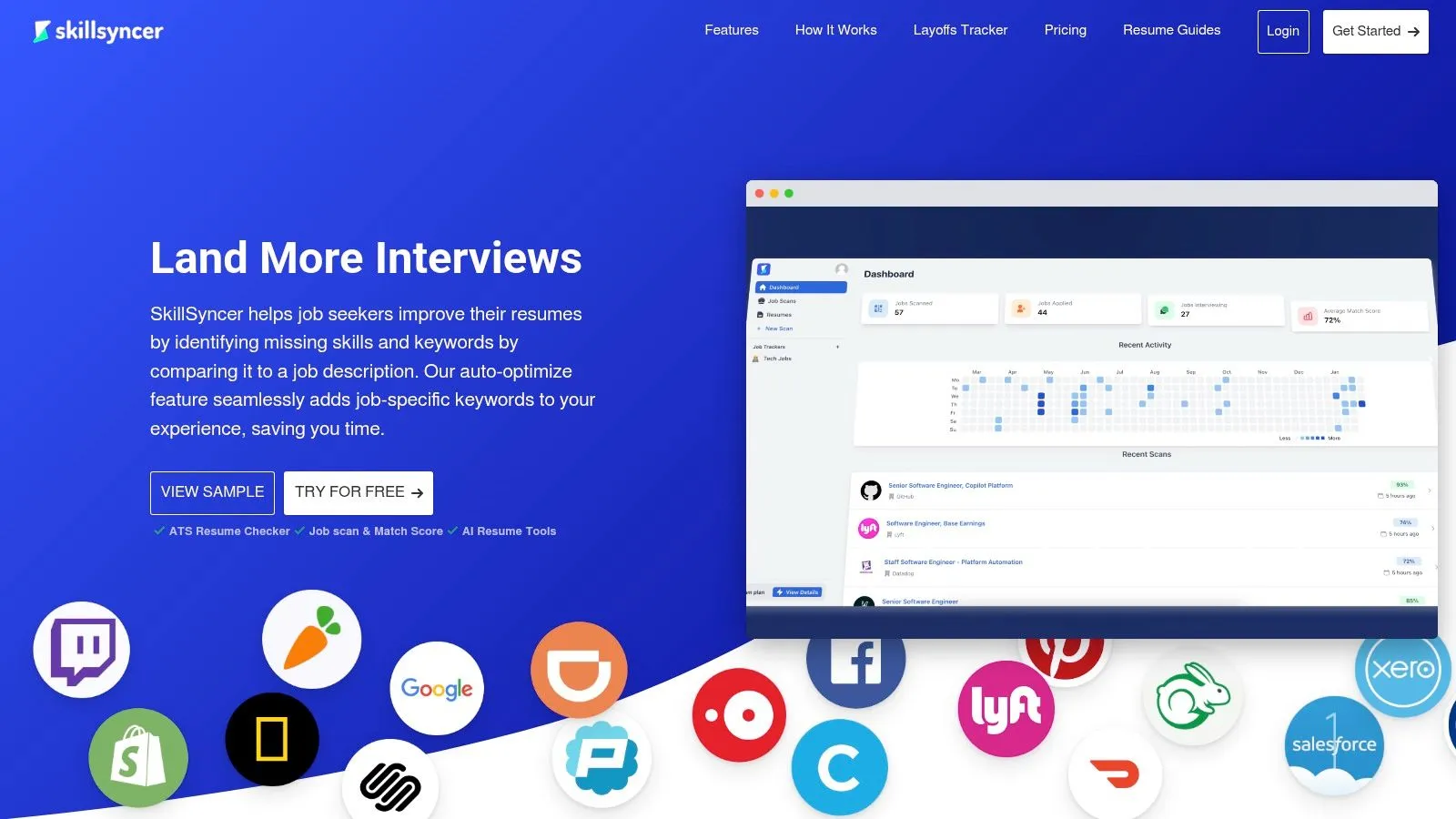
SkillSyncer is the budget pick for keyword gap analysis.
It’s narrower than an all-in-one platform, and that’s fine. If you already know what you want to say but need help making your resume sound like the job description, SkillSyncer handles that job without a lot of fluff.
This can be useful because ATS filtering is still brutal. One market report says 85% of resumes are rejected by ATS before human review, and also notes that the broader resume building tool market is projected to exceed USD 3.10 billion by 2033 after reaching USD 1.80 billion in 2026, according to Coherent Market Insights. That growth makes sense. People need help getting through the first gate.
What to expect
SkillSyncer is not where you go to discover your career story. It’s where you go to tighten terminology, spot missing keywords, and improve alignment.
That makes it a practical companion tool for career changers who’ve already done the harder work of translating their experience into a coherent narrative.
Best for
-
Low-cost ATS checks: You want keyword analysis without paying for a giant suite.
-
Tactical tailoring: You’re applying to a clear target role and need terminology cleanup.
-
Second-pass optimization: The substance is there. The wording needs work.
You can use it at SkillSyncer.
Top 7 Career-Changer Resume Tools: Quick Comparison
| Tool | 🔄 Implementation complexity | ⚡ Resource requirements | ⭐📊 Expected outcomes | 💡 Ideal use cases | ⭐ Key advantages |
|---|---|---|---|---|---|
| StoryCV | 🔄 Low, guided interview, minimal setup | ⚡ Low time cost; free first role, paid for full access | ⭐ High, narrative-driven, ATS‑friendly bullets and role summaries 📊 | 💡 Students, career changers, mid-levels, technical/business operators | ⭐ Story-focused, fast drafts; industry-aware language |
| Jobscan | 🔄 Low, upload resume + JD, learn report metrics | ⚡ Moderate, limited free scans; subscription for unlimited/LinkedIn | ⭐ Medium‑High, quantified match scores; clear keyword guidance 📊 | 💡 Validating fit before apply; keyword alignment for pivots | ⭐ Precise JD matching and ATS-oriented recommendations |
| Teal AI Resume Builder | 🔄 Medium, builder + job tracker integration | ⚡ Moderate, broad free tier; Teal+ behind paywall | ⭐ Medium, metrics-focused bullets and match scoring 📊 | 💡 Cross-functional pivots; organized multi-role searches | ⭐ Combined resume writing + job tracking; in‑tool Match Score |
| Resume Worded | 🔄 Low, upload for line-by-line feedback | ⚡ Low‑Medium, free limited; Pro unlocks full reports | ⭐ Medium, granular, example-based rewrites and scoring 📊 | 💡 Iterative improvement; users needing detailed tone/clarity fixes | ⭐ Detailed line-level recommendations and scoring |
| Rezi | 🔄 Low‑Medium, templates + one‑click tailoring | ⚡ Moderate, free caps; Pro or Lifetime for unlimited use | ⭐ Medium‑High, ATS-friendly formats; fast multi-version output 📊 | 💡 Rapid tailoring across roles; longer pivots needing many versions | ⭐ ATS-first templates; lifetime plan option for cost savings |
| Enhancv | 🔄 Medium, design + tailoring workflow | ⚡ Moderate, templates and features often paid | ⭐ Medium, visual, storytelling-forward resumes 📊 | 💡 Career changers wanting hybrid/combination layouts and design | ⭐ Strong storytelling with modern, ATS‑aware templates |
| SkillSyncer | 🔄 Low, straightforward scanning and suggestions | ⚡ Low, budget-friendly premium; weekly free credits | ⭐ Medium, keyword gap analysis and basic auto-optimize 📊 | 💡 Low-cost keyword checking and quick tailoring for pivots | ⭐ Affordable keyword focus and quick job match scoring |
The Right Tool is a Lever, Not a Crutch
Don’t waste weeks perfecting a resume.
A resume is not a product. It’s a sales argument. Its job is to earn a conversation. That’s it. If you’re changing careers, the worst move is obsessing over formatting while the underlying story stays vague.
Use the right tool for the right problem. If your resume already says the right things but misses role language, use Jobscan or SkillSyncer. If your search is sprawling and messy, use Teal. If you want line edits and scoring, use Resume Worded. If ATS structure is your main concern, Rezi is solid. If you want more control over layout and positioning, Enhancv helps.
But if you’re stuck because your experience is strong and your resume still undersells it, start with StoryCV. That’s the primary bottleneck for most career changers. Not effort. Not ambition. Translation.
One more thing. Don’t let resume work replace job-search work. The document matters, but conversations matter more. Use these tools to get clear faster, then spend your energy networking, applying selectively, and following up like a pro. That’s how you craft your powerful digital brand instead of polishing a PDF in isolation.
The best of the top resume writing tools for career changers won’t get you hired. They will help you sound like the obvious hire sooner.
Common questions
Which resume writing tools should I shortlist?
One per category at most, and only for categories where you have a real problem. A working shortlist for most people: one writing tool to get the content right, then a free ATS check as a final pass. The template tool is optional. Plain formatting rarely loses anyone a job.
Do I need a template builder or a writing tool?
Read your current bullets. If they describe what you actually did and you'd defend them in an interview, your content is fine, a template tool is enough. If they feel generic or wrong no matter how you rewrite them, the problem is upstream of formatting, and a template will just make weak bullets look more confident.
Are free resume tools enough?
For formatting and a basic ATS check, yes. For writing, ChatGPT is free but hands the hard part back to you: you have to already know what mattered about your work to prompt it well. Paying makes sense when a tool does thinking you can't easily do alone, not for prettier templates.
If your career story is stronger than your current resume, try StoryCV. It helps you turn real work into clear, credible narrative without fiddling with templates or prompting generic AI into submission. Start with one fully written role for free, then build the rest when you’re ready.