Writing a resume sucks. You’ve done great work, but you’re forced to cram your career into a list of bullet points, hoping a machine doesn’t throw it in the trash.
Most resumes never get seen by a human. They’re filtered by an Applicant Tracking System (ATS) that scans for keywords, not talent. The advice you find online is outdated. And using a generic AI resume builder just digs a deeper hole, spitting out robotic text that fails both the machine and the person on the other side.
The problem isn't just beating the bots. It’s telling a story a human actually wants to read.
Your Resume Is Being Ignored and AI Is Why
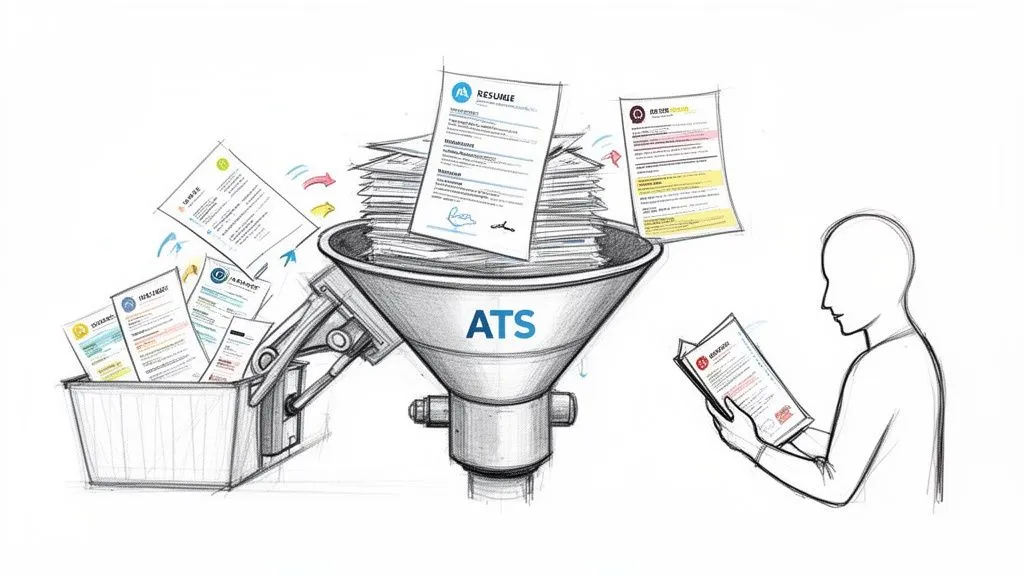
The job application process is broken. Keyword-stuffing is a losing game.
Even if you get past the bots, a recruiter spends just 30 seconds on your resume. They don't read. They skim for signals—clear signs of impact and results. Generic AI tools can’t do this. They don’t understand context. They just fill in boxes.
You have two problems:
-
Get past the AI screen that knocks out most applicants.
-
Tell a human a powerful story in under 30 seconds.
The Real Job of a Resume
A resume isn't a list of your past jobs. It's an argument for why you’re the best person to solve a company’s problems. Understanding how employment advertisements are crafted shows you what filters you're up against.
By 2026, 83% of companies will use AI to screen resumes. Over 70% of applicants are already rejected by an ATS. Generic bullet points won’t cut it.
The best AI resume writer isn't a formatting tool. It's a writing partner. It helps you beat the machine, then tell a better story to the human.
Stop thinking about templates. Start thinking about narrative. Articulate your value so clearly it survives the robot and the human skim test.
The Three Types of AI Resume Tools Available
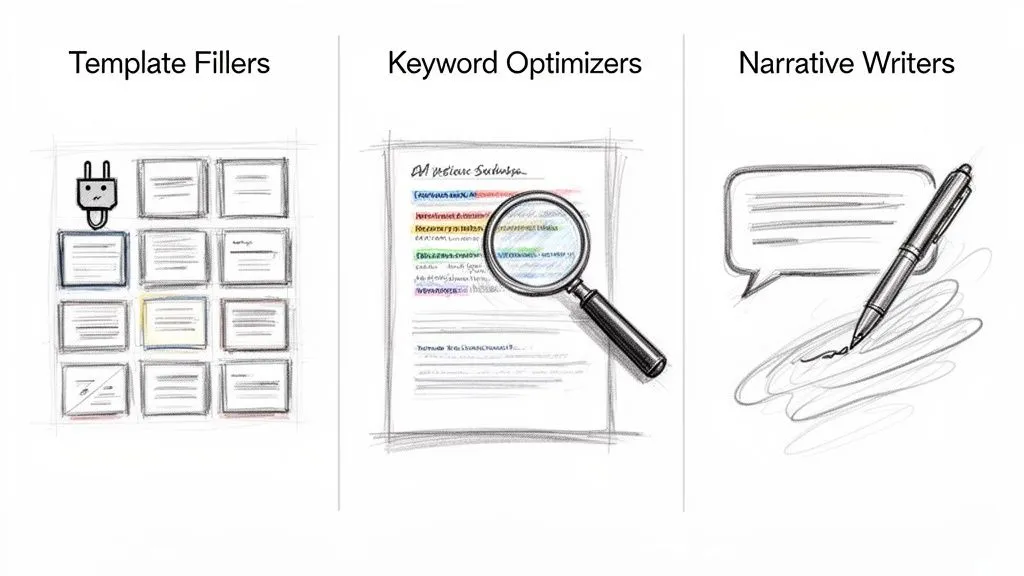
Not all AI is the same. An "AI resume writer" could be a glorified template or a sharp writing partner. The difference is critical.
Most tools are one of three types. Know the difference, and you'll know what you're really getting. Your goal isn’t to make a resume. It’s to get an interview.
Type 1: The Template Fillers
These are smart templates. You plug in your history, and the AI slots it into a nice-looking layout. It might tweak a few words to sound "professional," but it doesn't change the substance.
The appeal is speed. You get a clean document, fast. But for anyone with real experience, it's a trap. It encourages you to list duties, not impact. The result is a resume that looks fine but says nothing.
Type 2: The Keyword Optimizers
These tools have one goal: beat the ATS. They scan your resume against a job description, find missing keywords, and tell you to cram them in. They exist to get you a high "match score."
The problem? They optimize for the machine at the expense of the human. This leads to awkward, keyword-stuffed sentences that make a recruiter’s eyes glaze over. You might pass the filter, but you’ll fail the human review.
A resume that only speaks to a robot is useless once it lands in a human’s inbox. Optimization without a narrative is a waste of time.
An AI Resume Keyword Analyser shows how these tools work. They see keywords, not your career.
Type 3: The Narrative Writers
This is a new class of AI. A Digital Resume Writer. Instead of asking you to fill boxes, it engages you in a conversation. It asks smart, probing questions to uncover the why behind your work—the challenges, actions, and results.
This is for professionals who have done good work but struggle to articulate it. It’s about strategic storytelling, not formatting.
-
It focuses on impact: Translating duties into achievements.
-
It builds a story: Highlighting your unique value.
-
It balances machine and human needs: Crafting language that is both keyword-aware and compelling.
This is the only type of tool that acts like a true writing partner. It has editorial judgment. It turns a list of jobs into an argument for why you should be hired.
Comparing AI Resume Writer Philosophies
Here’s a no-BS breakdown of what each tool does.
| Tool Type | Core Function | Best For | Biggest Weakness |
|---|---|---|---|
| Template Filler | Populates pre-designed layouts with your input. | Students or early-career pros needing a quick, clean format. | Creates generic, task-based resumes that lack impact. |
| Keyword Optimizer | Scans for keyword density against job descriptions. | Anyone hyper-focused on passing the initial ATS screen. | Produces robotic, keyword-stuffed text that fails the human review. |
| Narrative Writer | Uses guided questions to uncover and articulate your career story. | Experienced pros who need to showcase strategic value and impact. | Requires more thoughtful input than a simple copy-paste tool. |
If you just need a polished list, a template filler works. If you only care about the bot, an optimizer will do that one job. If you need to convince a human to hire you, a narrative writer is the only serious option.
How We Judged the Best AI Resume Writers
A great AI resume writer helps you land an interview. That's it. Most features are just noise.
We evaluated platforms on five critical pillars. Use this framework to make your own choice.
Output Quality and Readability
Does it sound like a sharp professional wrote it, or a robot? This is the only test that matters. We looked for confident language that communicates impact without sounding like a template.
Great AI writing is:
-
Concise and impactful: No fluff. Straight to the point.
-
Narrative-driven: A mini-story of challenge, action, result.
-
Authentic: Your voice, but sharper.
If the text reads like a thesaurus exploded, it failed. You should sound like the best version of you, not a machine.
Role and Industry Adaptation
A resume for a SaaS Product Manager is different from one for a Logistics Director. A lot of AI tools don't get this. They use the same bland advice for every role. That’s a deal-breaker.
We tested for nuance. Can it change its tone and focus for a specific industry and seniority? A tool that spits out the same "results-driven" clichés for every job isn't smart—it's lazy.
A top AI resume writer needs editorial judgment. It knows the metrics for an engineer are useless to a marketer.
Storytelling vs. ATS Optimization
Most tools get this wrong. They either stuff your resume with keywords to "beat the ATS," or they write pretty sentences that no one ever sees. The best tools understand a resume has two audiences: the robot and the human.
We looked for a balance. AI that weaves in the right keywords while building a narrative a person actually wants to read. It's not an either/or game. A winning resume satisfies the bot and impresses the hiring manager.
User Experience
Is using the tool a smart conversation, or are you just filling out another form? The UX reveals a tool's philosophy. Forcing you to cram your career into tiny boxes is creatively draining.
We prefer tools with a conversational, interview-style process. This helps you dig deeper, uncovering details and metrics you’d otherwise forget. It should feel less like data entry and more like a brainstorming session with a sharp writing partner.
Data Privacy
What happens to your career data? When you upload your professional life, you have a right to know how it’s handled. We checked privacy policies. Are they using customer data to train public AI models? Selling it?
Your career history is personal. A trustworthy service treats it that way. Your data belongs to you. Period.
A Head-to-Head AI Resume Writer Comparison
You can't pick the top AI resume writer from a feature list. You have to see it in action.
So we put them to the test.
We took a common scenario for a mid-to-senior professional: turning a Senior Project Manager’s experience into sharp, impactful resume bullet points. The goal wasn't to sound "professional." It was to articulate real, metric-driven achievements.
The Scenario: A Senior Project Manager's Raw Notes
This is the kind of brain dump a busy professional writes. It’s honest, but it lacks strategic punch.
Raw Input: "I managed the company-wide migration to a new CRM system. It was a big project that involved working with a lot of different departments like sales, marketing, and IT. I was responsible for the whole thing from start to finish, including making the plan, keeping everyone on track, and dealing with any problems that came up. The project finished on time and the teams were happy with the new system."
It describes what the person did. But it fails to communicate impact, scale, or business value. All task, no story.
Let's see how different AI resume writers handle this.
The Template Filler's Attempt
First, the basic template filler. A digital word-shuffler.
Result (From a typical Template Filler):
-
"Successfully managed a company-wide CRM migration project from initiation to completion."
-
"Collaborated with cross-functional teams, including sales, marketing, and IT, to ensure project alignment."
-
"Developed and executed the project plan, monitored progress, and resolved issues to meet deadlines."
-
"Ensured the project was completed on schedule, resulting in high team satisfaction with the new system."
It just swapped the original sentences for bland, action-verb phrases. It’s clean, but it’s still just a list of duties. It adds zero strategic value. This is the definition of generic.
The Keyword Optimizer's Output
Next, the keyword optimizer. Its job is to cram in terms to get past an Applicant Tracking System (ATS).
Result (From a typical Keyword Optimizer):
-
"Orchestrated end-to-end project management for a large-scale CRM system implementation, leveraging agile methodologies to drive on-time project delivery."
-
"Spearheaded cross-functional collaboration with key stakeholders in sales, marketing, and IT to facilitate seamless CRM integration and optimize business processes."
-
"Responsible for strategic project planning, risk management, and resource allocation to achieve project objectives and key performance indicators (KPIs)."
This sounds more "professional" because it’s stuffed with jargon—"orchestrated," "leveraging," "stakeholders." It might score higher on an ATS scan, but it’s a nightmare for a human to read. It's robotic and soulless. It sacrifices clarity for keywords.
StoryCV: The Narrative Writer's Approach
Finally, we used the same raw notes with StoryCV’s guided, conversational process. Instead of just taking the input, StoryCV asked clarifying questions to find the missing context, metrics, and impact.
It asked:
-
"How many users were migrated to the new CRM?"
-
"What was the budget for this project?"
-
"What business problem did this new CRM solve?"
-
"Can you quantify the improvement? For example, did it increase sales productivity by a percentage?"
This guided process is the key. It unlocked the crucial details and helped the user articulate the story behind the work.
Result (From StoryCV):
-
"Led a $1.2M enterprise-wide migration to a new CRM, unifying sales, marketing, and IT data for 500+ global users and completing the project 100% on schedule."
-
"Improved sales team efficiency by 25% within the first quarter post-launch by replacing a legacy system with streamlined workflows and automated reporting."
-
"Reduced manual data entry errors by 40%, directly contributing to more accurate sales forecasting and a 15% increase in marketing campaign ROI."
The difference is night and day. This output is specific, quantified, and tells a clear story of business value. It explains why it mattered. This is what survives a recruiter's 30-second scan and gets you the interview.
Feature and Philosophy Deep Dive
The core philosophies are what matter. One fills a box, one games a system, and one tells a story.
| Criteria | StoryCV (Narrative Writer) | Competitor A (Keyword Optimizer) | Competitor B (Template Filler) |
|---|---|---|---|
| Core Goal | Uncover and articulate your unique value story. | Maximize keyword density to pass ATS scans. | Format existing text into a standard resume template. |
| User Input | Asks probing questions to extract context and metrics. | Relies on user to provide all keywords and context. | Accepts raw text with no strategic guidance. |
| Output Focus | Quantified achievements and cause-and-effect impact. | Jargon-heavy phrases and ATS-friendly terms. | Generic, task-based descriptions. |
| Human Readability | High. Clear, concise, and compelling for recruiters. | Low. Often sounds robotic and inauthentic. | Medium. Readable but forgettable and bland. |
| Best For | Professionals who want to communicate strategic value. | Users who are hyper-focused on passing automated filters. | Beginners who just need a basic, formatted document. |
The tool you choose depends on the problem you're solving. If you just need a quick format, use a template filler. If you think the bot is your only obstacle, use an optimizer. If you want to win over a human, you need a narrative.
The demand for quality is exploding. The Resume Writing Service Market is projected to hit USD 0.07 billion by the end of the decade. The industry is moving past simple formatting tools toward those that can write strategically.
A top AI resume writer doesn't just rephrase your words. It asks the right questions to help you find better ones. It acts as an editorial partner, not a mindless thesaurus.
This comparison reveals the gap between filling a template and building a narrative. The first two approaches create resumes that blend in. The third creates an argument for why you should be hired.
How to Choose the Right AI Resume Writer
Picking an AI resume writer isn't about features. It’s about matching the right tool to your career problem.
First, diagnose your challenge. This is a strategic decision, not a software one. This decision tree breaks it down: are you looking for a template, a keyword-stuffer, or a partner to help you build a career story?
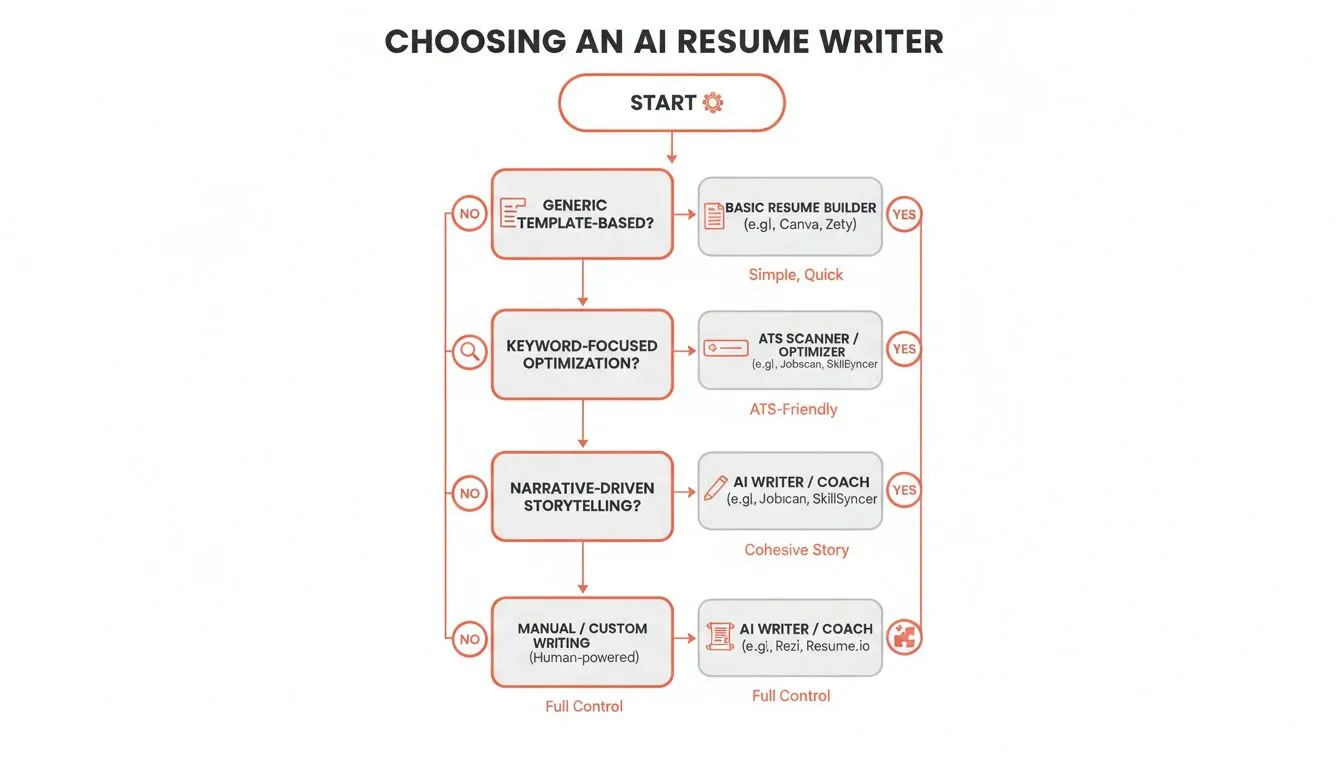
Your path depends on your goal: fill a page, beat a bot, or tell a story that gets you hired.
For the Mid-Career Professional
You’ve led projects and delivered results. Your challenge isn’t a lack of experience—it’s articulating your impact beyond a list of job duties.
A template filler is your enemy. It encourages you to list responsibilities, making you sound like everyone else. A keyword optimizer is just as bad, turning your leadership stories into robotic jargon.
A narrative-first approach translates nuanced experience into clear, powerful stories of impact. It connects your actions to bottom-line business outcomes.
You need a tool that asks questions, pushing you to quantify what you accomplished. Think "increased team productivity by 30%" instead of just "managed a team."
For the Career Changer
Your biggest hurdle is translation. You have valuable skills, but they're framed in the language of a different industry. Your resume needs to build a bridge for recruiters.
Template fillers and keyword optimizers will fail you. They can’t create a coherent story or explain the why behind your pivot.
A narrative writer is essential. It helps you:
-
Pinpoint transferable skills.
-
Reframe your experience in the language of your target industry.
-
Build a compelling story that makes your career change feel intentional.
For the Technical Specialist
Whether you're in engineering, finance, or data science, specifics matter. Vague claims are worthless. Your resume has to be precise and metric-driven.
Generic tools are a disaster for this. They sand down important technical details or replace them with fluffy business-speak. They don’t get the difference between Python and Java.
You need a tool that respects your expertise. A narrative approach connects your technical work to business goals. Instead of "built a new feature," it pushes you toward, "Developed a caching algorithm that reduced API latency by 80%, improving user experience for 2 million customers."
The market for these tools is growing because professionals need solutions that go beyond basic formatting. While there are many options, including surprisingly affordable resume writing services, the most effective solution helps you tell your own story, better.
Stop Filling Out Boxes. Start Telling Your Story.
Most resume tools treat your career like a data entry problem. They give you boxes to fill. The result? A resume that looks clean but feels empty—a soulless document designed to trick a robot.
That’s a broken approach.
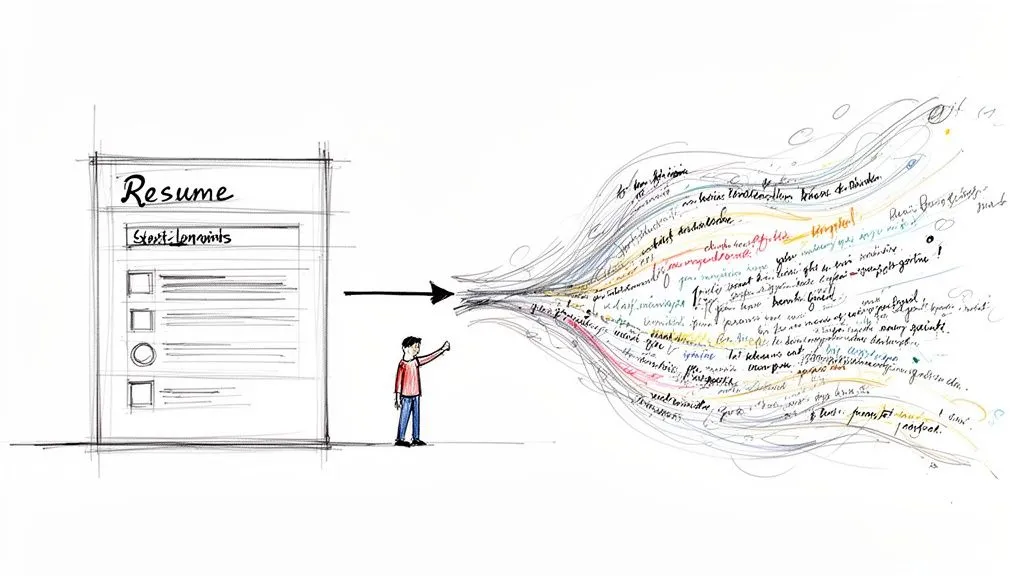
We built StoryCV on a simple belief: telling your career story is a human act. Filling out boxes is for machines. Our goal was never to be another template library. We created a Digital Resume Writer.
Beyond Templates and Tools
What does that mean? We provide the editorial judgment of a human consultant at the speed of software.
Instead of asking you to cram your achievements into a generic format, our guided process helps you uncover the why behind your work. It's a conversation designed to find the narrative hidden in your career.
This bridges the gap between two bad options:
-
The high effort of staring at a blank page for hours.
-
The high cost and long wait times of a traditional resume writer.
StoryCV gives you the strategic guidance of an expert and the immediate feedback of smart technology. We help you find the right words, not just the right template.
Your resume shouldn't be an obituary of your past jobs. It should be a compelling argument for your future.
The Power of Narrative
Your career is more than a list of responsibilities. It's a collection of problems you solved and value you created.
A narrative-driven resume connects those dots, showing not just what you did, but why it mattered. This is what grabs a recruiter's attention. It starts with understanding how to describe yourself in a resume as a strategic professional, not just a list of skills.
We’re not here to help you beat the machine. We’re here to help you tell a better story—one that is authentic, impactful, and yours.
Stop filling out boxes. Start telling your story.
Write your first role for free and see the difference.
Common Questions About AI Resume Writers
You've got questions. We've got straight answers. No fluff.
Can an AI Really Replace a Human Writer?
No, and it shouldn't. That’s not the point. The best AI is a co-pilot, not an autopilot. It gives you the strategic thinking of a professional writer at the speed of software. Its job is to help you find and articulate your own story, better and faster. You're always in the driver's seat.
Will My Resume Sound Generic and Robotic?
It will if you use a template filler. They are built to put your text in boxes, so your resume sounds like everyone else's. A narrative-first AI avoids this trap. It uses a conversational process to pull out the unique details, metrics, and context of your work. The output is specific to you because the story is built from your actual experiences.
If the process feels like filling out a form, the output will read like one. A real conversation leads to a real story.
Is My Personal Data Safe?
It depends on the tool. Some free or sketchy services might use your career history to train their public AI models or sell your data. Look for a privacy-first guarantee. This is non-negotiable. Your data is yours, period. It should never be sold or fed into a public model. Always read the privacy policy.
How Much Time Does This Actually Save Me?
A lot, but it's not just about the clock. The real value is avoiding the creative burnout that comes from writing a resume from scratch. A good AI helps you produce high-quality, tailored bullet points in minutes. It cuts through the friction and gets you from scattered notes to an interview-ready resume faster than any other method.
Stop wrestling with templates and start telling a story that gets you noticed. StoryCV acts as your personal digital writer, using a guided process to uncover and articulate your true impact.