"Affordable resume writing services" usually get you what you paid for: a cheap document that gets ignored. The real cost isn't the $50 price tag—it's the interviews you never get.
Best value resume writing on a budget doesn’t just save you money. It saves you from the hell of writing about yourself and actually gets you in the door.
The Real Cost of a Cheap Resume
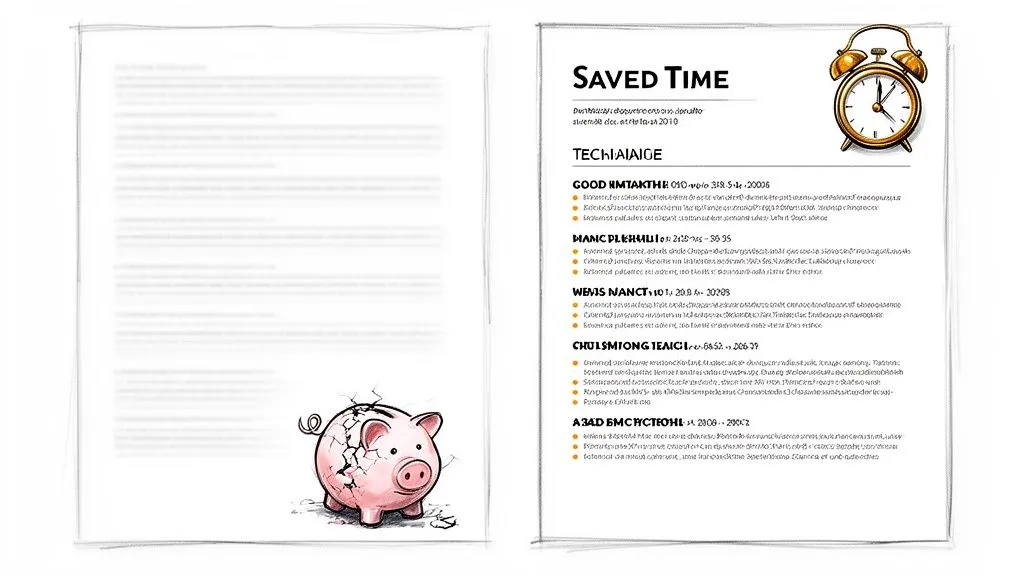
You’ve done great work. Explaining it feels impossible. Staring at a blank page, trying to distill years of your life into bullet points, is a special kind of nightmare.
So you look for help. You find a market flooded with services promising a "professional" resume for the price of lunch. It's tempting. But "affordable" shouldn't mean "forgettable."
A cheap resume's hidden cost is the opportunity it loses. A generic, templated document makes you sound like everyone else. It guarantees your application ends up in the trash.
The Three Paths Professionals Usually Take
You need a better resume. You have three choices. Each one is a trade-off, especially if you have more than a few years of experience.
-
The DIY Struggle: You download a template. You try to cram your career into its depressing little boxes. You waste hours wrestling with formatting and end up with something that feels weak.
-
The Expensive Consultant: You hire a writer for $500-$1,000+. You get personal attention, but the process is slow, involves awkward phone calls, and the price is insane for one document.
-
The Resume Factory: The most common "affordable" option. You pay around $150. Your info gets farmed out to a writer churning out dozens of resumes a week. The result is formulaic and lacks a human story.
This guide compares these options. But we'll also show you a fourth path—a smarter middle ground. One that combines an editor's judgment with the speed of good software. Because telling your story shouldn't require emptying your bank account.
| Path | Your Time Investment | Cost | The Likely Outcome |
|---|---|---|---|
| DIY Route | 8-12 Hours | Free | Frustration. A generic resume. |
| Traditional Writer | 2-4 Hours | $500 - $1,000+ | A strong story. Slow and expensive. |
| Digital Writer | < 1 Hour | ~$60 / Month | A focused story without the high cost. |
The Pricing Games Resume Services Play
Why does one writer charge $99 while another asks for $999? It’s rarely about quality. The price reflects their business model. Understand the model, and you won't get ripped off.
Most "affordable" services are resume factories. They're built on a high-volume assembly line. That structure dictates everything, from who writes your resume to how little time they spend on it.
You aren’t paying for expertise. You’re paying for a slot on the factory floor.
The Project Fee Assembly Line
The one-time project fee is the most common model. This is the world of the $100 to $400 resume. The math behind it tells the real story.
A writer at a high-volume shop might get paid $50 for that $200 package you bought. To make a living, they have to churn out several resumes a day. The system rewards speed, not depth. That’s why they lean on templates and canned phrases.
You spend an hour filling out a tedious questionnaire. They spend 20 minutes copying it into a template. That’s not writing; it’s data entry.
Services in the $100 to $400 range dominate the market. Freelancers on Fiverr might offer resumes for $50, while big operations like TopResume built their business in this tier. It’s a huge market, especially in North America, which accounts for 36% of the global resume writing industry.
Freelancers and the Hourly Rate Trap
Then you have freelance writers on platforms like Upwork. Their pricing seems more direct—an hourly rate or a higher project fee. But this path has its own problems.
An experienced freelancer charges $75-$150 an hour. A good resume requires hours of conversation and writing. The cost adds up fast, pushing them out of the "affordable" bracket.
What about the cheaper ones? They’re usually just the same assembly-line writers working for themselves. You get the same templated document, just without a big company logo. It's still a volume game.
Price Tag Red Flags
Some pricing tactics are universal red flags. They show the company cares more about sales than your success. See these? Walk away.
-
Aggressive Upsells: Your "basic" package suddenly needs a "keyword optimization" add-on. Nonsense. Any good writer bakes that in from the start.
-
Hidden Revision Fees: They offer one "free" revision, but any real change costs more. This punishes you for giving feedback.
-
"Guaranteed" Interviews: No one can guarantee an interview. It's a sleazy marketing gimmick to justify inflated prices.
The goal isn't to find a cheap resume. It's to find one that helps you tell your story. Price is just one data point, and it’s usually the least important one.
Comparing Affordable Resume Writing Options
Affordable resume writing essentials:
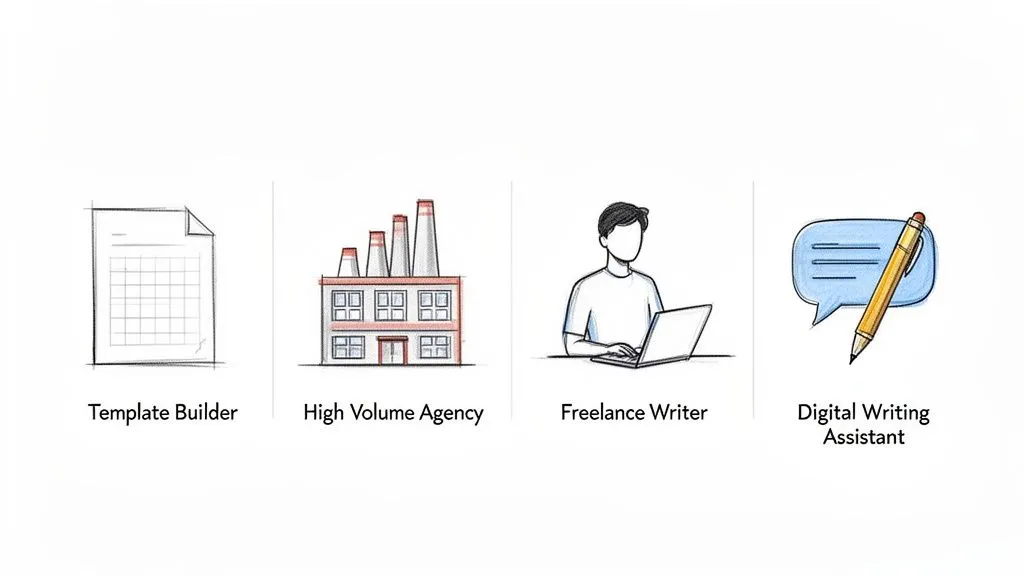
When you’re looking for an affordable way to get your resume done, you'll run into four main paths. Each one is a trade-off between your time, your money, and the quality of the story you end up with.
This isn't about features. It’s about whether the document you get actually proves your value.
DIY Builders: The Empty Box Problem
DIY builders like Canva and Zety hand you templates. Lots of them. You drag, drop, and fill in the blanks. It feels productive, but it's a trap.
The problem isn't the formatting; it's the words. These tools offer zero help with the single hardest part—the writing. You’re still staring at a blank page, just one that's been neatly organized into boxes. For a professional with a complex career story, this is useless.
A resume builder gives you a container. It doesn't help you find the story, tell it, or make it compelling. For professionals, that’s where the entire battle is won.
This works for recent grads. If you need to build a real narrative, a template will only get in your way.
High-Volume Agencies: The Assembly Line
Next up are the resume factories like TopResume. You pay a flat fee, fill out a long questionnaire, and your info gets assigned to a writer.
The issue is the business model. These agencies are built for scale, not strategy. Their writers are often paid a tiny fraction of what you paid, forcing them to churn out resumes daily. Speed, not depth, is their main metric.
Your resume isn't a craft; it's a work ticket. The result is a grammatically correct but soulless document. It might pass an ATS scan, but it fails to connect with a human.
Freelance Writers: The Quality Gamble
Hiring a freelancer from Upwork or Fiverr seems like a decent middle ground. You choose your writer and talk to them directly.
But "freelancer" isn't a synonym for "expert." You’re either paying a premium for a true professional ($500+) or gambling on a low-cost writer running the same high-volume playbook. Vetting them is all on you.
The demand for these services is intense. The resume writing market is projected to grow to $0.07 billion by 2035, and online services make up nearly 70% of that. This growth is fueled by fierce competition, pushing more people toward cheap options. You can read more in the full research about the resume writing service market.
StoryCV: The Digital Writing Partner
Then there's a fourth option: a digital writing partner. This isn't another builder or a factory. StoryCV is your writing partner. We use an interview-based process to help you uncover your true impact.
Instead of asking you to fill boxes, we ask smart questions. This guided conversation helps translate your experience into a clear, confident narrative. It gives you the editorial judgment of a human writer with the speed and affordability of software.
This model is for professionals who have done the work but struggle to write about it. It solves the core problem—the writing itself—not just the formatting.
Head-to-Head: The Real-World Trade-Offs
Let's put these four options side-by-side.
| Method | Typical Cost | Your Time Investment | Content Quality & Narrative Depth | Best For... |
|---|---|---|---|---|
| DIY Builders (Canva, Zety) | Free - $20/mo | High (8-12 hours). You do all the writing from scratch. | Very Low. Provides formatting only. No writing guidance. | Students or entry-level pros with a simple work history. |
| High-Volume Agencies (TopResume) | $150 - $400 | Medium (1-2 hours). You fill out long questionnaires. | Low. Generic, template-driven, and lacks a unique voice. | Professionals who want a basic refresh and are fine with a formulaic outcome. |
| Freelance Writers (Upwork, Fiverr) | $75 - $1,000+ | Variable. Vetting writers is time-consuming. | Variable. Quality ranges from poor to excellent. High-risk. | Those willing to invest significant time and money to find a top-tier writer. |
| StoryCV (Digital Writer) | ~$60/mo | Low (<1 hour). A guided interview extracts the right info. | High. Focuses on building a powerful, unique narrative of your impact. | Mid-to-senior professionals who need to tell a compelling story. |
"Affordable" means different things. The cheapest option often costs you the most time and delivers the weakest result. A small investment in the right process can save you hours and produce a much stronger narrative.
The Rise of The Digital Resume Writer
There’s a dead zone between cheap templates and expensive consultants. On one side, DIY builders give you empty boxes to fill—useless when the words are the hard part. On the other, traditional writers charge $1,000 for a slow, awkward process.
This gap is where a new category emerged: the Digital Resume Writer. This isn’t just another builder. It's a writing partner.
A digital writer combines human editorial judgment with the speed and cost of software. It’s designed to solve the one problem that holds back most experienced professionals: you know what you did, but you struggle to articulate it.
More Than a Tool, A Writing Partner
The difference is the process. A builder gives you a blank canvas and expects you to be a painter. A factory takes your rough sketch and traces it. A digital writer sits down with you and helps you draw.
Instead of a long, boring questionnaire, a system like StoryCV uses a guided, interview-based method. It asks smart questions to help you uncover your real impact.
-
It probes for specifics: Not "managed a project," but "how did you get it back on track when the budget was cut?"
-
It translates complexity: It helps you turn jargon into a clear narrative anyone can understand.
-
It focuses on story: The goal isn’t to list tasks. It's to build a coherent story of your value.
This conversational approach helps you connect your actions to their outcomes. This is the secret to a resume that gets noticed. For those embracing modern approaches, understanding how Personality AI improves sales script writing offers insights into the future of persuasive communication, including resumes.
A Digital Resume Writer doesn't just format your past. It helps you frame your future by making your achievements clear and compelling. It’s a partner, not a passive tool.
Editorial Judgment at Software Speed
A great human writer’s real value is their editorial judgment. They know which details to highlight and which to cut. They can spot a weak verb and reframe a simple task into a significant accomplishment.
A digital writer brings this same editorial logic into a software interface. It’s not just generating text based on keywords; it’s applying proven storytelling principles to your experience.
This ensures the final document is both ATS-friendly and human-readable. It has the keywords to get past the screen, but it also has the narrative to convince the hiring manager. This is where most affordable resume writing services fail—they optimize for the machine but forget a human makes the final call.
This model is a game-changer for mid-to-senior professionals. You've outgrown templates, but you don't need to spend a fortune to get expert-level writing help. You can learn more in our guide to the top AI resume writers.
How To Choose The Right Service For Your Career Stage
What's "affordable" for a new grad is a waste of money for a senior manager. You don't just need a document; you need a strategic argument for your next move.
A recent graduate’s resume is about potential. A senior professional's is about proven impact. The tool you choose has to match the story you need to tell.
Your Career Stage Defines Your Needs
Let’s be direct. Less than three years of experience? A clean template and a sharp summary can work. But once you've managed projects, led teams, or solved hard problems, your needs change completely.
You're no longer listing tasks. You're building a narrative that connects your past achievements to your future value. This is where most cheap services fall apart.
After three years, the goal shifts from proving you can do the work to proving you can create value. A resume that just lists job duties is a massive missed opportunity.
There are always trade-offs. DIY tools give you control but zero guidance. Traditional writers offer expertise at a steep cost. Digital writers aim for the sweet spot in the middle.
A Practical Decision Framework
Forget the generic advice. Here’s an opinionated guide based on who you are.
1. The Recent Grad (0-2 Years Experience)
Your job is to translate academic projects into skills. A DIY builder is usually enough. Your story is short. Clarity is everything.
-
Recommendation: DIY builder (Canva, etc.).
-
Focus: Clean formatting and a strong summary.
-
Why: You don't have a complex career to untangle yet. Paying for a service is overkill.
2. The Mid-Career Professional (3-10 Years)
You've done solid work, but your resume is a wall of text. Your challenge is to articulate impact. You have to show how your work moved the needle.
-
Recommendation: Digital Resume Writer (like StoryCV).
-
Focus: Translating tasks into achievements with clear metrics.
-
Why: A guided process helps you find the "so what?" behind your work without the high cost of a human writer. Learn more about this process in our guide on what a resume writer actually does.
3. The Career Changer (Any Experience Level)
Your hurdle is connecting the dots for the recruiter. You have to translate skills from one industry to another. A generic service will fail you.
-
Recommendation: Digital Resume Writer or a specialized human writer.
-
Focus: Building a narrative around your transferable skills.
-
Why: You need a strategic partner to help you frame your story. A digital writer can guide this process efficiently.
4. The Senior Specialist or Manager (10+ Years)
Your resume needs to scream leadership and impact. You're not just a doer; you're a force multiplier. Cheap services and basic templates will make you look junior.
-
Recommendation: Digital Resume Writer or a premium human writer.
-
Focus: Showcasing strategic thinking, leadership, and business outcomes.
-
Why: Your story is complex. A digital writer helps you structure this complexity into a clear argument that justifies your seniority.
A good resume is just one piece of your identity. Knowing how to build a personal brand that opens doors helps you pick a service that aligns with your bigger career goals. Your choice should reflect where you’re determined to go next.
Your Story Is Not A Template
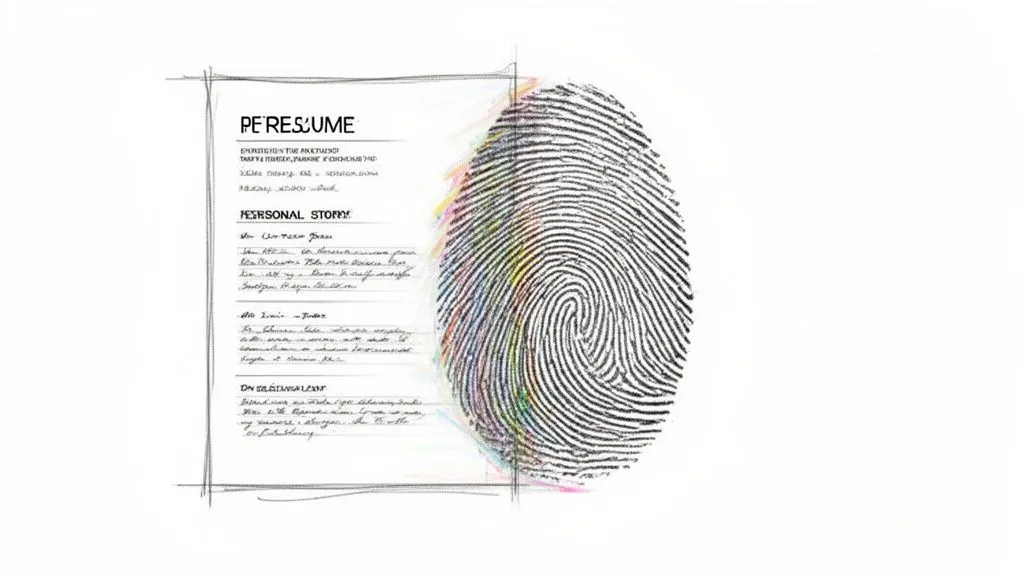
Your career isn't a template. Your resume shouldn't be either. The goal isn't to trick a machine; it's to connect with a human.
The market for affordable resume writing services is flooded with quick fixes. But a cheap document is a terrible investment if it makes you sound like everyone else. Real value comes from a process that helps you articulate your unique impact, not one that just fills in the blanks.
You did the work. The hard part is writing about it with clarity and confidence.
The most effective resume is a story, not a list. It frames your past achievements as proof of your future potential. A template can't do that. A resume factory won't bother.
Stop Filling Boxes. Start Telling Your Story.
Your time is your most valuable asset. Stop wasting it wrestling with templates or waiting on slow, overpriced writers.
For a busy professional, a guided, narrative-focused process is the smartest way to build a powerful resume. It helps you find the words you’ve been looking for, turning years of complex work into a story that gets noticed.
When you learn how to describe yourself in a resume, you move beyond listing jobs. You start building a case for why you’re the only person for the role.
It’s time to invest in a method that honors the work you’ve already done.
Still Have Questions?
You've got questions. Here are some straight answers.
Are cheap resume writing services worth it?
Honestly? Almost never. Anything under $100 is a giant red flag. These services use generic templates and spit out documents packed with tired phrases. Instead of helping, they make you sound like everyone else.
The real value isn't the price—it's the strategy. You're investing in an expert's ability to help you frame your unique career story.
How do I spot a bad resume writing service?
It’s easy. Bad services want your money, not to get you an interview.
Look for these signals:
-
Guaranteed interviews: Nobody can promise this. It’s a marketing gimmick.
-
Prices that are too good to be true: If a resume costs $50, the writer spent less than 30 minutes on it.
-
A portfolio of resumes that all look and sound identical: The easiest way to spot a template factory.
-
A process that doesn't involve actually talking to you: A good service is a partnership. A bad one is a transaction.
A quality service works with you. A bad one just takes your order.
Why not just use an AI resume builder?
Because most AI resume builders are just fancy Mad Libs. They generate generic bullet points but miss the big picture. They can't build a cohesive story because they have zero editorial judgment. They don't know what matters to a human.
A true digital writing partner, like StoryCV, changes the game. It uses a guided interview to understand the why behind your work—the context, the challenges, the impact. It’s not a tool that fills in blanks; it’s a strategist that helps you shape your experience into a story.
Ready to stop filling out templates and start telling your story? StoryCV is your digital writing partner, guiding you to articulate your impact with clarity and confidence. Get started for free at story.cv.