Your film student resume is a pitch, not a transcript. Producers don't care about your GPA; they want to see your hands-on experience and creative vision. You need to frame every single project—no matter how small—as a professional credit that proves you’re ready for a real set.
Your Resume Is A Pitch, Not A Course List
Stop thinking of your resume as a historical document. It’s not a list of classes you took or software you touched once. It’s a pitch deck for your career.
Its only job is to convince a busy producer you have the skills, drive, and vision to solve their problems on set. They aren’t hiring a student; they’re looking for a future collaborator.
This means every line on your resume needs to work. "Gaffer on Student Film" is a fact. It sells nothing. "Managed a three-person lighting team for a 15-minute short, using Arri Skypanels to create a high-contrast noir aesthetic" is a pitch. It shows skill, collaboration, and creative intent.
The Mindset Shift: From Student To Filmmaker
The biggest step is to stop seeing your school projects as assignments. They are your first professional credits. That short film you directed wasn't just for a grade—it was a micro-budget production you managed from concept to final cut.
Think about it:
- You didn't just "do a project." You produced a short film selected for the university film festival.
- You didn't just "edit a video." You cut a 5-minute documentary, streamlining a complex story into a compelling narrative.
- You weren't just a "production assistant." You coordinated logistics for a 10-person crew, ensuring the shoot stayed on schedule.
This shift in perspective is everything. It reframes your experience from academic exercises to practical application. Producers want people who can execute. Your student work is your first proof. If you're struggling to find the right language, our guide on how to describe yourself can help.
Treat Every Project Like A Case Study
Your filmography is a collection of case studies. Each project should demonstrate a specific, valuable skill. A director's resume needs to scream leadership and vision. An editor's has to emphasize storytelling chops and technical know-how.
A resume that reads like a course list tells a producer you're still in the classroom. A resume that reads like a portfolio of completed projects tells them you're ready for the set.
Instead of just listing the title and your role, add a bullet point detailing a specific achievement. What problem did you solve? What was the result? Frame each entry to answer the unasked question: "Why should I trust you with my project?"
By treating your resume as a strategic pitch, you move beyond being just another film student and become a filmmaker with demonstrated potential.
How To Structure A Resume Producers Actually Read
Generic resume templates are a waste of time in the film industry. This isn't a generic industry, so your resume can't be either.
Producers and hiring managers scan. The layout of your resume determines if they find what they need in 10 seconds or just toss it.
The industry standard is simple: reverse-chronological. Always put your most recent, relevant work at the top. This shows you understand how career progression works in this business. They need to see what you just wrapped, not some PA gig you did as a freshman.
Think of your resume less as a transcript and more as a strategic pitch for your future.
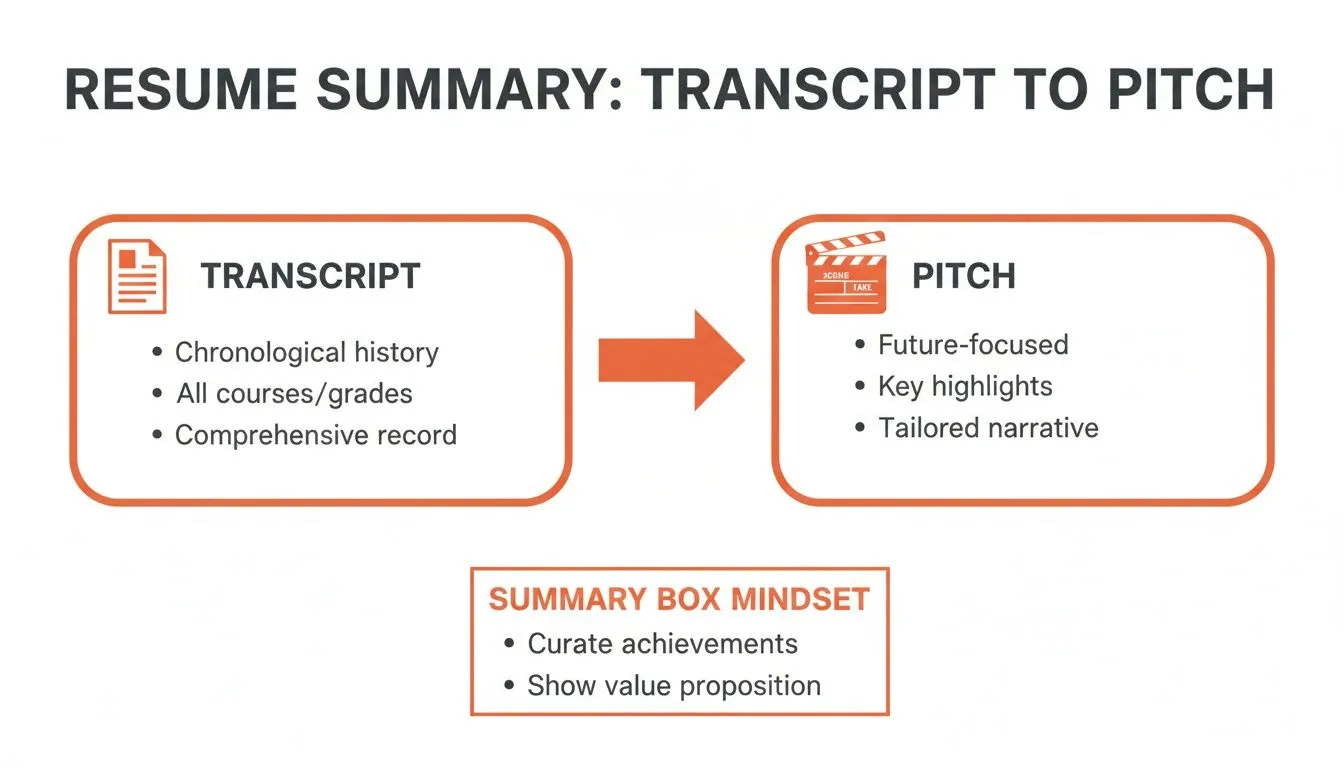
It’s about framing your experience to land the next job, not just list old ones.
The Essential Sections For A Film Resume
Your resume is a one-page pitch deck for you. It needs a clean, logical flow. Cut the fluff. Stick to these core sections.
Here’s the blueprint that works:
- Contact Information: Name, number, email, and location. Critically, include a direct, clickable link to your showreel or portfolio right here. Make it impossible to miss.
- Professional Summary: Your logline. A punchy, 2-3 sentence overview of who you are as a filmmaker. Are you a meticulous editor obsessed with pacing? A director with a knack for powerful performances? Say it upfront.
- Filmography / Projects: The heart of your resume. List your hands-on experience, always in reverse-chronological order.
- Skills: A curated list of your technical and practical skills. Think specific software (Adobe Premiere, DaVinci Resolve) and on-set competencies (Camera Operation, Sound Mixing).
- Education: Keep it short. School name, degree, and graduation date. That’s it. Your projects matter more.
Your resume’s structure needs to answer a producer’s primary question instantly: “Can this person do the job?” A clean layout proves you respect their time and know how to communicate clearly—a vital skill on any set.
To see the difference, let’s compare a typical student resume with one built for the film world.
Traditional Resume vs. Film-Centric Resume Structure
A standard student resume often buries the most important information. For film, you need to flip that structure on its head to highlight what producers care about: your practical experience.
| Section | Generic Student Resume (What to Avoid) | Film Student Resume (What to Do) |
|---|---|---|
| Top Section | Objective or Summary focusing on learning. | Professional Summary focused on skills and showreel link. |
| Second Section | Education is listed first, taking up prime real estate. | Filmography/Projects section is front and center. |
| Experience | Part-time jobs (e.g., barista, retail) listed prominently. | Film credits are the main focus; other jobs are secondary. |
| Skills | Vague soft skills ("team player," "good communicator"). | Specific, hard skills (software, gear, on-set roles). |
| Education | Detailed coursework and high GPA. | Kept brief: university, degree, graduation date. |
Putting your filmography first immediately shows what you can do.
Why This Structure Works
This layout works because it prioritizes what producers and department heads care about most: your hands-on experience.
By putting your Filmography section right under your summary, you’re leading with your strongest proof. Industry recruiters emphasize reverse-chronological layouts because they highlight career momentum.
Avoid "creative" or "functional" resume formats. They tend to obscure your work history and just frustrate the people trying to hire you. A clear, project-focused structure is your best bet for getting that call.
If you need some inspiration, check out our guide with a student resume template and real examples that follows this exact structure.
How to List Your Film Credits The Right Way
This is where most film student resumes fall apart.
I've seen it a thousand times. A line that just says "Gaffer on Student Film." What does that tell a busy producer? Nothing. Your experience section—and you should call it 'Filmography' or 'Projects'—needs to be treated like a real industry credit list, not a class roster.
This isn't just about listing what you did. It's about proving what you can do.
The format is simple and non-negotiable. Stick to the industry standard.
Project Title (Year) | Format | Your Role
It’s scannable and professional. It tells a producer what they need to know in a two-second glance.
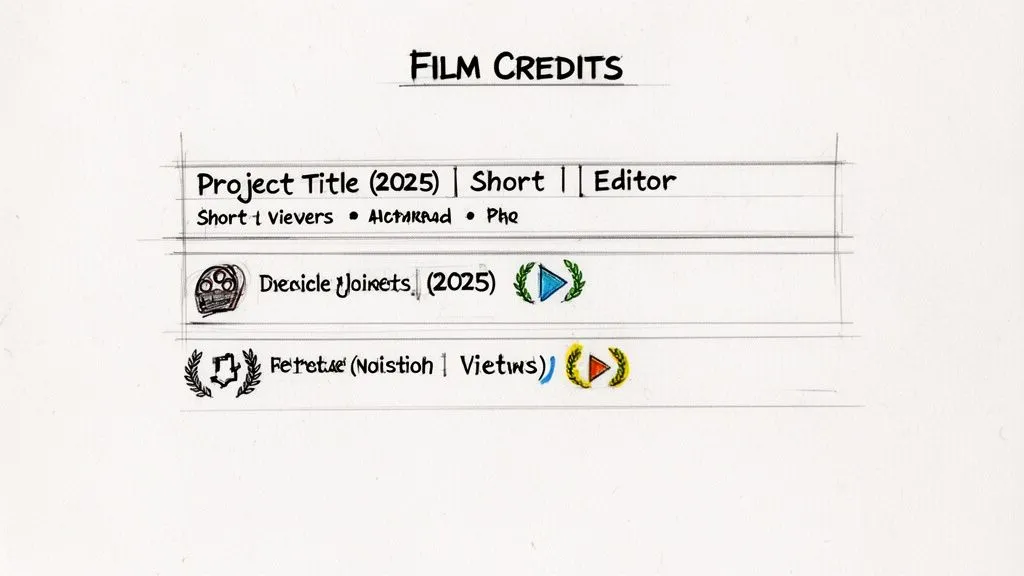
Here’s how that looks in practice:
- Liminal Space (2025) | Short Film | Director
- The Commute (2024) | Web Series | Editor
- City Lights (2024) | Music Video | Production Assistant
This structure provides immediate context. But the part that gets you the interview happens right after this line.
Write Bullets That Show Impact
Just listing your role is never enough. Follow it up with achievement-focused bullet points. Forget listing your duties. Nobody cares that you "operated the camera." They want to know what you achieved while doing it.
The difference is staggering:
- Weak (Duty): Operated the camera.
- Strong (Achievement): Captured all key scenes for a 15-minute short drama using a Canon C300, contributing to its selection for the university film festival.
See the difference? The second one shows technical skill (Canon C300), project scope (15-minute drama), and a tangible result (festival selection). It proves you didn’t just show up; you contributed to the project's success.
Stop describing your job description. Start describing your impact. Your resume is a highlight reel of your accomplishments, not a list of chores.
Examples For Key Film Roles
Let's break this down with real-world examples. The goal is always to connect your action to a meaningful result.
For a Director:
- Instead of: "Directed actors and crew."
- Try This: "Directed a cast of 5 actors, achieving nuanced performances that became central to the film's acceptance into 3 regional festivals."
For an Editor:
- Instead of: "Edited the film using Adobe Premiere."
- Try This: "Cut over 4 hours of raw footage into a tight, 8-minute narrative, enhancing emotional impact with a custom sound design in Adobe Premiere Pro."
For a Production Assistant (PA):
- Instead of: "Assisted on set."
- Try This: "Coordinated logistics for a 12-person crew, managing equipment rentals and call sheets to ensure the 3-day shoot finished on schedule and under budget."
Every example gives context, showcases specific skills, and hints at the project's scale. This is the language producers understand. It’s how you transform student work into a portfolio of legitimate production experience. Don’t just list your credits—sell them.
Translate Your Work Into Numbers Producers Get
The film industry speaks in numbers. Budgets, viewership metrics, festival awards—it all comes down to quantifiable results. Your film student resume needs to speak this language. If it doesn't, you’re just another creative with a cool idea. That’s not enough to get hired.
This isn't about becoming a math whiz. It's about translating your creative work into the cold, hard data producers use to make decisions.
Find The Metrics In Your Student Work
Every project, even a tiny student film, has numbers attached to it. Your job is to find them and put them on your resume.
This simple act transforms you from someone who "helped on a film" to someone who delivers tangible results. It’s the difference between being seen as a student and a professional-in-training.
Instead of just saying you "edited a short film," find the data that proves its impact. How long was it? How many views did it get online? How many festivals was it selected for?
A producer won't call you because you’re passionate. They’ll call you because you’ve demonstrated you can deliver a finished product that achieves something measurable.
This is the mindset that separates amateurs from the people who get hired.
Quantifiable Metrics For Your Film Student Resume
You might think your student projects don't have impressive numbers. You're wrong. You just need to know where to look.
Here are some metrics you can—and should—be using:
- Audience & Engagement: "Garnered 10,000+ views on YouTube with an 85% average watch duration."
- Festival Recognition: "Official Selection at 3 local film festivals, including the Student World Impact Film Festival."
- Production Scale: "Managed a production budget of $1,500, securing all locations and equipment under budget."
- Team & Resource Management: "Led a crew of 8 and coordinated a 4-day shooting schedule, completing production on time."
- Footage & Workflow: "Edited 5 hours of raw 4K footage into a cohesive 7-minute narrative."
Adding these details provides context and demonstrates a professional mindset. It shows you understand that filmmaking is a business. To learn more about how to strategically use data, check out our guide on adding metrics to your resume. It’s about proving your value, not just listing your tasks.
Make Your Showreel and Portfolio Impossible to Miss
Your resume is the script, but your showreel is the movie. And in this industry, nobody buys a script without seeing the film first. A film student resume without a portfolio link is an immediate red flag. It tells a producer you’re either not serious or have nothing to show.
Your reel is your single most important asset. It needs to be front and center. Place the link directly in your contact info section at the top of your resume, next to your email and phone number.
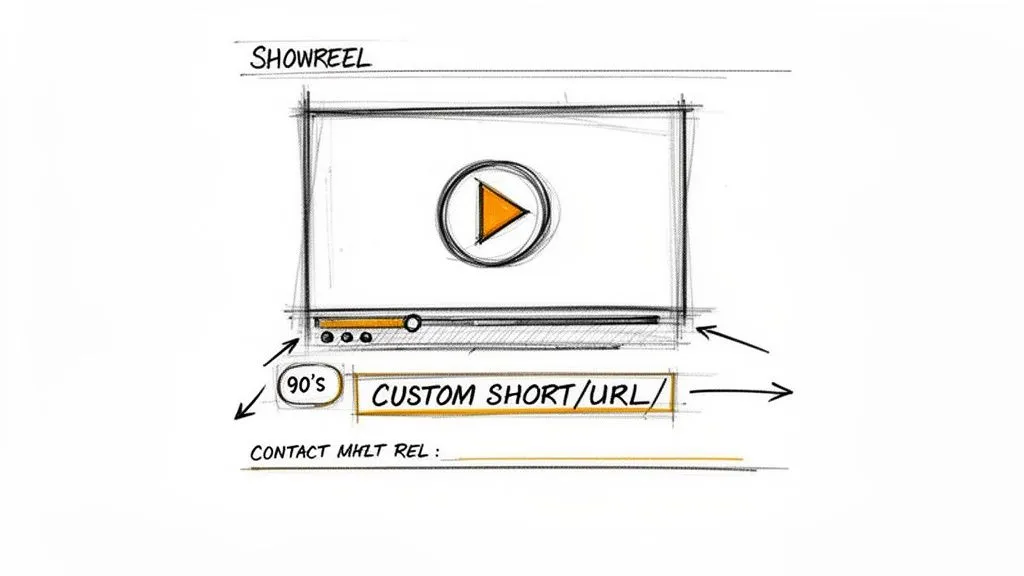
This isn’t just about visibility; it’s a mark of professionalism. Use a clean, custom URL. vimeo.com/YourNameEditor looks infinitely better than a random string of numbers and letters. It shows you care about the details.
Tailor The Reel To The Job
One reel does not fit all. Sending a generalist "best of" reel is a classic rookie move. A sharp, 90-second editing reel focused on pacing is completely different from a cinematographer's reel designed to highlight lighting.
You have to customize your reel for the specific role you want.
- For Editors: Show your best cuts. Emphasize rhythm, emotional timing, and seamless transitions. Keep it under two minutes. They won't watch more.
- For Cinematographers: Showcase your visual storytelling. Include a variety of shots demonstrating your mastery of lighting, framing, and camera movement.
- For Directors: This is your vision on display. Curate scenes that highlight your ability to guide performances and create a specific mood.
Your showreel isn’t an archive of everything you’ve ever shot. It’s a surgical strike designed to prove you can do one specific job exceptionally well. Cut everything that doesn't serve that one purpose.
Hook Them In Five Seconds
Producers are busy. They will not watch your entire reel if the first few seconds are weak. You have maybe five seconds to grab their attention before they click away.
Start with your absolute best, most visually stunning work. No slow fades, no title cards with your name. Get straight to the action.
Your reel also needs to be technically flawless. A bad audio mix can ruin great visuals. A solid understanding audio production is vital, because nothing screams "amateur" like muffled dialogue. Internships are the way in, and a killer showreel gets you in the door for the interview.
Top Film Student Resume Questions, Answered
Let's cut through the noise. Film students keep asking the same questions because they’re stuck with outdated advice. Here are the direct, no-BS answers you need to build a resume that actually gets you on set.
Should I put my GPA on my resume?
Only if it’s genuinely impressive (think 3.5 or higher) and you just graduated. Otherwise, leave it off. Your showreel and project credits matter infinitely more.
No producer has ever hired a PA based on their grade in film theory. They care about the short film you directed. Use that precious real estate to detail a project that proves you can do the work.
What’s the right length for a film student resume?
One page. That's it. No exceptions.
Producers are drowning in resumes. They need to see your value in seconds. Keeping it to a single page shows you can communicate clearly and edit ruthlessly—both non-negotiable skills on any film set. If your resume is spilling onto a second page, start cutting.
A two-page resume from a student signals one of two things: you don't have enough high-impact experience to fill one page well, or you don't know how to edit. Neither is a good look.
How can I write a resume with no "real" film experience?
You already have experience. You're just not framing it correctly. Every student project you've worked on is a credit. Treat them like professional gigs.
Create a section called "Filmography" or "Selected Projects" and list them like a pro would.
- List your role (Director, Editor, PA).
- Use sharp bullet points to describe what you actually did.
- Quantify your achievements (e.g., "Edited a 5-minute short selected for 3 university film festivals").
Your classroom projects are your portfolio. Own it.
Should I list my non-film jobs?
Yes, but be strategic. That barista job is more relevant than you think. It proves you can handle teamwork, customer service, and high-pressure situations—all daily realities on a chaotic film set.
Stick these roles in a brief "Other Experience" section at the bottom. Frame your bullet points to highlight skills that transfer to production.
- Instead of: "Served customers coffee."
- Try This: "Managed high-volume customer orders in a fast-paced environment, coordinating with a team of 4 to ensure quick service."
This small change shows a producer you can handle stress and work with a crew, which is exactly what they’re looking for.
Stop wrestling with templates. Your story is unique, and your resume should be too. StoryCV is a digital resume writer that helps you articulate the real impact of your film projects so you stand out. Build a resume that gets you on set.