The best way to describe yourself on a resume isn't about listing your past duties. It’s about showing your impact.
You need a short, sharp introduction that puts your biggest achievements front and center, using numbers and the same language you see in the job description. This simple shift makes your value crystal clear to a recruiter who might only give your resume a six-second glance.
Your Resume is Your First Story
Forget thinking of your resume as a dusty old document listing every job you’ve ever had. It’s a marketing tool. The product is you. The mission? Convince a hiring manager you’re the best solution to their problem.
Those first few lines are your entire pitch. It’s your one shot to get out of the “maybe” pile and onto the “must-interview” list.
This opening statement isn’t just a formality—it’s a strategic move designed to do three things, fast:
- Grab Attention Instantly: Recruiters spend an average of just seven seconds on that first scan. A powerful self-description makes every second count.
- Align with the Role: It proves you’ve done your homework and know exactly what the company is looking for.
- Beat the Bots: It weaves in the right keywords to sail past the Applicant Tracking Systems (ATS) and land in front of a real person.
The Challenge of Standing Out
Let's be real: the job market is tough. The numbers don't lie. An estimated 75% of resumes get rejected by an ATS before a human ever sees them, usually for missing keywords from the job description.
And it gets tougher. With 65% of managers now hiring based on skills alone, just listing your old job titles is a fast track to the rejection pile. You have to frame your experience as a story of achievement.
This is where a killer self-description changes the game. It connects the dots between what you’ve done and what the company needs, proving your worth from the very first line. If you're coming from academia, the same storytelling principles apply; you can find helpful tips for writing a compelling personal statement that show how to translate your experience.
Your Introduction Format Matters
Before you start writing, you need to pick the right format. This isn't a one-size-fits-all situation. The best choice depends on where you are in your career, your industry, and what you’re trying to achieve. The three main options are the resume summary, the professional headline, and the objective statement. Each one does a very different job.
A resume summary shows off your top wins and experience. A headline is a branding statement that defines your expertise. An objective focuses on your goals and works best if you have less experience.
So, which one is right for you? Let's break it down to help you figure out the best way to frame your professional story.
Choosing Your Introduction Summary vs Headline vs Objective
Use this table to quickly decide which format will give you the biggest advantage based on your career stage and goals.
| Type | Best For | Core Focus | Example Snippet |
|---|---|---|---|
| Resume Summary | Professionals with 2+ years of experience in their field. | Highlighting top achievements, quantifiable results, and key skills. | "Data-driven Marketing Manager with 5+ years of experience leading campaigns that increased lead generation by 40%." |
| Professional Headline | Specialists, freelancers, or career changers. | A concise branding statement or title that defines your expertise. | "Certified Scrum Master | Agile Project Management | SaaS Implementation" |
| Objective Statement | Students, recent graduates, or those making a significant career change. | Stating your career goals and how they align with the company's mission. | "Seeking to apply academic knowledge of UX principles and internship experience to a Junior Product Designer role at a mission-driven tech company." |
Picking the right format is the first real step in figuring out how to describe yourself on a resume. It makes sure your first impression is not just positive but perfectly tuned to what the reader expects from someone at your level. Get this right, and you've set the stage for a resume that actually works.
Choosing Your Format: The Resume Summary vs. The Professional Headline
Alright, you know why you need a strong intro. Now comes the real work: actually writing it. This isn't just about filling space at the top of your resume; it's about crafting a sharp, compelling pitch that makes a recruiter stop scrolling.
The two best tools for the job are the resume summary and the professional headline. They serve different strategic purposes, and knowing which one to use—and how to write it well—is what separates a forgettable resume from one that lands you an interview.
A resume summary is your career’s highlight reel, a quick narrative for professionals with a solid track record. Think of it as your elevator pitch in print.
On the other hand, a professional headline is more like a branding statement. It's a single, bold line that instantly flags your expertise. This makes it perfect for specialists or anyone making a career pivot.
The Proven Formula for a Powerful Resume Summary
Vague, fluffy summaries get ignored. To avoid that trap, I've always relied on a simple, effective three-part formula. It forces you to be specific and cover your identity, your core skills, and most importantly, your impact.
The formula is: [Adjective + Job Title] + [Years of Experience in Key Skill Areas] + [Top Quantifiable Achievement].
Let's see how this plays out in the real world:
-
For a Mid-Level Marketer:
- Adjective + Title: Results-driven Digital Marketing Manager
- Experience & Skills: with over 6 years of experience in SEO, PPC, and content strategy for B2B SaaS companies.
- Top Achievement: Proven ability to increase organic traffic by 150% and drive a 40% growth in qualified leads through data-backed campaign optimization.
-
For a Senior Operations Manager:
- Adjective + Title: Strategic Operations Manager
- Experience & Skills: with a decade of experience in supply chain optimization, process re-engineering, and team leadership.
- Top Achievement: Spearheaded a warehouse automation project that reduced operational costs by 22% and improved fulfillment speed by 35% in the first year.
See how that works? The adjective adds a bit of personality, the skills align you with the job description, and the achievement gives them undeniable proof you can deliver.
Crafting a High-Impact Professional Headline
A professional headline is your resume's tagline. It needs to be punchy, scannable, and perfect for when you need to define your niche or signal a career change. Forget full sentences; this is all about keywords and branding.
This approach is a lifesaver for specialists whose value is tied to specific skills or certifications. It’s also a powerful move for career changers who need to bridge their past experience to a new industry.
Check out these examples:
- For a Career Changer: Military Logistics Expert Transitioning to Supply Chain Management | PMP Certified
- For a Tech Specialist: Senior Full-Stack Engineer Specializing in Scalable FinTech Solutions | AWS Certified Developer
- For a Creative Professional: UX/UI Designer with a Focus on E-commerce Conversion Rate Optimization
Your headline should instantly answer the recruiter's question: "What does this person do, and why should I care?" It’s all about immediate clarity and relevance.
If you're still not sure which path to take, this decision tree can help you visualize the best choice based on your background.
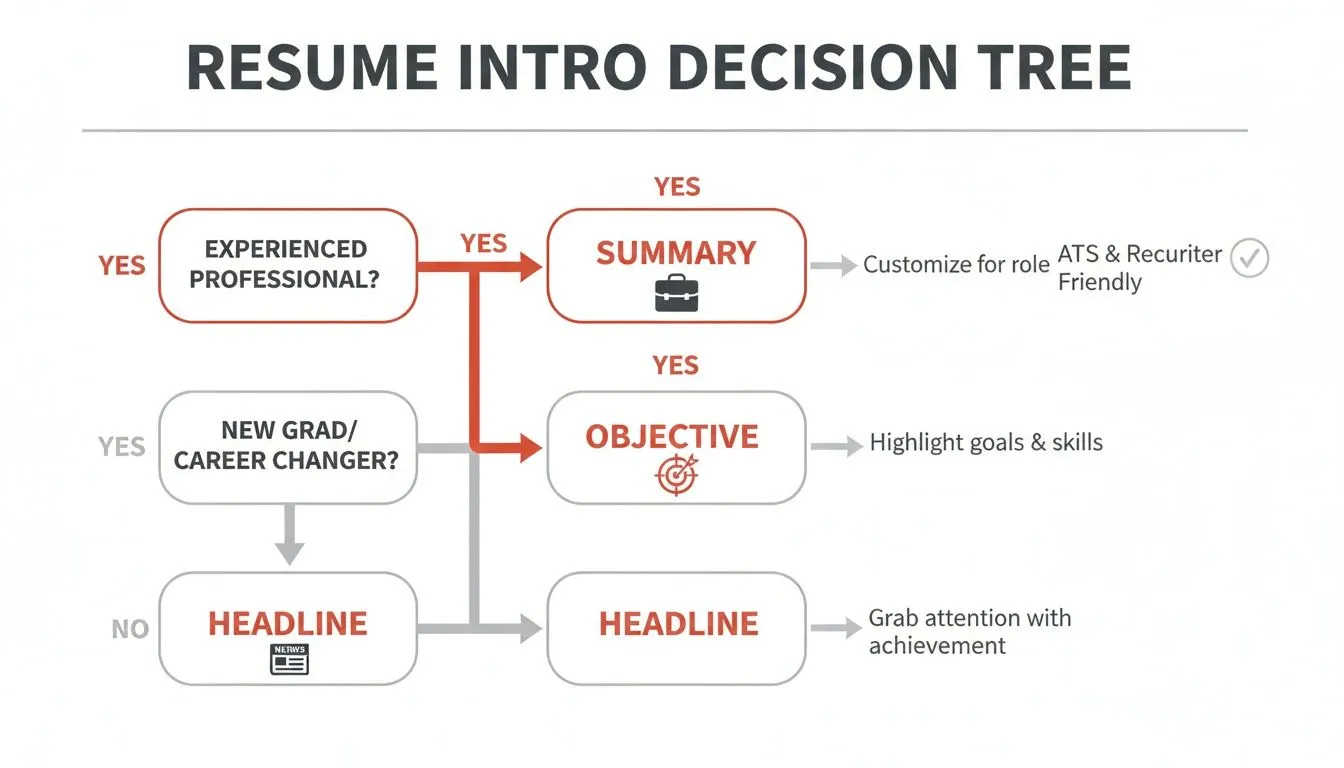
As the chart shows, if you have a history of achievements, the summary is your best bet. If you're a specialist or making a career move, the headline's direct branding power is the way to go.
Ultimately, whether you pick a summary or a headline, your goal is the same. You have to tailor it meticulously to the job description. Pull the key terms, required skills, and desired outcomes right from the posting. Weave them into your intro to show both the hiring manager and the ATS that you’re a perfect match from the very first line.
Writing Achievement-Focused Bullets That Tell a Story
Your resume summary is the opening act, but the real proof of your value is in the work experience section. This is where you have to stop listing job duties and start proving your impact. The best way to describe yourself is to build a consistent story of achievement, one bullet point at a time.
Think of each bullet point as a mini-story. It's your chance to show a hiring manager not just what you did, but why it mattered. Get rid of passive phrases like "responsible for" or "duties included." Every single line should scream accomplishment.
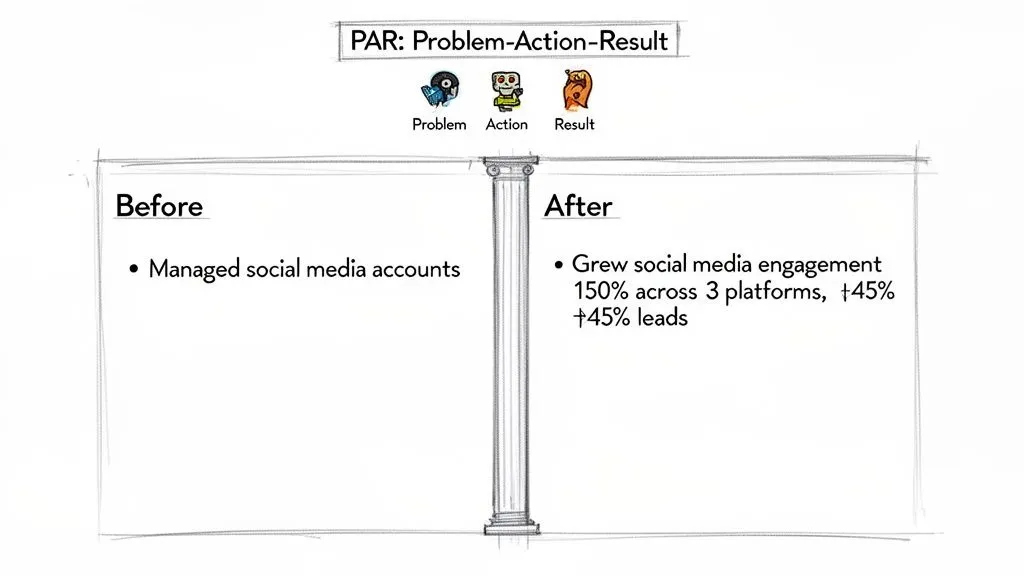
From Passive Duties to Powerful Accomplishments
The key is to completely reframe your thinking. Your last boss didn't pay you just to do things; they paid you to get results. Your resume needs to show that.
This shift is critical. Recruiters are hunting for evidence that you can solve problems and create value. In fact, an analysis of over 70,000 resumes found that longer, two-page resumes actually had a 35% higher interview rate. Why? Because they provided more room for detailed, impactful achievements, not just a laundry list of tasks. You can dig into more job search trends to see how this shapes resume strategy today.
Let's make this real with a classic "before and after" I see constantly.
Before (The Responsibility):
* Responsible for managing social media accounts.
This tells the reader absolutely nothing. It's a passive statement that could describe an intern or a senior strategist. It’s a total waste of valuable space.
After (The Achievement):
* Grew social media engagement by 150% across three platforms by launching a data-driven content strategy, resulting in a 45% increase in qualified leads.
Now that tells a story. It shows initiative, specific skills (data-driven strategy), and a direct link to business goals (engagement and leads). This is how you describe yourself as someone who gets things done.
Use the PAR Method to Structure Your Story
A simple but incredibly effective way to build these bullets is the Problem-Action-Result (PAR) method. It creates a natural story structure that’s easy for recruiters to scan and instantly understand.
Here’s the breakdown:
* Problem: What was the challenge or situation you faced? (This is often implied by your action).
* Action: What specific steps did you take? Kick this off with a strong action verb.
* Result: What was the measurable outcome? This is where you plug in your metrics.
Let's try it with another common role.
Before:
* Handled customer support tickets.
After (Using PAR):
* Action: Implemented a new ticketing triage system and created standardized response templates.
* Result: Reduced average customer response time by 30% and improved customer satisfaction scores from 85% to 95% within one quarter.
This bullet implies the problem (slow response times), details the action, and quantifies the impressive result.
Uncovering Metrics in Non-Obvious Roles
"But what if my job doesn't have clear numbers?" I hear this all the time. It’s a common hurdle, but trust me, nearly every role has quantifiable results if you know where to look. You just have to think a bit more creatively about the impact you made.
Here are a few places to hunt for hidden metrics:
* Efficiency Gains: Did you create a process that saved time? (e.g., "Automated a weekly reporting process, saving 10 team hours per week.")
* Cost Savings: Did you find a cheaper vendor or reduce waste? (e.g., "Renegotiated a vendor contract, resulting in $15,000 in annual savings.")
* Quality Improvements: Did you reduce errors or improve accuracy? (e.g., "Introduced a peer-review system that decreased documentation errors by 25%.")
* Customer or Team Satisfaction: Did you get great feedback or improve team morale? (e.g., "Mentored three junior developers, leading to a 100% retention rate on the team for the fiscal year.")
The goal is to connect your actions to a tangible business benefit, whether it's measured in dollars, percentages, or time. This demonstrates a commercial mindset, a quality that is valuable in any role.
By leading with dynamic action verbs, quantifying your results, and structuring your experience as a series of accomplishments, you transform your resume from a simple list into a compelling story of your professional value.
Showcasing Your Skills the Right Way
Your resume needs to do more than just list job titles. It has to prove what you can actually do. With the corporate world shifting hard towards skills-based hiring, being able to articulate your capabilities isn't just an advantage anymore—it’s a flat-out necessity.
The old way of just dropping a generic "Skills" block filled with empty words like "communication" or "teamwork" is a massive wasted opportunity. Recruiters want proof, not just claims.
This trend is completely reshaping the job market. A recent study found that 73% of employers are now using skills-based hiring practices, and a huge 65% prioritize a candidate's skills over their college degree. It gets even more real: 45% of companies are actively planning to scrap degree requirements for some roles. The message is loud and clear—show what you know how to do.
Differentiating Your Skill Sets
To really nail this, you have to understand the different kinds of skills you have. Every professional has a unique mix of hard, soft, and transferable skills. Knowing the difference helps you build a much more compelling and well-rounded profile.
-
Hard Skills: These are the technical, teachable abilities you pick up through training, certifications, or just plain old hands-on experience. They're specific and measurable. Think Python, SQL, Adobe Photoshop, or fluency in Spanish.
-
Soft Skills: These are the interpersonal or "people" skills that show how you work and get along with others. They're tougher to measure, but they are absolutely critical. In fact, a whopping 91% of recruiters specifically hunt for strong soft skills. We're talking about leadership, collaboration, and problem-solving.
-
Transferable Skills: These are the abilities that travel with you across different jobs and industries. If you're changing careers, these are your golden ticket. Project management, for example, is just as vital in marketing as it is in construction.
Weave Skills into Your Experience for Proof
The single most powerful way to describe yourself is to show, not tell. Instead of just listing "Project Management" in a skills section, you need to prove it right inside your work experience bullets. This gives context and undeniable proof that you know your stuff.
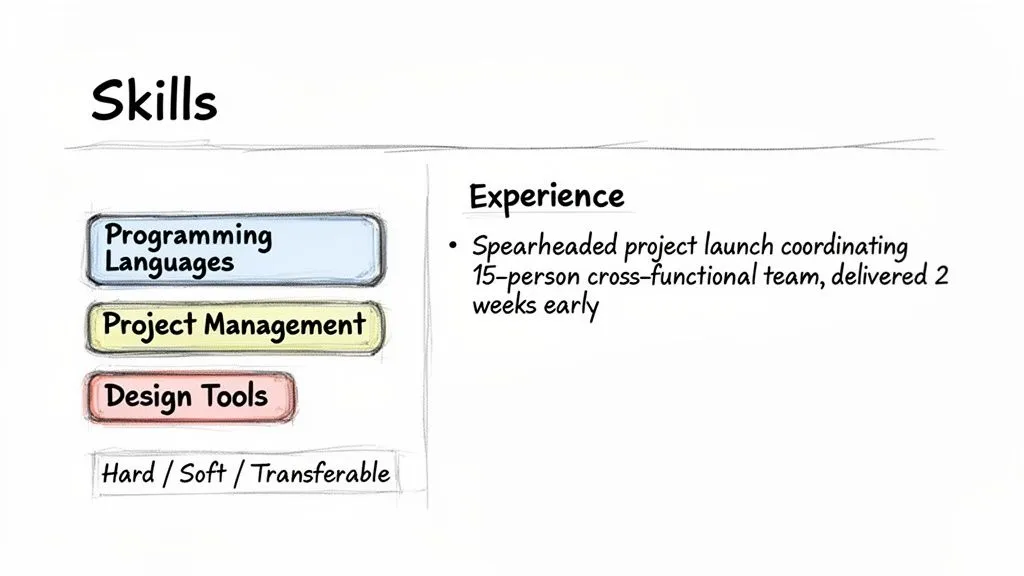
Generic Listing:
* Project Management
Powerful Demonstration:
* Spearheaded a critical project launch, coordinating a 15-person cross-functional team to deliver the final product two weeks ahead of schedule.
See the difference? The second one doesn't just name the skill; it proves it with a quantifiable win. This approach is way more convincing and helps you dodge a common dealbreaker for recruiters: a resume with zero measurable results. Beyond just listing abilities, truly effective self-description involves mastering leadership strengths and weaknesses to demonstrate your self-awareness and growth potential.
Your work experience section should be a gallery of your skills in action. Each bullet point is an opportunity to provide evidence of a specific hard or soft skill that delivered a tangible result.
Creating a Scannable and Optimized Skills Section
While weaving skills into your experience is the main event, a dedicated "Skills" section still has its place. It serves two key functions: it gives human recruiters a quick, scannable overview, and it helps your resume get past the Applicant Tracking Systems (ATS).
The secret is to be specific and strategic. Ditch the single, messy list of words. Instead, organize your skills into logical categories that echo the language in the job description. This simple trick makes your resume easier to read and dramatically boosts its ATS performance.
By the way, if you really want to get your resume past those bots, you need to understand https://story.cv/blog/articles/ats-filter-90-10-rule/.
Effective Skill Categories:
* Programming Languages: Python, Java, C++, JavaScript
* Marketing Tools: Google Analytics, HubSpot, SEMrush, Marketo
* Project Management: Agile, Scrum, Jira, Asana, Trello
* Design Software: Figma, Sketch, Adobe Creative Suite (Photoshop, Illustrator)
When you combine contextual proof in your experience section with a clean, well-organized skills list, you paint a complete and powerful picture of your capabilities. This dual approach ensures both human readers and automated systems see you as the perfect fit for the role.
Tailoring Your Description for Different Career Stages
How you describe yourself on a resume isn't a one-size-fits-all formula. Your story needs to adapt to where you are in your career. A recent graduate and a senior professional are telling fundamentally different stories, and generic advice just doesn't cut it.
A hiring manager’s expectations for a student are worlds apart from what they expect from someone changing careers. The trick is to frame your experience—or even your lack of it—in a way that shows the value you bring to the table right now.
Let’s break down how to do that for the most common career stages.
For Students and Recent Graduates
When you’re just starting out, you won’t have a long list of job titles. That’s fine. Your resume’s power comes from showing potential, academic chops, and any hands-on project work you’ve done. Your description needs to focus on what you’ve learned and how you’ve already applied it, proving you’re a proactive and capable learner.
Forget what you lack. Highlight what you have: fresh knowledge, tangible skills from coursework, and a solid work ethic you can prove through internships or projects.
Example Student Summary
Driven and detail-oriented Computer Science graduate with a 3.8 GPA and hands-on experience in Python and Java from a capstone project that developed a full-stack mobile application. Eager to apply strong problem-solving skills and a passion for software development to a junior engineering role at a fast-paced tech company.
Why This Works
- Highlights Academics: The 3.8 GPA immediately signals high achievement.
- Shows Applied Skills: It names specific languages (Python, Java) and ties them to a real project—a "full-stack mobile application."
- Focuses on Eagerness: Words like "eager" and "passion" convey genuine enthusiasm, a key trait hiring managers want in entry-level hires.
For a deeper dive, checking out a detailed student resume template with real examples can give you a really solid starting point.
For Mid-Level Professionals
At this stage, your story shifts from potential to proven impact. You have a track record, and hiring managers are looking for quantifiable results and clear signs of growth. Your description must go beyond just listing responsibilities. It needs to showcase measurable accomplishments that prove you’re ready for the next level.
The goal is to position yourself as a reliable expert who not only executes but also improves processes, leads initiatives, and directly contributes to the company's bottom line.
Example Mid-Level Summary
Results-focused Marketing Manager with over 7 years of experience in B2B SaaS, specializing in demand generation and marketing automation. Successfully led a team to launch a multi-channel campaign that increased marketing-qualified leads (MQLs) by 45% in six months and reduced cost-per-acquisition by 15%. Proficient in HubSpot, Marketo, and Salesforce.
Why This Works
- Leads with Impact: It opens with a strong title and years of experience, establishing credibility right away.
- Quantifies Everything: Numbers like a "45% increase in MQLs" and a "15% reduction in cost" provide concrete proof of your value.
- Shows Leadership: The phrase "Successfully led a team" shows you've moved beyond being just an individual contributor.
For Career Changers
When you're switching careers, your resume has one job: connect the dots between your past and your future. Your summary has to act as a bridge, highlighting the transferable skills that make your unique background a strength, not a liability.
You need to build a compelling narrative that shows your career move is a deliberate, well-thought-out step. Focus on skills that translate anywhere—things like project management, communication, data analysis, or leadership.
Your resume summary is your opportunity to reframe your history. Don't let a recruiter guess how your past fits their needs—tell them directly and confidently.
Example Career Changer Summary
Accomplished military logistics officer with 10+ years of experience in strategic planning and team leadership, now transitioning to a project management role in the private sector. Proven expertise in managing complex, multi-million dollar projects and coordinating cross-functional teams of over 50 personnel to meet critical deadlines. Certified Project Management Professional (PMP) with a strong aptitude for process optimization and risk mitigation.
Why This Works
- States the Goal Clearly: It immediately announces the transition to "project management."
- Highlights Transferable Skills: It uses language like "strategic planning," "team leadership," and "process optimization"—all core to project management.
- Includes Relevant Credentials: The PMP certification adds instant credibility and shows a serious commitment to the new field.
Quick Templates for Your Resume Summary
Getting started is often the hardest part. Use these formulas as a launchpad, but remember to fill them with your own specific achievements and metrics.
| Career Stage | Summary Formula | Example |
|---|---|---|
| Student/Graduate | [Adjective] and [Adjective] [Degree] with a [GPA/Key Achievement] and experience in [Skill 1] and [Skill 2]. Eager to apply [Key Ability] to a [Role] at a [Company Type] company. | Detail-oriented Finance graduate with a 3.9 GPA and experience in financial modeling and data analysis. Eager to apply strong analytical skills to a Financial Analyst role at a fast-growing fintech startup. |
| Mid-Level Pro | [Adjective] [Job Title] with [X] years of experience in [Industry/Specialty]. Proven track record of [Key Accomplishment with Metric]. Proficient in [Tool 1], [Tool 2], and [Tool 3]. | Data-driven Product Manager with 6 years of experience in e-commerce. Proven track record of launching features that increased user retention by 20%. Proficient in JIRA, Mixpanel, and SQL. |
| Career Changer | [Adjective] [Former Role] with [X] years of experience in [Transferable Skill 1] and [Transferable Skill 2], transitioning to a [New Role]. Proven ability to [Accomplishment Relevant to New Role]. Certified in [New Field Credential]. | Creative Graphic Designer with 8 years of experience in visual storytelling and client management, transitioning to a UX/UI Design role. Proven ability to translate user needs into intuitive interfaces. Certified in UX Design by Google. |
These templates are just guides. The best summaries feel personal and are backed by the proof you provide in the rest of your resume. Take these structures and make them your own.
Common Questions About Describing Yourself on a Resume
Even with a solid strategy, a few nagging questions can pop up and slow you down. Getting these final details right is what separates a good resume from a great one, ensuring your entire document feels polished and professional. Let's clear up some of the most common sticking points.
How Long Should My Resume Summary Be?
Keep it brief and powerful. Your resume summary is a concise pitch, not your life story. Aim for three to five lines of text, which usually lands you under 100 words.
This length is perfect for a busy recruiter doing a quick scan. It gives them your top qualifications without burying them in details. Remember, its job is to hook them and make them want to read more.
A great summary is like a movie trailer for your career—it shows the best parts and makes the audience want to see what happens next. It respects the recruiter’s time while showcasing your value.
Should I Use "I" or the Third Person?
Neither, actually. The standard for resume writing is an implied first-person voice. This means you write as if you're the subject of the sentence but you leave out personal pronouns like "I," "me," or "my."
For example, instead of writing, "I managed a team of five people," you'd simply write, "Managed a team of five people." This approach creates a direct, professional tone that keeps the focus squarely on your actions and accomplishments.
How Do I Describe a Layoff or Career Gap?
The key here is to frame your time off positively and focus on proactive things you did. You never need to mention a layoff directly in your summary or experience section. Instead, you can address the gap by highlighting skills you gained or projects you completed during that period.
Consider adding a section like "Professional Development" or "Project Work" if it makes sense for your story:
* Skill Development: "Completed advanced certification in Google Analytics and managed a PPC campaign for a local nonprofit."
* Project Focus: "Led a home renovation project, managing a $25,000 budget and coordinating with three external contractors."
This approach shows you stayed productive and continued to build relevant skills, turning a potential red flag into a demonstration of your initiative.
Can AI Write My Resume Description?
AI tools can be a fantastic starting point for brainstorming or knocking out a first draft, but they need a human co-pilot. They are excellent at identifying keywords and structuring sentences, which can save you a ton of time.
The problem is, AI often lacks the personal context to tell a truly compelling story. It might miss the nuances of your achievements or spit out generic-sounding phrases a recruiter has seen a hundred times. Using AI is smart; letting it fly the plane solo is not. For anyone looking for more specialized help, it's worth understanding what a professional resume writer does and how they blend their expertise with your unique story.
Ready to stop guessing and start creating a resume that tells your unique story? StoryCV's AI-powered platform guides you through a smart interview to uncover your real impact, producing clear, compelling drafts in minutes. Move beyond generic templates and start building a narrative that opens doors. Try it for free at https://story.cv.