Staring at a blank page, trying to write a resume with no "real" work experience, feels impossible. The problem isn't your lack of a job history. It's the advice you're following.
Ditch the old playbook. Stop seeing "no experience" and start seeing a blank canvas. It's an opportunity to highlight the skills, projects, and academic work that actually matter. This guide shows you how.
Why Your Student Resume Is Getting Ignored
You did what you were told. Listed your degree, maybe a summer job, and hit "send." Then… nothing. It’s not your fault. Most resume advice for students is disconnected from how hiring actually works.
The rules have changed. The numbers are grim. Graduating in 2026? Entry-level job postings have already crashed by 29% since January 2024. To make it worse, 99% of Fortune 500 companies use Applicant Tracking Systems (ATS) to filter resumes. These bots aren’t looking for potential. They’re scanning for keywords. You can discover more insights about this hiring landscape from recent analyses.
This isn't a game you can win with old strategies.
Old vs. New Resume Rules For Students
The advice that worked for your parents is a resume-killer today. Here's what to ignore versus what to do now.
| Outdated Rule | Modern Strategy |
|---|---|
| "Your resume should be a history of everything you've done." | "Your resume is a marketing document. Only show what's relevant to the job." |
| "Focus on your responsibilities and duties." | "Focus on achievements and quantifiable results. Show your impact." |
| "Use one generic resume for every application." | "Tailor your resume with specific keywords and projects for each job." |
| "A fancy design will make you stand out." | "A simple, single-column format is best for passing both ATS scans and the 7-second human review." |
Following the old rules is a fast track to the rejection pile. It's time to adapt.
The Real Problem: How You're Telling Your Story
The issue isn’t a lack of experience. It’s a failure to communicate your value. Most student resumes are passive lists of things they’ve done: attended class, joined a club, worked part-time. They read like a boring record, not a compelling pitch.
A recruiter spends just 7 seconds scanning a resume. If they don't see immediate proof of your skills, you're out.
Your resume is getting ghosted for a few reasons:
-
It’s not tailored. Sending the same generic resume is a guaranteed fail. The ATS and the hiring manager need to see specific keywords from the job description.
-
It focuses on duties, not results. “Responsible for social media posts” is weak. “Grew the club’s Instagram followers by 20% in three months” proves you deliver results.
-
It buries the good stuff. If your most impressive project is hidden at the bottom, no one will ever find it.
Stop treating your resume like a biography. It’s a marketing document, and the product is you. Stop listing what you’ve done. Start showing what you can do.
How To Spotlight Your Education Section
Your education is your work experience. Stop treating it like a footnote. For a student with no paid jobs, your academic section is your most valuable real estate.
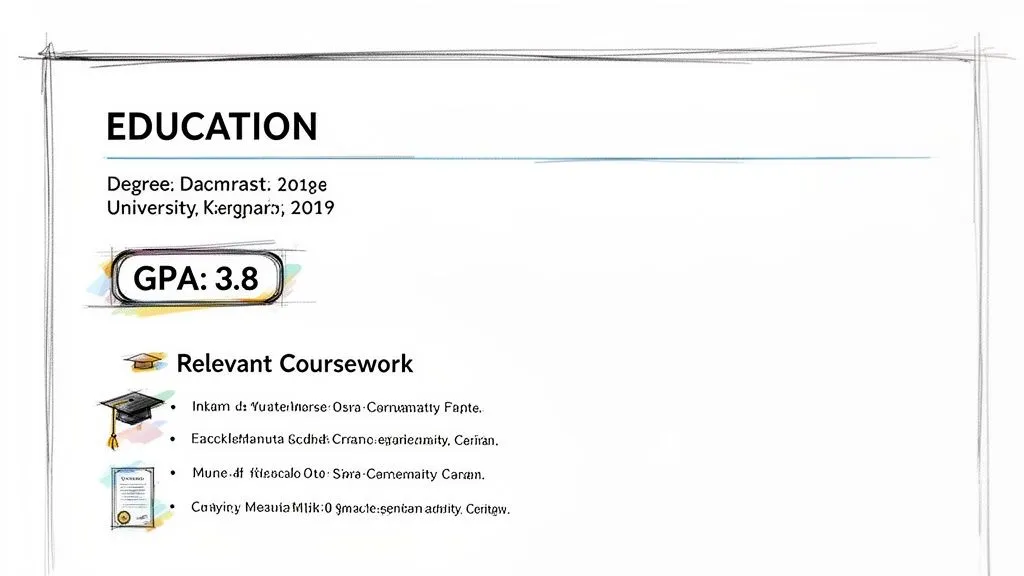
Just listing your degree is lazy. It tells a recruiter nothing. Treat this section like a job entry. Use bullet points to highlight your best achievements. Prove you have the knowledge and drive to get things done.
Go Beyond The Basics
A standard education entry is a missed opportunity. Show the substance behind the degree.
Here's how to expand it:
-
University Name, Location
-
Degree and Major | Expected Graduation Date
-
GPA: Only include it if it's 3.5 or higher. Anything lower is noise.
-
Honors & Awards: Dean’s List, scholarships, or academic honors are proof of dedication.
-
Relevant Coursework: List 3-5 advanced courses that align with the job description.
Listing coursework isn't filler. It’s a strategic move. It helps you mirror the language in the job posting, which gets you past initial ATS scans and shows the hiring manager you speak their language.
Don't just state your education. Use it to show what you know. A detailed education section is more powerful than irrelevant part-time work.
Transform Coursework Into Accomplishments
Course titles aren’t enough. Frame them with context and results. What were the major projects from each class? Did you build something? Analyze data? Lead a team?
Turn a boring list into a showcase of your skills.
Bad Example:
University of Amsterdam
B.A. in Communication and Media
2019 – 2023
This tells the recruiter nothing. It’s forgettable.
Good Example:
University of Amsterdam | Amsterdam, NL
Bachelor of Arts in Communication and Media | May 2023
-
GPA: 3.8/4.0 (Graduated with Honors)
-
Relevant Coursework: Digital Marketing, Consumer Psychology, Brand Strategy
-
Led a 4-person team in a semester-long project to develop a full-funnel marketing campaign for a local nonprofit, presenting our strategy to the board.
-
Authored a 15-page research paper on the impact of short-form video on Gen Z purchasing behavior, earning a departmental award for outstanding analysis.
See the difference? The second example is alive. It demonstrates leadership, project management, and analytical skills, backed by real academic achievements. This is how you build a student resume with no work experience.
Turn Projects Into Proof Of Your Skills
You think you have no experience. But what about that coding project, the group business plan, or a personal hobby you poured hours into? These aren't just distractions. They're a goldmine of skills.
Stop thinking of them as school assignments. Start treating them as evidence of what you can do.
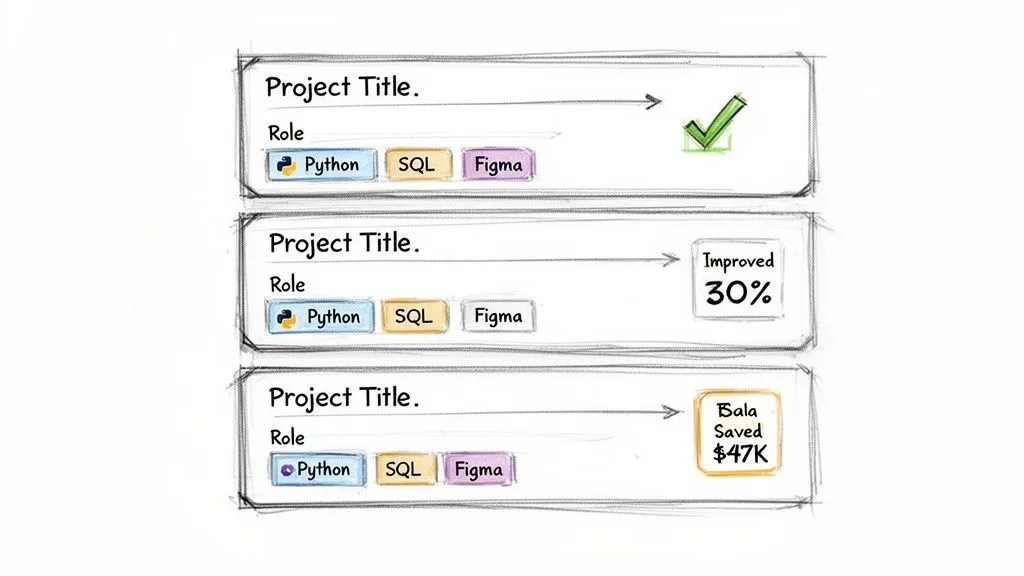
A dedicated "Projects" section is non-negotiable. It connects academic theory to real-world application. It’s your chance to show a hiring manager that you don't just learn—you build, analyze, and solve problems.
How to Frame Your Projects Like a Pro
A project title tells a recruiter nothing. Structure each entry like a mini-job description. Show your role, the tools you used, and the outcome.
What did you actually do? Use specific software? Work with a team? Produce something tangible?
A weak project description:
- Group project for marketing class
A strong one tells a story:
-
Project Lead | Fictional Brand Launch Simulation
-
Developed a comprehensive digital marketing strategy for a mock CPG brand, using SEMrush for keyword analysis and Canva to design social media mockups.
-
Coordinated a 4-person team using Asana to manage tasks and meet a strict 4-week deadline.
-
Presented the final strategy to a panel of professors, earning a 95% for strategic depth.
-
The second example proves skills in project management, digital marketing tools, and teamwork. It shows you can deliver.
A project section isn’t filler. It’s evidence. It shows you apply knowledge, use modern tools, and achieve measurable outcomes. It makes your potential tangible.
From Academic Exercise to Business Impact
When you don’t have work history, you have to get creative. Show you can think like a professional, even if your experience is from the classroom. A business analytics student, for instance, could frame a class simulation as a real business case.
By reporting to mock executives, they might show a hypothetical savings of $47,000 in vendor costs. This project-first approach is critical, especially when 52% of the Class of 2023 were underemployed a year after graduating. You can read more in our guide on writing a resume for an internship.
This simple shift turns a school assignment into a story of impact. It proves you connect your work to bottom-line results—exactly what recruiters want. Even if the numbers are from a simulation, the thinking is real. You've already done the work.
Writing Bullet Points That Show Your Impact
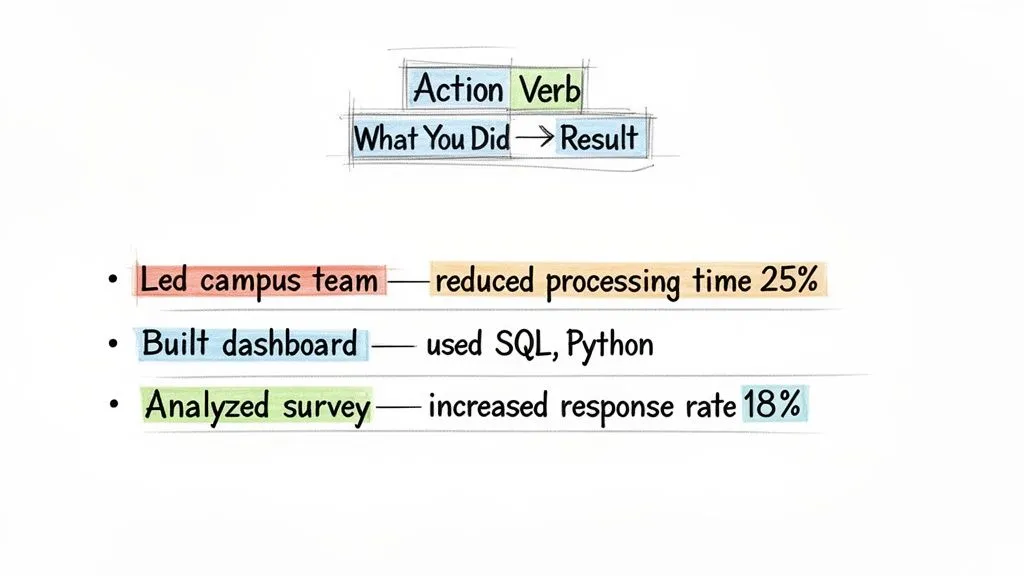
Your bullet points are the heart of your resume. Most students use dead-end phrases like "Responsible for..." or "Tasks included...". These are resume killers. They describe chores, not impact.
Stop listing what you were told to do. Start proving what you did. Each bullet point needs to be a mini-story of competence. Every line must prove you made something better, faster, or more efficient.
The Action + Result Formula
The fastest way to write strong bullets is to follow a simple formula. It forces you to focus on results, not tasks.
Action Verb + What You Did + The Quantifiable Result
This structure turns a passive statement into compelling evidence. It shows what you accomplished with a clear, measurable outcome. This is the core of how to write resume bullet points that get you noticed.
Let’s see it in action:
-
Weak (Duty-focused): "Responsible for managing the club's social media."
-
Strong (Impact-focused): "Grew the club's Instagram followers by 35% in one semester by creating and scheduling content with Canva and Buffer."
The first one is forgettable. The second proves you have marketing skills and can drive real growth. That gets you an interview.
Quantifying Results Without a Paycheck
"But I don’t have any numbers!" is a common excuse. You have more metrics than you think. Quantification isn't just about money. It's about showing scale, efficiency, or improvement.
Measure your work with:
-
Percentages: Increased engagement by 15%? Reduced a process time by 20%?
-
Frequency: Published 3 articles per week? Coordinated 5 team meetings?
-
Scale: Presented to a class of 50 students? Organized an event for 200 attendees?
-
Time: Completed a project 2 weeks ahead of schedule?
Numbers give your achievements weight. They turn a vague claim into a concrete fact. Measure every accomplishment, no matter how small it seems.
For instance, if you were a club secretary, don't just say you took meeting minutes. Say this: "Streamlined club communications by creating a centralized Notion dashboard, reducing scheduling conflicts by 50%."
Strong Action Verbs for Students
Your verb sets the tone. Ditch passive words like "Helped," "Worked on," or "Assisted." They make you sound like a bystander.
Choose powerful, specific verbs that show ownership.
| Category | Action Verbs |
|---|---|
| Leadership | Coordinated, Directed, Guided, Mentored, Organized, Led |
| Communication | Authored, Presented, Persuaded, Wrote, Edited, Drafted |
| Technical | Built, Designed, Developed, Engineered, Programmed, Coded |
| Analytical | Analyzed, Researched, Evaluated, Modeled, Forecasted, Assessed |
| Creative | Created, Designed, Composed, Illustrated, Produced, Formulated |
Start every bullet point with a verb from a list like this. It forces you to frame your experience around your actions. It's what hiring managers want to see.
Building A Skills Section That Passes The Test
Your skills section isn’t a junk drawer. It’s a strategic weapon. Its job is to get you past the ATS and convince a human you’re the right person in seven seconds.
A messy, disorganized list of skills is useless. You need a targeted, scannable list that screams, "I'm the one."
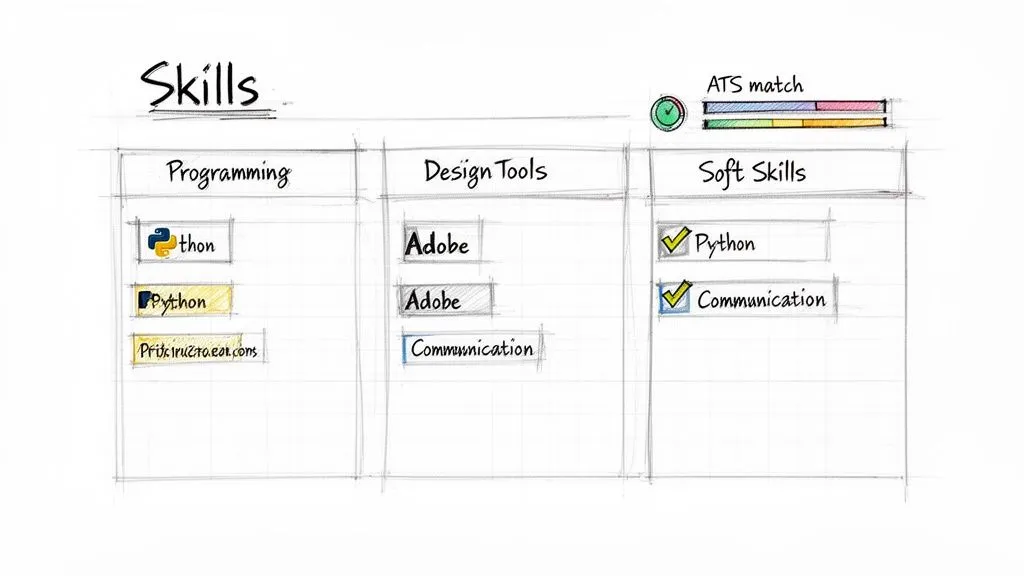
This section gets you past the robot gatekeepers. It has to work with your projects and education to tell a complete story about what you can do.
Hard Skills vs. Soft Skills
You need both, but they don't belong in the same list.
-
Hard Skills: Teachable, technical abilities. Think software, programming languages, or specific techniques like Python, Adobe Photoshop, or financial modeling. These are your keywords.
-
Soft Skills: Interpersonal traits. Communication, leadership, problem-solving. These are demonstrated, not listed.
Don't ever create a "Soft Skills" list with words like "Teamwork." It’s noise. Prove these skills in your bullet points about projects and extracurriculars.
For instance, winning Model UN awards shows research, public speaking, and diplomacy without ever listing them. The achievement speaks for itself.
Your skills section should focus on hard skills. They are what the ATS scans for. Getting this right is a critical part of knowing what skills to put on a resume.
Dissect The Job Description
The perfect skills section is a direct response to the job description. Print it out. Highlight every tool, software, or technical requirement they mention. This is your shopping list.
Your goal is to mirror their language precisely. If they ask for "Data Analysis," you use "Data Analysis." If they mention "Google Analytics," you list "Google Analytics." This isn't cheating; it's speaking their language so the machine can understand you.
The job market is brutal for students. Looking ahead to 2026, 47% of hiring managers rank AI skills as a top requirement for new graduates. But 49% will reject resumes that feel written by a robot.
This means you must show genuine, tangible skills, not just stuff keywords. The best way is to use projects or volunteering and quantify your impact. For example: "Prepped four years of data from eight sources into MySQL, leading to a 14% rating gain for a class project."
Organize Your Skills Into Categories
Don't dump skills into a chaotic block of text. Group them into logical categories. It makes your resume scannable and shows you have an organized mind.
Example of Categorized Skills:
-
Programming: Python (NumPy, Pandas), SQL, R, Java
-
Design Tools: Figma, Adobe XD, Sketch, Canva
-
Laboratory Techniques: PCR, Gel Electrophoresis, Western Blotting
-
Languages: English (Native), Spanish (Professional Proficiency)
This organized approach helps a hiring manager quickly confirm you have the technical abilities they’re looking for. It makes your student resume look professional, even with no work experience.
Answering Those Final, Nagging Resume Questions
You’ve reframed your projects and classes into achievements. But a few tricky questions might still be floating around. Let's sort them out so you can send your resume with confidence.
What's The Best Resume Format For A Student With No Experience?
Use a reverse-chronological format, but flip the script. "Education" goes at the top, right under your summary. Follow it with "Projects" and "Skills." Any "Volunteer" or "Extracurricular" experience comes after.
This structure immediately puts your academic wins and hands-on project work in the spotlight. It leads with what you have, so no one notices the missing "Work Experience" section.
Keep the layout simple. Stick to a single column. Fancy designs confuse both ATS screeners and human recruiters. Clean and simple always wins.
Should I Use A Resume Objective Or A Summary?
Ditch the objective. It’s an outdated relic that talks about what you want. It's all "me, me, me."
Instead, write a short, punchy Summary of 2-3 sentences. A summary focuses on the value you can bring to them.
Think of it as your 30-second elevator pitch. Start with who you are ("Recent Computer Science graduate"), mention a key skill ("proficient in Python and Swift"), and connect it to their needs ("seeking to apply skills in building intuitive mobile applications"). Customize this for every single job. A generic summary is pointless.
How Do I Fill A Whole Page If I Don't Have Work Experience?
You don't "fill" it. You build it with substance. A one-page resume is the gold standard. If you’re struggling to fill it, you’re not giving yourself enough credit.
Don't fall back on fluff like massive fonts or margins. Add real depth where it counts:
-
Go deeper on Education: Add "Relevant Coursework." Use bullet points for key academic projects or research papers.
-
Show off your Projects: Give your 2-3 best projects their own section. Use 3-4 bullet points for each to explain the problem, your actions, and the outcome.
-
Quantify your Extracurriculars: Managed a club’s budget? Organized an event for 100+ students? That’s leadership and project management. Frame it that way.
A half-page resume packed with impact is a thousand times better than a full page of filler. Quality smashes quantity, every time. To get a sense of which skills to highlight, understand the current job market for students and see what's in demand.
Tired of staring at a blank page? StoryCV is a Digital Resume Writer. We don't give you a template; we provide editorial judgment at software speed. Stop guessing and start telling your story the right way. Get your first role written for free at Story.cv.