Writing an internship resume is all about turning your academic projects, classwork, and part-time jobs into solid proof of your potential. It’s not just a list of things you’ve done. It’s about showcasing your skills and drive in a way that makes a recruiter see you as a future contributor. You do this by framing your experiences to highlight the context, your actions, and the impact you made.
Your First Step to Landing a Great Internship
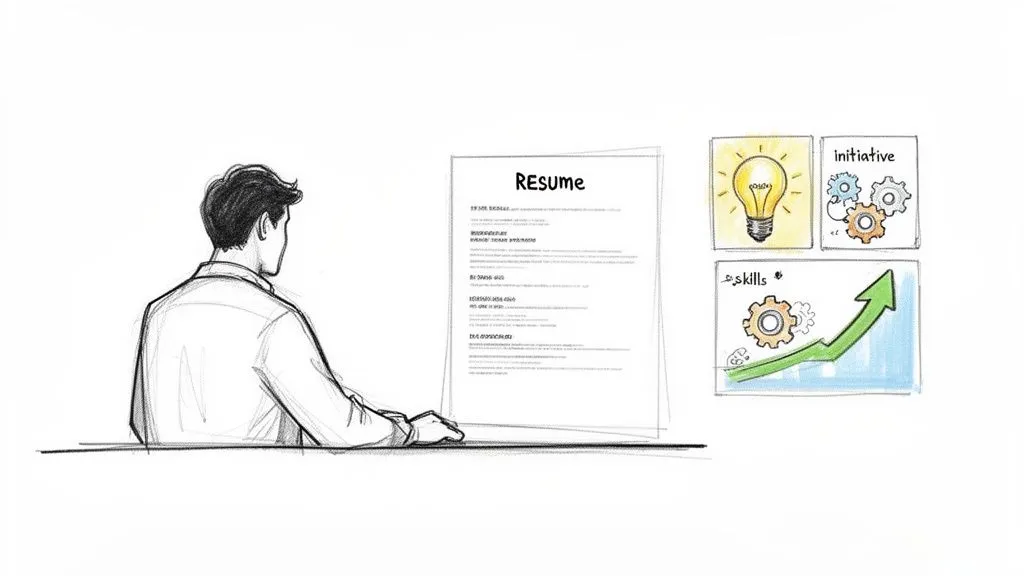
Staring at a blank page, trying to figure out how to capture your potential, can feel like a huge task. Let's be real: the internship market is tough, and a generic, cookie-cutter resume just won't get you noticed. Your goal is to ditch the templates and build a strategic marketing tool that actually opens doors.
This guide moves beyond just listing tasks. We’re focused on helping you tell compelling stories that prove your value. We'll dig into what recruiters really look for in an intern—initiative, potential, and transferable skills—and show you how to frame your experiences to hit those marks.
The Competition is Real
The search for an internship has gotten a lot more intense. For example, listings on platforms like Handshake dropped by over 15% between early 2023 and 2025, while student applications shot up. What does that mean for you? Competition for every single opening has basically doubled.
The numbers are even more dramatic in popular fields. Tech and professional services saw internship listings fall by 30% and 42%, respectively. This shift makes it crystal clear: you need a resume that does more than just state what you’ve done. It has to spell out your unique contributions and potential impact.
Key Takeaway: A powerful internship resume isn't just a history of your activities. It's a forward-looking document that proves you're ready to learn, contribute, and grow in a professional environment.
Before you start building your own, it helps to see what a polished, effective resume looks like. To get a feel for a strong structure and visual layout, check out our guide on a student resume template with real examples. It’s a great starting point to build on as you work through the steps in this guide.
Laying the Groundwork for a Winning Resume
Before you dive into writing about your experiences, you need to build the right structure. A clean, logical format is your best friend—it helps recruiters find what they need in seconds and ensures your resume doesn't get scrambled by the automated systems that do the first round of screening.
Think of it like a blueprint. If the foundation is shaky, it doesn't matter how great the stuff inside is. The whole thing will fall apart.
Start with Clean Contact Information
Your contact info should be professional and dead simple to find. Stick it right at the top so a recruiter never has to hunt for a way to reach you.
Here’s exactly what you need (and what you don't):
- Must-haves: Your full name, a professional email (think
firstname.lastname@email.com), your phone number, and a link to your LinkedIn profile. - What to skip: Your full street address is unnecessary; city and state are plenty. Also, leave off personal social media like Instagram or Twitter unless you've curated them to be professional and they're directly relevant to the role.
This section is prime real estate. Keeping it lean and professional sets the right tone from the very first glance.
Format for Readability and Robots
The look of your resume matters just as much as the words on it. Recruiters spend only a few seconds on their initial scan, so a clean layout is non-negotiable. Even more important, nearly every big company uses Applicant Tracking Systems (ATS) to filter resumes before a human ever sees them.
These bots love simple, predictable formats. To make sure your resume is friendly to both humans and the ATS, stick to these rules:
- Go with a single-column layout. Those fancy two-column templates might look cool, but they often confuse ATS software, which can garble your information.
- Use a standard, professional font. Classics like Calibri, Garamond, or Georgia are your best bet. Keep the size readable, usually between 10-12 points.
- Always save it as a PDF. This locks in your formatting, so what you see on your screen is exactly what the recruiter sees on theirs, no matter the device.
A resume that’s hard to read is a resume that gets tossed. Your goal isn't flashy design—it's clarity and simplicity. A clean format screams professionalism and attention to detail.
To get your writing foundation right, it helps to understand what makes any piece of writing persuasive. For some broader advice on making a compelling case, check out these crucial college essay writing tips.
Map Out Your Key Resume Sections
With your contact info and formatting locked in, it's time to outline the core of your resume. As a student or recent grad, your education is usually your biggest asset, so it deserves a prime spot.
Here’s a simple, effective order that just works:
- Education: Put this right below your contact information. For student resumes, it's the first thing recruiters look for.
- Experience: This is where you'll list part-time jobs, volunteer work, or any previous internships.
- Projects: Create a dedicated section to show off academic or personal projects where you've actually applied your skills.
- Skills: A clean, organized list of your technical and soft skills.
Under Education, always include your university, degree, major, and expected graduation date. If you have a GPA of 3.5 or higher, definitely put it on there. You can also add a "Relevant Coursework" line to list classes that directly relate to the internship you want. This structure creates a clear story, walking the reader through your qualifications in a way that makes perfect sense.
Crafting Bullet Points That Tell Your Story
Your resume sections are now framed out. But this is where the real work begins—turning simple descriptions into stories that stick. The bullet points under your Experience and Projects sections are your best chance to prove you’re worth the interview.
A great bullet point doesn't just list what you did. It tells a mini-story about your contribution. To do that, we'll use a simple but powerful framework: Context → Action → Impact. This method is the difference between saying "Managed social media" and proving you grew an audience with smart content. It shifts your resume from a passive list to an active showcase of your skills.
And in a crowded field, you need every bullet point to work for you. In 2023 alone, there were an estimated 4.1 million internships in the U.S., with over 21% of college students participating. Nearly 90% of employers are scanning for specific skills and attributes, so you have to make your accomplishments crystal clear.
The Context-Action-Impact Framework Explained
So, what is this magic formula? It’s just a structured way to make sure every bullet point answers the three questions a recruiter is silently asking: Where were you? What did you do? And why did it matter?
- Context: Set the scene. What was the challenge or situation? A few words is all you need. (e.g., "For a university-wide case competition...")
- Action: Describe what you did. Start with a strong, active verb. (e.g., "...analyzed market data and developed a three-tiered marketing strategy...")
- Impact: Explain what happened because of your action. This is the most important part—use numbers whenever you can. (e.g., "...which led to a 1st place finish among 25 teams.")
This approach turns a boring task into a measurable achievement. It shows you take initiative, solve problems, and care about results—exactly what hiring managers are looking for.
This whole process is about building a strong foundation first, so your accomplishments can really stand out.
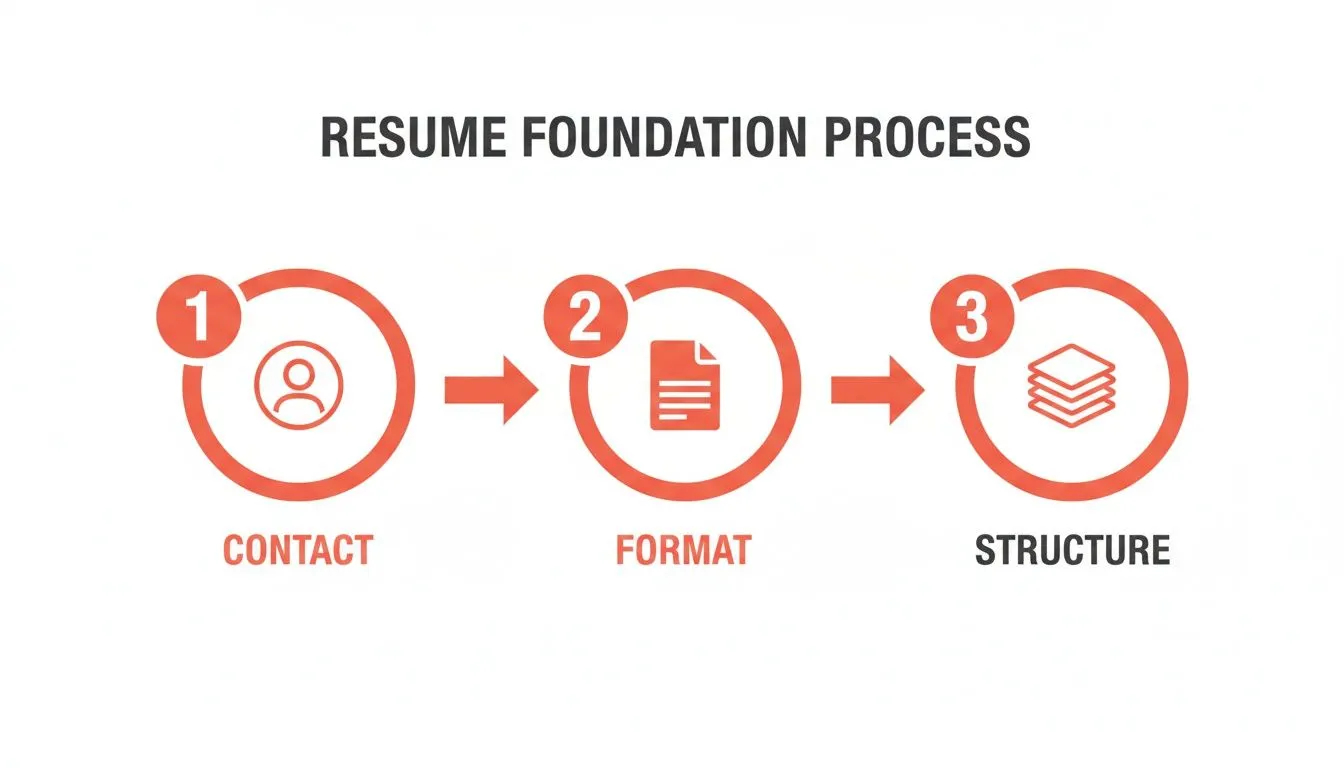
A solid structure allows your well-crafted bullet points to do the heavy lifting.
Putting the Framework into Practice
Theory is one thing, but let's see how this actually works. We’ll take a few common student experiences and give them the Context-Action-Impact treatment.
Example 1: Class Project
* Before: Worked on a group project for a marketing class.
* After: Conducted primary market research for a semester-long project by surveying 100+ students, informing a new product launch strategy that our professor graded in the top 10% of the class.
Example 2: Part-Time Retail Job
* Before: Helped customers and organized the store.
* After: Redesigned the front-of-store product display to better highlight seasonal promotions, contributing to a 15% increase in sales for featured items over a three-month period.
Example 3: Volunteer Role
* Before: Planned a fundraising event.
* After: Coordinated logistics for a 200-attendee charity auction, securing in-kind donations from 15 local businesses and exceeding the fundraising goal by 25%.
The "after" examples don't just state a duty; they demonstrate ownership and results. They show you made a tangible difference, which is far more impressive to a hiring manager.
How to Find Numbers When You Don't Have Any
"But I don't have hard data!" I hear this all the time, especially when the experience comes from classwork or a casual volunteer gig. Don't worry. Quantifying your impact isn't just about revenue or percentages.
Think about other ways to measure what you did:
- Scale: How many people did you serve? How big was the team? (e.g., "Trained 5 new volunteers...")
- Frequency: How often did you do something? (e.g., "Published 3 articles per week for the campus blog...")
- Efficiency: Did you make a process faster or easier? (e.g., "Created a new filing system that reduced document retrieval time by 50%.")
By thinking creatively about scale, scope, and efficiency, you can add powerful numbers to almost any experience. Framing your contributions this way is a huge part of learning how to describe yourself in a resume as a proactive, results-oriented candidate.
Showcasing Your Skills and High-Impact Projects
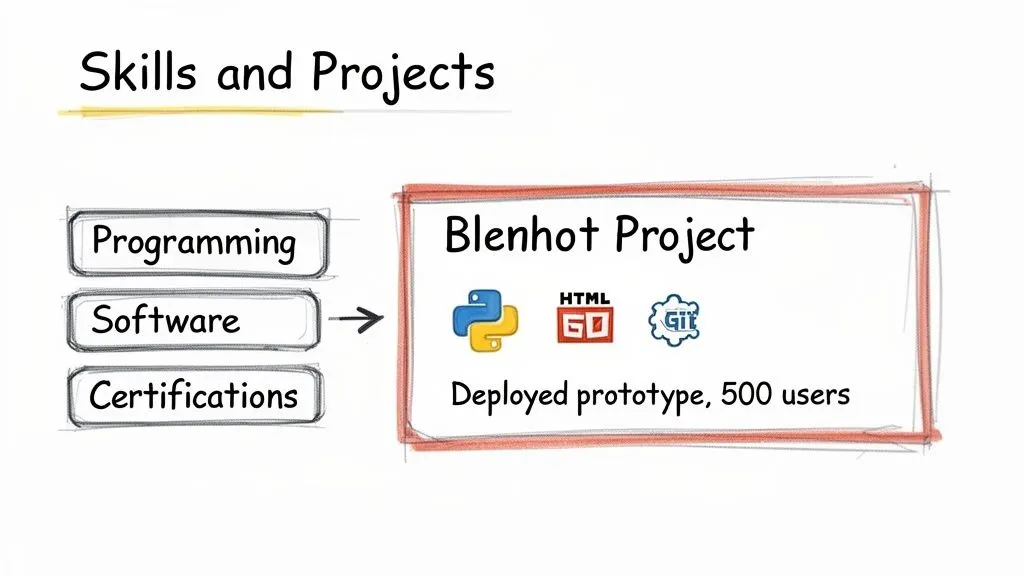
For most students, the best proof you can do the job lives outside of a traditional employment history. Your skills and academic projects are where you get to show a hiring manager what you’re truly capable of.
This is especially true for internships. Managers aren't just looking for past experience—they're betting on your potential. The key is to present this information strategically. A messy list of programming languages or a vague project description won’t cut it. You need clean, scannable sections that tell a clear story about what you can do.
Organize Your Skills for Clarity (and for the Bots)
Think of your Skills section as a quick-scan area for recruiters and a keyword goldmine for Applicant Tracking Systems (ATS). Instead of just dumping everything into one long list, group your abilities into logical categories. It’s a simple change that makes your qualifications much easier to digest.
Try using categories that align with the jobs you’re targeting:
- Programming Languages: Python, Java, JavaScript, C++, SQL
- Software & Tools: Figma, Canva, Microsoft Excel (Pivot Tables, VLOOKUP), Jira, Git
- Certifications: Google Analytics IQ, AWS Certified Cloud Practitioner
- Languages: Spanish (Conversational), French (Basic Proficiency)
This simple structure immediately tells a recruiter where your strengths are. It also helps them quickly confirm you have the specific skills mentioned in the job description. If you need more ideas, check out our guide on examples of technical skills in a resume to see what's relevant in your field.
Turn Projects Into Powerful Experience
If you’re short on formal work experience, your Projects section is easily the most important part of your resume. This is your chance to showcase how you apply your knowledge in the real world.
Pick the projects that are most relevant to the internship, whether it's a capstone project, a hackathon build, or a personal website you coded from scratch.
Treat each project like a job. Use the same Context-Action-Impact bullet points we discussed earlier. Your goal is to prove you can take a concept from idea to execution and deliver something real.
This section is also a great place to highlight skills essential for modern work. With remote and hybrid internships becoming standard—64.8% of employers plan to offer hybrid roles, according to a recent report—your ability to work independently is a huge asset. When describing your projects, make sure to emphasize skills like adaptability, digital communication, and self-directed problem-solving. These are exactly the traits that thrive in remote environments.
Example of a High-Impact Project Entry
Let’s look at how this all comes together. Notice how this entry clearly outlines the project's purpose, the specific technologies used, and the measurable results.
Blenhot Mobile App | Personal Project
* Technologies: React Native, Firebase, Figma
* Developed a recipe discovery mobile app for iOS and Android that allows users to filter recipes by dietary restrictions and available ingredients, solving a common meal-planning challenge.
* Designed the complete UI/UX in Figma, conducting user testing with 10 peers to refine the interface and improve navigation flow by 30% based on feedback.
* Engineered the front-end with React Native and integrated Firebase for real-time database and user authentication, successfully launching the app on the Google Play Store.
Tailoring and Polishing Your Final Draft
You've built the foundation. You've hammered out some powerful bullet points. Now comes the part that separates a good resume from an interview-winning one: tailoring and polishing.
Sending the same generic resume to every company is one of the biggest mistakes you can make. It screams low effort. You need to show each company you’ve done your homework and are genuinely interested in their specific role, not just any role.
Deconstruct the Internship Description
Your first move is to become a detective. Pop open the internship job description and start highlighting every keyword tied to skills, responsibilities, and qualifications. Look for specific software, methodologies, or even character traits they mention over and over.
This list is your cheat sheet. These are the exact terms the hiring manager and the Applicant Tracking System (ATS) will be scanning for. It's also smart to get a basic sense of how AI in recruiting screens resumes so you understand how these systems filter applications before a human ever sees them.
Once you have your keyword list, put it side-by-side with your resume. Where are the gaps? This simple analysis will guide every single edit you make from here on out.
Strategically Align Your Content
Now it's time to weave those keywords into your resume. The goal is to mirror the company’s language without sounding like you just copied and pasted it.
- Tweak your Skills section. If the job description asks for "data analysis" and you’ve listed "statistical modeling," consider adding or rephrasing to match. Add any required software you know but might have forgotten to include.
- Refine your bullet points. Rework your impact statements to feature the most relevant keywords. If a role emphasizes "collaboration," make sure your project descriptions mention working with a team to achieve a specific outcome.
For example, if the description prioritizes "user-centric design," you could change a bullet point from "Built a mobile app..." to "Designed a user-centric mobile app by conducting 5 peer interviews to refine the UI..."
That small change makes a massive difference because it directly addresses the employer's stated needs.
Key Takeaway: Tailoring isn't about making things up. It's about strategically highlighting the parts of your real background that are most relevant to the specific internship you want.
The Final Polish: A Proofreading Checklist
Typos and formatting mistakes can get you disqualified instantly. They signal a lack of attention to detail—a trait nobody wants in an intern. Before you even think about hitting "submit," run through this final checklist.
- Read it out loud. This feels silly, but it works. It forces you to slow down and helps you catch awkward phrasing or missing words that your eyes just skim over.
- Check for consistency. Are all your dates formatted the same way (e.g., May 2024 vs. 05/2024)? Is your font and font size consistent everywhere?
- Verify names and titles. Double-check the spelling of companies, software, and tools. Getting these wrong just looks sloppy.
- Get a second opinion. Please, do not skip this. Ask a career advisor, a trusted professor, or a mentor to review it. A fresh pair of eyes will always spot errors you’ve become blind to.
Your Toughest Internship Resume Questions, Answered
Even after you've got all the big pieces in place, it’s the small, nagging questions that can bring your progress to a dead halt. Let's clear up the most common points of confusion so you can hit "send" with total confidence.
How Long Should My Resume Be?
One page. That's it. This isn't just a suggestion—for students and recent grads, it's a hard and fast rule.
Recruiters are scanning resumes in a matter of seconds, not minutes. A single, high-impact page proves you can prioritize information and communicate the most important details efficiently. Think of it as your first test: can you make a powerful case for yourself without wasting anyone's time?
Should I Bother with an Objective or Summary?
For an internship resume? Almost never. That prime real estate at the very top of your page is far too valuable to waste on something generic. You want to lead with your strongest proof—your skills, projects, and achievements.
Objective statements often feel dated and state the obvious ("Seeking a marketing internship to learn new skills..."). A summary is just fluff if your experience section already tells a compelling story. Let your accomplishments do the talking. They're much louder.
Pro Tip: Every single line on your resume should be earning its keep. A strong bullet point showing what you actually did will always beat a vague summary claiming you're a "hard worker."
What if I Have Zero "Real" Work Experience?
This is the number one fear for most students, and guess what? Hiring managers completely expect it. The trick is to stop thinking of "experience" as only paid, full-time jobs. It's not.
You have more experience than you think. You just need to frame it correctly. You can—and absolutely should—include:
- Academic Projects: Dive deep into a significant class project. Talk about your specific role, the problem you solved, and the outcome. Did you build an app? Analyze a complex dataset? Present your findings to the class? That’s experience.
- Volunteer Work: Any role where you had responsibilities counts. Did you organize an event, manage communications for a charity drive, or work with a team to reach a goal? That's project management and teamwork.
- Club Leadership: Running a student organization is like running a small business. You're managing budgets, marketing events, and coordinating people. Highlight those skills.
- Personal Projects: Did you build a website just to learn how? Create a cool data visualization for fun? A personal project is one of the best ways to show genuine passion and initiative.
Treat these activities just like you would a job. Use that Context → Action → Impact formula to show you have the skills they're looking for.
Do I Really, Truly Need to Write a Cover Letter?
Yes. A thousand times, yes. Unless the application specifically tells you not to, you need to write one.
A cover letter is your chance to connect the dots between your resume and the company's specific needs. It's where you show you've done your homework and can tell a story that a list of bullet points never could. A lazy, copy-paste cover letter is worse than nothing. But a sharp, thoughtful one? That can be the very thing that gets your application moved to the top of the "yes" pile.
Stop staring at a blank page and let AI guide your story. StoryCV's intelligent writer helps you articulate your true impact, turning your academic projects and experiences into a compelling professional narrative that gets results. Start writing your high-impact resume in minutes at https://story.cv.