Changing careers feels like starting from scratch. You’ve done great work, but new industries can’t connect the dots. They see irrelevant job titles, not valuable experience. The problem isn't your background. It's the translation.
Don't just list "communication" and expect to get hired. That's a dead end. Prove it. Focus on the transferable skills that signal your value, no matter the role. These are concrete abilities that solve an employer's problems from day one.
This guide breaks down 10 critical skills. For each one, you’ll get concrete examples to build a compelling narrative. We'll show you how to demonstrate your value, not just declare it.
1. Communication & Storytelling
Your experience isn't a random collection of jobs; it's a story. Communication and storytelling are the most critical transferable skills because they connect the dots. This skill is about articulating complex ideas and achievements in a clear, compelling narrative. Instead of just listing what you did, storytelling explains why it matters for the job you want now.
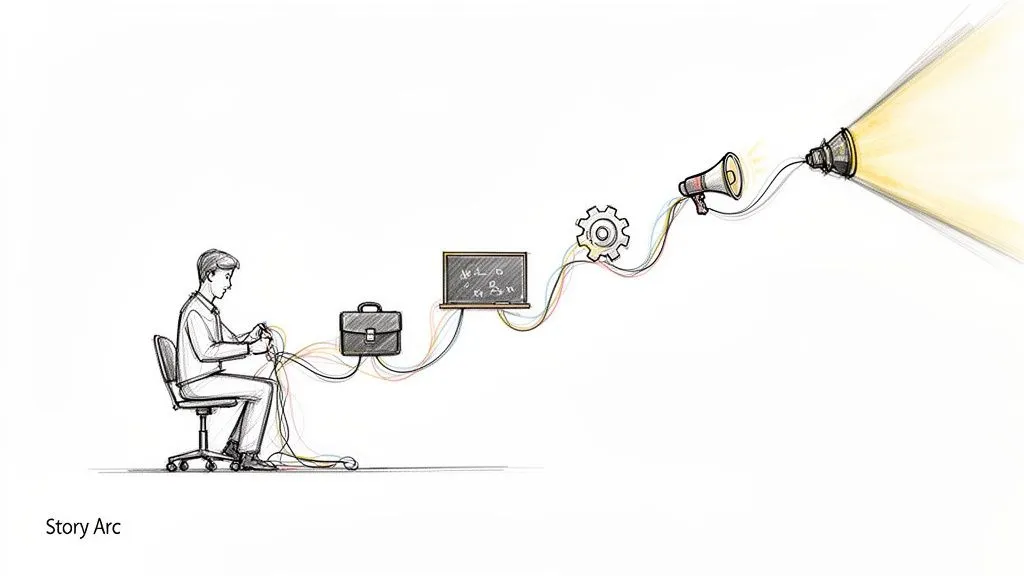
A hiring manager isn't hiring a set of skills; they're hiring a person who can solve their problems. Storytelling transforms your accomplishments into accounts of impact, making you memorable and relevant.
Resume Examples
- Retail Manager to Customer Success: Analyzed sales data and customer feedback to overhaul store operations, improving customer satisfaction scores by 15% and increasing repeat business by 10% over six months.
- Teacher to Corporate Trainer: Designed and launched a new curriculum for 150+ students, increasing standardized test scores by 25% by tailoring instructional methods to diverse learning styles.
Interview Talking Points
Use the STAR method (Situation, Task, Action, Result). Then add a "T" for Tie-in, connecting your story directly to the new role.
Example: "In my last role, we faced a 20% budget overrun (Situation). I was tasked with getting the project back on track (Task). I renegotiated with two vendors and reallocated internal resources, saving 25% on projected costs (Action). We delivered the project on time and 5% under budget (Result). I'm confident I can bring that same fiscal discipline to the Operations Lead role here."
2. Project Management & Organization
Every company has goals. Project management turns those goals into reality. It’s the ability to plan, execute, and complete initiatives. It proves you can handle complexity, manage resources, and deliver.
For career changers, project management skills show you navigate ambiguity and drive results. You’re not just a thinker; you’re a doer. An employer sees this and trusts you can bring order to chaos. For those looking to formalize this skill, a credential like the Project Management Professional (PMP) certification can add weight.
Resume Examples
- Nonprofit Grant Writer to Business Operations: Managed a portfolio of 12 grant proposals simultaneously, coordinating with program, finance, and leadership teams to secure $1.2M in funding.
- Military Officer to Tech Program Manager: Directed end-to-end logistics for deploying equipment across 3 continents, coordinating with 5+ international agencies to ensure 100% on-time delivery.
Interview Talking Points
Focus on scale and outcome. Don't just say you "managed a project." Explain the budget, the team size, the timeline, and the business impact.
Example: "As an event coordinator, our main venue canceled three weeks before the event (Situation). I had to find a new venue for 500+ attendees without increasing the budget (Task). I secured a new venue in 48 hours and renegotiated with vendors to match our original costs (Action). The conference was a success, with a 95% satisfaction rate, and we stayed 3% under budget (Result). I’m ready to apply that same crisis management to your product launches."
3. Problem-Solving & Critical Thinking
Every job exists to solve problems. This is about your ability to analyze a situation, find the root cause, and implement the best solution.
For career changers, this proves you add value without years of domain-specific knowledge. You can diagnose challenges and create measurable improvements. Companies don't hire people to maintain the status quo. They hire them to fix things. Your problem-solving muscle proves you can handle the unknown and adapt, making you a low-risk, high-reward hire. To excel, explore practical strategies for improving critical thinking skills.
Resume Examples
- Retail Manager to Operations Analyst: Identified a sales decline in a key category by analyzing weekly data; revised the store layout to increase product visibility, resulting in a 15% sales lift.
- HR Admin to Process Improvement Specialist: Mapped the employee onboarding workflow, identified three bottlenecks, and streamlined the process, reducing total onboarding time by 30%.
Interview Talking Points
Explain your thought process, not just the outcome. Show them how you think.
Example: "My team received complaints about a software feature (Problem). I analyzed three weeks of support tickets to find the root cause (Information Gathering). It was a confusing UI, not a bug. I mocked up a simpler UI and presented it with the data to the product team (Action). They implemented it, leading to a 60% reduction in complaints for that feature (Result)."
4. Adaptability & Learning Agility
Industries change. Tools become obsolete. Adaptability is your insurance against irrelevance. It’s the ability to absorb information quickly and apply lessons to new challenges.
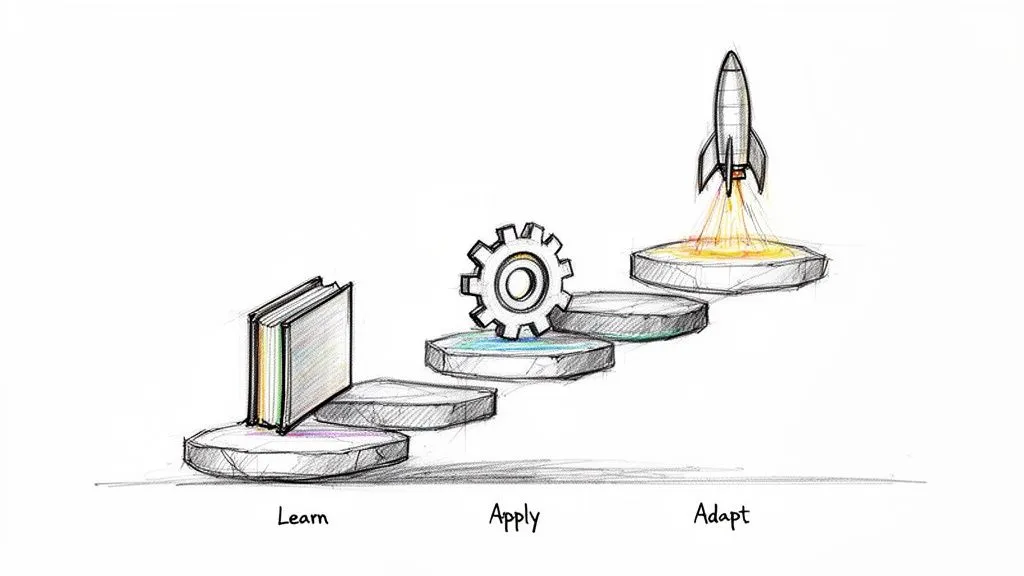
Hiring managers want this in career changers. It signals you can bridge the gap between your old industry and their new one, reducing ramp-up time. Your capacity to learn is more important than what you already know.
Resume Examples
- Military Veteran to Tech Project Manager: Self-taught in Agile and Scrum, earning a CSM credential in 60 days and immediately applying principles to increase project velocity by 18%.
- Sales Pro to SaaS Account Executive: Mastered a complex B2B software product within 30 days—50% faster than the team average—and closed the first deal within 6 weeks.
Interview Talking Points
Frame your career pivots as deliberate learning projects. Show the process of how you get up to speed.
Example: "Moving from hospitality to logistics, I didn't know supply chain software. I spent my first two weeks studying documentation and shadowing top performers. I was managing my own routes by week three, a process that normally takes six weeks. I see a similar opportunity here to quickly learn your CRM and start contributing."
5. Leadership & Influence (Without Authority)
True leadership isn't about a title. It's about impact. It’s the ability to guide and mobilize others without formal authority. This skill shows you can drive change from any position.
Many people think they lack leadership experience if they haven't been a manager. Wrong. Influencing teams, shaping decisions, and spearheading initiatives are all potent forms of leadership. You're showing you can build consensus and get things done.
Resume Examples
- Analyst to Product Manager: Championed a new data visualization strategy that was adopted by three departments after presenting a compelling business case to leadership.
- Individual Contributor to Team Lead: Mentored three junior team members on new protocols, cutting their onboarding time by 40% and contributing to a 100% team retention rate for the year.
Interview Talking Points
Focus on how you built buy-in and aligned different stakeholders.
Example: "My team was hesitant to adopt a new project management tool (Situation). I had to gain their buy-in to improve our workflow (Task). I hosted small-group demos tailored to each department's pain points (Action). The entire 15-person team adopted the tool, cutting our weekly reporting time by 20 hours (Result). I’m eager to apply that same consensus-building approach here."
For a deeper dive into phrasing these achievements, explore our guide on what skills to put on a resume.
6. Customer-Centric & Empathy Skills
Every business solves a customer's problem. This skill is about deeply understanding the needs and pain points of those users. For career changers, it proves you grasp business value beyond your job title.
This isn't just about being friendly. It's about using customer insights to drive strategy, improve products, and boost retention. It shows you can connect your work directly to the bottom line by focusing on the people the business serves.
Resume Examples
- Customer Service Rep to UX Researcher: Analyzed patterns in 300+ support tickets to identify a critical product bug, leading to a fix that reduced related complaints by 85%.
- Data Analyst to Product Manager: Used user behavior data to spot a 40% increase in user drop-offs after a process change, prompting a redesign that restored engagement.
- Finance Pro to Operations Manager: Interviewed 20+ colleagues about the expense submission process and used their feedback to reduce average submission time by 50%.
Interview Talking Points
Frame your empathy in terms of business impact. Show how understanding a user led to a measurable positive outcome.
Example: "In my last role, our help guides had a high bounce rate (Situation). I conducted five user interviews and discovered the language was too technical (Action). I rewrote the top 10 guides in simpler terms, which cut related support tickets by 60% (Result). I know this customer-first mindset is key to your growth, and I can apply that same process here."
7. Data Analysis & Quantitative Reasoning
Opinions are cheap. Data is currency. Data analysis turns noise into signals, letting you make decisions based on logic, not just intuition. This skill is no longer confined to tech; every sector uses data to find a competitive edge.

For career changers, data literacy proves you think analytically and connect your actions to measurable outcomes. It shows you don’t just do the work; you understand its impact.
Resume Examples
- Marketing Manager to Product Analyst: Analyzed campaign data in Excel, identified underperforming channels, and reallocated a $50K budget, increasing lead generation by 25% in one quarter.
- HR Admin to People Analytics Specialist: Interpreted turnover data to identify high-risk departments, leading to a new retention program that decreased voluntary attrition by 18%.
Interview Talking Points
Focus on how you used data to drive a specific decision. Explain the "so what?" of your analysis.
Example: "We saw a 30% drop in daily active users (Situation). I had to find the cause (Task). I found the drop correlated with our latest app update on older Android devices (Action). My analysis showed performance lags, so we rolled back the update for that segment and developed a patch, restoring engagement levels to 95% of their previous state within a week (Result)."
8. Sales, Negotiation & Influence
Persuasion isn't just for salespeople; it's a core leadership function. This skill is about understanding motivations and guiding people toward a mutually beneficial outcome. Framing past experience as negotiation proves you can advocate for ideas, secure resources, and drive agreement.
This shows you can do more than complete tasks; you can influence outcomes. Whether you're getting buy-in for a project or managing stakeholder expectations, the ability to persuade is what separates contributors from leaders.
Resume Examples
- Recruiter to Operations Manager: Negotiated with 15+ external vendors to reduce annual recruitment software costs by 18% while strengthening partnerships.
- Business Development Lead to Product Manager: Influenced the product roadmap by presenting customer insights from 50+ prospect interviews, leading to a 10% increase in trial sign-ups.
- Non-Profit Fundraiser to Account Executive: Secured $500K+ in major donor commitments by aligning the organizational mission with their philanthropic goals, exceeding targets by 20%.
Interview Talking Points
Focus on how you built relationships and found common ground. Show that you listen more than you talk.
Example: "A major corporate partner was hesitant to renew their sponsorship (Situation). I had to retain their support (Task). I held a discovery session to understand their new marketing goals and proposed a re-structured partnership that gave them more visibility (Action). They renewed and increased their commitment by 15% (Result). This approach of creating value is how I plan to manage key accounts here."
9. Technical Literacy & Domain-Specific Knowledge Transfer
Technical ability isn't just about coding. It's the skill of understanding and applying technical concepts and then transferring that systematic thinking to new contexts. It proves you can master complex processes and apply rigorous, logical problem-solving.
Many career changers think their technical skills are locked into their old field. Wrong. An analyst's mastery of complex Excel formulas is the same process-oriented thinking a data analyst uses. This shows you can learn quickly and contribute with depth from day one.
Resume Examples
- Financial Analyst to Data Analyst: Automated monthly reporting by building a system of interconnected spreadsheets, cutting report generation time by 80% and eliminating manual errors.
- Software Engineer to Product Manager: Translated complex backend engineering constraints into a clear product roadmap, enabling the design team to create feasible UI/UX solutions.
- Design Systems Specialist to UX Operations: Managed a component library used by 50+ developers, establishing clear protocols that decreased design-related bug reports by 40%.
Interview Talking Points
Focus on the process of learning and applying a technical skill. Explain how you taught yourself a new tool and what problem it solved.
Example: "Our marketing team struggled with tracking ROI. I wasn't a data expert, but I learned Google Data Studio. I built a dashboard that gave the team real-time visibility. This led to a 15% budget reallocation to higher-performing channels. I'm excited to bring that same proactive approach to understanding your team's needs."
10. Resilience, Accountability & Self-Awareness
A career change is a test. Resilience, accountability, and self-awareness are the meta-skills that determine how you handle it. This is your capacity to navigate setbacks, own outcomes, and understand your own strengths.
For career changers, this combination is a powerful signal. It shows you’ve reflected on your transition and are moving toward something intentionally. It proves you can adapt, learn, and grow from challenges—exactly what a new role demands.
Resume Examples
- Marketing Specialist to UX Researcher: Pivoted a low-performing ad campaign by conducting rapid user feedback, identifying a messaging gap, and relaunching with revised copy, resulting in a 40% increase in click-through rates.
- Event Planner to Product Manager: After a vendor cancellation threatened a 500-person conference, took ownership of the crisis, sourced new vendors in 24 hours, and executed the event with a 95% attendee satisfaction score.
- Hospitality Manager to HR Coordinator: Used feedback from an engagement survey to revise scheduling protocols, contributing to a 20% reduction in turnover within one quarter.
Interview Talking Points
Don't be afraid to discuss a time things went wrong. A "failure story" can be one of your most effective narratives. It shows you take risks and learn from them.
Example: "My last role wasn't the right long-term fit, and I take responsibility for that. I realized I was most energized by the data analysis part of my job. That self-awareness led me to pursue this Data Analyst role, and I’ve since completed certifications in SQL and Tableau to build the skills needed here."
Top 10 Transferable Skills Comparison for Career Changers
| Skill | 🔄 Implementation complexity | ⚡ Resource requirements | 📊 Expected outcomes | 💡 Ideal use cases | ⭐ Key advantages |
|---|---|---|---|---|---|
| Communication & Storytelling | 🔄 Medium — requires reflection and practice | ⚡ Low–Medium: time for practice, feedback | 📊 Clear, memorable narratives; stronger interviews and applications | 💡 Career changers explaining role transitions, interviews, resumes | ⭐ High memorability; frames experience coherently |
| Project Management & Organization | 🔄 Medium — learnable frameworks and processes | ⚡ Medium: tools, templates, stakeholder coordination | 📊 On‑time delivery, reduced risk, measurable outputs | 💡 Cross‑functional projects, operations, product launches | ⭐ Broad applicability; quantifiable impact |
| Problem‑Solving & Critical Thinking | 🔄 Medium — iterative, context‑dependent process | ⚡ Low–Medium: analytical tools, case examples | 📊 Root‑cause fixes; better decisions under uncertainty | 💡 Consulting, strategy, ambiguous roles | ⭐ Universally valued signal of capability |
| Adaptability & Learning Agility | 🔄 Low–Medium — mindset and habits to cultivate | ⚡ Low: self‑study, courses, on‑the‑job learning | 📊 Faster ramp‑up, applied learning across contexts | 💡 Fast‑moving tech, startup pivots, skill shifts | ⭐ Enables successful transitions across domains |
| Leadership & Influence (Without Authority) | 🔄 Medium — relational and political skills | ⚡ Low–Medium: mentorship, cross‑team engagement | 📊 Secured buy‑in, led initiatives without formal authority | 💡 Cross‑functional initiatives, leadership‑track moves | ⭐ Differentiates contributors for advancement |
| Customer‑Centric & Empathy Skills | 🔄 Low–Medium — research and listening practice | ⚡ Medium: user interviews, feedback tools, analysis | 📊 Improved product fit, retention, customer satisfaction | 💡 Product, UX, customer‑facing and strategy roles | ⭐ Aligns work to user value; builds internal credibility |
| Data Analysis & Quantitative Reasoning | 🔄 Medium — requires methodological rigor | ⚡ Medium–High: tools (SQL, Tableau), datasets, training | 📊 Evidence‑based decisions; measurable business impact | 💡 Operations, product analytics, strategy roles | ⭐ Highly verifiable and persuasive in hiring contexts |
| Sales, Negotiation & Influence | 🔄 Medium — technique and situational practice | ⚡ Low–Medium: CRM/tools, role‑play, real deals | 📊 Closed agreements, secured resources, partnerships | 💡 Account management, partnerships, stakeholder negotiation | ⭐ Direct translation to business results and revenue |
| Technical Literacy & Domain‑Specific Transfer | 🔄 Medium–High — depth and applied practice needed | ⚡ High: hands‑on practice, certifications, tooling | 📊 Faster onboarding; technical credibility; better tradeoffs | 💡 Tech transitions, technical‑adjacent roles (PM, ops) | ⭐ Builds credibility and reduces ramp‑up time |
| Resilience, Accountability & Self‑Awareness | 🔄 Low — introspective practice and feedback loops | ⚡ Low: feedback, coaching, reflective practice | 📊 Demonstrates maturity; lowers hiring risk; continuous growth | 💡 Any career change, leadership readiness, high‑stress roles | ⭐ Signals trustworthiness and capacity to learn from failure |
Stop Filling Boxes. Start Telling Your Story.
You've seen the skills. You recognize your experience in them. That's the easy part. The hard part is connecting those skills to a new career so a hiring manager instantly gets it.
Listing "Adaptability" on your resume is useless. It’s a dead end. Showing that you "migrated an entire department from an outdated CRM to HubSpot in 60 days with zero data loss" tells a story. One is a claim. The other is proof.
From Inventory to Impact
Your career is not a random collection of job titles. It’s a story of problems you’ve solved and value you’ve created. Your task is not to list your skills. It's to weave them into a compelling narrative.
- The Box-Filler: Lists skills. Makes the recruiter guess what you mean. This is resume roulette.
- The Storyteller: Shows skills in action. Turns concepts into concrete results.
Your resume shouldn't be a compliance document. It should be a preview that makes a hiring manager eager to call you.
Frame Your Past for Your Future
Don't let your experience get lost in translation. Stop thinking about what you did. Start articulating what you achieved.
- Instead of: "Managed social media accounts."
- Try: "Grew organic social media engagement by 75% in 6 months by developing a content series that addressed customer pain points, contributing to a 10% lift in web traffic."
This shift is everything. It redefines you from someone who performed tasks to someone who delivered outcomes. This is the language of value. Your story is your proof. Now, go tell it.
Tired of staring at a blank page or a soul-crushing template? StoryCV is a Digital Resume Writer that guides you through a narrative interview to articulate your skills and achievements. We help you find the right words to tell your career story with confidence. Build your narrative-first resume today.