Most “storycv vs teal” comparisons are lazy.
They treat these products like two resume builders fighting over the same job. They aren't. One is mainly about organizing applications and tailoring fast. The other is about figuring out what your experience means on the page.
That distinction matters more than any feature checklist. If you pick the wrong tool for the wrong bottleneck, you'll waste time polishing the wrong thing.
| Tool | What it actually does | Best for | Weak spot |
|---|---|---|---|
| Teal | Job-search organization platform with resume tooling | People juggling many active applications and needing a system | Doesn't solve weak underlying resume content by itself |
| StoryCV | Guided AI resume writer focused on narrative creation | People who've done strong work but can't turn it into credible bullets | Doesn't manage application workflow or volume |
You Are Asking the Wrong Question
The usual storycv vs teal framing is wrong from the start.
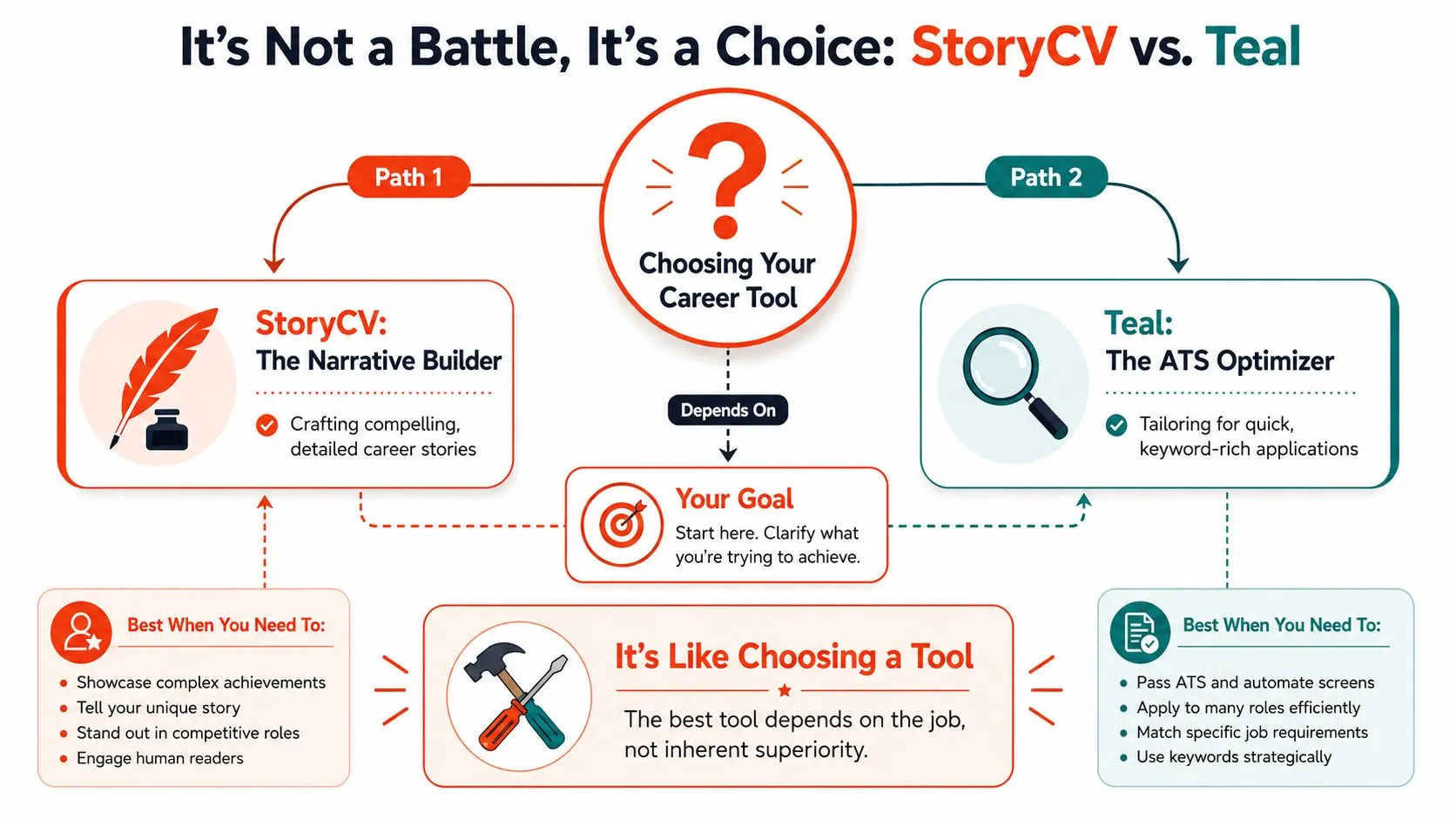
You're not choosing between two equal resume tools. You're choosing between two different jobs-to-be-done. Teal is built like a job-search operating system. StoryCV is built like a digital resume writer that helps you talk through your work and turn it into usable content.
That's why feature-by-feature comparisons miss the point. A tracker, contact manager, and resume customizer solve a different problem than a guided interview that extracts decisions, constraints, and outcomes from your actual work.
The real split
Most professionals fall into one of two camps:
- You already have decent material. Your problem is chaos. Too many roles, too many tabs, too many versions.
- Your material is weak or vague. Your problem is language. You know you did meaningful work, but your bullets sound flat, generic, or just wrong.
That second problem is more common than people admit. People don't need another template. They need help articulating what changed because of them.
Practical rule: If you can talk about your work clearly but can't manage the process, you need workflow help. If you can't explain your impact in writing, you need content help.
This split shows up in other product categories too. Language apps are a good example. Some optimize repetition and drills. Others reduce friction by letting people speak naturally. That's why ChatPal's voice-first approach is a useful analogy here. The interface changes the kind of problem being solved.
Stop looking for a winner
There isn't one universal winner here.
There's only the better answer to your actual bottleneck. If your resume is already solid, Teal can make your search cleaner and faster. If your bullets are thin, keyword-tuning them won't rescue the document.
What Teal Is Actually For
Teal is for the person who wants a command center.
It's positioned as an all-in-one job-search organization platform that combines a contact manager, CRM, and resume-building tool, and it's described as a fit for organized job seekers managing roughly 10 to 50 applications per week in this Teal comparison overview. That tells you what Teal really is. Not a pure writing product. A workflow product.
Teal helps when your search is messy
If your desktop looks like this, Teal makes sense:
- Too many open loops. You've saved roles in different places and forgotten where you applied.
- Too many versions. You're editing multiple resumes and can't remember which one went where.
- Too much admin. Following up, tracking status, and storing contacts is taking more energy than the applications themselves.
Teal is useful when the content foundation is already acceptable and your next problem is throughput with some level of customization.
You don't buy a system like Teal because you're blocked by one sentence. You buy it because your search has turned into operations work.
What its AI is really doing
Teal also includes resume optimization features, but the point isn't deep authorship. The point is faster alignment. It helps users tailor existing content, adjust phrasing, and work against job descriptions inside a broader workflow.
That's valuable. It's just not the same thing as extracting better raw material from your career.
If you're tightening your whole professional presence, this broader LinkedIn guide for career professionals is worth reading alongside your resume work. And if you're comparing AI-assisted builders more broadly, this Wonsulting AI review gives useful context on where builder-style tools help and where they flatten your story.
What StoryCV Is Actually For
StoryCV sits in a different category.
It's described as a guided AI resume writer focused on narrative creation, not job tracking, and it's framed as strongest when “content is the problem” in this resume writer tools comparison. That's the core distinction.
This is for people who are not blocked by organization. They're blocked by articulation.
The blank-page problem is real
Mid-career professionals hit a specific kind of resume paralysis. They've done the work. They've solved difficult problems. They've influenced teams, handled ambiguity, and improved things that weren't working.
Then they open a resume and write this:
- Managed cross-functional projects
- Responsible for operations improvements
- Worked with stakeholders
- Supported strategic initiatives
That language isn't false. It's just useless.
What the guided interview changes
A guided interview changes the input.
Instead of asking you to produce polished bullets from scratch, it asks about the role, the decisions, the constraints, and what changed because of your work. That is a better way to get good resume content out of someone who thinks better by talking than by staring at a blank document.
StoryCV's interview-style workflow is built for exactly that kind of user. Someone whose bottleneck isn't application volume. It's the fact that every bullet they write undersells the work.
The person who benefits here is usually not asking, “How do I make twenty versions faster?” They're asking, “Why does everything I write sound smaller than what I actually did?”
Who this fits best
This approach tends to fit people with less obvious impact on paper:
- Career changers who need to translate past work into a new lens
- Veterans and returners whose experience needs reframing for civilian hiring language
- Mid-level professionals whose contribution involved judgment, tradeoffs, and influence, not just tasks
That's why storycv vs teal is often a false comparison. One tool manages your search. The other helps you finally say something worth sending.
A Side by Side Reality Check
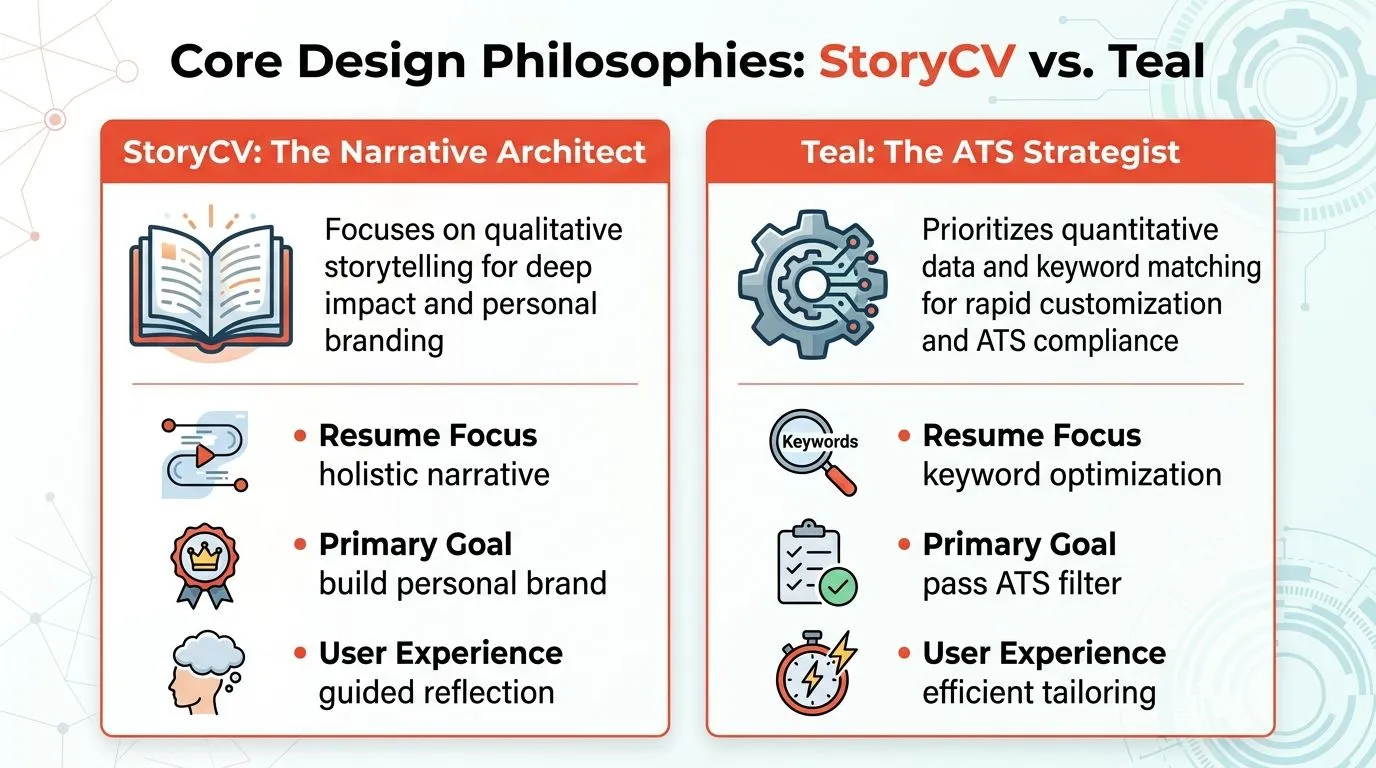
The cleanest way to compare storycv vs teal is to stop comparing features and compare architecture.
Teal is a broader job-search operating system with resume building as one module. StoryCV is a narrative-first resume writer built around a guided interview, as described in this product architecture comparison. That difference shapes everything else.
They start from different assumptions
Teal assumes you already have enough material to work with. Its job is to help you manage the search, align your resume to job descriptions, and keep your applications moving.
StoryCV assumes the opposite. It assumes the material itself is incomplete, vague, or trapped in your head.
That's not a subtle UX difference. It's a completely different philosophy.
| Question | Teal | StoryCV |
|---|---|---|
| Main assumption | You need structure and tailoring | You need help extracting and writing content |
| Core interaction | Builder, tracker, optimizer | Guided interview and narrative drafting |
| Best use case | Multiple active applications with workflow complexity | Strong experience, weak articulation |
| Main output | Managed search plus edited resume versions | Stronger base bullets and summaries |
Their AI is doing different work
This point often confuses people.
AI in Teal is mostly about optimization inside a builder flow. AI in a narrative-first writer is about context extraction and authored language. Those sound similar in marketing copy. They don't feel similar when you use them.
One helps you rewrite what's already on the page. The other tries to uncover what should have been on the page in the first place.
A polished weak bullet is still a weak bullet.
If you want to study how structure affects output quality, even outside resume tools, good templates can still be useful. This collection of best product manager resume templates is a solid example of format helping clarity, but format alone still won't invent strong thinking.
The practical difference in workflow
Here's the simplest contrast.
A Teal user might say, “I'm applying broadly. I need to save jobs, track progress, and tweak my resume against each posting.”
A StoryCV user might say, “I've been stuck on the same role for weeks because I can't describe what I contributed.”
Those are different days. Different frustrations. Different products.
If you want a more direct comparison between narrative-first writing and builder-first workflows, this Rezi vs StoryCV breakdown is useful because it focuses on what happens when the writing itself is the bottleneck.
Example Outputs A Tale of Two Bullets
The easiest way to understand storycv vs teal is to look at output.
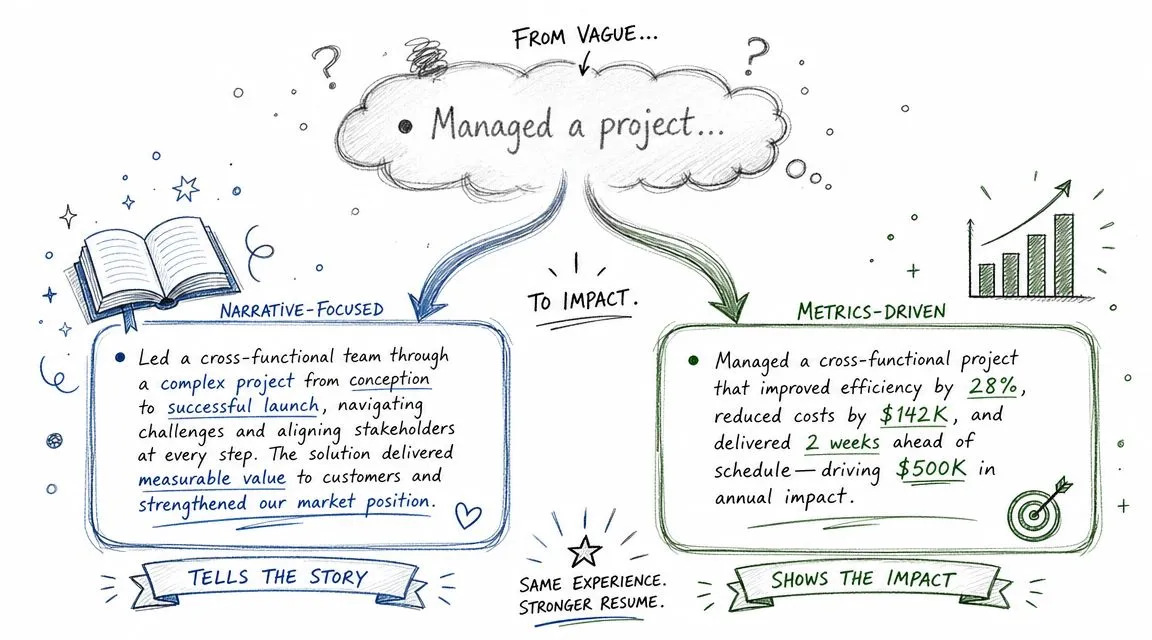
Start with a weak bullet. Not terrible. Just empty.
Original bullet
Managed a project to improve system performance.
That line has the classic resume disease. Motion without meaning.
What a builder-style optimization tends to do
Teal provides tools like a Match Score against job descriptions and AI utilities for rewriting bullets, according to this AI resume tools comparison. So a builder-oriented rewrite might turn that weak bullet into something cleaner and more keyword-aligned.
Teal-style result
Led a cross-functional project to improve system performance, collaborating with stakeholders and supporting operational efficiency.
That is better. The verbs are stronger. The phrasing is more professional. It may align better to a job description.
But it still has a problem. It doesn't tell me what was broken, what you changed, or why anyone should care.
What a guided narrative process tends to do
A guided interview pushes for missing context first. It asks questions like:
- What was going wrong
- Why did this matter
- What did you personally change
- What constraint made it hard
- What improved afterward
Then it drafts from substance instead of polishing a vague sentence.
Narrative-first result
Redesigned a slow internal workflow that was frustrating account teams, clarified handoffs across teams, and made the process more reliable during high-pressure periods.
No invented metric. No fake precision. Just clearer stakes, ownership, and consequence.
Better question: Did the bullet get shinier, or did it get more truthful?
One hypothetical, two very different users
User one already has decent bullets and is applying to a lot of companies. That person should use Teal. Their problem is scale with some customization.
User two has been staring at the same bullet for three weeks because every version feels wrong. That person needs a writing workflow that can pull the core story out through conversation. One option in that category is StoryCV, which uses guided questions to turn role context and outcomes into draft bullets.
If this is your bottleneck, this guide on how to write resume bullet points is worth reading before you obsess over templates.
The Verdict Which Problem Do You Have
This is simpler than the marketing makes it look.
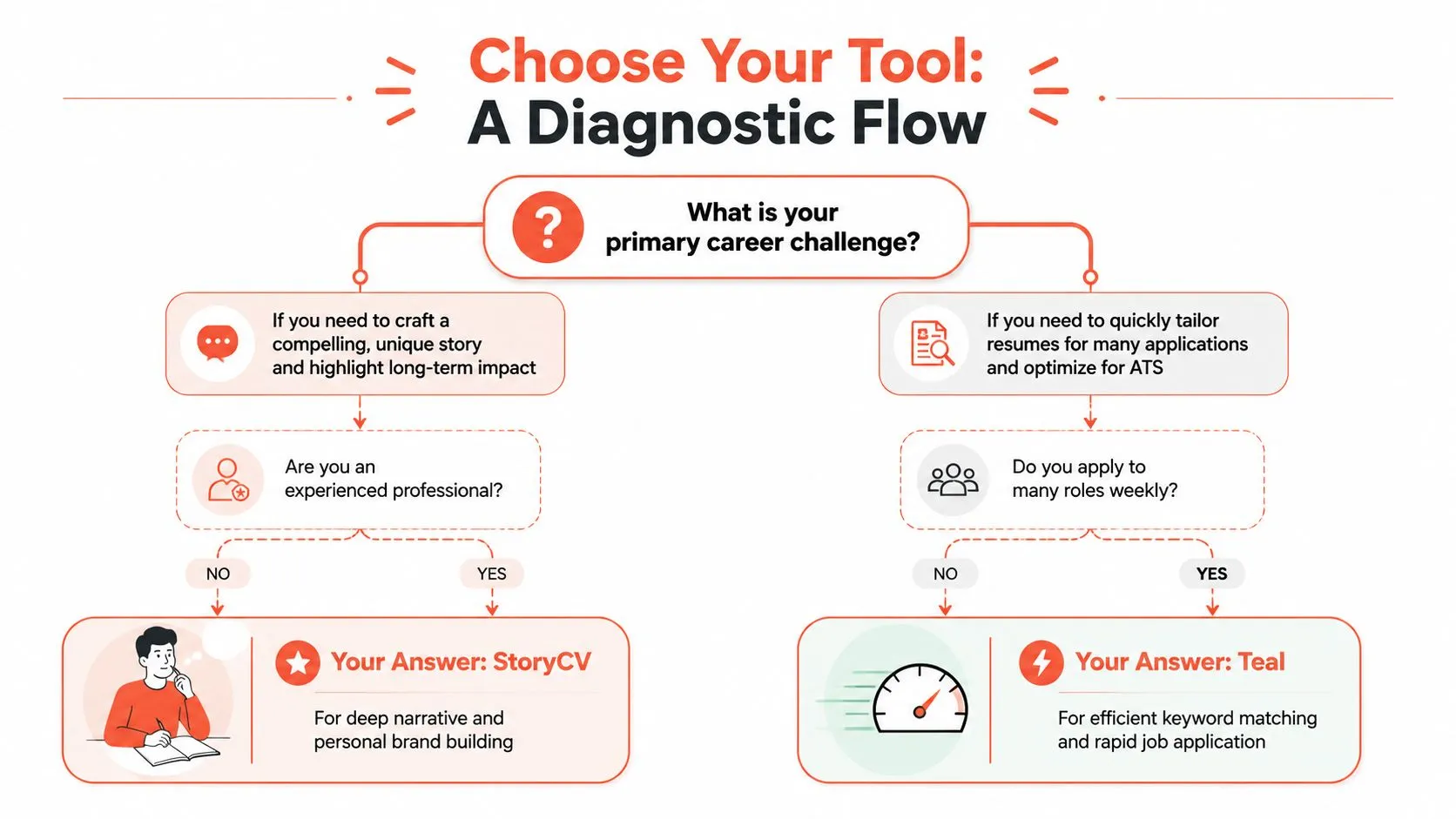
The actual choice is not “Which tool wins?” The actual choice is “Where am I stuck?”
Pick Teal if your pain is process
Use Teal if these sound like you:
- You're managing lots of active applications. You need one place for jobs, contacts, and status.
- You already have a solid base resume. It may need tailoring, but it doesn't need to be rebuilt from the ground up.
- You care about search discipline. You want a repeatable system more than a writing partner.
Pick StoryCV if your pain is content
Use StoryCV if these sound like you:
- Your bullets are the problem. You've done strong work, but the language on the page feels generic or incomplete.
- You think better by talking. A guided interview is easier than forcing polished prose from scratch.
- You're applying selectively. You'd rather send fewer, stronger stories than spray out weak versions.
A useful framing from this comparison of resume and job-search tools is whether you gain more from managing roughly 10 to 50 applications carefully or from producing fewer, stronger role-specific stories. That's the decision.
The honest answer for many people
A lot of mid-career job seekers don't need to choose forever.
They need one tool to get the story right and another tool to manage the search. If your content is weak, start there. No amount of tracking fixes bad bullets. Once the content is strong, a workflow tool becomes a lot more useful.
Frequently Asked Questions
Can I use StoryCV and Teal together
Yes. That's often the most sensible setup.
Use a narrative-first writer to build stronger core bullets and summaries. Use Teal to organize jobs, track applications, and tailor versions as needed. Write first. Systemize second.
Which one is better for career changers
Usually the narrative-first option.
Career changers often don't need more formatting help. They need help translating past work into language that fits a new role. A guided interview is better for that than a builder that assumes your content is already in decent shape.
What about data privacy
Treat both like software that holds sensitive career information. Read each product's privacy terms before uploading anything important.
The practical rule is simple. Don't assume all AI tools handle data the same way. Check what they store, what they retain, and what controls you have over your information.
If your resume problem is that the words on the page still don't sound like your actual work, StoryCV is built for that specific bottleneck. It's a digital resume writer that uses a guided interview to help you turn real experience into stronger bullets before you worry about managing the rest of the search.