Most advice on how to talk about your work is bad. It tells you to “be confident” and “sell yourself” while also warning you not to brag. That's useless. It gives you two bad options: sound inflated, or disappear.
There's a better way. Confidence is not a personality trait. It's a writing skill. The people who sound confident usually aren't performing confidence. They're describing the work clearly. The people who sound braggy are usually describing themselves.
That difference matters on a resume, in interviews, in a Slack intro, and when someone asks what you do.
The Confidence Trap Why Most Advice Fails
The usual advice says you need more confidence. No. You need better sentence structure.
It is often thought that the choice is between modesty and arrogance. It isn't. Both are self-focused. One says, “I'm amazing.” The other says, “It was nothing.” Neither tells me what happened, what you did, or why it mattered.
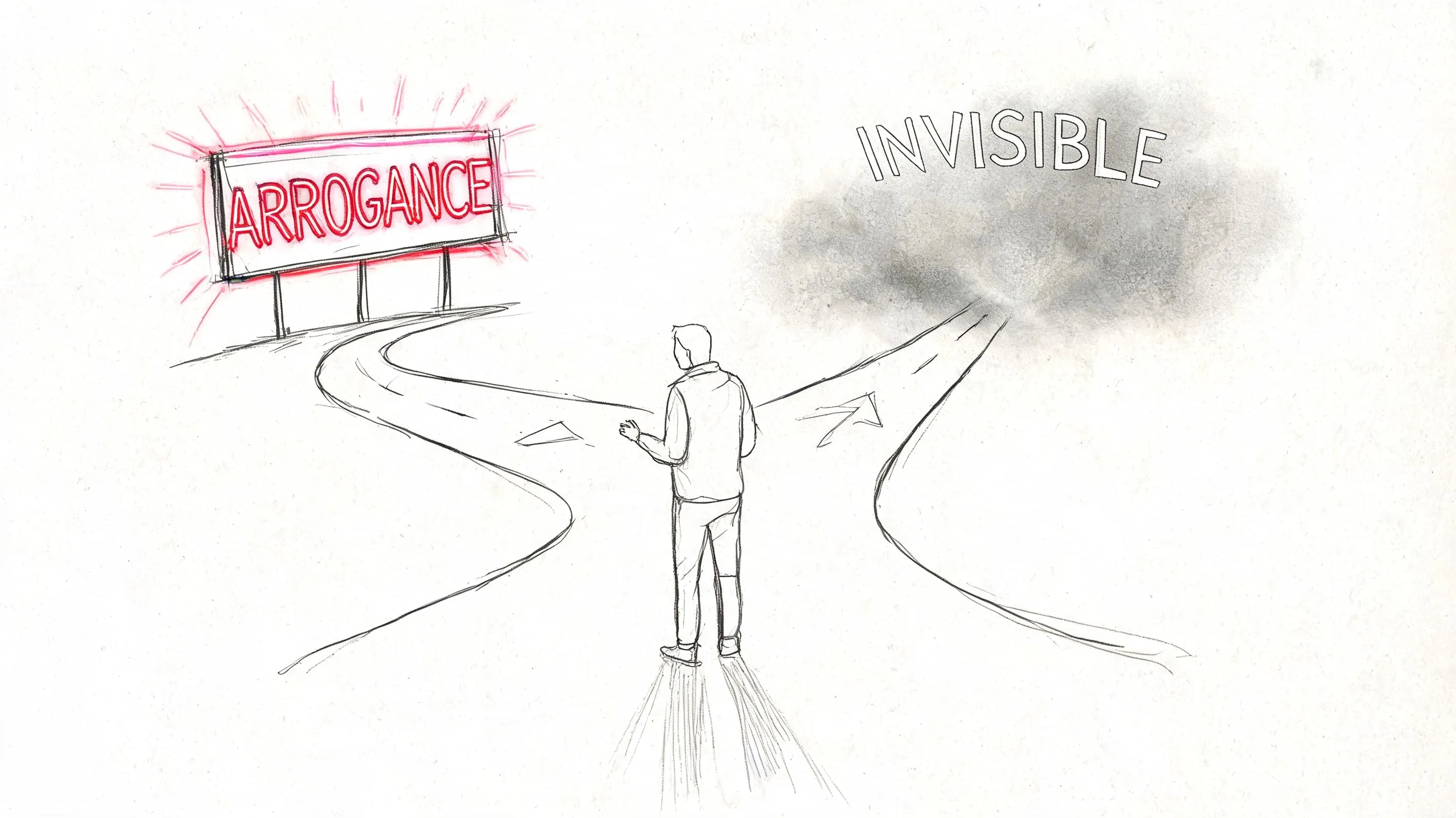
What self-focused language sounds like
You've seen this stuff before:
- “Passionate about…” This says nothing anyone can verify.
- “Results-driven” Fine. Show the result.
- “Strategic thinker” According to who.
- “Self-starter” Everyone writes this. It means nothing.
These phrases fail for a simple reason. They ask the reader to accept your self-image. That's weak evidence.
The confident version describes the work. The braggy version describes the person.
A hiring manager or colleague doesn't need your personality slogan. They need a clear account of what changed because you were there.
That's especially important because work itself is already measured in outcomes. One workplace summary notes that workers spend 8.5 hours per week on administrative work and 50% of work time on repetitive tasks, which is exactly why employers care about what you improved, automated, or saved, not just what sat on your plate (workplace trends on measurable contribution).
Why modesty can hurt you just as much
A lot of capable people hide behind understatement. They say things like:
- “I just helped out on the rollout.”
- “I was kind of involved.”
- “The team did it.”
Maybe that's emotionally safer. It's also how less capable people end up sounding more impressive than you.
If this feels familiar, read StoryCV's piece on imposter syndrome on your resume. The pattern is common. Good people erase themselves by refusing to state plain facts.
Shift Your Focus From Yourself to the Work
Stop trying to sound impressive. Make the work legible.
That's the whole job.
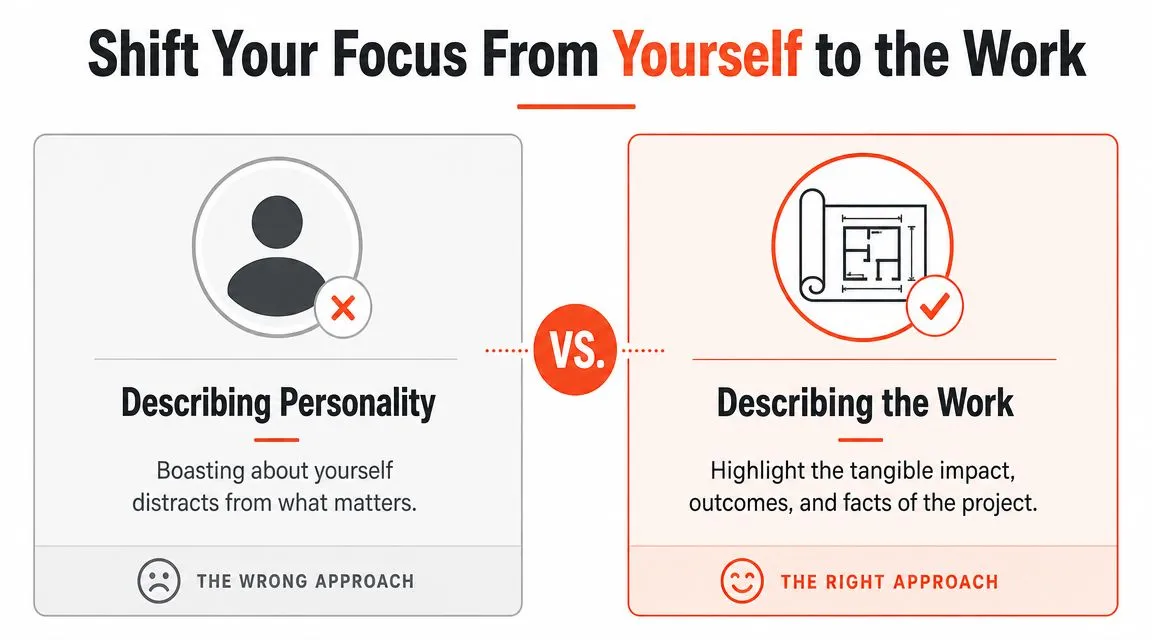
The clean test
Here's the fastest way to tell if your writing works:
| Weak version | Strong version |
|---|---|
| Makes a claim about you | Describes the work |
| Uses labels | Uses facts |
| Sounds polished but empty | Sounds specific and credible |
| Can't be checked | Could be verified by a colleague |
That's why this line works:
I rebuilt the onboarding flow after the old version wasn't converting, and we moved activation from 22% to 31%.
And this line doesn't:
I'm a results-oriented operator who consistently drives transformational outcomes.
The first one is grounded. The second one is costume jewelry.
One project, two different voices
Same person. Same project. Totally different effect.
Self-focused version
I'm a strategic product leader with a strong ability to align cross-functional teams and deliver high-impact initiatives. I took ownership of onboarding and drove a transformational improvement in user activation.
Work-focused version
New users were dropping off during onboarding. I reviewed the flow, removed steps that were creating friction, and worked with design and engineering to ship a simpler version. Activation moved from 22% to 31%.
See the difference? The second version doesn't need to say “strategic.” The decisions make that obvious.
What to write instead of trait words
If you're about to write a trait, replace it with one of these:
- What was happening when you got involved
- What decision you made
- What alternative you rejected
- What constraint mattered
- What changed in the end
That's how you talk about your work without sounding arrogant. You remove the personality claims and keep the evidence.
Practical rule: If a former coworker could nod and say, “Yes, that's exactly what happened,” you're probably doing it right.
A Simple Framework for Describing Your Work
You don't need a giant framework. You need three moves: Context, Action, Result.
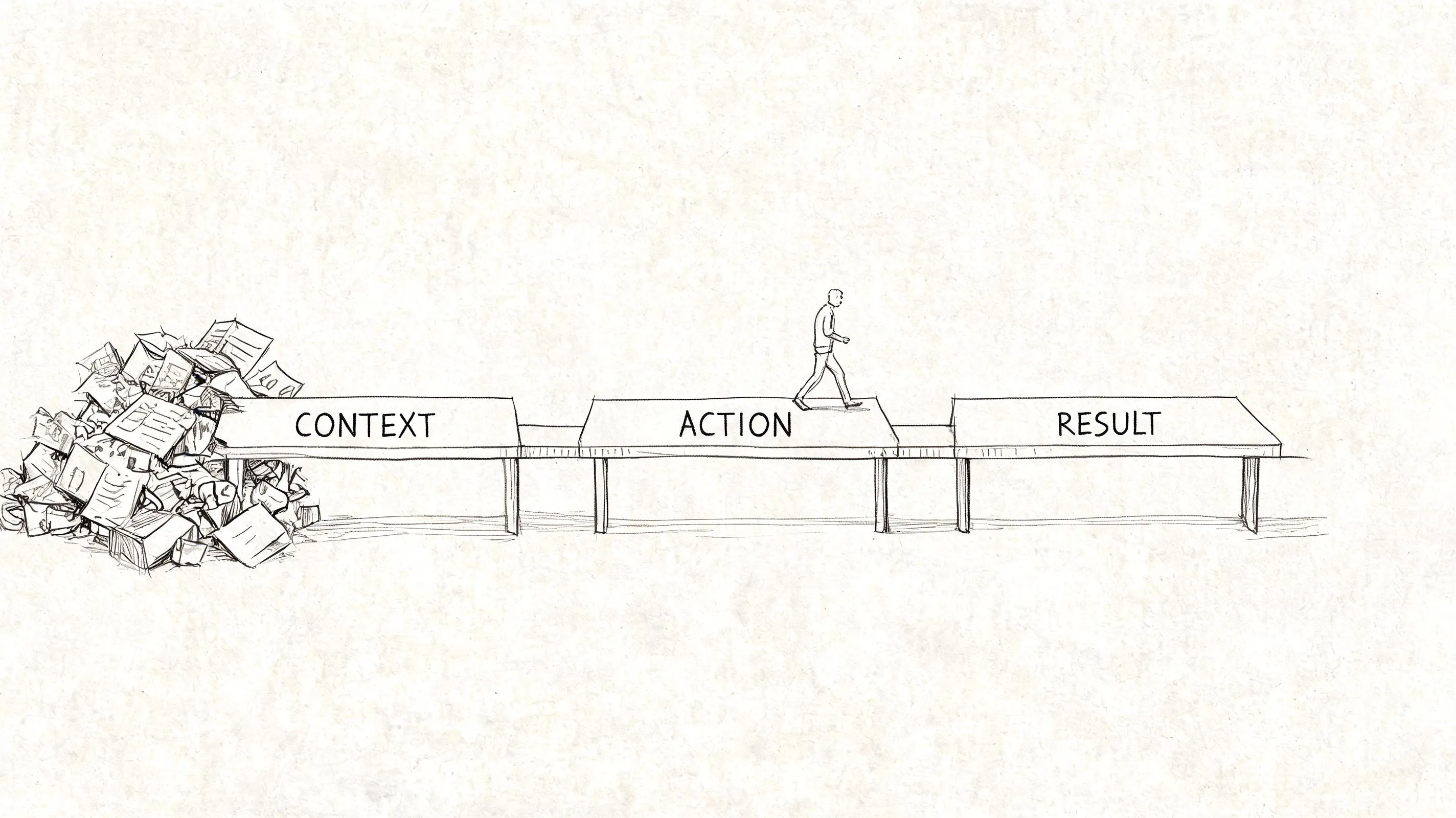
Use Context Action Result
Context
What was going on? What was messy, slow, broken, unclear, late, risky, or stuck?
Action
What did you do? Not “supported” or “assisted.” What decision did you make, what system did you change, what conversation did you lead, what process did you redesign?
Result
What changed? Use numbers if you have them. If you don't, describe the shift plainly.
Here's a software example.
-
Weak
Responsible for improving internal reporting processes. -
Strong
Monthly reporting took days because teams pulled numbers from different spreadsheets. I built a single reporting workflow in Looker and standardized the inputs with finance and ops. Leadership got one consistent view instead of three conflicting ones.
If you want help tightening bullets like that, StoryCV's guide on how to write impact statements is useful.
Why structure matters now
Your story has to work in multiple places. A hiring manager hears it live. An ATS scans it. A recruiter skims it. That's why a structured narrative matters. It needs to be credible to both humans and machines, especially as AI now sits inside both hiring and job search workflows (why the narrative must work across chat, profile, and ATS contexts).
If you work at senior levels, it also helps to understand executive branding as a core function. Not in the cringe sense. In the sense that people need a coherent explanation of how you think and what kind of problems you solve.
A short example helps more than theory. Watch this, then rewrite one bullet of your own in the same spirit.
How to Adapt Your Story for Any Context
You don't need five different stories. You need one core story told at different lengths.
Career paths are messier than people admit. Job switching remains high and career changes are more common, which is exactly why people need a way to frame scope, outcomes, and value without sounding scripted (why non-linear work histories need better framing).
One story in three formats
Take this core story:
You inherited a chaotic onboarding process, simplified it, and improved activation.
Now adapt it.
Interview answer
“When I joined, onboarding had too many steps and users were dropping before they reached the core feature. I reviewed session data, identified the worst friction points, and worked with design and engineering to remove unnecessary fields and reorder the flow. After launch, activation moved from 22% to 31%. What mattered most was deciding not to add more education screens, even though that was the default suggestion.”
Resume bullet
Redesigned user onboarding flow by removing friction points and aligning design and engineering on a simpler path, increasing activation from 22% to 31%.
Networking intro
I work on messy product problems. One recent example was onboarding. We simplified the flow and got a clear lift in activation.
If the work wasn't glamorous
People often freeze at this point. They think, “My job was boring,” or “I'm not proud of that role.”
Doesn't matter. Describe the reality of the work.
Try this angle:
- State the environment you were operating in
- Name the constraint you had to work under
- Show the judgment you used
- Pull out the transferable value
Example:
Bad
Worked in a legacy support role and handled tickets.
Better
Inherited a high-volume support queue with inconsistent triage and incomplete documentation. I standardized response paths for recurring issues and flagged product bugs that kept reappearing. That work reduced confusion internally and gave engineering clearer patterns to fix.
That's credible. No fake glamour needed.
If you're polishing the surrounding profile too, details matter there too. A sharp photo helps more than people think, and this guide on LinkedIn headshot specs is practical without being fussy.
For interview versions of the same story, StoryCV's article on how to answer for tell me about yourself is worth reading.
If the story is true, specific, and adapted to the context, it won't sound rehearsed. It will sound prepared.
A 3-Point Checklist Before You Hit Send
Before you send the resume, post the update, or answer the interview question, run this filter.
1. Does it describe the work or describe you
Cut the adjectives about your character. Keep the nouns and verbs tied to the work.
Bad: “I'm a highly motivated leader.”
Better: “I led the rollout after the original launch plan stalled.”
2. Could a former colleague verify it
If the sentence sounds like branding copy, rewrite it until someone who worked with you could confirm it without squinting.
Quick check: Would an ex-colleague say, “Yep, that happened,” or would they ask what on earth you mean?
3. Does it answer so what
Activity is not impact.
“Managed stakeholder communication” is activity.
“Kept finance, legal, and ops aligned during a vendor migration so the rollout didn't slip” starts to answer the obvious question.
That's the standard. Not louder. Not humbler. Clearer.
StoryCV is a Digital Resume Writer that uses a guided interview to help you describe your work in terms of context, decisions, and outcomes. If you've done solid work but hate writing about yourself, that's useful. It gives you editorial judgment at software speed, without forcing you into dead template language.