You wrote a bullet that's true. The launch shipped. The process got fixed. The team got better. Then you reread it and feel a little sick.
It sounds inflated. Not false. Just wrong.
I know that feeling well. I've written about my own work, stared at the screen, and wondered whether I was describing reality or dressing it up. The instinct is usually to make it smaller. Strip the result. Add softer verbs. Hide behind “supported” and “assisted.” That usually makes the resume worse, not more honest.
What gets called an imposter syndrome resume problem is often a writing problem. Senior people hate self-promotion for a reason. Real work is messy, shared, political, delayed, revised, and full of tradeoffs. Resume bullets flatten all of that into one neat sentence. If the sentence makes a big claim without the context that earns it, of course it feels fake.
Your Resume Feels Wrong and It's Not Your Fault
You are not broken because a strong bullet feels uncomfortable.
A lot of smart professionals assume that discomfort means they lack confidence. I think that diagnosis is lazy. Often, the discomfort is rational. You know the bullet is skipping the hard part. It states the conclusion without showing the path.

That's why “just be more confident” is bad advice. A 2026 survey on workplace impostor syndrome found that 43% of workers experience imposter syndrome, 66% feel pressured to project more confidence than they have, 58% say it has negatively affected career growth, and 7% have turned down major opportunities because they felt unqualified. This is not some niche mindset issue. It's common, and it shapes how people present themselves.
The bullet is often the problem
A resume bullet asks you to make a first-person achievement claim in a compressed format. High-achievers usually don't think that way. They remember the uncertainty, the dependency on other teams, the bad assumptions, the half-failed draft, the workaround nobody saw.
So when the bullet says:
-
Led strategic initiative that improved operations
-
Drove key product launch
-
Managed high-performing team
you react like a sane person. Those lines sound like verdicts, not evidence.
A bullet can be true and still feel dishonest if it floats above the facts.
Stop treating overthinking like the enemy
Sometimes you are overthinking. Sometimes you are noticing a real flaw in the writing. Those are not the same thing.
If your brain spirals after every draft, this guide on how to stop overthinking and worrying is useful because it helps separate looping thought from actual problem-solving. And if you've ever struggled to name your work clearly, this breakdown on why it's hard to describe your accomplishments gets at the core issue.
What you need isn't more swagger. You need a bullet that can survive scrutiny.
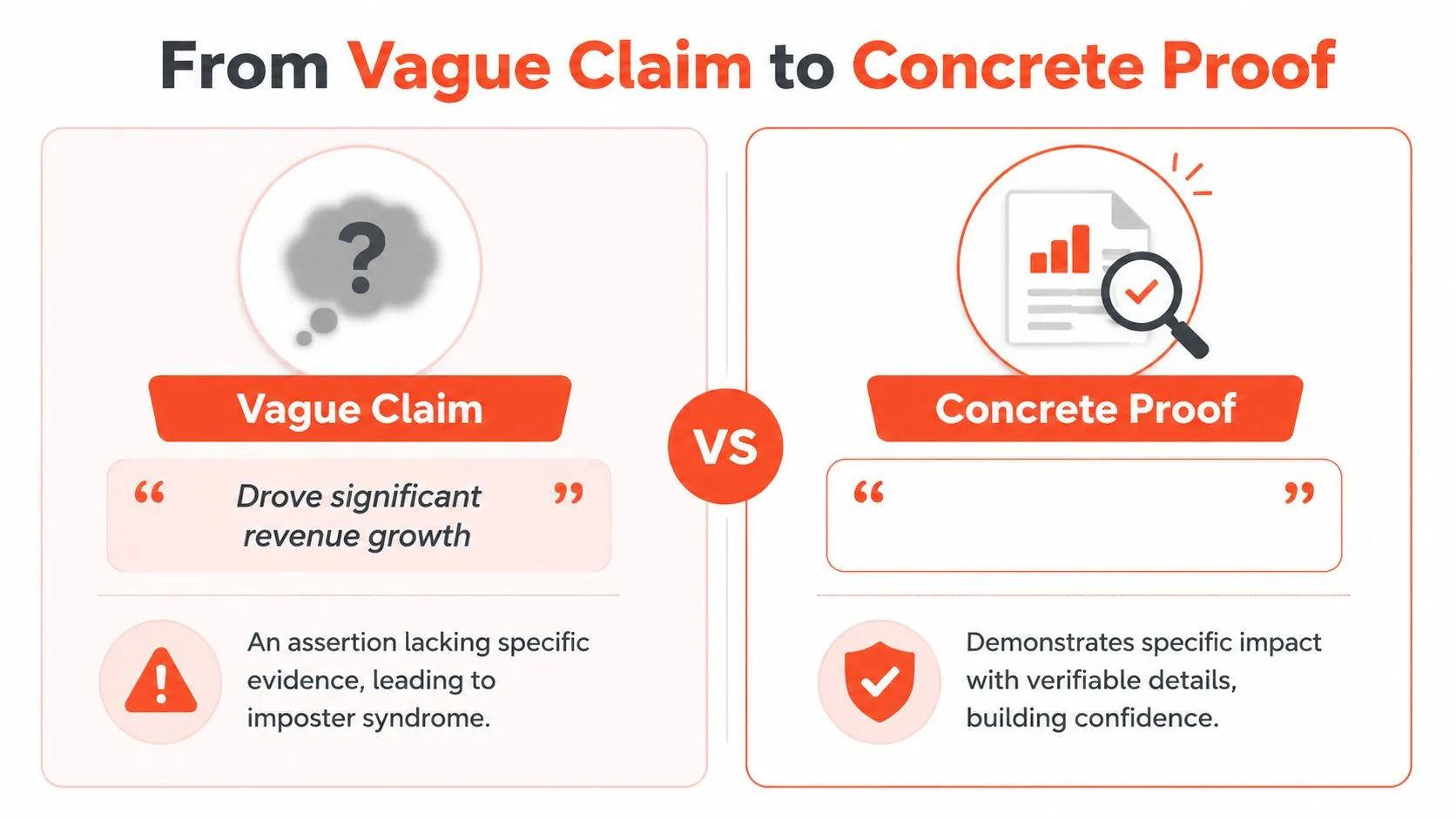
From Vague Claim to Concrete Proof
Most imposter syndrome resume advice tells you to stop minimizing yourself. Fair enough. But it skips the craft issue.
A bullet feels like bragging when it makes a judgment call for the reader. It tells them what to think, instead of showing what happened.
What makes a bullet feel fake
Here are the usual offenders:
| Weak bullet style | Why it feels wrong |
|---|---|
| Big adjective | “Exceptional,” “transformational,” “strategic” ask the reader to trust your self-rating |
| Empty business verb | “Led,” “managed,” “owned,” “drove” can mean almost anything |
| Outcome with no setup | The result appears, but the constraint, decision, and change are missing |
| Group success presented as personal glory | You know other people were involved, so the line feels slippery |
The fix is simple, but not easy. Stop writing verdicts. Start writing evidence.
A better structure
Use this pattern:
Starting state + action you took + what changed
That structure works because it mirrors how serious professionals think. Not “I'm amazing.” More like “Here's the messy situation, here's what I decided, here's what moved.”
Before and after examples
Before
-
Drove significant revenue growth
-
Led cross-functional collaboration
-
Improved deployment efficiency
-
Managed team performance
After
-
Reworked pricing and onboarding for a stalled product line, which reopened expansion conversations and increased account growth
-
Coordinated product, ops, and sales through a delayed launch after scope changed mid-cycle, keeping release decisions aligned across teams
-
Rebuilt the deployment process after repeated release friction, cutting release cycles from three weeks to five days
-
Reset team workflows after two missed deadlines, clarified ownership, and got delivery back on track
Notice what changed. The stronger versions don't sound “humble.” They sound grounded.
Practical rule: If a bullet could apply to a thousand other candidates, it's too vague.
Show your decisions, not your self-esteem
A hiring manager doesn't need your internal confidence. They need enough detail to believe the claim.
That's also why a lot of generic tech resume advice falls short. The useful part of crafting winning tech resumes is the push toward specifics, not slogans. The strongest bullets make your judgment visible. They show what broke, what you changed, and why it mattered.
If a bullet still feels like a lie, don't make it softer. Make it more legible.
How to Mine Your Work for Real Evidence
Don't rely on memory. Memory is biased, selective, and weirdly cruel.
If you sit down and try to “remember your achievements,” your brain will usually hand you the cleanest, flattest summaries. That's exactly the material that produces a weak imposter syndrome resume. You need raw evidence, not polished self-description.

Do career forensics
Open the stuff you normally ignore:
-
Calendar history to find launches, reviews, audits, incident calls, hiring loops
-
Slack or Teams threads to spot problems you resolved and decisions you influenced
-
Project docs like PRDs, post-mortems, status notes, and kickoff decks
-
Performance reviews because other people often remember your impact better than you do
-
Old job descriptions to compare what the role was supposed to be with what you ended up doing
This is not journaling. It's evidence collection.
A Rutgers-cited study on data analysts found that systematically logging accomplishments weekly reduced imposter feelings in 68% of participants, with a 40% drop in resume revision rates and a 22% increase in interview callbacks. That tracks. When the proof is sitting in front of you, you stop rewriting the same vague bullet for the tenth time.
Use STAR like a thinking tool
STAR is useful. Not as a rigid resume formula. As a way to recover missing context.
Ask these four questions:
-
Situation
What was broken, late, unclear, underperforming, growing too fast, or politically sensitive? -
Task
What were you responsible for? Not the team. You. -
Action
What decision did you make, what process did you change, what did you build, cut, rewrite, renegotiate, or unblock? -
Result
What changed afterward? Speed, quality, cost, risk, alignment, throughput, adoption, stakeholder trust?
That sequence stops you from writing puffed-up claims because it forces the sentence to earn itself.
For a more tactical breakdown, this guide on how to write achievements in a resume is worth reading.
A quick explainer helps if STAR feels too rigid in your head:
This matters even more in non-linear careers
Career changers, returners, and veterans often get hit hardest here. Not because they lack evidence. Because they discount it.
A veteran may describe real leadership as “supported operations.” A returner may bury strong earlier work because the timeline feels awkward. A career changer may hide transferable decision-making because it doesn't map neatly to the new title.
The trick is not to force your past into the new role's language too early. First document what you actually handled. Translation comes after.
The Language of Impact That Feels Honest
Once you've got the evidence, the phrasing gets easier. Not easy. Easier.
The standard advice is to use stronger verbs. That's incomplete. Stronger verbs alone create louder nonsense. What you want is precise language. Verbs that point to real action. Nouns that point to real systems. Results that point to visible change.
Swap the verdict for the scene
Here's the difference.
-
Instead of “Experienced leader who drove transformational results”
Write “Took over a team after two missed deadlines, reset delivery ownership, and restored a predictable release schedule” -
Instead of “Managed critical projects across stakeholders”
Write “Coordinated engineering, ops, and finance on a pricing rollout with conflicting requirements and got signoff without delaying launch” -
Instead of “Excellent communicator”
Write “Wrote the decision memo that aligned product and sales after a disputed scope change” -
Instead of “Improved team efficiency”
Write “Removed duplicate approval steps from the intake process so work moved faster from request to execution”
Useful micro-prompts
When a bullet feels puffy, ask:
-
What was the mess?
-
What did I change personally?
-
What decision would not have happened without me?
-
What got faster, clearer, safer, cheaper, or less chaotic?
Those questions force concrete language.
A small rewrite table
| If you wrote this | Try this instead |
|---|---|
| Led | Rebuilt, aligned, launched, reset, negotiated, clarified |
| Responsible for | Handled, owned the decision on, ran, reviewed, delivered |
| Worked on | Shipped, audited, migrated, implemented, redesigned |
| Improved | Cut, reduced, increased, stabilized, simplified |
Writing test: If the bullet sounds like a recommendation letter, rewrite it. If it sounds like a work record, keep it.
This is the same reason strong personal positioning matters outside the resume too. A good personal branding tool can help you tighten how you describe your work, but the principle stays the same. Don't announce that you're impressive. Describe what happened in a way that makes the conclusion obvious.
If you want more examples of this style, this guide on how to write impact statements is useful.
Let a Guide Ask the Right Questions
Most AI resume products make this worse.
They ask for a title, some responsibilities, maybe a few keywords, then generate polished filler. The result sounds competent in a generic way and alien in a personal way. That's where a lot of “AI imposter syndrome” comes from. You read the draft and think, “This sounds too clean, too broad, too fake. I can't defend any of it.”
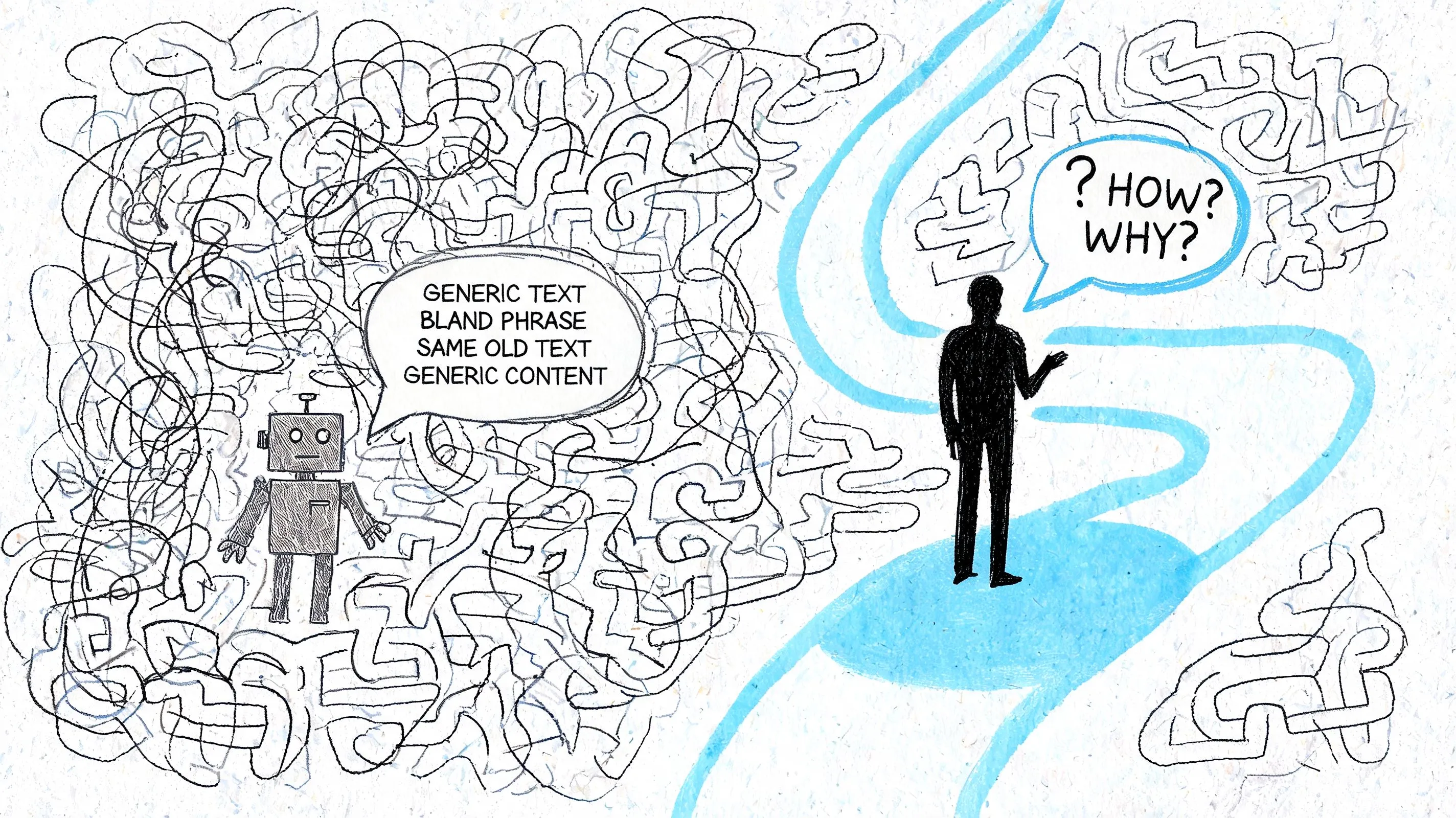
A better system doesn't start with bullets. It starts with questions.
Not “What did you achieve?” That's too abstract. Better questions are narrower. What was going wrong? Who disagreed? What changed after your decision? What metric, workflow, handoff, or risk profile moved because you stepped in?
That approach lines up with the evidence on guided AI. A 2025 survey on AI imposter syndrome and resume confidence found that professionals using guided AI interviews reported 62% higher confidence in their resumes than those using generic template tools. That makes sense. A guided system acts like a memory jogger and editor, not a hype machine.
The best resume help doesn't flatter you. It interrogates the work until the proof shows up.
That's the proper fix for an imposter syndrome resume problem. Not fake confidence. Not softer bullets. Better extraction. Better evidence. Better writing.
If you want that kind of help, StoryCV is built for it. It's a Digital Resume Writer, not a template library. Instead of asking you to invent polished bullets from scratch, it guides you through a smart interview, pulls out the decisions and context that matter, and turns them into clear, defensible resume language. If your work is real but your resume still feels off, this is the faster way to make it read true.