You opened a blank doc. You typed your name, your last job title, maybe the company. Then nothing.
You’re not lazy. You’re not bad at writing. You’re stuck because you’re trying to write before you’ve decided what the work meant.
That’s the core problem with most resume advice. It treats your resume like a wording task. Polish the bullets. Use stronger verbs. Follow STAR. Match keywords. Fine. None of that helps if you still haven’t answered the only question that matters: what changed because you were there?
If you’ve been postponing your resume for weeks, this is probably why.
The Blank Page Is Not Your Fault
The blank page shows up after a very specific mistake. You started drafting before reflecting.
That sounds obvious, but this step is often overlooked. They open a doc and expect language to appear on command. Then they blame themselves when all they can produce is “Managed cross-functional projects” and “Worked with stakeholders.”
That isn’t a writing failure. It’s missing raw material.
Most resume advice solves the wrong problem
“Just start writing” is bad advice when you don’t know what you’re trying to say.
“Use STAR” is also incomplete. STAR helps organize a story. It doesn’t help you find one. If your memory of a role is still a blur of meetings, deadlines, and Slack messages, a framework won’t save you.
Recruiters spend only 6-8 seconds on an initial resume review, according to Boston University Questrom’s guide to crafting your professional story. That’s exactly why career reflection before resume writing matters. You do not get time to “warm up” on the page.
Practical rule: Don’t draft bullets until you can explain your role out loud like a human, not like an HR system.
If you’ve ever written a decent self-review, you’ve already felt this difference. The useful part isn’t the final wording. It’s the thinking you do before the wording. That’s why this guide on writing a self-assessment for a performance review tends to lead to stronger resume material too.
The freeze is a symptom
You don’t freeze because your career is unimpressive.
You freeze because your work lives in fragments. Half-remembered projects. Decisions you made under pressure. Problems you solved so routinely that you forgot they were hard. Reflection pulls those fragments into shape. Then writing gets easy.
The page isn’t blank because you have nothing to say. It’s blank because you haven’t excavated the story yet.
Your Job Description Is a Trap
The fastest way to ruin a resume is to copy your old job description and start paraphrasing it.
People do this because it feels productive. You already have the text. It sounds official. It covers your responsibilities. It also strips out everything that made your work yours.
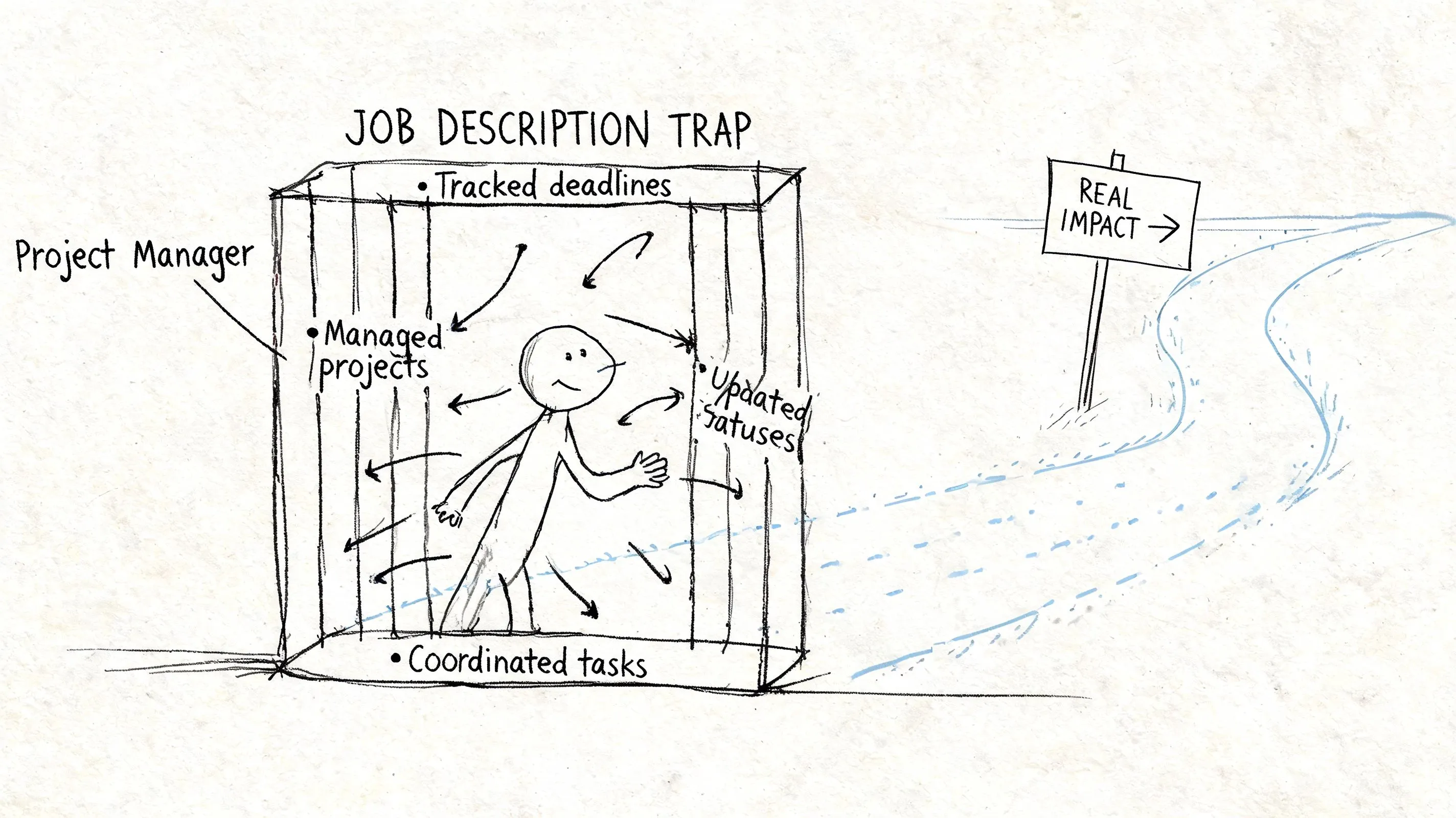
A job description describes the role. Your resume has to describe your impact inside the role. Those are different documents.
Dead bullets come from borrowed language
Here’s the trap in plain English.
| What you copy from the job description | What belongs on the resume |
|---|---|
| Responsible for managing project timelines and stakeholder communication | Built a reporting rhythm that gave leaders earlier visibility into blocked work and made handoffs cleaner |
| Oversaw cross-functional collaboration | Got design, engineering, and operations aligned on one launch sequence after repeated delays |
| Improved team processes | Replaced a messy approval path with a simpler one people actually used |
The left column is accurate. It’s also dead.
The right column starts to sound like a person who did something.
A concrete example
Let’s use a hypothetical project manager.
If they copy the job description, they write this:
- Generic bullet: Managed project timelines, coordinated stakeholders, and supported delivery across cross-functional teams.
Technically true. Also interchangeable with thousands of other project managers.
If they reflect on the role, they might remember this:
- Leadership kept getting surprised by delays.
- Weekly status meetings wasted time and still didn’t surface real blockers.
- They created a simpler dashboard, changed the update cadence, and pushed teams to flag risk earlier.
- After that, conversations got sharper and decisions happened sooner.
Now the bullet has a pulse:
- Reflected bullet: Reworked project reporting so teams surfaced blockers earlier and leaders made decisions with less back-and-forth.
No fake drama. No buzzwords. Just actual change.
According to Flair’s resume statistics roundup, 81% of job seekers don’t quantify achievements. That matters because the people who skip reflection also skip evidence. They default to duties because duties are easier to remember than outcomes.
Your resume should not read like “what someone in my role was supposed to do.” It should read like “what I actually moved.”
If you have numbers, use them. If you don’t, don’t invent them. But don’t hide behind generic language either. A clear before-and-after is already stronger than recycled HR text.
The One Question to Unlock Your Story
The best question I know is brutally simple:
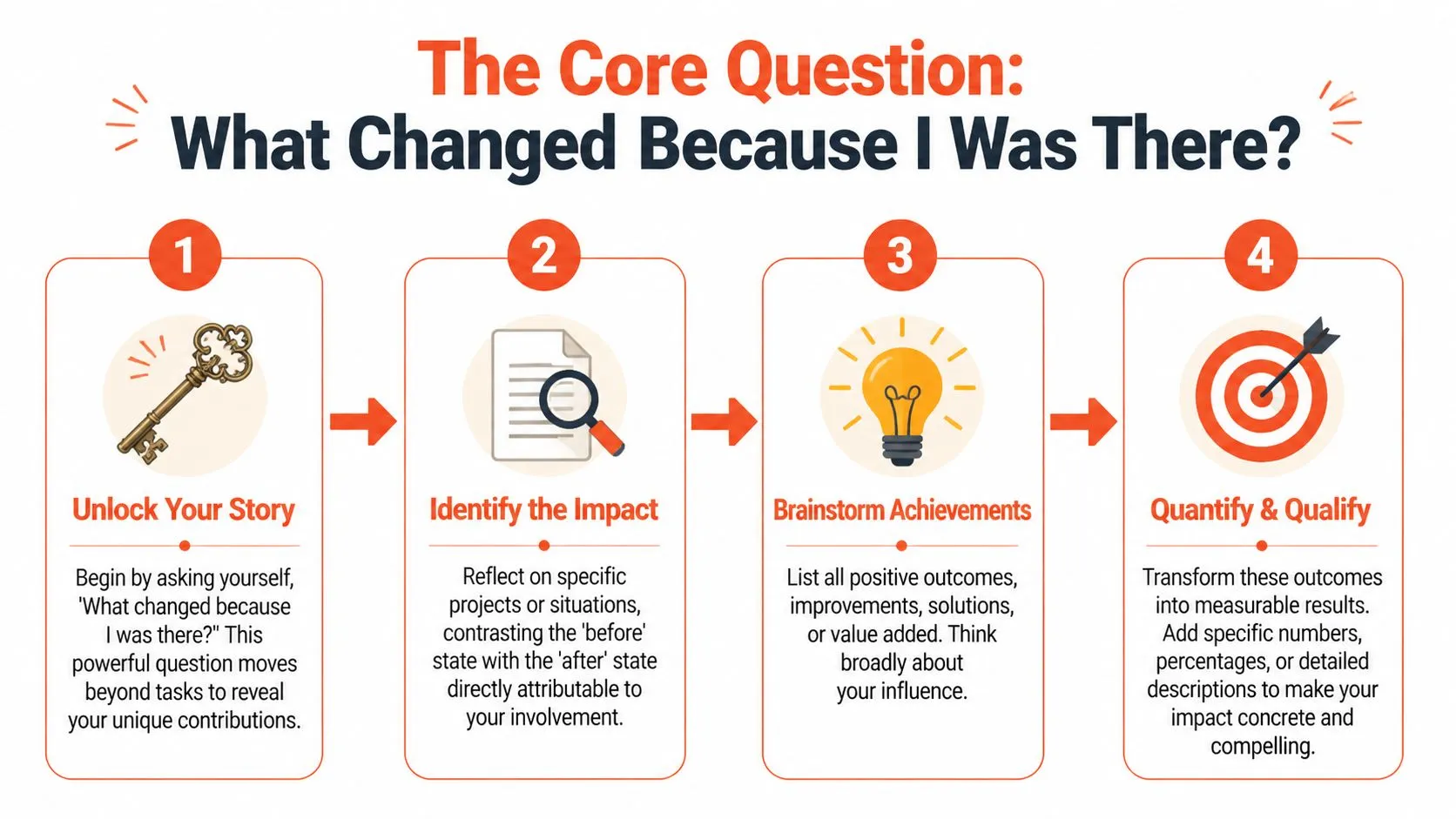
What changed because I was there?
That’s the question many avoid because it’s uncomfortable. It forces you to separate yourself from the team, the department, and the official scope of the role. It asks what shifted because of your judgment, your persistence, your decisions, your follow-through.
That discomfort is useful.
Why this question works
It stops you from narrating activity.
Job seekers often answer resume prompts with motion. Attended. Supported. Helped. Participated. Collaborated. Those words describe presence, not impact.
“What changed because I was there?” forces contrast. Before you. After you. Problem. Intervention. Result.
This is especially important for people with non-linear paths. For career changers and people translating transferable experience, reflection is what turns soft skills into credible narrative, as noted in Industry Connect’s piece on reflection and reassessing your career path.
Here’s the visual version of that shift.
Better prompts than “tell me about your responsibilities”
Ask sharper questions.
- What fire did you put out that other people were tolerating?
- What broken process did you fix because you got tired of watching it waste time?
- What decision did you push through that changed how the team worked?
- What problem kept landing on your desk because people trusted you to handle it?
- What became easier, faster, cleaner, calmer, or more reliable after your involvement?
A career changer can use the same logic.
Someone moving from teaching into customer success shouldn’t write, “Responsible for lesson planning and classroom management.” They should reflect harder: de-escalated conflict, explained complex information clearly, built trust fast, tracked progress across competing needs, adapted communication for different audiences. That’s the material.
Ask not what your title covered. Ask what your presence altered.
Once you answer that honestly, you stop sounding generic.
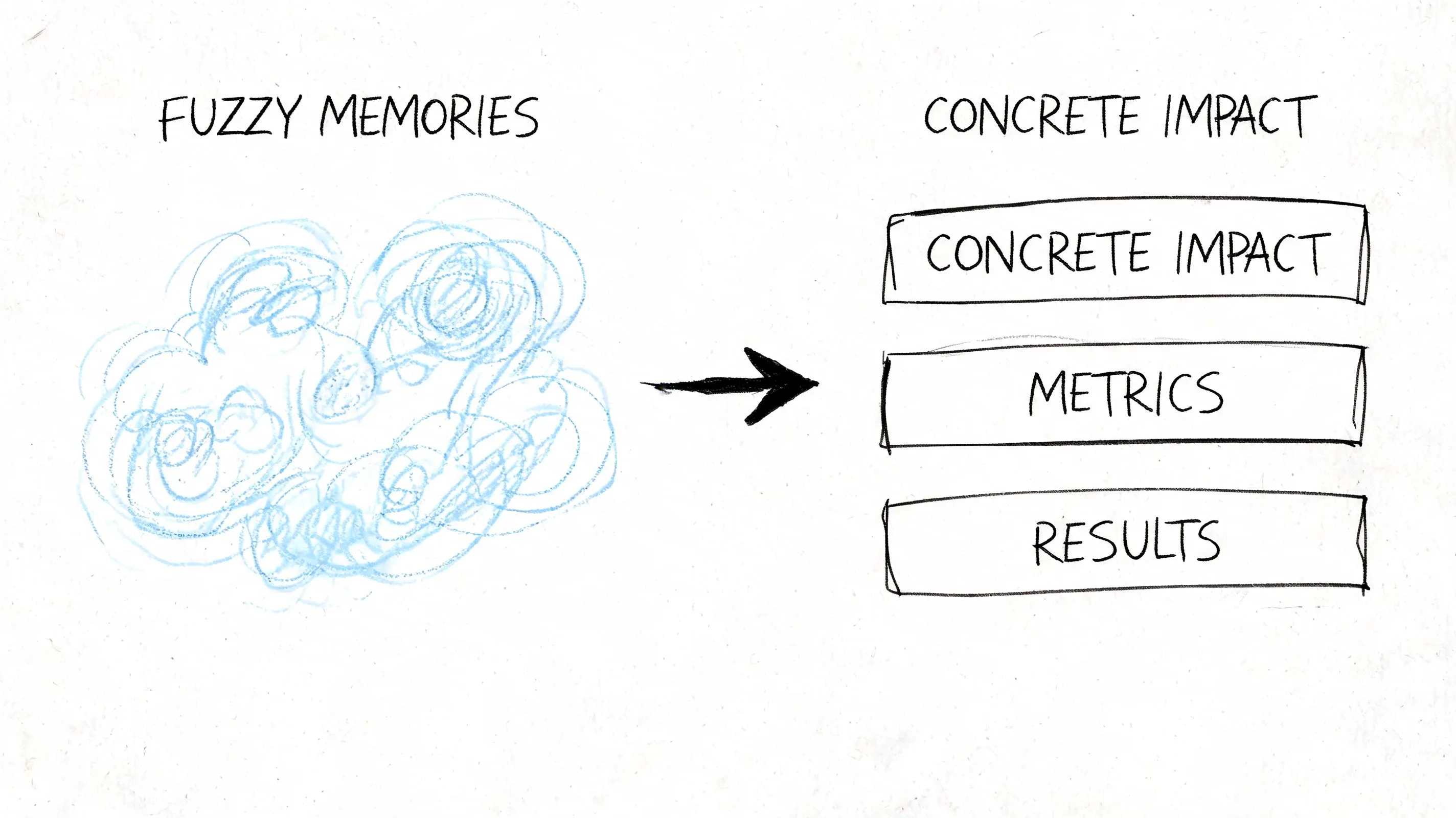
From Fuzzy Memories to Measurable Impact
Reflection sounds nice until you sit down and realize your memory is foggy.
That’s normal. Most good work doesn’t feel cinematic while you’re doing it. It feels like emails, meetings, fixes, nudges, and one decision after another. The trick is to pull one proud moment into focus and rebuild the scene around it.
Start with a moment, not a summary
Don’t begin with “What were my responsibilities?”
Begin with, “When did I feel useful, proud, relieved, trusted, or stretched?”
Then ask:
- What was going wrong
- What did I specifically do
- What happened after
- What proof do I have
That last part matters. Candidates with reflection-infused resumes achieve a 68% hire rate within 90 days, according to the PMC-cited research summary on reflection-driven resume prep. The point isn’t magic wording. The point is clarity of impact.
If you need help turning outcomes into evidence, this guide on using metrics in a resume is useful. It helps when you know something improved but haven’t yet translated that into a concrete statement.
Three examples that show the difference
Here’s what this looks like across different backgrounds.
A recent graduate with an internship
Vague memory: “I helped with market research.”
Better reflection: the team needed cleaner competitor tracking, the intern noticed the spreadsheet was inconsistent, standardized the format, and made updates easier for everyone using it.
Resume version:
- Internship bullet: Standardized competitor research tracking so the team could review updates faster and make comparisons more easily.
A mid-level manager on a team project
Vague memory: “I led a cross-functional initiative.”
Better reflection: priorities were conflicting, meetings drifted, ownership was muddy, and the manager created a clearer decision path that got stalled work moving again.
Resume version:
- Management bullet: Clarified ownership across a cross-functional initiative, which reduced confusion and helped the team move stalled work forward.
A career changer coming from an unrelated role
Vague memory: “I worked in retail.”
Better reflection: handled upset customers, trained new staff, spotted recurring issues at handoff, and became the person others relied on during rush periods.
Resume version:
- Transferable-skills bullet: Resolved high-pressure customer issues and coached new team members, building the communication and judgment I now bring to client-facing work.
What measurable impact really means
Numbers are great when you have them. Use them when they’re real.
But measurable impact isn’t only percentages. It can also be scope, complexity, ownership, or a visible before-and-after. If your action made work clearer, faster, safer, more consistent, or less chaotic, that counts. The point of career reflection before resume writing is to stop flattening your work into generic task language.
Now, You Can Finally Write
Once the thinking is done, the writing stops being painful.
You do not need a fancy template. You do not need to “find better resume words.” You need a short list of real achievements and the discipline to state them plainly.
Keep the draft brutally simple
Do this for each role:
- Pick the strongest achievements you uncovered in reflection.
- Write one sentence for each in plain English.
- Group them under the role and cut anything that sounds like a job description.
That’s enough for a draft.
If a sentence feels flat, don’t immediately rewrite it five times. Check whether you’re still hiding the actual point. Sometimes you don’t need better phrasing. You need better thinking. And if you do need help tightening language without drifting into robotic filler, it helps to understand effective paraphrasing so you improve clarity without sanding off your voice.
Don’t confuse polish with substance
Polish matters late.
Substance matters first.
That’s why I like tools that ask good questions before they generate text. StoryCV, for example, works as a digital resume writer by guiding you through your experience and turning that reflection into draft language. That’s far more useful than staring at a blank template and hoping bullets appear.
Self-reflection is also tied to long-term adaptability. SHRM notes that self-reflection is a strong predictor of career adaptability with β=0.31 in its summary of Jennifer Appleman-Vassil’s reflection-based career advice. So this isn’t just about getting through today’s resume. It’s a career skill.
One more practical move. After you draft, compare every bullet against this standard from writing impact statements: does it show what you changed, or just what you were around?
If it’s the second one, cut it.
Your resume isn’t a history of your job descriptions. It’s the highlight reel of your impact.
If you’re tired of blank docs, generic bullets, and resumes that sound technically correct but dead, try StoryCV. It helps you think before you write, using guided prompts to pull out the work that mattered so your resume sounds like you did the job, not like you copied the posting.