The worst resume advice on the internet is still the most popular: “Just add more keywords so you can beat the ATS.”
No. That's not your problem.
If your resume bullet points failing ats is the story you've been telling yourself, you're probably treating a writing problem like a software problem. That's comforting. It suggests a hack. But most of the time, the bullets aren't failing a robot. They're failing the recruiter who sees what the system surfaces.
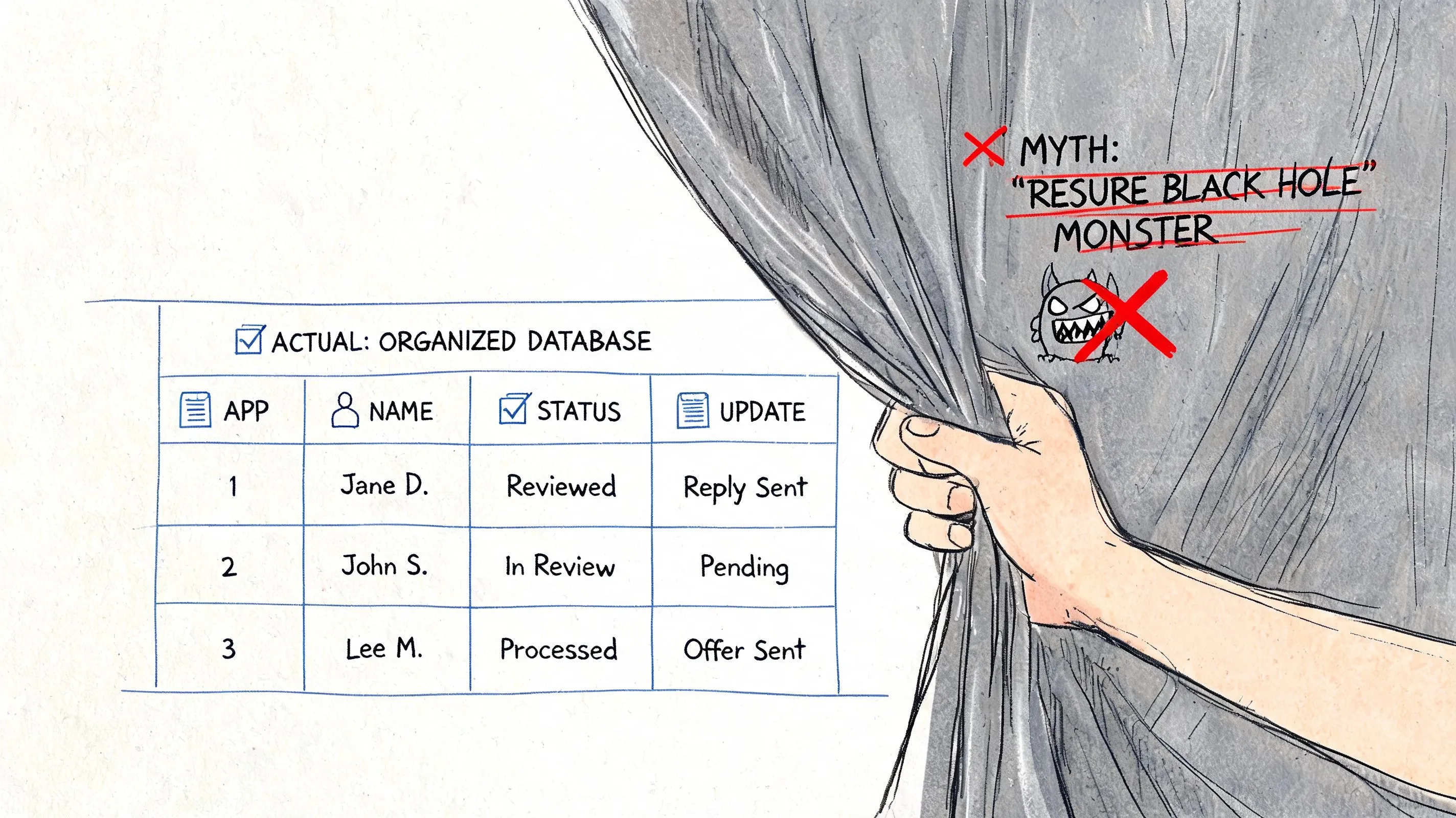
Most modern ATS platforms sort, rank, and organize. Then a person reads. And if your bullets are thin, generic, or structurally messy, nobody has much to work with.
Stop Blaming the Resume Robots
The ATS has become the all-purpose villain of the job search. No callback? ATS. No interview? ATS. Weird silence after a strong application? Definitely ATS.
That story falls apart fast.
The old “most resumes are auto-rejected by bots” claim has been stretched way past what the evidence supports. The more useful view is simpler: the system parses your resume, ranks it, and hands it to a recruiter. Then your writing has to do its job. If you want to understand how hiring teams read technical resumes once they're surfaced, these insights for hiring managers are worth your time because they show what human readers look for after the software step.
If you want the software side in plain English, StoryCV's piece on AI resume screening is a useful companion. Read it once, then stop obsessing over mythical robot gatekeepers.
Practical rule: If your resume gets parsed but your bullets still say almost nothing, the ATS isn't the problem. Your evidence is.
The hard truth is that weak bullets look weak in any system. A recruiter doesn't care that your line technically contains the phrase from the job description. They care whether they can tell what you owned, changed, improved, fixed, led, or shipped.
Why Your Bullets Really Fail (It's Not Keywords)
Let's kill the folklore.
The popular claim that “75% of resumes are rejected by ATS” is widely described as unsupported, and modern ATS platforms usually rank and sort rather than reject on keyword counts alone. More importantly, qualification mismatch accounts for 57% of rejections, compared with 23% for parsing errors, according to this ATS review.
That matters because it flips the usual diagnosis. You don't have a secret keyword problem. You probably have a relevance problem.
Generic bullets read like metadata
A bullet like “Managed stakeholder communication” isn't strong because it contains business words. It's weak because it tells nobody what happened. A ranking system sees vague language with little context. A recruiter sees filler.
That's why keyword advice is so seductive. It lets you avoid the harder question: does this bullet describe meaningful work clearly enough for someone to grade it?
A generic bullet doesn't become persuasive because you add one more noun from the job description.
What recruiters actually need
They need enough detail to understand scope, decision-making, and change.
Not a diary. Not a paragraph. Just a real account of work.
If your bullet could apply to a thousand people, it won't stand out to software or humans. You're not losing because someone else jammed in more keywords. You're losing because someone else described their contribution with more precision.
The Three Ways a Bullet Point Dies
There are three common failure modes. None of them are fixed by “optimizing harder.”

It's a fragment
This is the classic one-line non-bullet.
“Led cross-functional team.”
“Owned product launch.”
“Managed reporting.”
Those are labels. Not descriptions. They're so short and generic that they barely register as evidence of work. The eye skims right over them.
A strong bullet doesn't need to be long. It needs enough substance that a reader can answer, “What happened here?”
The structure breaks parsing
Some resumes really do create technical problems. Parsing errors account for 23% of resume rejections, with formatting issues causing another 12%. Non-standard bullet points, multi-column layouts, and text boxes can trigger misreads, while plain DOCX has a 4% failure rate, based on ATS formatting data.
That means the fancy template with sidebars, icons, tables, and cute symbols is not helping you.
Use plain bullets. Use clean dates. Use standard section headings. Keep title, company, and dates easy to separate.
Here's the quick diagnostic:
- Bad sign: Your title, employer, and dates blur together when pasted into plain text.
- Worse sign: Your bullets use arrows, checkboxes, icons, or symbols instead of standard bullets.
- Fix: Strip the formatting until the document reads cleanly as raw text.
It describes duties, not change
This is the biggest one.
“Responsible for weekly forecasting.”
“Worked with cross-functional teams.”
“Supported executive reporting.”
That's job-description language. It tells me what the role was supposed to include. It does not tell me what changed because you were in the seat.
Diagnosis: If the bullet explains the role but not the effect of your work, it will feel empty even when it's technically accurate.
Rewriting a Bullet That Actually Works
Stop hunting for a formula. Use a better question.
Ask your weakest bullet: what changed because I did this?
That question forces you out of resume theater and back into real work.
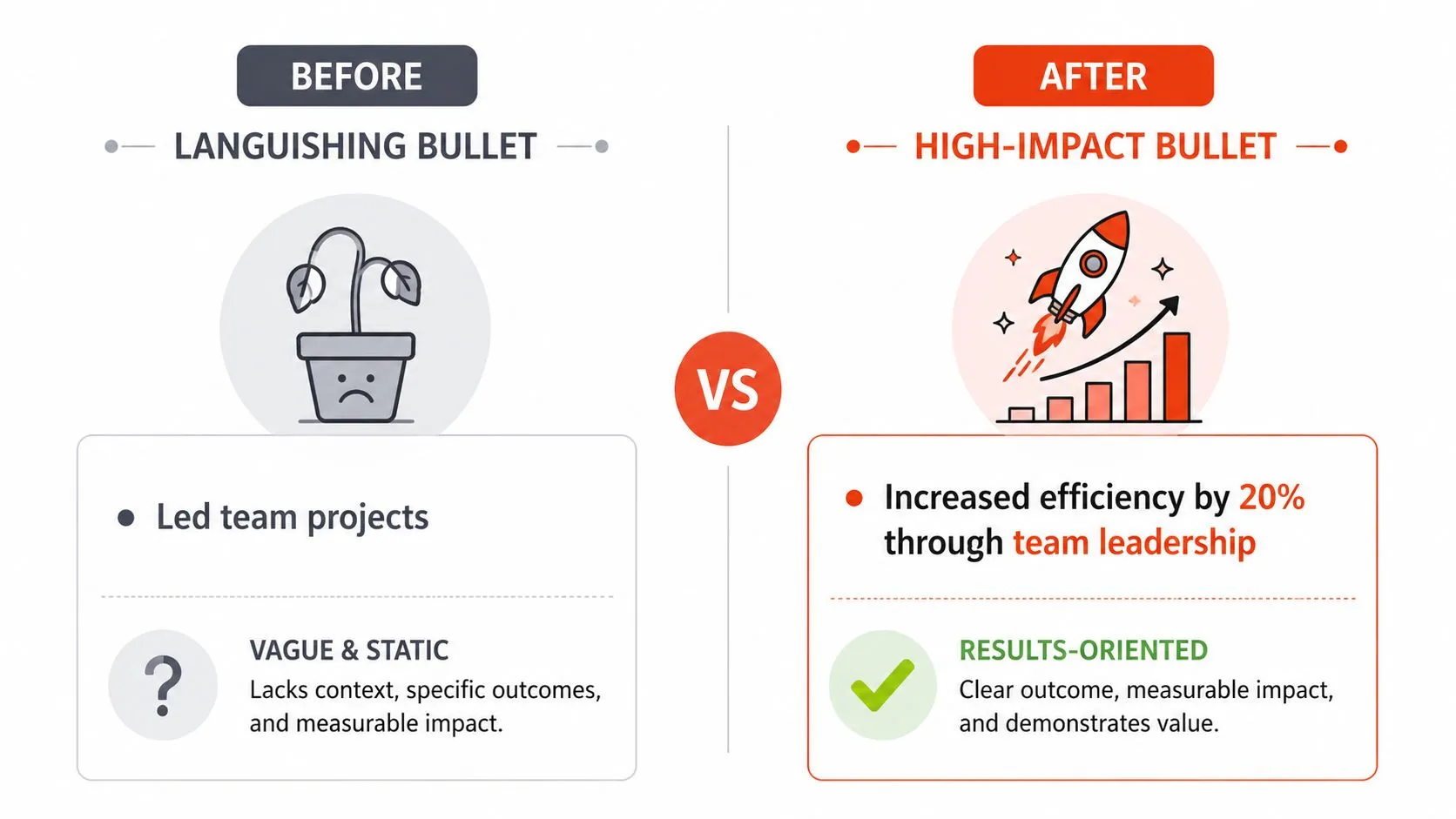
Before and after
Before
- Led cross-functional team to deliver Q2 product launch
This scans like a tag. There's no decision, no stakes, no consequence. It sounds competent, but it doesn't give a reader anything solid to hold onto.
After
- Coordinated product, design, and operations to resolve launch-blocking handoff issues before the Q2 release, clarified decision ownership across teams, and shipped on schedule after the original plan started slipping
Same basic story. Completely different effect.
Now the bullet tells me:
- Who was involved
- What problem existed
- What you did
- What changed
That's enough for both machine ranking and human judgment.
What changed in the rewrite
The rewrite didn't get better because it used shinier verbs. It got better because it became legible as work.
If you need help seeing that difference in your own experience, StoryCV's guide to good bullet points is useful because it focuses on rewriting vague claims into concrete statements instead of gaming scanners.
Write the bullet the way you'd explain the work to a smart colleague, not the way you'd fill out a performance review form.
Why “Keyword Stuffing” Is a Losing Strategy
The internet still tells people to copy terms from the job description and scatter them across the resume. That advice is stale.

Modern AI-powered ATS platforms are designed to penalize keyword repetition and contextual misuse, and excessive keyword loading can lower rankings or trigger rejection. The bigger issue is still qualification mismatch, which accounts for 57% of rejections, according to this analysis of ATS score checker mistakes.
Use the language, don't stuff the language
Yes, you should mirror important terms from the posting. But they need to appear in context, inside actual evidence.
Bad:
- “Agile, Agile, sprint planning, cross-functional, roadmap, stakeholder management”
Better:
- “Ran sprint planning for a cross-functional product team, resolved roadmap conflicts with design and engineering, and kept stakeholder decisions moving during a delayed release cycle”
The second version sounds like a human wrote it because a human did.
A quick explainer on this myth is worth watching:
If your resume reads like you're trying to satisfy a search query, you've already lost the recruiter.
Your Two-Minute Resume Sanity Check
Forget score checkers for a minute. Do this instead.
First test the structure
Copy your resume into Notepad, TextEdit, or Google Docs with formatting removed.
Then check three things:
- Titles and dates: Can you instantly tell where each role starts and ends?
- Bullet integrity: Do bullets stay intact, or does the text collapse into a weird blob?
- Section clarity: Does Experience still look like Experience, or did your layout depend on columns and boxes?
If the raw text is ugly, the parser may see it the same way.
Then test the substance
Pick one bullet you don't trust. Read it out loud. Then ask, “What did I do, and what changed?”
If you can't answer cleanly, rewrite it.
An analysis found that 99% of resumes had experience-section gaps relative to the job description, and 52% of keywords in a job description are missing from the average qualified candidate's resume. The practical fix is to map the job's language to a matching achievement and rewrite the bullet so the competency is obvious, as shown in this ATS statistics breakdown.
Here's the simplest version of that check:
- Mark the repeated words in the job description. Tools, responsibilities, domain terms, job title language.
- Match each one to a real project, task, or outcome from your experience.
- Rewrite one bullet so the key competency appears inside a real example, not a skills dump.
If you work in technical fields, these powerful CV tips for STEM are also useful because they push clarity and evidence over generic self-description. And if your bullets need stronger proof, StoryCV's article on metrics in resume writing helps with the part many candidates skip: showing impact without turning every line into nonsense.
If a recruiter can understand your contribution in seconds, you're in much better shape than someone still chasing ATS hacks.
StoryCV is a Digital Resume Writer that helps you turn fuzzy experience into clear bullets through a guided interview, not a template. If your resume keeps getting ignored and you've been blaming the ATS, start there. The fix is usually better writing.