You’re probably asking the wrong question.
Most web developers obsess over resume format for web developer roles like it’s a CSS bug. One page or two. Skills at the top or bottom. Which font. How much white space. Meanwhile, the problem sits in plain sight: the resume reads like a shopping list of tools, not evidence of work.
You’ve shipped features. Fixed painful bugs. Cleaned up legacy code nobody wanted to touch. But your resume says “React, Node.js, TypeScript, AWS” and stops there. That’s not a career story. That’s inventory.
Your Resume Is a Tech List Not a Career Story
A lot of resume advice gets one thing half right. Yes, format matters. ATS is real. Up to 75% of resumes are rejected before human review when formatting, structure, or keywords break parsing, according to Smashing Magazine’s overview of web developer resume conventions. So you do need a clean structure.
But clean structure is table stakes. It won’t save weak content.
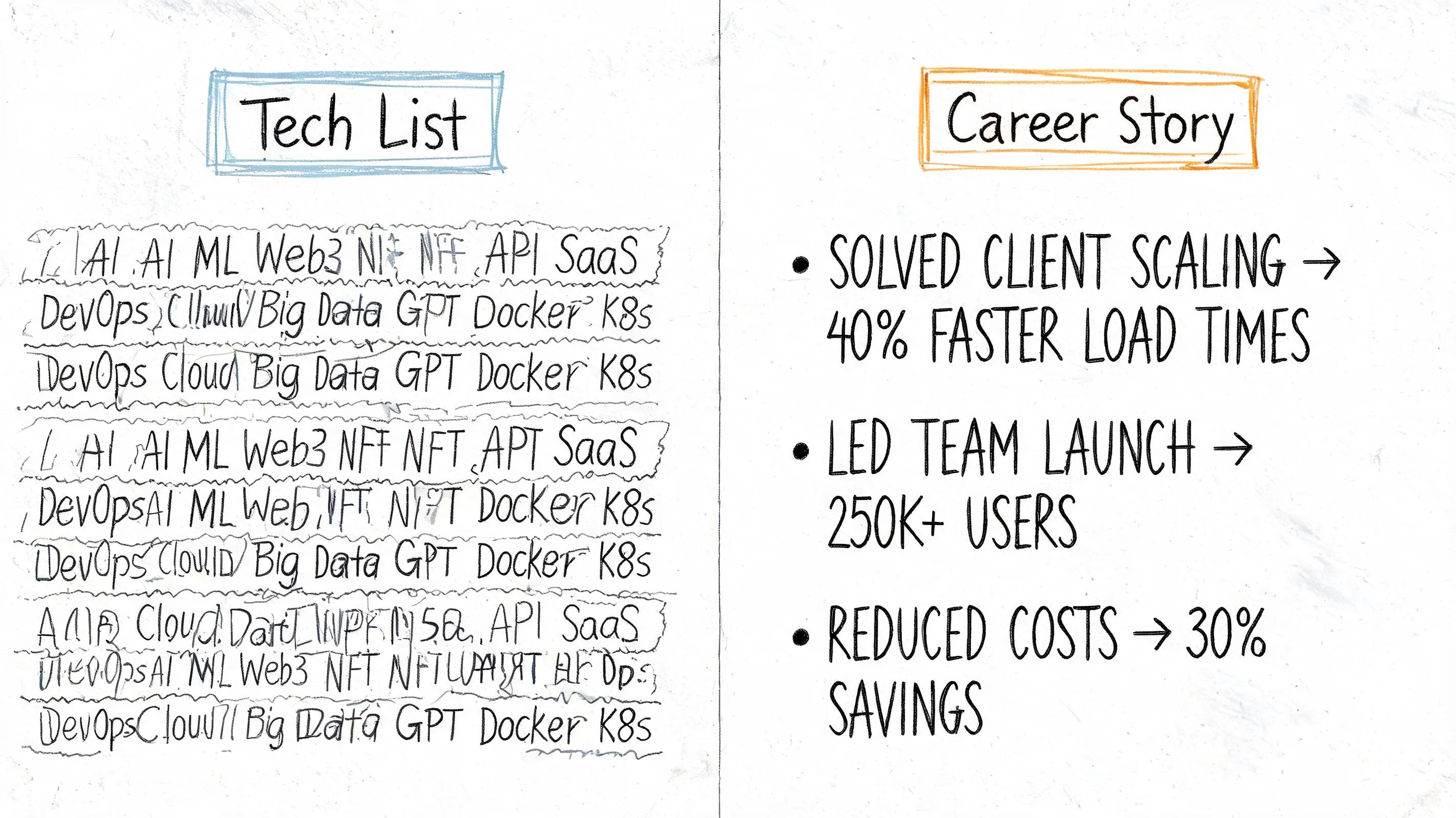
The usual developer resume fails in a predictable way. It says:
- Built REST APIs with Node.js and Express
- Developed responsive pages using React
- Worked with MongoDB and AWS
- Collaborated with cross-functional teams
A bootcamp grad can write that. A senior engineer can write that. A mediocre dev can write that. None of it tells a recruiter what you did, what was hard, or what changed because your work shipped.
What recruiters need to understand fast
Your resume has one job. It needs to answer a simple question fast: what kind of problems have you solved, and at what level?
That’s why “format” is really a hierarchy problem. What sits near the top should make your level obvious. If your first impression is a wall of frameworks, you look interchangeable.
Your skills tell me what you’ve touched. Your bullets should tell me what you changed.
Even section labels matter because they guide scanning. If you care about structure beyond resumes, this breakdown of understanding heading tags for SEO is useful for the same reason: hierarchy changes how people process information.
The shift that fixes most developer resumes
Stop writing your resume like internal documentation. Write it like proof.
Instead of “used React and Redux to build dashboards,” say what the dashboard was for, who used it, what constraint mattered, and what improved. That’s the difference between listing tech and showing judgment.
The Only Format Rule That Matters Is Hierarchy
If you’ve got real experience, your strongest evidence should appear before your supporting evidence. That’s the rule.
Hiring managers spend 7.4 seconds scanning resumes, and putting the right information where they can find it matters. The same hiring-manager guidance also notes that a clearly presented Technical Skills section in the top third can lift callbacks when it’s structured well and categorized properly, as discussed in Stack Overflow’s hiring-manager advice for developer resumes.
That sounds like an argument for leading with a giant skills block. It isn’t. The nuance matters.
What should actually go first
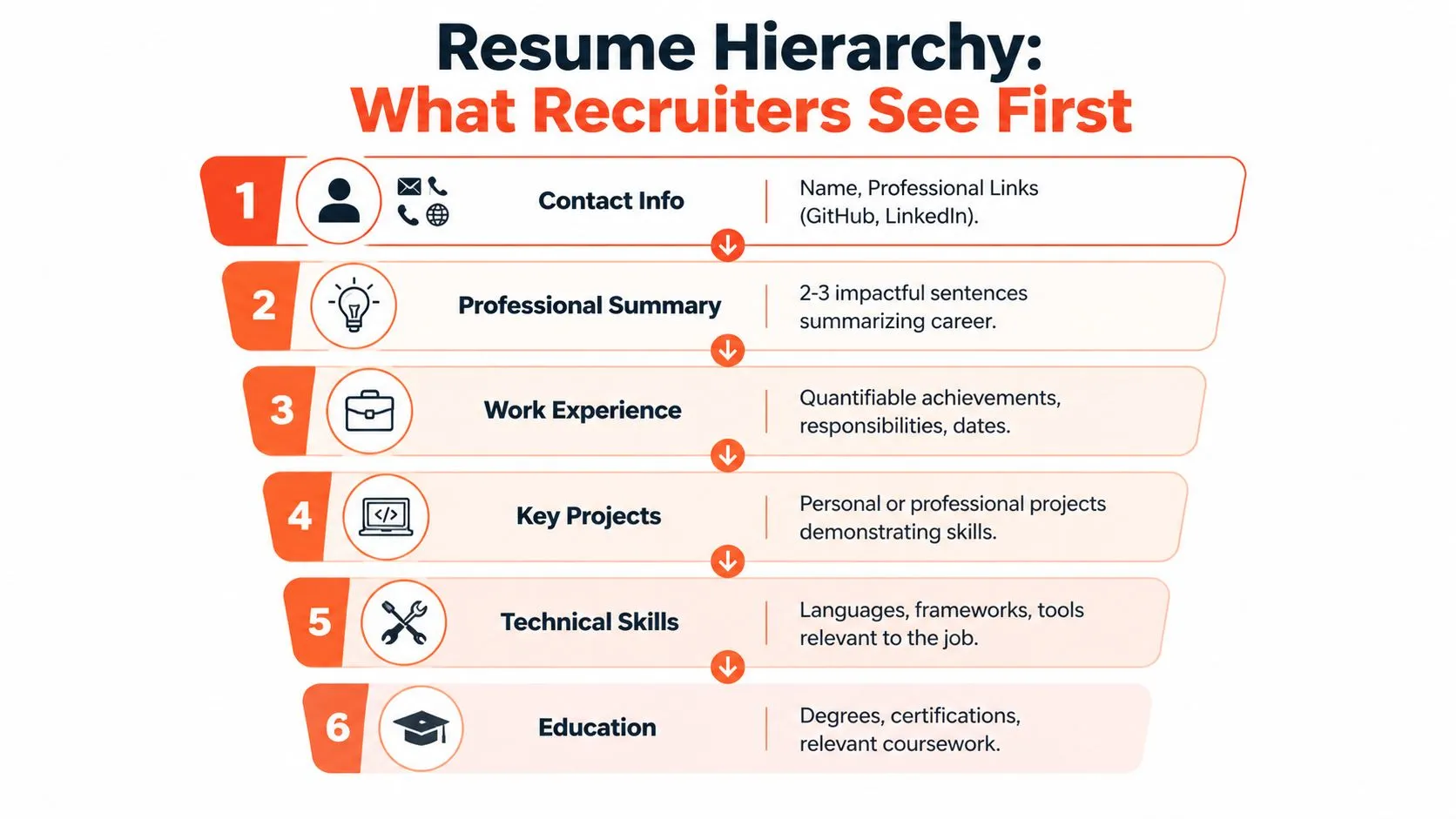
For most working developers with three or more years of experience, the hierarchy should look like this:
-
Contact info
Name, email, GitHub, portfolio if it’s good. -
Professional summary
Short. Sharp. Role, domain, strengths. -
Work experience
This is the proof. -
Projects
Only if they add something your jobs don’t show. -
Technical skills
Tight, categorized, relevant. -
Education
The recruiter doesn’t need your whole stack before they know whether your work matters. They need enough context to place you, then they need evidence.
Why skills-first often backfires
A long skills block at the top usually signals one of two things:
- You’re junior.
- You don’t trust your experience bullets.
That’s the problem. A skills section is a promise. Your work history is the receipt.
If you keep skills near the top for ATS reasons, keep them compact and disciplined. Use categories. Match the job description accurately. Don’t dump every framework you touched once in a side project.
| Section | What it should do | Common mistake |
|---|---|---|
| Professional summary | Frame your level and specialty | Generic buzzwords |
| Work experience | Prove impact | Describing tasks only |
| Technical skills | Confirm tools already used in bullets | Replacing evidence with keywords |
| Projects | Fill a proof gap | Competing with stronger job experience |
A better way to think about format
Think less about layout and more about sequencing.
If your top half says, “I build production systems that solve real business problems,” the rest of the resume works harder. If your top half says, “I know React, Node, Docker, GraphQL, Jest, Tailwind, Next.js, Prisma,” you’ve made the recruiter do the interpretation work.
Practical rule: put the section that best proves your level above the section that merely claims your capability.
That’s the only format rule worth defending.
How to Turn Tech-Speak into Impact Bullets
Most resumes die here.
Resumes with specific metrics receive 40% more callbacks, and 80% of tech recruiters prioritize results-oriented bullets, according to Resume Worded’s web developer resume examples and hiring data. That lines up with what I see constantly. Developers write implementation details and skip the part anyone hiring cares about.
The bullet formula that works
Use this:
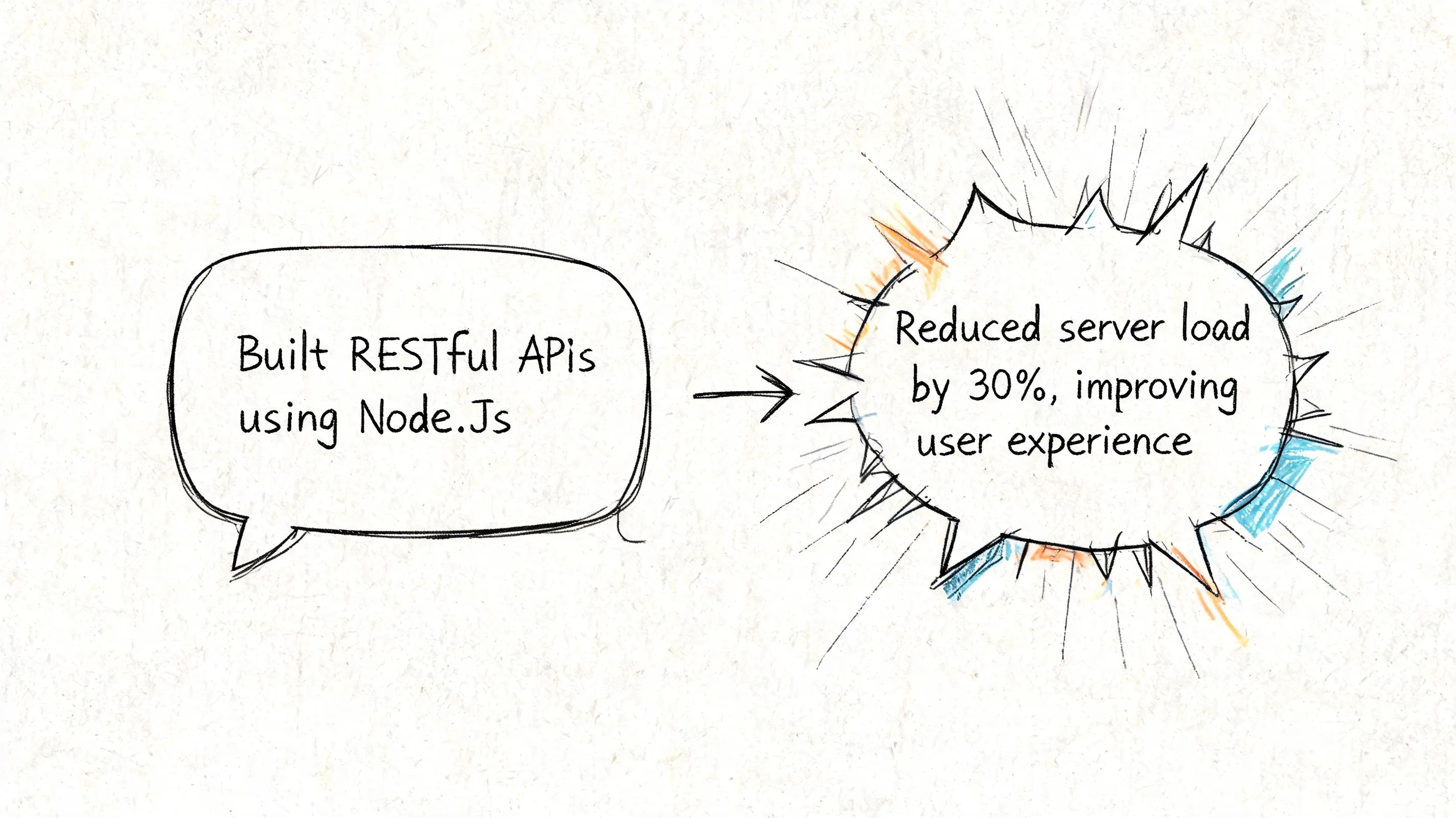
Action verb + specific system or feature + scale or constraint + outcome
Not every bullet needs all four parts, but most strong ones hit at least three.
Here’s the difference.
| Weak bullet | Better bullet |
|---|---|
| Built and maintained REST APIs using Node.js and Express | Designed the notification API handling 4M daily events, moved from polling to webhooks, cut server load by 40%, and closed a long-running latency issue |
| Developed responsive web pages using React | Rebuilt the mobile checkout flow in React, removed a fragile legacy component chain, and reduced checkout abandonment by 22% |
| Worked on AWS deployment pipelines | Streamlined the deployment pipeline for a multi-service app on AWS, reduced failed releases, and gave the team a safer release path during peak traffic periods |
The first version in each row tells me the stack. The second tells me the work.
What to add when your bullet feels thin
If your bullet sounds generic, it’s usually missing one of these:
-
The system
Not “internal tool.” Say what it was. Admin dashboard, billing service, onboarding flow, notification pipeline. -
The scope
Was it customer-facing, internal, high-traffic, legacy, multi-team, deadline-driven? -
The constraint
Tight deadline. Performance issue. Reliability problem. Ugly migration. Accessibility gap. -
The result
Faster load time, fewer incidents, better conversion, cleaner handoff, fewer complaints.
If you struggle to find strong achievements, this guide on how to write achievements in resume is worth reading because it forces the before-and-after thinking most developers skip.
Before and after rewrites
Front-end example
Before:
Built reusable UI components using React and TypeScript.
After:
Built a reusable React and TypeScript component library for the customer portal, cut duplicate front-end code across multiple flows, and sped up delivery for new UI work.
Back-end example
Before:
Built and maintained REST APIs using Node.js and Express.
After:
Designed the notification API handling 4M daily events, moved from a polling model to webhooks, cut server load by 40%, and resolved a latency issue that had sat in the backlog for over a year.
That second bullet works because it’s specific. It names the system, the scale, the decision, and the outcome.
A short walkthrough can help if this still feels unnatural:
Full-stack example
Before:
Worked on an e-commerce platform using Next.js, Node.js, and PostgreSQL.
After:
Engineered a Next.js and Node.js e-commerce platform for a growing catalog, reduced load times by 40% for 10k+ users through code-splitting and CDN optimization, and improved the shopping experience during peak traffic.
What to cut immediately
Don’t waste bullet space on these unless they lead somewhere meaningful:
- “Responsible for”
That phrase kills momentum. - Tool-only descriptions
“Used React, Node, MongoDB” is not an accomplishment. - Soft-skill filler
“Team player,” “hard worker,” “excellent communicator.” Prove those through work.
If a bullet could describe thousands of developers, it’s too vague.
Your Skills and Projects Sections Are Backwards
Most developers use these sections as a hiding place. That’s why they’re often backwards.
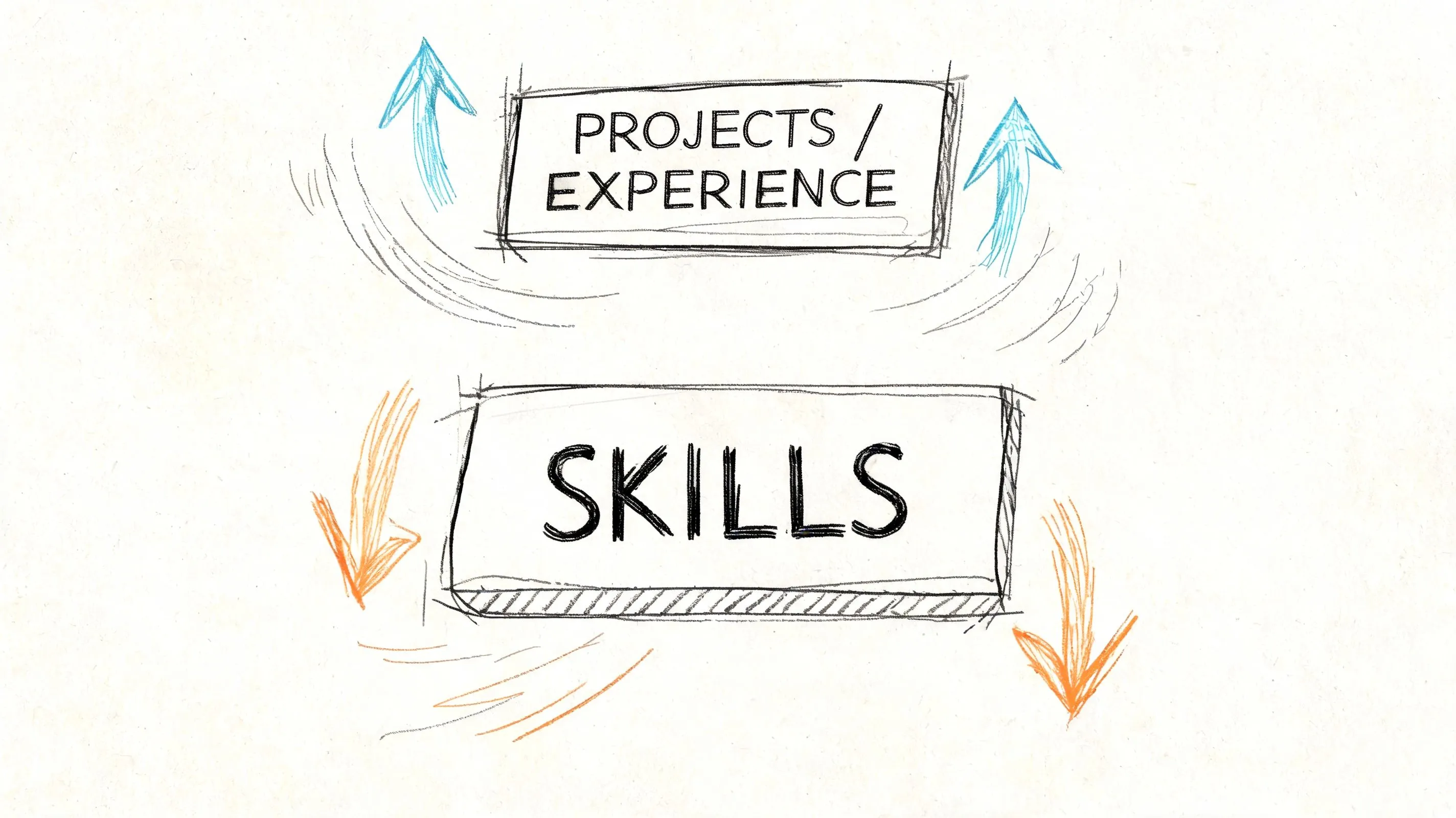
A giant skills block at the top says, “Please notice my keywords.” A projects section above real work says, “Ignore my job history and look at this weekend app instead.” Neither helps if you already have professional experience.
What the skills section is actually for
It’s for confirmation, not introduction.
Yes, ATS matters. In 2026, 98% of Fortune 500 companies use ATS, and tailoring a categorized technical skills section to the job description can improve parse performance, according to SoundCV’s summary of ATS optimization for web developer resumes. Fine. Keep the section clean and scannable.
But don’t confuse ATS compatibility with persuasion.
A good skills section should be:
- Short
Focus on the stack relevant to the role. - Grouped
Frontend, backend, databases, tools. - Supported by experience
If React appears here, it should also appear in a bullet that proves real use.
If you want a cleaner way to structure that section, this guide to the resume skills section gets the order right.
When projects should move up
There is one clear case for putting projects above experience: your work history does not yet prove you’re a web developer.
That’s common for career changers, returners, and veterans translating nontraditional experience. In those cases, projects can do the heavy lifting if they’re real, deployed, and relevant.
If you already have several years of paid development work, lead with that. A side project should support the case, not replace it.
A simple decision rule
| Situation | Put Projects Above Experience | Keep Projects Below Experience |
|---|---|---|
| Career changer with unrelated prior roles | Yes | No |
| Junior dev with internships and one strong product project | Sometimes | Sometimes |
| Mid-level developer with solid shipped work | No | Yes |
| Senior engineer with production systems in prior roles | No | Yes |
The projects section should fill a credibility gap. It shouldn’t create one.
Stop Obsessing Over Page Count and ATS Scores
The one-page rule gets abused.
A cramped one-page resume with tiny type and zero breathing room is worse than a clean page and a half. If you’ve got seven or eight years of experience, cutting smart beats compressing everything.
What should go first when you trim?
- Old roles that don’t strengthen your current target
- Bullets that only list tasks
- Tools you can’t defend in an interview
- Projects that duplicate what your work experience already proves
For ATS, don’t get cute. Use a single-column layout. Standard headings. Plain text links to GitHub or a live portfolio. Write honest bullets that naturally include the language of the role. If you need help tightening those lines without turning them into keyword sludge, this article on ATS resume bullet points is useful.
There’s also a separate issue a lot of resume advice misses. It doesn’t serve career changers, veterans, or returners very well. That gap matters because tech roles filled by career switchers rose 25% in 2025 to 2026, as cited in Enhancv’s discussion of web developer resume gaps for nontraditional candidates. Those candidates don’t need more keyword stuffing. They need sharper translation.
Your GitHub link matters less than most developers think. The link is expected. The explanation is what makes it useful. A clean README that says what the project does, why you built it, and what tradeoffs you made tells me more than a repo graveyard ever will.
You Build Things Now Learn to Talk About Them
Building the work and explaining the work are different skills. A lot of strong developers never learn the second one, so their resumes undersell them.
The format isn’t the story. It’s the container. What gets interviews is clear proof of systems built, problems solved, and outcomes improved. If you’re earlier in your career, the mechanics differ a bit. Resources on writing a CV for graduate careers can help with that starting point. But for working developers, the rule stays the same: stop listing tools and start describing the work.
StoryCV is a Digital Resume Writer, not a template library. It helps you turn vague tech bullets into clear, credible achievements through a guided writing process that pulls out the context, decisions, and impact behind your work. If your resume still sounds like a stack list, start there.