Most ATS advice is backward.
It tells you to cram in keywords, chase a score, and hope the machine approves. That’s how you end up with a resume full of sterile bullets like “Responsible for cross-functional collaboration.” It may look optimized. It says nothing.
ATS resume bullet points don’t need more stuffing. They need more signal. The machine has to parse them. The human has to care. If either side fails, your resume loses.
Why Your Resume Bullet Points Are Failing ATS and Humans
The problem usually isn’t that your resume lacks a few magic words. The problem is that your bullets read like a job description.
Recruiters don’t hire job descriptions. They hire evidence.
A Maywise study of 50 resumes found that 94% failed ATS scans due to inconsistent formatting, keyword absence, or non-quantified bullet points. That should kill the fantasy that a decent-looking resume is “probably fine.”
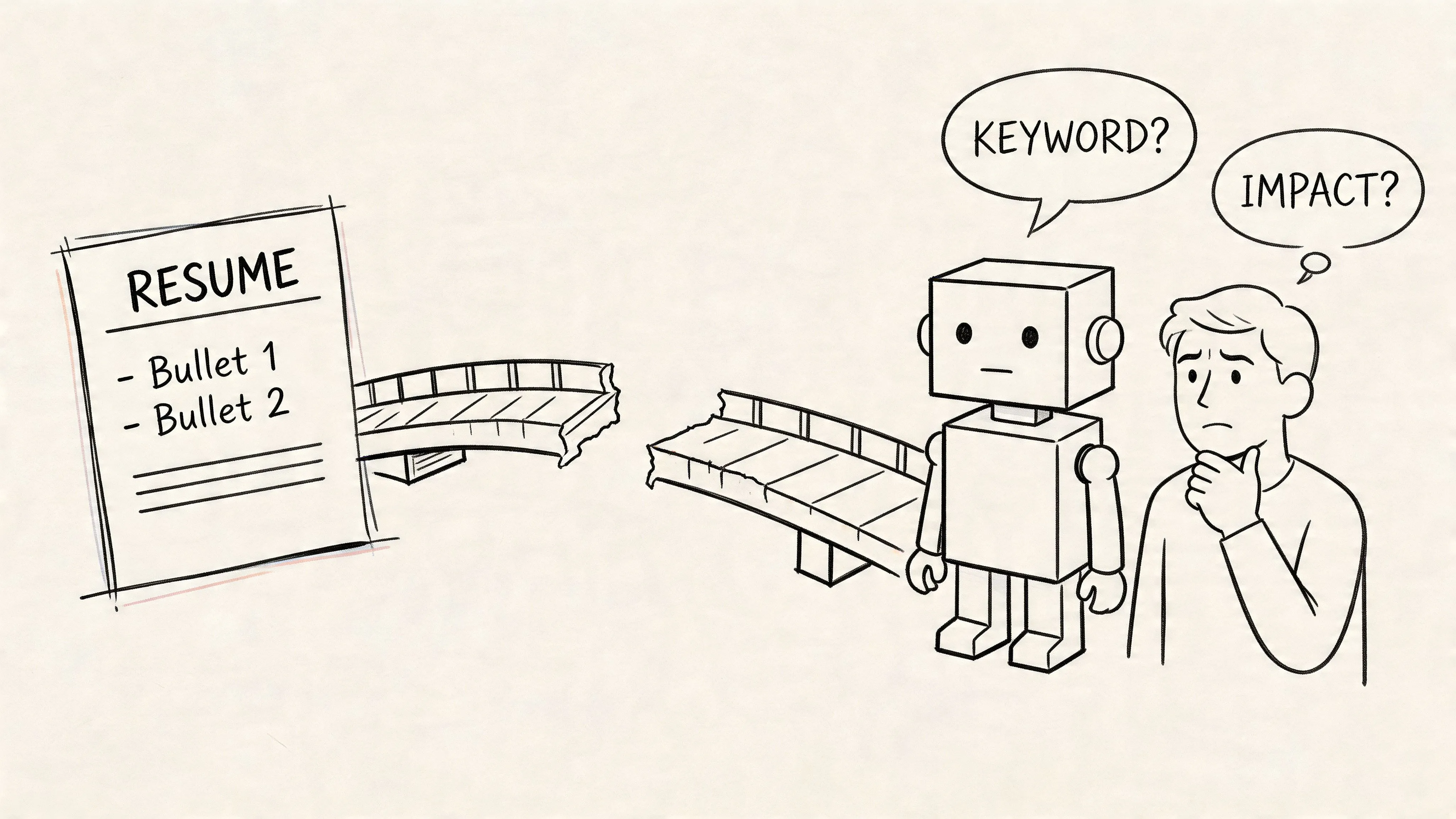
The ATS score myth
People obsess over getting a perfect match score. Bad goal.
A high score on a checker can still produce dead-on-arrival bullets if every line sounds robotic. You don’t win because software tolerates your resume. You win because a recruiter sees proof fast.
Practical rule: Write each bullet to pass a parser first, then reward a tired human reader.
That means clean formatting, exact role-relevant language, and actual impact. If you want a quick keyword gap check before editing, the Ai Jobs Resume Keyword Analyser is useful for spotting missing terms. Just don’t let a scanner become your writer.
Why generic bullets fail twice
A weak bullet usually breaks in two ways:
- It’s vague for ATS: No clear keywords, no recognizable skills, no concrete context.
- It’s useless for humans: No outcome, no scale, no sign you changed anything.
- It repeats duties: “Managed projects” tells me your title, not your value.
If your bullets sound interchangeable with anyone else in your function, they’re bad bullets.
That’s why I’d rather see a simple resume with sharp evidence than a “perfectly optimized” resume that reads like sludge. Story matters. So does structure. Both are part of the screen.
For a sharper explanation of where ATS filtering goes wrong, StoryCV’s take on the 90/10 ATS filter rule is worth reading.
The Formula for High-Impact Resume Bullet Points
Use this formula and stop overthinking it:
Accomplished [X] as measured by [Y] by doing [Z].
That structure forces you to write about outcomes instead of chores.
What each part does
[X] is the win.
What changed because you were there? Faster delivery, fewer errors, cleaner reporting, stronger onboarding, smoother launches.
[Y] is the proof. You add a metric, scope, frequency, budget, volume, or another concrete marker. ATS systems can parse numbers and symbols like $, %, and #, and they often struggle with tables, text boxes, or fancy layouts, so keep the format simple and standard when writing ATS resume bullet points.
[Z] is the method.
How did you make the result happen? Through automation, stakeholder coordination, SQL analysis, process redesign, training, documentation, campaign testing, or something else specific.
Front-load the part that matters
Don’t bury the result at the end if it’s the strongest part.
Bad:
- Responsible for onboarding new team members and improving documentation for internal systems
Better:
- Reduced ramp-up friction for new hires by rewriting internal system documentation and standardizing onboarding steps
The second version gives the reader a reason to keep reading.
Good bullets don’t start with your task list. They start with your contribution.
From Vague to Valuable
| Weak Bullet (What You Did) | Strong Bullet (The Impact You Made) |
|---|---|
| Responsible for managing vendor relationships | Improved vendor response times by standardizing communication workflows and escalating blockers early |
| Worked on monthly reporting | Delivered monthly reporting with clearer trend visibility by rebuilding recurring reports and tightening data checks |
| Helped with recruiting coordination | Coordinated interview scheduling across multiple stakeholders, reducing back-and-forth and keeping hiring processes on track |
| Managed customer support tickets | Resolved a high volume of customer issues while documenting repeat problems to improve team response consistency |
| Assisted with project management | Kept cross-functional projects moving by tracking deadlines, surfacing risks early, and following up on stalled tasks |
Use plain formatting or get ignored
Many individuals sabotage their efforts. They spend hours polishing a resume in Canva-style layouts, then wonder why the ATS mangles it.
Don’t use:
- Text boxes
- Tables for core content
- Icons as bullets
- Decorative symbols
Use:
- Standard bullet points
- Clear section headings
- Simple alignment
- Readable metrics inside the bullet itself
The formula is simple on purpose. Strong resume bullet points impact both systems because they’re readable, concrete, and specific.
How to Quantify Your Impact Without Obvious Metrics
The excuse I hear most is, “My job didn’t have numbers.”
Usually false.
You may not have owned revenue. Fine. You still worked at a certain scale, with a certain frequency, for a certain scope of people, systems, or tasks. That counts.
Resumes that include quantified achievements are 3.2 times more likely to secure interview callbacks than resumes with generic statements. That matters because numbers turn claims into evidence.
Think like an investigator
Don’t ask, “What numbers do I have?” Ask better questions:
- Scale: How many people, locations, tickets, accounts, stakeholders, or deliverables were involved?
- Frequency: Daily, weekly, monthly, quarterly. How often did you do it?
- Speed: Did you shorten a step, remove back-and-forth, or cut manual work?
- Ownership: Did you lead, support, train, coordinate, review, or improve something important?
If you’re stuck, use an interview mindset. Reconstruct the work.
Instead of “I handled onboarding,” ask:
- Who came through it?
- What was messy before?
- What did I change?
- What became clearer, faster, or easier?
For more ways to find evidence hiding in plain sight, this guide on resume metrics is useful.
Examples when the metric isn’t obvious
Weak:
- Helped with team meetings
Stronger:
- Coordinated recurring team meetings, tracked follow-ups, and kept action items visible across stakeholders
Weak:
- Supported customer requests
Stronger:
- Handled recurring customer requests across busy shifts and flagged repeat issues to improve response consistency
Weak:
- Worked on internal documentation
Stronger:
- Rebuilt internal documentation for repeat processes, making handoffs clearer and reducing reliance on verbal instructions
You don’t need glamorous metrics. You need believable ones.
If you don’t have a clean number, quantify the environment. Mention the size of the team, the volume of work, the cadence, or the complexity. That still gives the bullet weight.
Choosing Action Verbs That Strengthen ATS Bullet Points
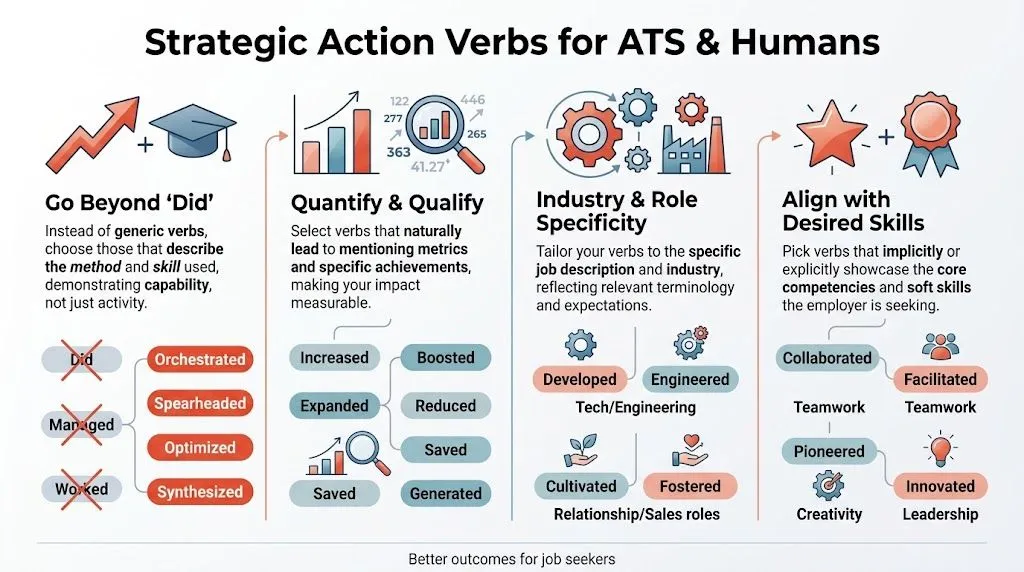
Most advice about action verbs ATS bullet points is lazy. It hands you a giant alphabetized list and calls it strategy.
That’s useless.
The right verb depends on the story you’re telling. “Led” and “optimized” are not interchangeable. One signals ownership. The other signals improvement. Pick the wrong verb and your bullet gets blurry.
Match the verb to the kind of impact
Use verbs that fit your actual contribution.
- For building things: Developed, Designed, Built, Launched
- For improving things: Optimized, Rationalized, Refined, Simplified
- For leading work: Led, Coordinated, Mentored, Directed
- For growth or expansion: Increased, Expanded, Grew, Secured
The verb should pull the reader toward the result, not just decorate the sentence.
Don’t overstuff your role with grand verbs
If you “assisted,” don’t write “spearheaded.” Inflated language makes good candidates sound fake.
ResumeWorded advises using 4 to 6 bullet points for most jobs, and up to 8 for the most recent role. That limit is useful because it forces better choices. You don’t need every verb. You need the right few.
Specific verbs create trust. Generic verbs create fog.
Also, mirror the job description when it makes sense. If the role calls for “project management,” don’t swap in internal shorthand that the ATS may not connect. Precision beats creativity here.
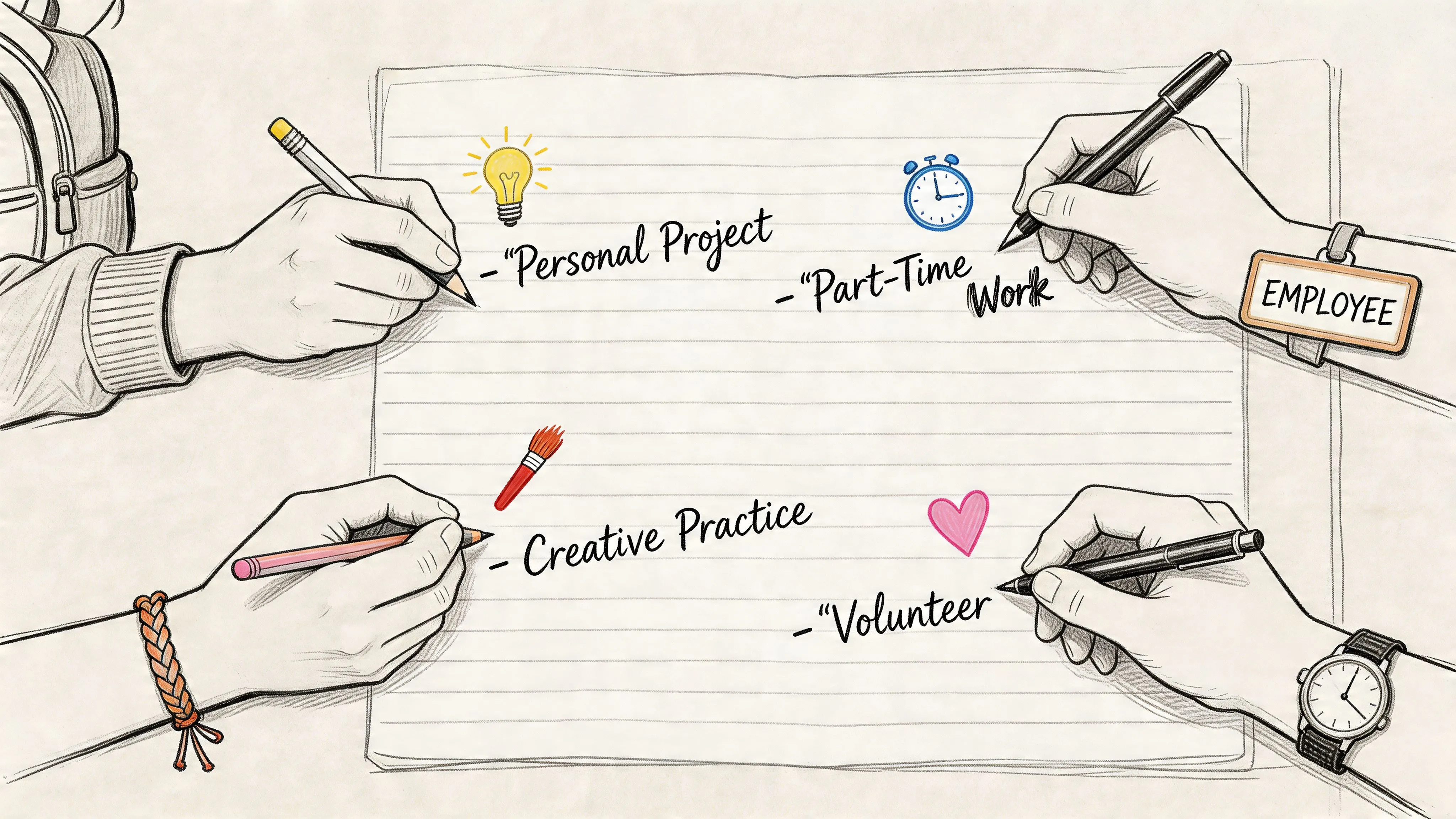
Bullet Point Examples for Interns Projects and Part-Time Jobs
Early-career candidates often think they need senior-level wins to write strong bullets. Wrong.
You need proof that you solved problems, improved something, supported work at a meaningful level, or learned fast in a real environment. That’s enough.
75% of resumes are rejected for poor keyword match, while 60% of ATS-passing resumes are discarded by recruiters because they lack a compelling impact story. That’s why these examples balance keywords with narrative.
Software engineering internship
- Built internal features for a web application, fixing recurring usability issues and supporting smoother handoff to production
- Collaborated with engineers and product teammates to test changes, document edge cases, and reduce release confusion
- Improved development workflow visibility by updating issue tracking and keeping task status current across sprint work
Why these work: they include engineering keywords, show collaboration, and hint at real contribution without pretending the intern ran the company.
Marketing project
- Designed campaign assets and messaging for a class or freelance project, aligning content with audience goals and channel format
- Analyzed engagement patterns across project outputs to identify which messages resonated more clearly
- Presented campaign recommendations to stakeholders, connecting creative choices to audience response and business intent
Why these work: they show thought process, communication, and relevance to actual marketing work.
If you’re building an early-career resume from scratch, this guide on how to write an internship resume can help structure the experience properly.
Retail or food service job
- Handled high-volume customer interactions during busy shifts while maintaining accuracy, pace, and service quality
- Resolved order or service issues quickly, helping keep lines moving and reducing friction for customers and teammates
- Trained new staff on daily procedures, equipment use, or service expectations to support smoother shift coverage
Why these work: they translate service work into operations, training, and problem-solving. That’s far more useful than “Responsible for cashier duties.”
A quick walkthrough can help if you want to hear the logic out loud:
Volunteer role
- Coordinated volunteer schedules and event logistics, helping maintain reliable coverage across key activities
- Created clearer communications for participants or donors, reducing confusion and improving follow-through
- Supported program delivery by organizing materials, tracking needs, and keeping day-of operations running smoothly
One simple editing test
Read each bullet and ask:
- Could someone else in the same title copy this exactly?
- Does this show outcome, scale, or method?
- Would a recruiter learn anything useful about how I work?
If the answer is no, rewrite it.
One practical option for doing this at scale is StoryCV. It uses a guided interview approach to turn raw experience into stronger bullet drafts without relying on generic templates.
Stop Writing for Bots Start Telling Your Story
Your resume isn’t a keyword container. It’s a hiring argument.
The ATS needs clean structure, relevant language, and readable formatting. Fine. Give it that. Then move on to the important work, which is showing what changed because you did the job.
That means asking better questions. Not “What were my responsibilities?” Ask, “What did I improve, fix, deliver, support, speed up, clarify, or own?” That’s where strong bullets come from.
The best resumes don’t feel stuffed. They feel clear. They sound like a capable person explaining real work with evidence.
Write like you’re preparing for a conversation, not gaming a scanner. That shift changes everything.
StoryCV is a Digital Resume Writer built for people who’ve done meaningful work but struggle to turn it into sharp, credible resume language. Instead of templates, it uses a guided interview to pull out context, achievements, and nuance so your bullet points sound like you, while still staying ATS-friendly.