Writing an internship resume is about selling your potential, not your past. The goal is to show impact through projects, coursework, and skills. Use numbers to prove you deliver.
Why Your Internship Resume Isn't Working
Your resume feels broken. You've used the templates, listed your classes, and polished your objective statement. It’s still generic.
Recruiters spend about 7 seconds scanning each resume. Yours looks like a hundred others they’ve seen today.
The problem isn't your lack of experience. It’s how you present it. Most student resumes are passive lists of responsibilities. “Assisted with social media.” “Helped organize events.” These phrases are empty. They don’t prove you can solve a problem or create value.
We're cutting the noise. It’s time to reframe your approach from listing tasks to showcasing impact.
From Tasks to Achievements
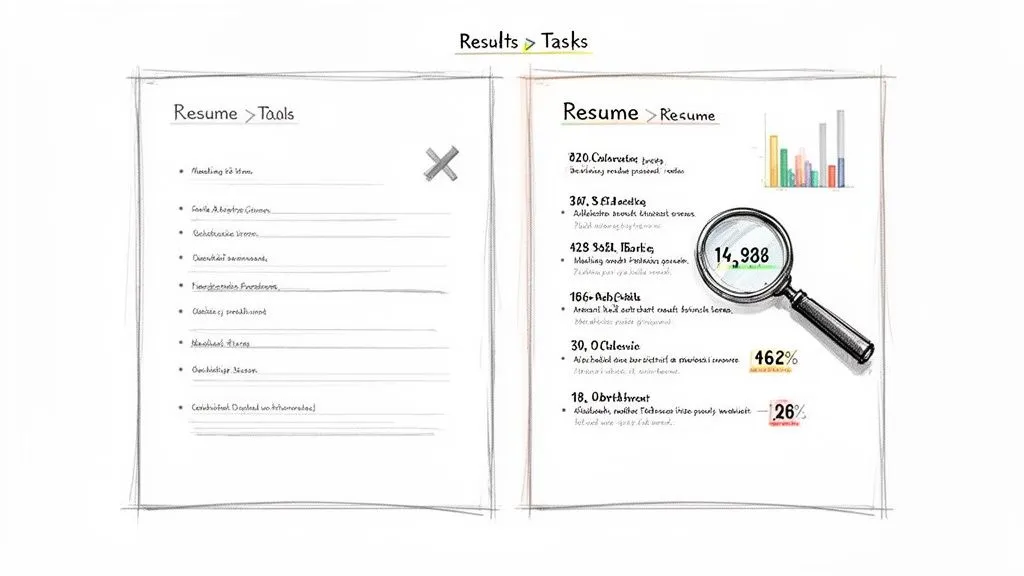
The biggest mistake students make is writing a resume that reads like a job description. Your future boss knows what an intern does. They want to know what you accomplished.
Your resume isn't a historical document of your duties. It’s a marketing document showcasing your achievements.
Getting a great internship matters. According to the National Association of Colleges and Employers (NACE), 66.4% of interns get a full-time job offer after their internship ends.
Interns also earn salaries that are $15,000 higher on average than their peers who didn't. You can dig into more numbers in Standout CV's research on the topic.
To get there, your resume has to speak the language of results.
The Problem with Templates
Templates are the enemy. They force your unique experience into a soul-crushing, generic mold. You end up with a resume that looks professional but says nothing about what you can do.
Here’s what a recruiter is thinking:
-
They scan for impact. They want numbers, action verbs, and clear outcomes.
-
Generic gets ignored. "Team player" and "hard worker" are empty claims.
-
Achievements tell a story. Quantifiable results prove you can make a difference from day one.
Change your approach. Stop describing what you were supposed to do. Show what you actually did.
| Shift from a Task-Based Resume to an Achievement-Focused One |
| :--- | :--- |
| Old Approach (The Problem) | New Approach (The Solution) |
| Reads like a generic job description. | Reads like a highlight reel of your accomplishments. |
| Uses passive language like "Responsible for..." | Uses strong action verbs like "Launched," "Increased," "Built." |
| Describes duties without context. | Quantifies results with numbers (%, $, #). |
| Forces the recruiter to guess your value. | Clearly communicates your direct impact. |
Thinking in achievements turns a chore list into a reason to call you. It transforms "helped with a project" into "streamlined data entry, reducing processing time by 20%."
One is a task. The other is a result. For an internship resume, that distinction is everything.
Building the Core of Your Resume
A great internship resume is lean. No "Objective." No "References Available Upon Request." It has four core sections. That’s it.
Anything extra is noise. Make the recruiter’s job easy. Don't give them more to skip.
Contact Information The Right Way
This sounds obvious, but people mess it up. Your contact info needs to be clean, professional, and easy to find.
Here’s what you need:
-
Your Name: Largest text on the page.
-
Phone Number: One you'll actually answer.
-
Professional Email:
firstname.lastname@email.com. -
LinkedIn URL: A custom one, not the default garbage.
-
Portfolio/GitHub (If relevant): Non-negotiable for creative or technical roles. It’s proof you can do the work.
Don’t include your full mailing address. City and state are fine, but it’s a leftover from another era.
Making Your Education Section Work for You
As a student, your education is a big asset. But just listing your university, major, and graduation date is a missed opportunity. Show that your studies gave you practical skills.
Think beyond the basics. Include things that show initiative.
-
Relevant Coursework: List 3-5 upper-level courses related to the internship. Nobody cares about "Intro to..." classes.
-
GPA: Include it only if it’s 3.5 or higher. If it’s lower, let your projects do the talking.
-
Academic Honors: Dean's List, scholarships, or any awards prove you’re a high-achiever.
-
Major Projects: Briefly describe a significant project. Highlight the skills you used and the result. Example: "Developed a marketing plan for a local business, leading to a proposed 15% increase in social media engagement."
This turns your education section from a passive credential into an active demonstration of what you can do.
How to Frame Your Experience Section
This is the heart of your resume. This is where students get stressed. They think they have "no experience." This is wrong. You just need to learn how to frame it.
Part-time jobs, volunteer roles, and campus positions are all experience. They prove you can handle responsibility and solve problems. Employers consistently rank work experience as the #1 thing they look for. 79% of employers are open to hiring candidates with resume gaps if they can show impact. Get this section right. You can find more insights in these resume statistics on ResumeGenius.com.
The key is to translate responsibilities into achievements. No one cares that you were a "cashier." They care that you "handled $2,000+ in daily transactions with 100% accuracy."
Here’s how to reframe common student jobs:
-
Instead of: Retail Sales Associate
-
Think: What results did you drive? "Assisted 50+ customers daily, contributing to a team that consistently exceeded sales targets by 10%."
-
Instead of: Club Treasurer
-
Think: What was your impact? "Managed a $5,000 annual budget for a 40-member organization, ensuring all events were funded and records were meticulously kept."
See the difference? Show, don't tell.
The Skills Section No Fluff Allowed
Finally, the skills section. Give the recruiter a quick, scannable list of your hard skills. Be specific.
-
Technical Skills: List the software, languages, and tools you actually know (e.g., Python, SQL, Figma, Adobe Creative Suite).
-
Languages: Include languages you speak and your proficiency level (e.g., Fluent, Conversational).
-
Certifications: Add any relevant certifications, like Google Analytics, HubSpot, or AWS.
Do not list soft skills like "communication" or "teamwork." These words are clichés. You prove these skills in your experience bullet points, you don't list them here. A bullet point showing you led a team project is better than writing "leadership skills."
Writing Bullet Points That Show Your Impact
This is where most resumes die. Vague, passive phrases like "Assisted with marketing campaigns." These are dead space. They tell a hiring manager what you were assigned, not what you accomplished.
To land an interview, your bullet points must prove your value. They need to be sharp and focused on results. This isn't bragging; it's communicating the impact of your work, no matter how small the role seems. This is the single most important skill to master for your internship resume.
The goal is to transform every bullet from a passive duty into a compelling achievement. That shift gets you the call.
The Formula For Impactful Bullets
Stop listing tasks. The best bullet points follow a simple framework: What did you do? How did you do it? What was the result?
The X-Y-Z formula forces you to connect your actions to a measurable outcome.
Accomplished [X] as measured by [Y] by doing [Z].
This structure forces you to include a quantifiable result ([Y]), which is what grabs a recruiter's attention. Even without a hard number, you can still show impact.
Let’s break this down.
Finding Your Metrics When They Aren't Obvious
"But I don't have any metrics." This is rarely true. Impact isn't always about revenue. It's about making things faster, better, or bigger.
Dig for the numbers. Ask yourself:
-
How many? How many customers did you help? How many posts did you create? How many lines of code did you write?
-
How much? Did you save time? Did you reduce errors? Did you increase engagement?
-
How often? Did you handle daily, weekly, or monthly tasks?
Even small numbers provide proof. "Responded to 15+ customer inquiries daily" is infinitely better than "Handled customer service." For more ideas, read our full guide on how to write resume bullet points.
Before And After: Transforming Weak Bullets
The difference between a weak and strong bullet is night and day.
Finance Intern Example:
-
Before: Responsible for creating financial models in Excel.
-
After: Developed 5 detailed financial models to analyze potential investments, which were used by senior analysts to inform their Q3 portfolio strategy.
Marketing Intern Example:
-
Before: Helped manage the company's social media accounts.
-
After: Increased Instagram follower engagement by 25% over 3 months by creating and scheduling 15+ weekly posts and stories using Canva.
Software Engineering Intern Example:
-
Before: Worked on debugging the company's mobile app.
-
After: Identified and resolved 12 critical bugs in the iOS application's checkout flow, improving the user transaction success rate by 10%.
Each "After" example nails the X-Y-Z framework. It states what was done, how, and the tangible outcome. This is how you prove you deliver results.
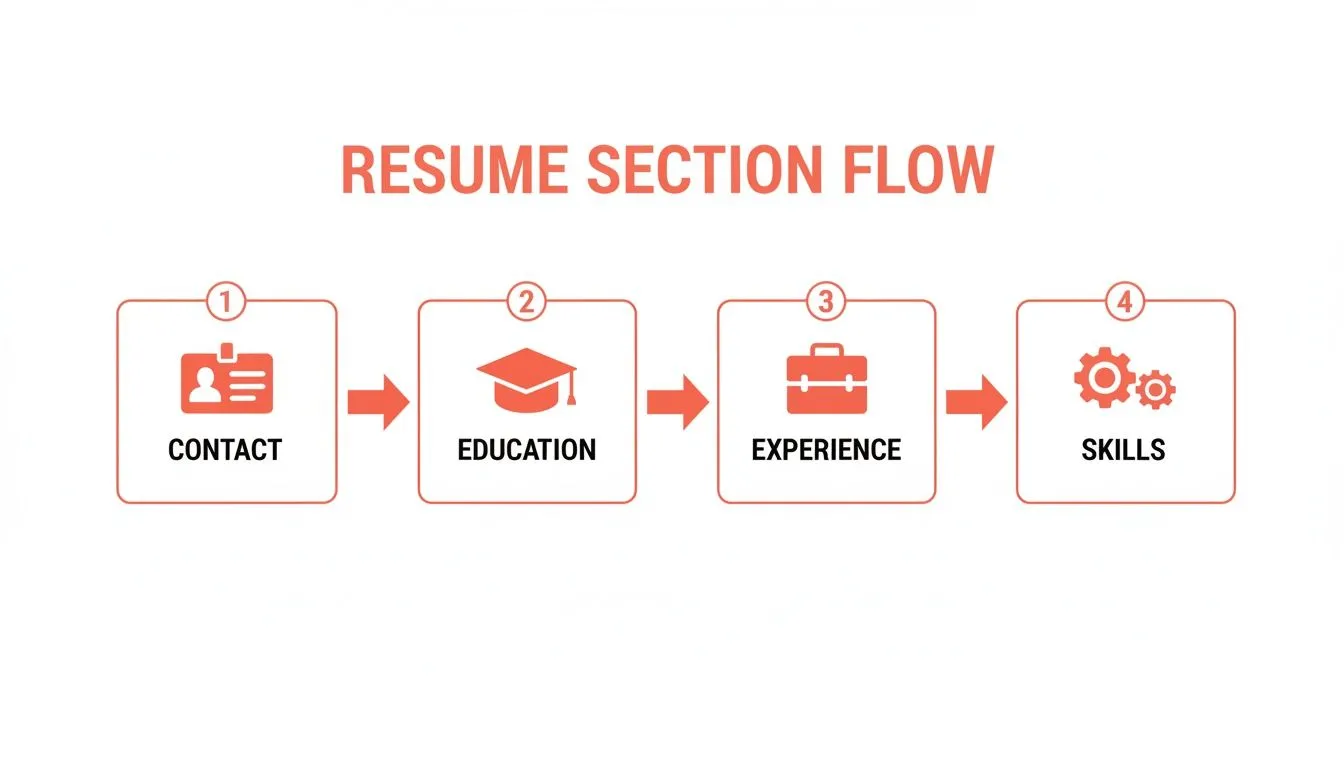
This visual shows the logical flow a recruiter expects. Your impactful bullet points are easy to find, right where they belong.
Start With Strong Action Verbs
The first word of your bullet point sets the tone. Passive phrases like "Responsible for" are weak. Kill them. Start every bullet with a strong, specific action verb.
Action verbs tell the reader what you did. You didn't just "help" with a project; you coordinated it, designed it, or launched it. The verb defines your contribution.
Here's a quick cheat sheet.
| Action Verb Cheat Sheet for Impactful Resumes | ||
|---|---|---|
| For Leadership and Initiative | For Analytical and Technical Skills | For Communication and Teamwork |
| Orchestrated | Analyzed | Collaborated |
| Spearheaded | Audited | Presented |
| Directed | Calculated | Advocated |
| Executed | Debugged | Mediated |
| Founded | Engineered | Persuaded |
| Pioneered | Modeled | Synthesized |
Choose verbs that accurately describe your role and show ownership. Don't say you "worked on" a team. Say you "collaborated with" a team. The difference is subtle but significant.
Tailoring Your Resume Without Wasting Time
Spamming 100 internships with the same resume is a losing game. It feels productive, but it’s just busy work. Rewriting your resume from scratch for every application is another way to burn out.
There’s a smarter way. Make the recruiter's job easy. Show them in ten seconds that you are the obvious fit for this specific role. Be strategic, not just busy.
Dissect the Job Description First
Before you touch your resume, figure out what the company cares about. The job description is your cheat sheet.
Print it out or copy it. Find the top 3-5 most critical skills and qualifications they keep mentioning.
-
Look for patterns. If they say "data analysis" three times, that's your bullseye.
-
Zero in on requirements. The "Qualifications" section isn't a suggestion list.
-
Note the specific tools. Do they list Python, Figma, or Salesforce? Make a list.
This gives you a clear target. Now you know exactly what the recruiter is scanning for. When you tailor your resume, knowing how to pick the best keywords is half the battle.
Build Your Master Resume
This is the key to tailoring resumes without losing your mind. Your master resume is a private document with every project, job, and skill you can think of. It can be five pages long. No one sees it but you.
Think of it as your career database. It should have everything:
-
Every Job & Internship: 5-7 detailed, quantified bullet points for each.
-
Every Project: Every academic, personal, or freelance project you’ve done.
-
Every Skill: Every piece of software, language, or technical skill you have.
This master document is your arsenal. When you find an internship you want, copy your master resume and start deleting everything that isn't a perfect match.
Your master resume is your source of truth. The tailored version is the highlight reel you send out. This system saves you hours.
Mirror Their Language Strategically
With the job description analyzed and your master resume ready, connect the dots. Edit your resume to mirror the company's language. You're not lying; you're aligning your experience with their needs.
-
Tweak Your Bullet Points: Find bullet points that match the top 3-5 skills you highlighted. Rephrase them using the exact keywords from the job description. If they ask for "managing social media campaigns," make sure your bullet says that.
-
Customize Your Skills Section: Reorder your skills list. The most important skills for the job go at the top.
-
Adjust Your Project Descriptions: Change project descriptions to spotlight the parts most relevant to the role.
This entire process should take no more than 15 minutes per role. For a deeper look, check our guide on tailoring your resume to a job description. It’s a simple system that dramatically increases your response rate.
Formatting Your Resume to Beat the Robots
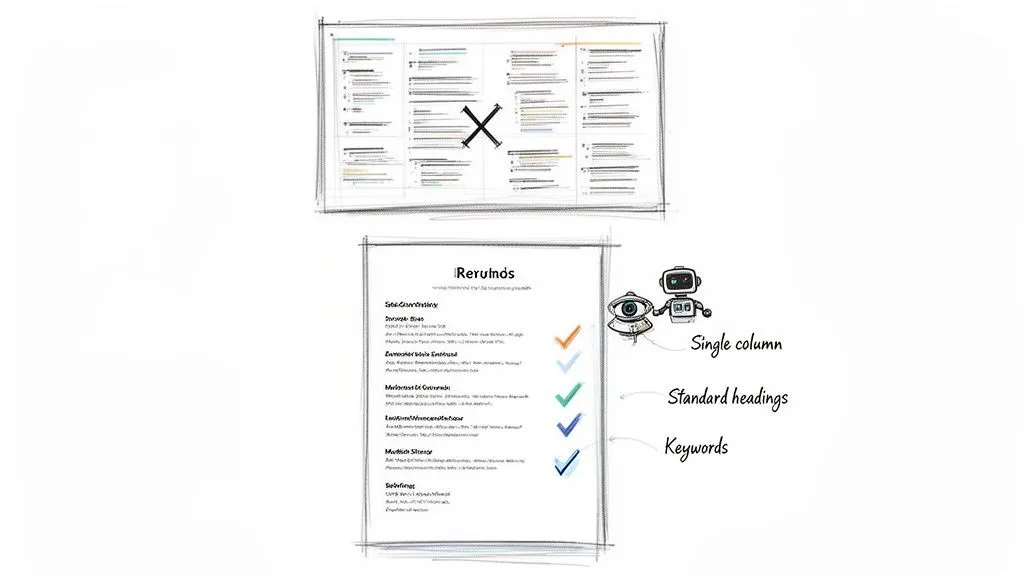
You wrote great content. Now present it cleanly. Fancy fonts, multi-column layouts, and graphics get mangled by Applicant Tracking Systems (ATS).
Your resume has two audiences: a robot and a human. Please the robot first to get to the human. Formatting has to be simple and unbreakable.
Keep It Clean and Simple
The best format is the one that gets read correctly. Forget flashy templates with photos or icons. They confuse the ATS.
Stick to these unbreakable rules:
-
Single-Column Layout: The gold standard. It ensures the software reads your information in the right order.
-
Standard Fonts: Arial, Calibri, or Helvetica. Easy to read and parse.
-
Ideal Margins: Set them between 0.5 and 1 inch. This creates white space and avoids a cluttered look.
The goal is zero friction. Your formatting should be so clean that your achievements are the only thing the reader notices.
Optimizing for the ATS Without Sounding Robotic
Beating the robots doesn't mean writing like one. Make your content easy for software to categorize while keeping it compelling for a human.
It’s all about structure and keywords. The ATS is scanning for specific information. Make its job easy.
Use standard section headings:
-
Work Experience (or Professional Experience)
-
Education
-
Skills
-
Projects
Don’t get clever with titles like "My Journey." The software is looking for "Experience" and "Skills." Give it what it expects. This is a huge part of learning how to write an internship resume that gets through the first gatekeeper.
The One-Page Rule for Interns
For an internship resume, one page is the rule. Period. Recruiters expect a concise summary of your potential. Stretching to two pages is a rookie mistake.
It tells a recruiter you don’t know how to prioritize. A tight, single-page resume shows confidence and respect for their time. If you’re struggling to fit everything, edit more aggressively.
The hiring landscape is changing. First impressions are made in 6-8 seconds. Recruiters prioritize skills (86% for grads) and past internships over degrees. While many internships are unpaid, 66% convert to full-time roles with salary bumps. A powerful resume unlocks this.
The only exception? Ph.D. candidates with extensive, relevant research. For everyone else, stick to one page.
Internship Resume FAQ
Let's tackle a few common questions. Getting these details right makes a difference.
What if I Have No Real Work Experience?
This is a myth. Everyone starts somewhere. Stop thinking about "jobs" and start thinking about "projects." Your resume is a showcase of your skills, no matter where you built them.
Untraditional experience is still experience.
-
Academic Projects: Led a team for a class project? Frame it like a professional achievement. "Led a 4-person team to build a marketing plan for a local business, using market research to drive our final strategy."
-
Volunteer Roles: That campus event you helped organize? That's project management. "Coordinated a charity bake sale that raised over $500 for the local food bank, managing promotion and a team of 5 volunteers."
-
Personal Ventures: Built a small website that gets 50 visitors a month? That's web development and SEO.
Connect your actions to the skills the employer wants. Quantify results.
Should I Put My GPA on My Resume?
This is simple. It comes down to the number.
Your GPA is a data point, not a reflection of your worth. Use it strategically.
Here's the rule:
-
3.5 or higher: Absolutely. It’s a strong, positive signal.
-
3.0 to 3.4: Judgment call. If your project experience is the star, let that shine.
-
Below 3.0: Leave it off. Don't volunteer a number that might create a negative first impression. Let your skills and projects do the talking.
More companies are ditching strict GPA cutoffs anyway. They care about what you can do.
Do I Actually Need a Cover Letter?
Yes. Unless they specifically tell you not to. Don't treat it like a chore. It’s a huge opportunity most candidates waste.
Your resume shows what you did. The cover letter explains why you're the right person for this specific role at this specific company. It connects the dots and proves you’ve done your homework.
A generic, copy-pasted cover letter is worse than nothing. Keep it short and sharp. Pull one or two key achievements from your resume and explain how they relate to the company's mission.
Once your resume is polished, get it in front of recruiters. Learn how to add your resume on LinkedIn to build your professional presence.
Tired of fighting with templates and generic bullet points? StoryCV is a Digital Resume Writer that interviews you to uncover your real impact. We turn your experience into a clear, confident narrative that gets you noticed, without the high cost of a human writer. Get your first role written for free at https://story.cv.