You're hiring for a role in a new field. A resume lands in your inbox from someone trying to switch careers. The first lines explain why they want out of their old industry. You still have one question. Can this person do the work?
That is the whole game.
A career switch resume works when it answers the hiring manager's question fast. Show the skills, decisions, and results that already map to the target role. Skip the autobiography. Skip the pitch about passion. If you need help identifying the right proof, start with these transferable skills for career changers.
Hiring teams are shifting in that direction anyway. The trend toward hiring based on skills in Latin America reflects a broader filter. Employers want evidence of ability, not a polished explanation for a career pivot.
That changes how you should read every sample in this guide. These are not templates to copy line for line. They are framing lessons. Each one shows how to present old experience as relevant evidence for the new job.
The rule is simple. Prove fit. Don't defend the switch.
1. Skills-First Resume for Tech Pivot
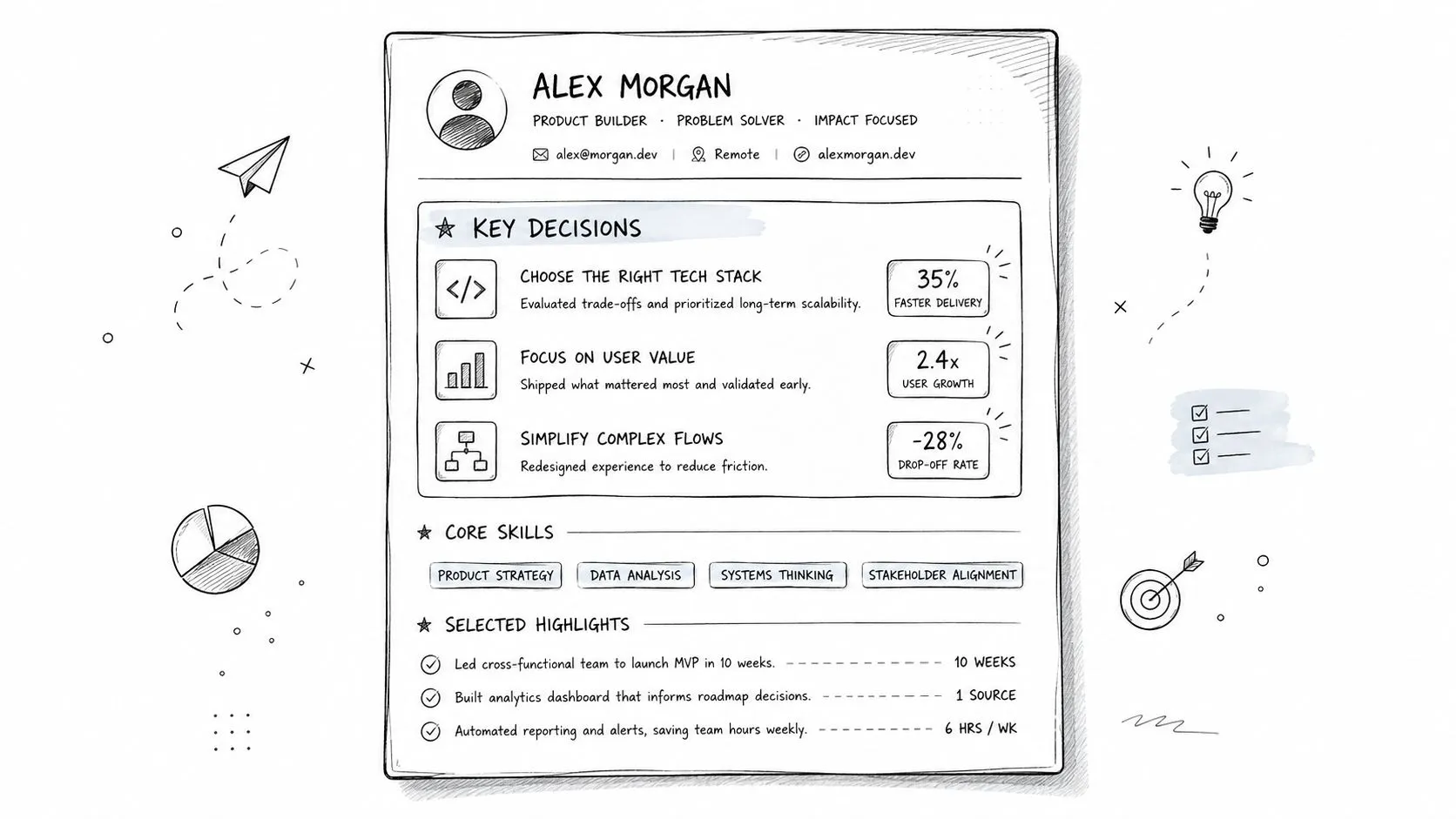
A hiring manager opens your resume for a tech role and sees ten years of unrelated titles. You have seconds to stop the skim. A skills-first structure does that because it shows relevant capability before old job labels.
Use a hybrid resume. Put the proof near the top. Save the full career history for later. Wharton Online and No Nervous Resume both point career changers toward a combination format for exactly this reason: it lets you lead with transferable skills, projects, and results instead of forcing the reader to reverse-engineer your fit.
That is the primary job of this resume. Make the hiring manager think, “This person can already do parts of this role.”
What this looks like
Say you work in HR and want to move into operations. Your old title is not the story. Your operating decisions are.
Write bullets like this:
Built hiring infrastructure that supported growth from 40 to 120 employees. Redesigned onboarding workflows to cut ramp friction. Managed budget decisions across recruiting systems and external vendors.
Now the reader sees systems, process design, and resource management.
A teacher moving into corporate learning should do the same.
Built a 12-week curriculum for mixed-ability learners. Tracked outcomes across the program. Revised delivery based on weak spots to improve retention.
That reads like program design, measurement, and iteration. Good. Those are the signals that matter.
What to put near the top
- Summary with a target-role angle: State the function you can perform, not the industry you want to leave.
- Skills section before work history: BeamJobs recommends this order for career-change resumes: summary, skills, achievements, prioritized work history, then education and certifications (BeamJobs career change resume examples).
- Relevant projects and achievements: Show internal tools work, process redesign, analytics, documentation, automation, or cross-functional execution.
- Translated bullet points: Strip out company jargon and rewrite your experience in the language of the target role. If you need help identifying the right proof, review these transferable skills for career changers.
This structure matches how employers screen now. The shift toward hiring based on skills in Latin America reflects the same filter. Show usable skill first. Let your old titles sit in the background.
2. Engagement-Over-Credentials Resume
You apply for a new field. The hiring manager opens your resume and sees an old job title that does not match the role. They have one question: have you already started doing this work, or are you still explaining why you want to?
That is the whole section.
An engagement-over-credentials resume proves motion. It shows that the switch is already in progress through work, artifacts, and repeated effort. Hiring managers do not need your backstory. They need signs that you can contribute fast.
A graphic designer aiming for UX should not fill the page with taste, tools, and vague interest. Show practice in the field:
- Applied coursework: Completed UX training and used it in redesign work with documented decisions.
- Research output: Ran usability sessions, identified friction points, and changed flows based on findings.
- Visible artifacts: Published case studies, pattern libraries, audits, prototypes, or annotated screenshots that show how you think.
A restaurant manager moving into tech operations should do the same. Surface the parts of the job that map to the new one. Scheduling, throughput, staffing, forecasting, quality control, and bottleneck reduction are operating skills. Put those signals where the reader can see them without digging.
The principle is simple. Prove you can do the new job. Do not spend your best space justifying why you want to leave the old one.
Structure matters here. Put evidence of engagement high on the page so the case is obvious before the reader reaches your timeline. A hybrid format usually works best for this. If you are deciding between layouts, this guide to a functional resume vs chronological resume explains the tradeoff clearly.
Use this order:
- Targeted summary: Name the function you can perform now.
- Relevant projects or practice: Show real output, not class exercises with no stakes.
- Recent learning: Include courses or certifications only if you applied them.
- Work history: Keep it concise and translated into the language of the target role.
One more filter matters. Applicant tracking systems screen for match and readability before a recruiter ever sees your file. Jobscan explains that ATS software ranks resumes against job-specific keywords and formatting patterns, which is why career changers need to mirror the language of the role they want, not the language of the role they are leaving (Jobscan ATS resume guide).
Declared passion does not carry a career switch resume. Evidence does.
3. Judgment-Transfer Resume
A hiring manager opens your resume and sees your old title first. They sort you into the old box fast. That is the problem this format solves.
Use a judgment-transfer resume when your value is not a tool, credential, or side project. It is how you think. How you prioritize. How you make tradeoffs under pressure. Your job is to make that judgment visible before the reader scans your titles and dismisses the switch.
A hybrid layout works best here. Put decision-making themes first. Put the timeline second. A pure functional resume can look like concealment. A pure chronological resume often obscures the full story. If you want a practical breakdown of the tradeoff, compare the functional resume and chronological resume formats.
Lead with the judgment the new job needs
Old titles are weak headlines. Decision patterns are stronger.
Skip this:
- Experienced Financial Analyst
Use headers like these:
- Strategic Prioritization
- Cross-Functional Decision Making
- Resource Allocation Under Constraints
- Process Improvement
Then support each one with proof. Keep it tight. One line is enough if it shows judgment and consequence.
Financial analyst moving into product management:
Evaluated performance trends, recommended where to invest and where to simplify, and shaped decisions tied to user impact and cost.
Manufacturing engineer moving into supply chain operations:
Found throughput constraints, reset workflow across dependent steps, and improved flow where delays were compounding.
That framing does the work. It shows how you think in a way the target role already values.
Keep the top focused
Use three to five competencies. More than that reads like keyword stuffing.
Then force alignment between the top section and the timeline. If you claim cross-functional decision making, your experience bullets need to show where you handled competing priorities, influenced partners, or made tradeoffs with real stakes.
Editorial rule: The top section states the judgment. The experience section proves it.
Cut older material hard. Early-career roles do not need equal space if they do not strengthen the case for the new role. The AARP guide to resume writing recommends trimming work history to the most relevant recent experience and omitting jobs from many years ago that no longer support your target, which is the right call in a career switch because recent evidence wins attention (AARP resume guide).
4. Contrasted Before-and-After Resume Example
A hiring manager opens your resume for six seconds. The first lines explain why you want out of your old field. You lose.
The fix is simple. Show proof first. Motive is irrelevant until you have earned interest.
Before
Healthcare administrator moving into health tech operations:
“After years in healthcare administration, I'm passionate about using technology to improve patient outcomes and excited to transition into healthcare tech.”
This lead spends valuable space on your intention. Intention does not reduce risk for the employer.
After
Managed clinic operations in a high-volume care environment. Cut patient wait times, found cost savings, and led EMR implementation across core workflows.
Now the reader can place you. Operations. Systems. Rollout work. Measurable improvement. That is the whole game in a career switch. Prove you can do the new job. Do not defend why you are leaving the old one.
The same pattern works in other pivots.
Nonprofit fundraising to business development:
Built and managed a major-donor portfolio, grew annual revenue, and negotiated multi-year partnerships with external stakeholders.
That line works because the mechanics match. Pipeline ownership. Revenue responsibility. Relationship management. The industry changed. The value did not.
What the comparison teaches
A good summary is short because its job is narrow. The resume guide from UC Davis recommends a concise summary of qualifications at the top that aligns your background with the role, which is exactly the right standard for career changers because the top of the page must frame relevance fast (UC Davis Internship and Career Center resume guide).
Use that space with discipline:
- Line one: target role and strongest overlap
- Line two: one or two achievements that match the work
- Line three: recent project, training, or certification only if it closes a real gap
That structure forces the right mindset. You stop writing autobiography and start writing evidence.
If you want more examples of how to frame that evidence, this guide on writing a resume for a career change breaks down how to match proof to the target role.
Write the summary like a verdict, not a confession.
5. Industry Translation Resume
A hiring manager opens your resume for a compliance job in finance and sees HIPAA, patient audits, and hospital reporting. They should not have to decode any of it. If they have to translate your background, you already made the read harder than it needs to be.
Industry translation resumes fix that problem. The job did not change as much as the setting did. Your task is to rewrite your experience in the language of the target business.
A compliance manager moving from healthcare to financial services still handles controls, audits, risk gaps, documentation, and adherence. An operations leader moving from ecommerce to manufacturing still manages throughput, inventory, vendors, forecasting, and cost. Hiring managers screen for the mechanics first. Industry labels come second.
Translate the work, not the history
Career changers lose ground here because they copy old terminology straight from their last title and expect the reader to connect the dots. The reader will not do that extra work.
A StoryCV research interview points to the same problem. Hiring managers reject resumes that stay stuck in the old industry's jargon because the candidate's fit stays fuzzy instead of obvious (StoryCV research interview video).
Write for the target reader's mental model.
So instead of this:
Managed patient compliance reporting and HIPAA audit remediation.
Write this:
Designed compliance reporting workflows, ran audits, closed risk gaps, and improved adherence to regulatory standards.
The second version travels. It keeps the substance and strips out the context that narrows you.
How to frame the switch fast
Use one plain-English line near the top that names what carries over.
- Healthcare to finance: Compliance process, audit discipline, and risk control transfer directly.
- Ecommerce to manufacturing: Forecasting, inventory control, vendor coordination, and process improvement transfer directly.
Then make your bullets match that framing. Choose verbs and outcomes the new industry already uses. If you need help translating those bullets, this guide on writing a resume for a career change breaks down how to reframe old experience for a new audience.
Skip long lists of vague transferable skills. Show transfer in the wording of the work itself. That is what makes a hiring manager believe you can do the new job.
6. Portfolio-Backed Resume
If your target role can be shown, show it. Don't make the reader trust prose when they could verify the work.
That's why portfolio-backed resumes work so well for career pivots into design, analytics, product, content, engineering, and research.
A strong portfolio-backed career switch resume sample is light on explanation and heavy on receipts.
What to include
If you're an accountant moving into data work, link to notebooks, dashboards, and short write-ups. If you're a graphic designer moving into UX, link to case studies, prototypes, usability findings, and system decisions.
Each project entry should answer four things:
- Problem: What were you trying to solve?
- Approach: What did you analyze, design, build, or test?
- Outcome: What changed?
- Learning: What would you improve next?
Resume bullets are stronger when they follow a tight formula. Jobboy's makeover guidance frames the best version as action verb, what you did, quantifiable result, and business impact (resume makeover case studies).
Keep the links clean
Dead links kill confidence. So do sloppy repos and vague case studies.
Add one line of context under each project. Then link out to the artifact. If the work is code, document it. If it's design, explain decisions. If it's analytics, show the question, method, and output.
Here's a practical walkthrough worth watching before you organize project proof on the page:
You don't need more adjectives. You need cleaner evidence.
7. Mentor-Backed Resume
A hiring manager sees your old title, pauses, and asks one question. Who has already pressure-tested this person for the work they want now?
That is the only reason mentorship belongs on a resume. It is not there to impress. It is there to reduce doubt.
Show the work the mentor shaped
Skip prestige signals. Skip company-name worship. State the operating value of the relationship.
Use language like this:
Product strategy mentorship focused on roadmap tradeoffs, prioritization decisions, and case study critique.
Or:
Operations mentorship centered on workflow design, process documentation, and review of pilot recommendations.
This works because it tells the reader what got better. Your thinking. Your output. Your judgment.
What hiring managers trust
Three things make mentor-backed experience believable:
- Clear scope: State the topic or decision area the mentor reviewed.
- Concrete artifact: Tie the mentorship to a case study, memo, presentation, prototype, or audit.
- Real permission: Mention a mentor only if they agreed to be named or contacted.
The strongest move is to connect mentor input to a visible revision. That gives the relationship a job on the page.
For example, in a portfolio case study, add one line like this: “After mentor review, I cut two vanity metrics, changed the recommendation criteria, and rebuilt the final dashboard around retention risk.” That shows coachability and stronger judgment. It also proves the feedback changed the work.
Outside hiring, the pattern is the same. Early credibility often comes from trusted relationships plus visible output, which is why curated resources like Storyloft's literary agent guide matter to first-time authors. The contact opens the door. The pages still have to hold up.
Use mentorship as corroboration. Never as the headline. The resume still has one job: prove you can do the new role.
7 Career-Switch Resume Approaches Compared
| Resume approach | 🔄 Complexity | ⚡ Resources | 📊 Expected outcomes | ⭐ Key advantages | 💡 Ideal use cases |
|---|---|---|---|---|---|
| Skills-First Resume for Tech Pivot | Moderate, reframing past decisions into target-domain language | Low–Moderate, time to analyze and rewrite; no new work required | Faster pass in initial screens; hiring manager sees competence quickly | Surfaces transferable judgment early; efficient use of resume space | Adjacent pivots (e.g., sales→PM, ops→data) where past decisions map to new role |
| Engagement-Over-Credentials Resume | High, documents sustained engagement and outputs | High, projects, certifications, case studies, measurable time investment | Convinces employers you've been doing the work; closes credibility gap | Demonstrates initiative and domain knowledge without formal credentials | Complete pivots with no relevant degree or job title; learners who produced real work |
| Judgment-Transfer Resume (Functional Hybrid) | Moderate, craft competency section + chronological evidence | Moderate, requires selecting competencies and matching achievements | Balances ATS pass rate with human-readable judgment proof | Works for senior hires; shows judgment and track record together | Mid‑to‑senior switchers (5+ years) needing ATS compatibility and narrative clarity |
| Contrasted Before-and-After Resume Example | Low, editing sequencing and language | Low, rewrite summary/bullets to show decisions first | Improves clarity; reduces justification language that harms fit signal | Teaches an actionable principle applicable across roles | Anyone diagnosing/rescuing a switcher resume; quick editorial fix |
| Industry Translation Resume (Same Skills, New Vertical) | Moderate, translate constraints and reword context | Low–Moderate, time to map and write a concise translator sentence | Rapid acceptance when skills genuinely transfer; clarifies portability | Fastest path when core skills already strong; minimal reinvention | Same-discipline moves to new vertical (e.g., ops → manufacturing) |
| Portfolio-Backed Resume (Proof Through Projects) | High, assemble, polish, and link work artifacts | High, real projects, working links, documentation, hosting | Strong verifiable credibility; hiring managers can validate claims | Eliminates trust gap with tangible evidence of ability | Creative, technical, analytical pivots where work can be shown publicly |
| Mentor-Backed Resume (Credibility Through Relationships) | Low–Moderate, document structured mentorship and outcomes | Moderate, requires genuine relationships and permission to list | Adds a credibility signal that can accelerate review | Provides external validation without extensive portfolio | Switchers with limited field experience but strong mentor ties |
The Interview Goes to Proof, Not Passion
A hiring manager opens your resume with 20 seconds to spare. The first line says you are "seeking to transition" into a new field. You just made them do extra work. They still do not know whether you can do the job.
Start with proof of fit. Save the career-change story for later.
A strong career switch resume does three jobs fast. It shows you understand the target role. It shows you have already made decisions that match that work. It shows this move is backed by action, not impulse. That is the filter. Hiring managers are not grading your courage. They are checking for evidence.
Format matters because order matters. A hybrid resume often works better for a switcher because it puts relevant skills, projects, and results before older titles pull attention in the wrong direction. A review from Professional Resume Free's career changer examples makes the same point. Put transferable proof first, then support it with work history.
Results matter more. A vague line like "passionate about data analytics" does nothing. A line like "built a reporting dashboard that cut weekly manual reporting by 6 hours" gives the reader a reason to keep going. As noted earlier, resume guidance for career changers keeps coming back to the same rule: replace responsibilities with measurable outcomes. Numbers work because they reduce doubt.
Keep your explanation short. Your resume is not the place to defend your exit from the old field or narrate a personal reinvention. Its job is narrower. Show that you can already operate in the new one.
That is the pattern across every sample in this article. The useful ones do not argue for potential. They frame existing evidence so a hiring manager can recognize it quickly.
If you want help writing that kind of resume, StoryCV is an online resume writer that uses a guided interview to turn your experience into clear, targeted drafts. That helps career changers because the usual problem is not lack of value. It is weak translation.
The interview goes to the candidate who already looks capable on paper.