Most advice on functional resume vs chronological resume is lazy. It treats format like a cosmetic choice, as if you're picking a font.
You're not.
You're deciding how a stranger will read your career story under time pressure. That's the core issue. A resume format either makes your story obvious or forces the reader to do extra work. Recruiters hate extra work. So do hiring managers.
If your background is clean and linear, don't get cute. If your background is messy, don't pretend it isn't. Pick the format that helps your strongest story land fast.
Stop Agonizing Over Resume Formats
People overthink resume formats because the internet makes it sound like a personality test. It isn't. It's a packaging decision.
A format only matters because it changes what gets noticed first, nothing more. In the functional resume vs chronological resume debate, the right question isn't “Which one is better?” The right question is “What story needs to be understood immediately?”
Two stories, two structures
A chronological resume tells a progression story. It says: here's where I worked, here's how I grew, and here's what I did most recently.
A functional resume tells a skills-first story. It says: ignore the sequence for a second, look at the capabilities.
That distinction matters because most resume problems are really story problems:
- Stable career, weak resume: Your experience is fine. Your presentation is muddy.
- Career change: Your timeline doesn't explain your value on its own.
- Employment gap: Dates draw attention before your skills do.
- Mixed background: The raw facts are true, but the order hurts you.
The format doesn't create a good story. It either supports one or gets in the way.
The decision is simpler than people make it
You probably don't need a dramatic reinvention. You need a format that reduces friction.
Use chronological when your recent work supports your next move. Use functional only when your timeline actively fights your case. And for plenty of people in the middle, the smarter answer is a hybrid approach, not a pure functional one.
That's the whole game. Not templates. Not colors. Not “modern design.”
Readability first. Narrative second. Decoration last.
The Default Choice Chronological Resumes
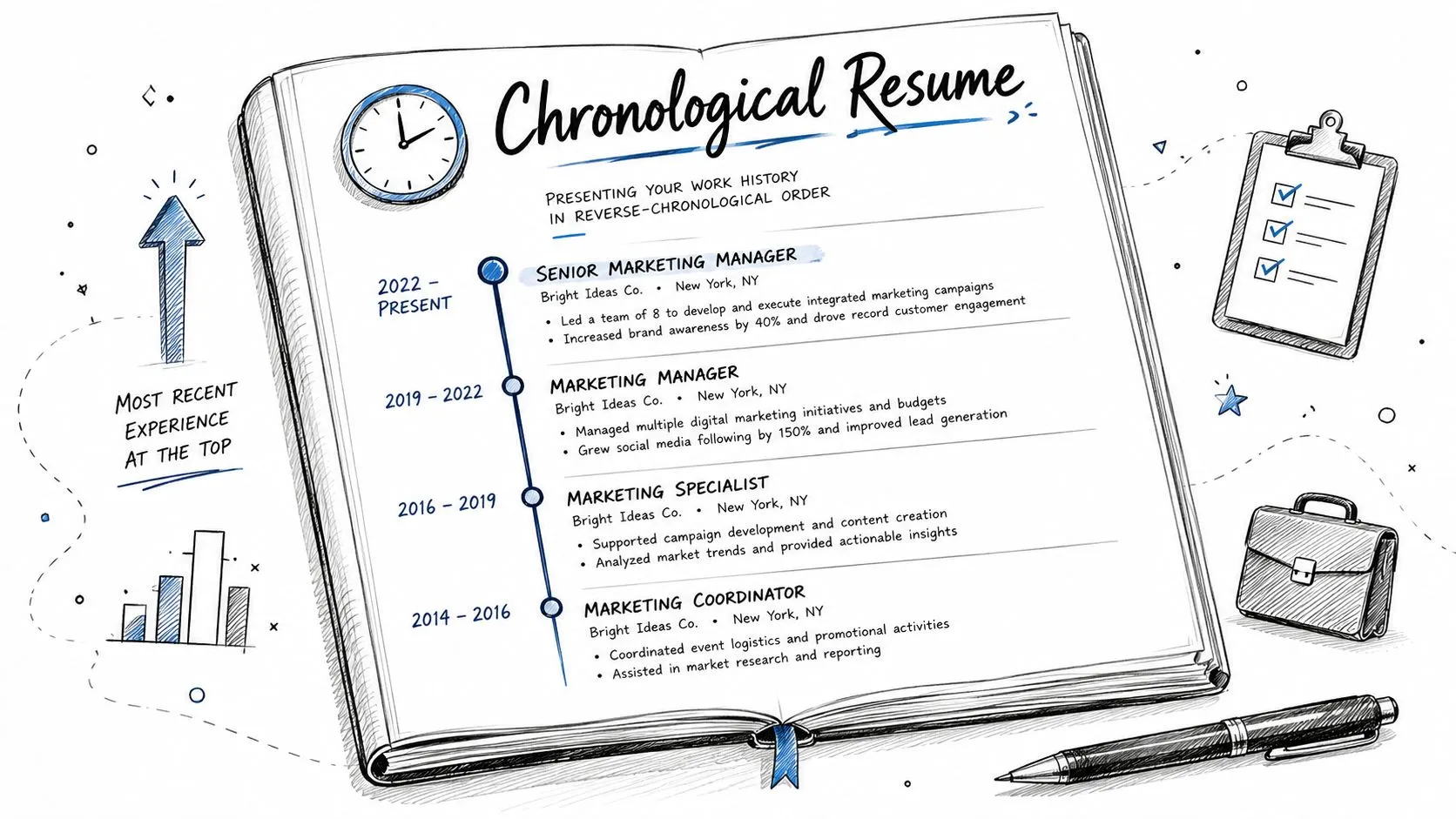
A chronological resume lists your work history in reverse order, with your latest role first. That sounds obvious because it is. Employers want to know what you've done lately, and this format answers that question immediately.
One hiring guide says reverse-chronological is the default, and Indeed notes that about 90% of recruiters prefer the reverse-chronological format. That's not subtle. It's the market telling you what feels familiar, easy to scan, and low-risk.
Why chronological keeps winning
Recruiters usually don't read resumes like novels. They scan for signal.
Chronological format works because it puts the signal where they expect it:
- Recent role first: They can judge your current level fast.
- Clear progression: Promotions, scope changes, and industry consistency are easy to spot.
- Dates attached to jobs: Nobody has to guess when you did what.
- Lower cognitive load: The reader doesn't have to reconstruct your timeline.
If your career has no significant employment gaps, and you're applying in the same field, chronological is usually the best answer. It supports the strongest version of a straightforward story.
What a good chronological resume actually looks like
A solid chronological resume usually focuses on your most recent 10 years of experience, with skills and education lower on the page. That's useful for one reason. It keeps attention on the work that most directly explains your current value.
Here's the basic structure:
| Section | What goes there | Why it works |
|---|---|---|
| Header | Name, contact info, target role | Gets the admin stuff out of the way |
| Summary | Short positioning statement | Frames your level and direction |
| Experience | Roles in reverse order | Shows momentum and relevance |
| Skills | Tools, methods, domain strengths | Supports the work history |
| Education | Degrees, certifications | Keeps credentials visible without stealing space |
Practical rule: If your timeline already makes sense, don't replace it with a puzzle.
Chronological resumes aren't exciting. Good. Your resume isn't there to entertain. It's there to make your case easy to believe.
The Strategic Tool Functional Resumes
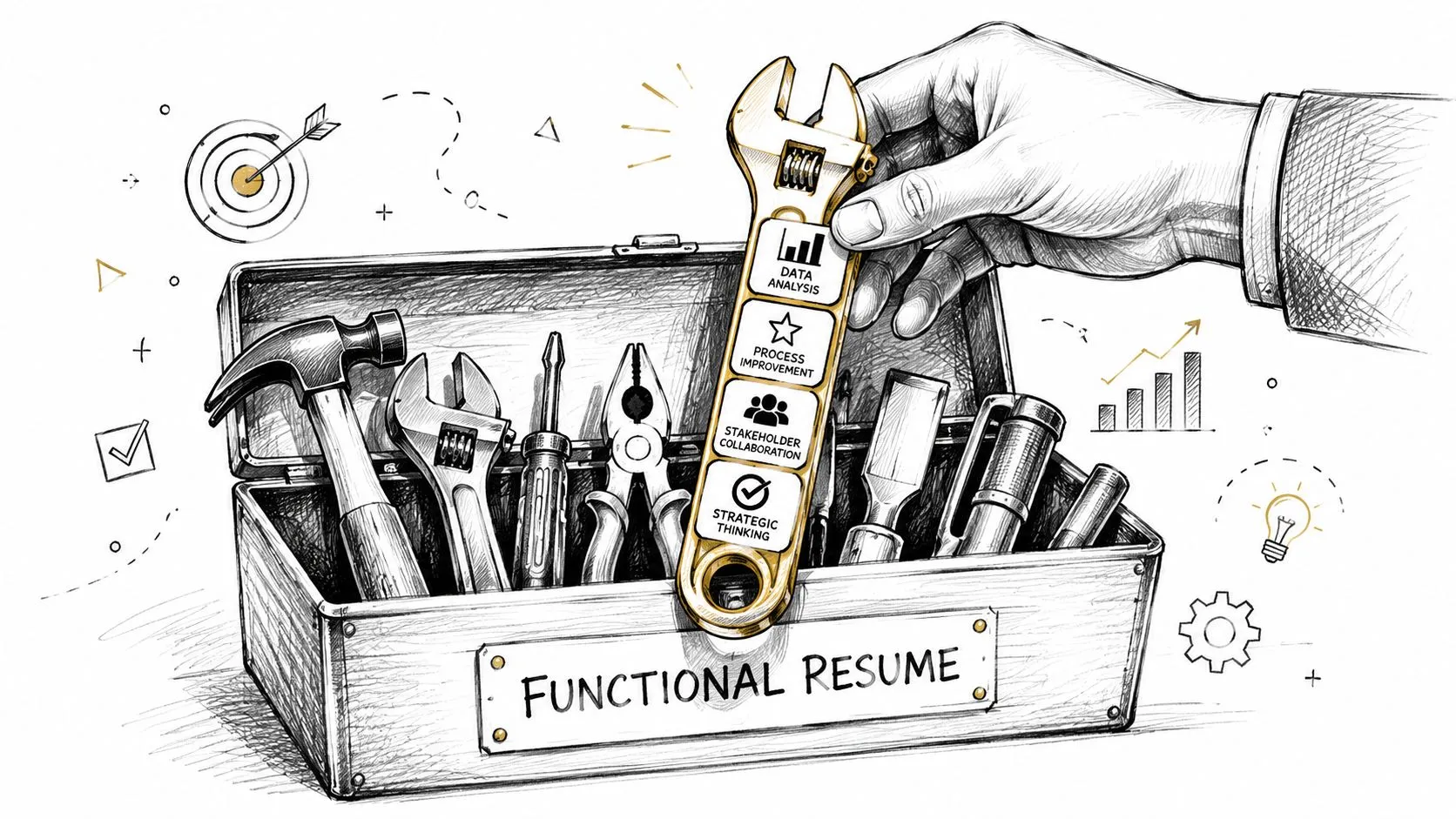
A functional resume puts skills at the top and pushes the timeline down. Sometimes dates are minimized. Sometimes work history gets reduced to a short list. That's not automatically bad. It's just a very specific move.
This format exists for people whose chronology doesn't help them enough on its own. Goodwill notes that a functional resume is commonly used by people new to the workforce, switching fields, or dealing with significant employment gaps, and also notes that chronological is still the format “preferred by almost all recruiters” in the broader market in its breakdown of chronological and functional resumes.
When functional makes sense
A functional resume can help when the timeline distracts from the value:
- Career change: You need transferable skills to lead the conversation.
- Re-entry after a gap: You want capability to show up before chronology.
- Unconventional path: Contract work, project work, and mixed roles can look cleaner when grouped by skill.
- Thin direct experience: You have relevant ability, but not a neat ladder of titles.
If you're changing careers, this guide to career change resumes is worth reading because it focuses on reframing experience instead of pretending the old story still works. And if your issue is weak bullet points, not weak experience, fix that first with this article on how to write achievements in resume.
The catch nobody likes to admit
Functional resumes can look evasive.
That's the problem. Not because you're hiding something, necessarily, but because the format has trained recruiters to wonder what got hidden. If dates are vague and employers are buried, the reader starts solving for risk instead of noticing your strengths.
A functional resume is a strategic exception, not a clever shortcut.
Use it when your skills tell a stronger story than your sequence of jobs. Otherwise, you're paying a credibility tax for no reason.
Functional vs Chronological The Real Tradeoffs
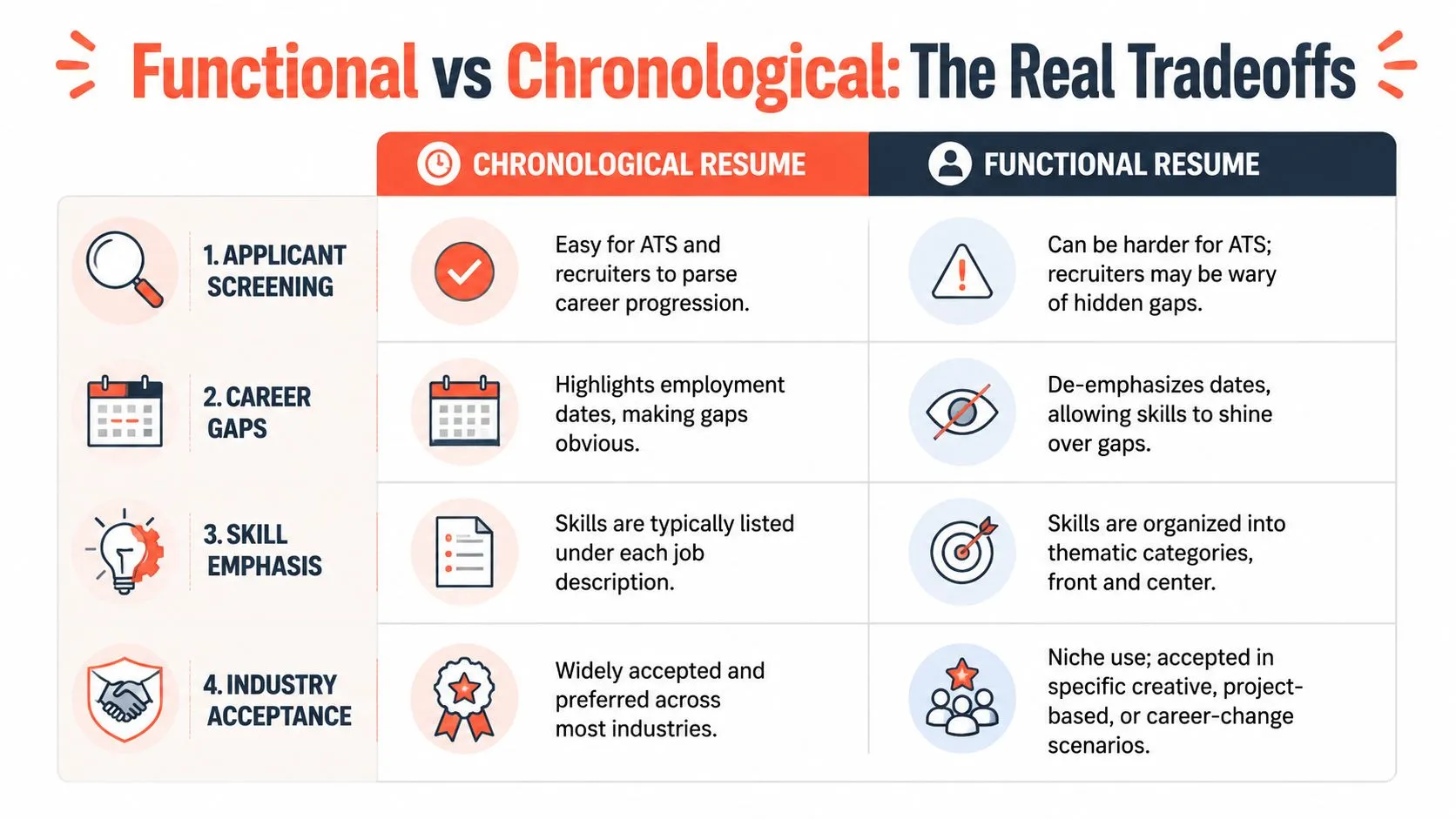
The cleanest way to compare functional resume vs chronological resume is to stop talking about “style” and start talking about consequences.
Side by side comparison
| Criteria | Chronological resume | Functional resume |
|---|---|---|
| Applicant screening | Easy to parse quickly | Can require more interpretation |
| Recruiter readability | Timeline is obvious | Reader has to piece together sequence |
| Storytelling | Shows momentum and progression | Shows capability clusters |
| Career gaps or pivots | Makes gaps more visible | Softens timeline issues by leading with skills |
| Market acceptance | Standard and expected | Niche and more situational |
ATS and screening risk
The functional resume quickly begins to lose points. Indeed Flex notes that de-emphasized dates can confuse applicant tracking systems and can make it look like information is being hidden.
That doesn't mean ATS will reject every functional resume on sight. It means you're adding friction in a process already built around speed and pattern recognition.
Hard truth: If a recruiter has to decode your structure, your content had better be exceptional.
Chronological is safer because the machine understands it and the human expects it. That's not glamorous, but neither is getting filtered out.
A quick visual helps if you're still undecided.
Recruiter readability
A recruiter reading a chronological resume can move fast. Company, title, dates, scope. Done.
A recruiter reading a functional resume has to ask extra questions. Where did this happen? How recently? For how long? Was this one job or three? The more questions they need to answer alone, the less confident they feel.
That's why chronological tends to feel trustworthy even when the writing is average. The structure itself does part of the work.
Storytelling power
Chronological tells a moving story. It has direction. It shows how one role led to the next.
Functional tells a static story. It can present strong themes, but it often loses the sequence that makes growth believable. Skills without context can read like claims. Skills attached to jobs read like evidence.
Chronological says, “Here's how I grew.” Functional says, “Here's what I can do.” Most employers want both, but they usually trust growth evidence first.
Handling gaps and career change
This is the one area where functional has a real advantage. If your timeline is messy, putting skills first can stop the reader from fixating on the mess.
But don't confuse “de-emphasize” with “erase.” A missing timeline doesn't become less important just because it's lower on the page. It just becomes a follow-up question later.
So Which Resume Format Should You Use
Here's the blunt answer. A chronological resume is typically the best option. A smaller group should use hybrid. Very few should use pure functional.
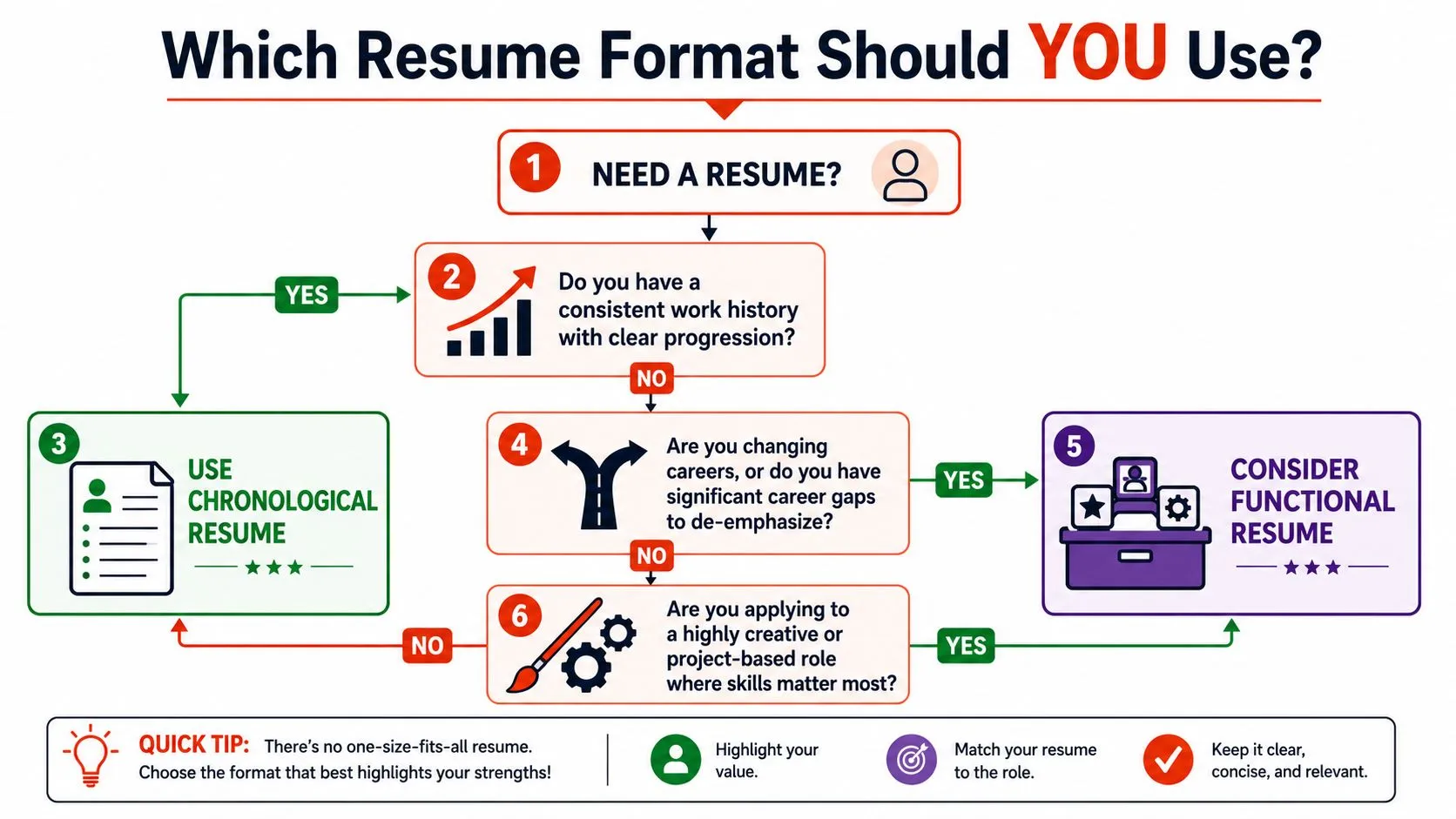
Use this decision rule
- Consistent work history with clear progression? Use chronological.
- Changing careers or trying to soften significant gaps? Consider functional, but only if your skills case is stronger than your timeline.
- Need both credibility and reframing? Use hybrid.
The hybrid format is usually the grown-up answer. It starts with a sharp summary and selected skills, then gives an efficient chronological work history. You get the clarity recruiters want and the positioning you need.
My recommendation by situation
- Mid-career professional in the same field: Go chronological. You're not trying to hide anything, so don't act like you are.
- Career changer: Use hybrid first. If the chronology still sabotages you, then consider functional. This guide on how to write a career change resume is a better place to start than blindly grabbing a template.
- Senior leader with a long history: Chronological, but trimmed. Focus on recent, relevant roles and stop treating every job since the early internet as sacred.
- Project-heavy creative professional: Hybrid works well because you can foreground capabilities while still proving where the work happened.
- Returner after a major gap: Hybrid is usually safer than pure functional because it keeps trust intact.
What not to do
Don't use functional because writing achievements feels hard.
Don't use chronological if your story clearly needs context up front.
And don't confuse “different” with “better.” A weird format isn't strategy. It's often just avoidance.
If your experience is strong, make it easy to verify. If your path is unusual, explain it clearly. That's the whole job.
From Format to Narrative The Final Step
Even the right format won't save weak writing. A clean chronological resume filled with job duties is still dead on arrival. A functional resume packed with vague skill labels is just a prettier version of the same problem.
The core work is turning experience into evidence.
Before and after
Bad bullet:
- Managed cross-functional projects and worked with stakeholders to improve processes.
Better bullet:
- Led a cross-functional operations cleanup across finance, support, and product, fixing handoff issues that were slowing customer escalations and giving leadership a clearer view of recurring bottlenecks.
The second version works because it gives context, action, and consequence. It sounds like someone who did the work, not someone filling space.
Another one:
- Responsible for onboarding new team members.
Better:
- Built and ran onboarding for new operations hires, turning scattered tribal knowledge into a repeatable process with documented workflows, training checkpoints, and clearer role expectations.
Tailor the story, not just the format
A resume should match the job you're applying for, not the job you happened to have. That's why tailoring matters. This guide on tailoring your resume to a job description gets into how to adjust the emphasis without rewriting your entire career from scratch.
That's the final piece people miss in the functional resume vs chronological resume argument. Format is the container. Narrative is the lever. If the story is flat, the format debate won't rescue it.
StoryCV is a Digital Resume Writer, not another template box. It uses a guided interview to pull out the essential substance of your work, then turns it into a clear, ATS-friendly narrative that sounds like you on your best day. If you're tired of wrestling with format decisions and lifeless bullet points, start there.