Most AI resume summaries sound like they were written by the same tired intern. That's not because the model is broken. It's because people feed it mush.
If you type "write my summary" and hand over a vague job title, you'll get vague corporate wallpaper back. An AI resume summary writer only becomes useful when you give it raw material worth shaping, which is the part many job seekers skip.
Why Most AI Resume Summaries Sound the Same
The bad advice says the AI needs better wording. Wrong. It needs better evidence.
The real problem is extraction
A summary is not a place to cosplay as “results-driven” and “dynamic.” It's a tight frame for your actual value, and the model can't invent that for you. That's why the strongest workflows start with extraction, not generation. The candidate has to surface role, context, proof, and constraints before the AI writes a single line.
Practical rule: If you can't explain your work to a recruiter in plain language, an AI summary won't save you. It'll only hide the problem behind smoother sentences.
This is the same reason a good how to craft a dating profile process starts with specifics, not generic “fun facts.” Good writing comes from useful inputs. Bad writing comes from pretending the prompt is the whole job.
The market already treats AI help as normal. In early 2024, 45% of job seekers reported using generative AI to create, revise, or refine résumés, according to a Forbes summary of research published that January. That means the bar is no longer “can AI help?” It's “can you make the output sound like a real human with real experience?” Forbes summary of January 2024 research
StoryCV's ChatGPT for resume writing guide makes the same point in plainer language, the model is only as sharp as the material you feed it. That's the whole game.
The Five Inputs Every AI Resume Summary Prompt Needs
A decent prompt is specific. A strong prompt is structured. A great prompt gives the model no excuse to drift.
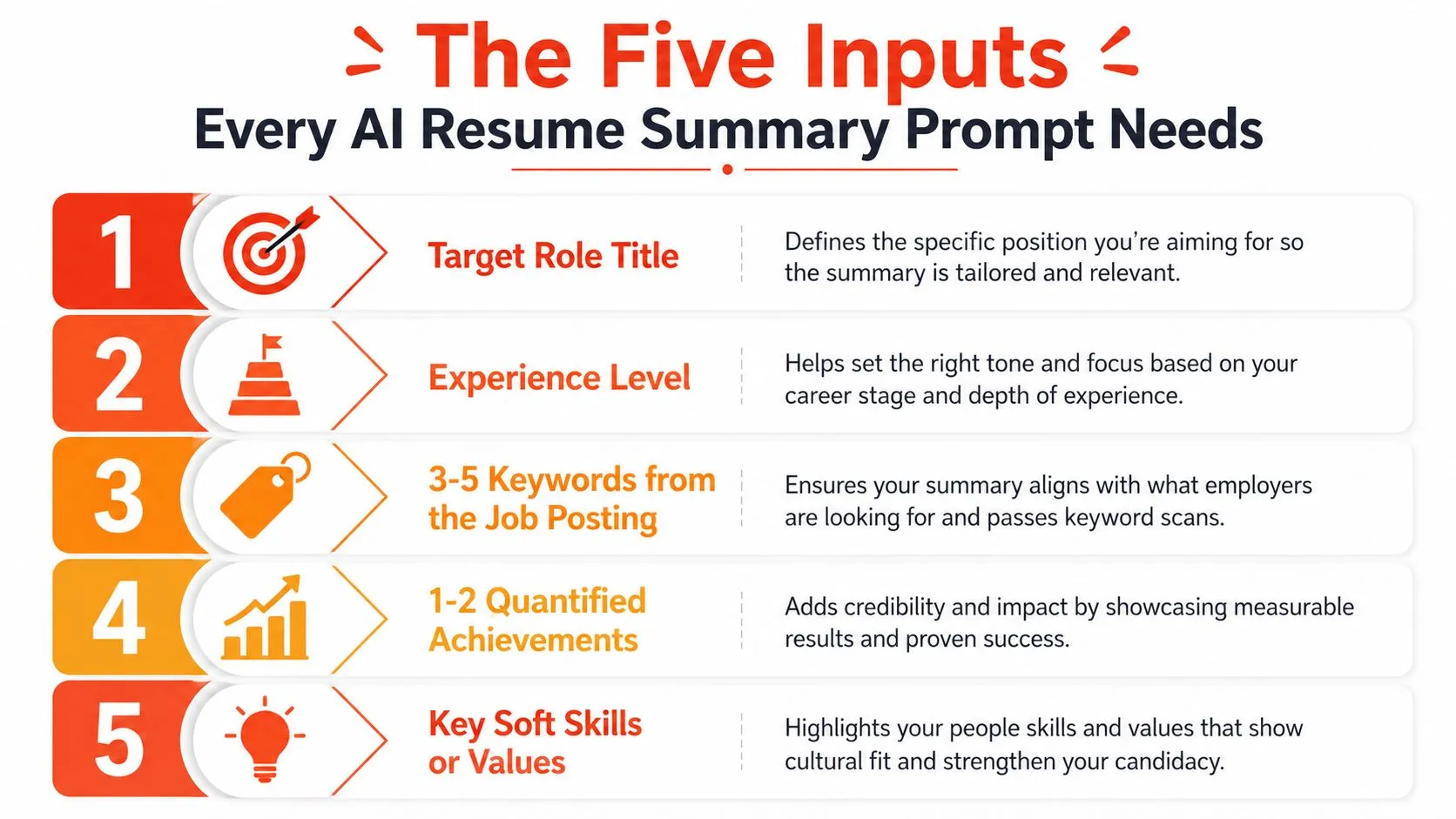
1. Target role title
Weak input, “I work in marketing.” Strong input, “B2B Demand Generation Manager.” The model needs the destination, not your department. If you blur the role, the summary blurs too.
2. Experience level
Weak input, “I have experience.” Strong input, “6 years in revenue operations.” Experience level changes tone, seniority, and what gets emphasized. A junior summary and a senior summary should not sound interchangeable.
3. Three to five keywords from the job posting
Weak input, “SEO, leadership, communication.” Strong input, “pipeline generation, ABM, HubSpot, lifecycle marketing, cross-functional planning.” Pull the language from the posting itself, then keep it tight. The more generic the keyword list, the more generic the draft.
4. One or two quantified proof points
Weak input, “I improved performance.” Strong input, “grew pipeline by 40% through ABM campaigns.” You don't need six metrics. You need one or two that prove you're not just talking.
5. Output constraints
Weak input, “make it good.” Strong input, “Write 3 sentences, 60 words max, no buzzwords, no first person.” Constraints keep the model from rambling. Without them, you'll get a paragraph that sounds busy and says almost nothing.
Use this structure: role title, experience level, job keywords, proof points, and output limits. Then ask for one draft, not a pile of sludge.
A practical prompt looks like this, “Write a 3-sentence resume summary for a Senior Product Operations Manager with 8 years of experience. Use these keywords: workflow automation, stakeholder alignment, reporting, analytics, process improvement. Include these proof points: reduced manual reporting time, supported quarterly planning. Keep it at 50 to 75 words.”
That's not magic. It's discipline.
StoryCV's impact statements guide pairs well with this approach because the summary should sound like a compressed impact statement, not a self-congratulatory bio.
Before and After Summaries for Real Job Seekers
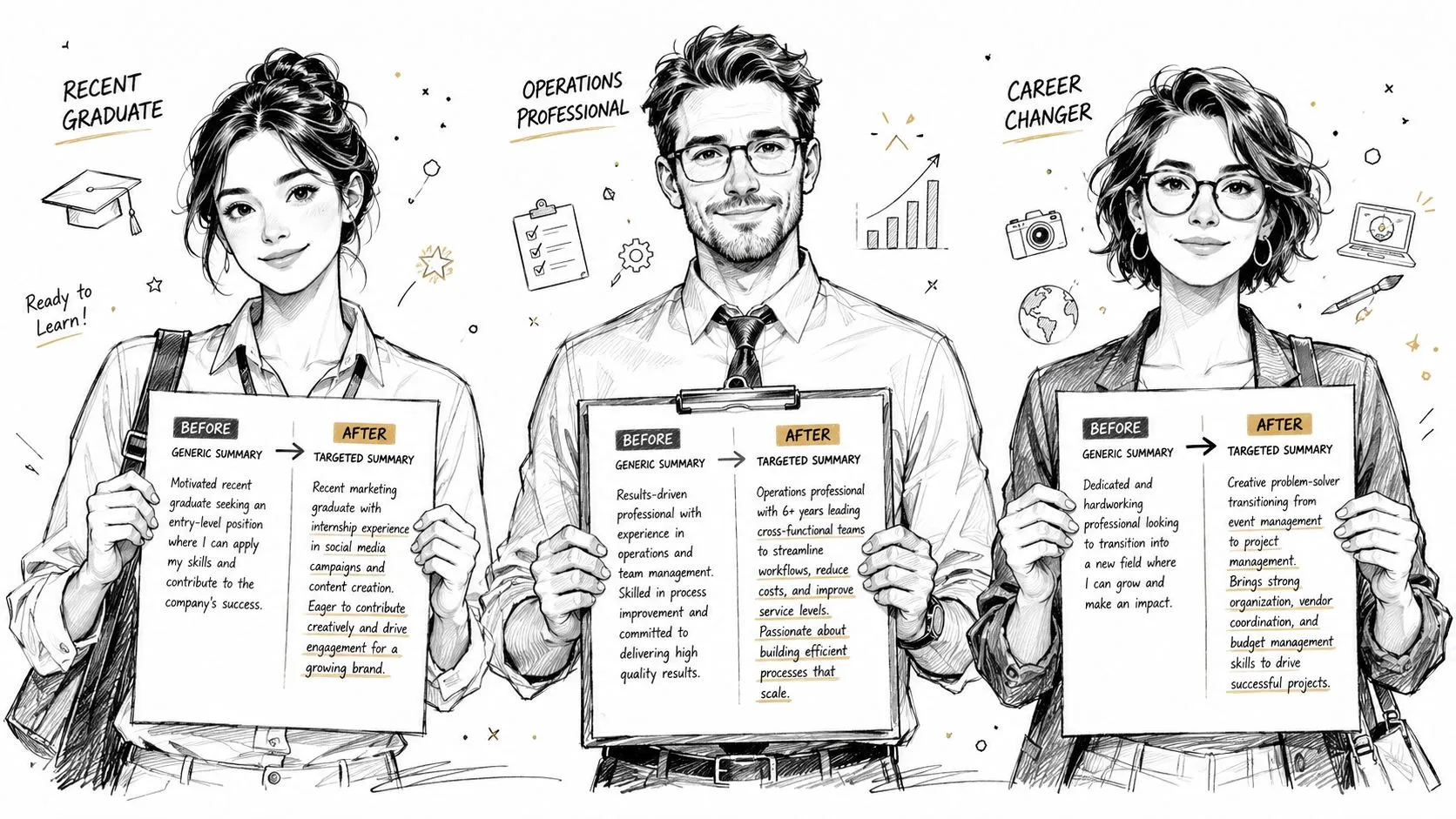
A lot of AI summaries fail because the user never gave the model anything worth keeping. Here's what that looks like when you fix it.
Recent graduate with internship experience
Before, “Motivated recent graduate with strong communication skills and a passion for learning.”
After, “Recent marketing graduate with internship experience supporting social media content, basic campaign reporting, and brand copy. Comfortable working across creative tools, collaborative teams, and fast-turnaround projects.”
The after version doesn't pretend the candidate is senior. It gives the reader a usable frame. That's what a summary should do.
Mid-level operations professional moving up
Before, “Results-driven operations professional with a track record of success in fast-paced environments.”
After, “Operations professional with 6 years of experience improving reporting workflows, coordinating cross-functional work, and tightening execution across internal teams. Known for building structure in messy processes and keeping stakeholders aligned.”
The rewrite works because it names the actual job of the person. No fluff. No fake drama.
Career changer translating military experience
Before, “Hardworking leader seeking new opportunities in business.”
After, “Former military team lead with experience managing people, enforcing process discipline, and handling high-pressure coordination. Brings calm execution, strong accountability, and transferable leadership to operations-focused roles.”
That's credible. It translates experience instead of flattening it.
The pattern is simple. Say what you did, then compress it. If you don't have a clean metric, don't fake one. Use context, scope, and responsibility.
Tailoring Your Summary to Different Roles and Industries
One summary for every job is lazy. Hiring managers can smell it immediately.
Build a master summary, then swap parts
Keep one core version that captures your identity, then create modular pieces for different roles. For a fintech role, emphasize accuracy, process control, risk awareness, and scale. For a nonprofit role, focus on stakeholder coordination, mission alignment, and resourcefulness. Same person, different framing.
The keywords should change first. The proof points should change second. The tone should change last. If the posting cares about operational rigor, don't lead with creative flair. If the posting values client-facing work, don't bury the relationship side of your experience.
You can also tune the length to the company's style. A concise startup summary should read faster than a summary for a formal enterprise role. The content stays honest either way.
Good tailoring is subtraction. Remove whatever doesn't help this employer see the match.
A useful workflow is to keep three versions of your summary on hand, one for broad business roles, one for specialist roles, and one for leadership-track roles. That way, you're not starting from zero every time. You're editing with purpose.
Common Mistakes That Quietly Kill Your Interview Rate
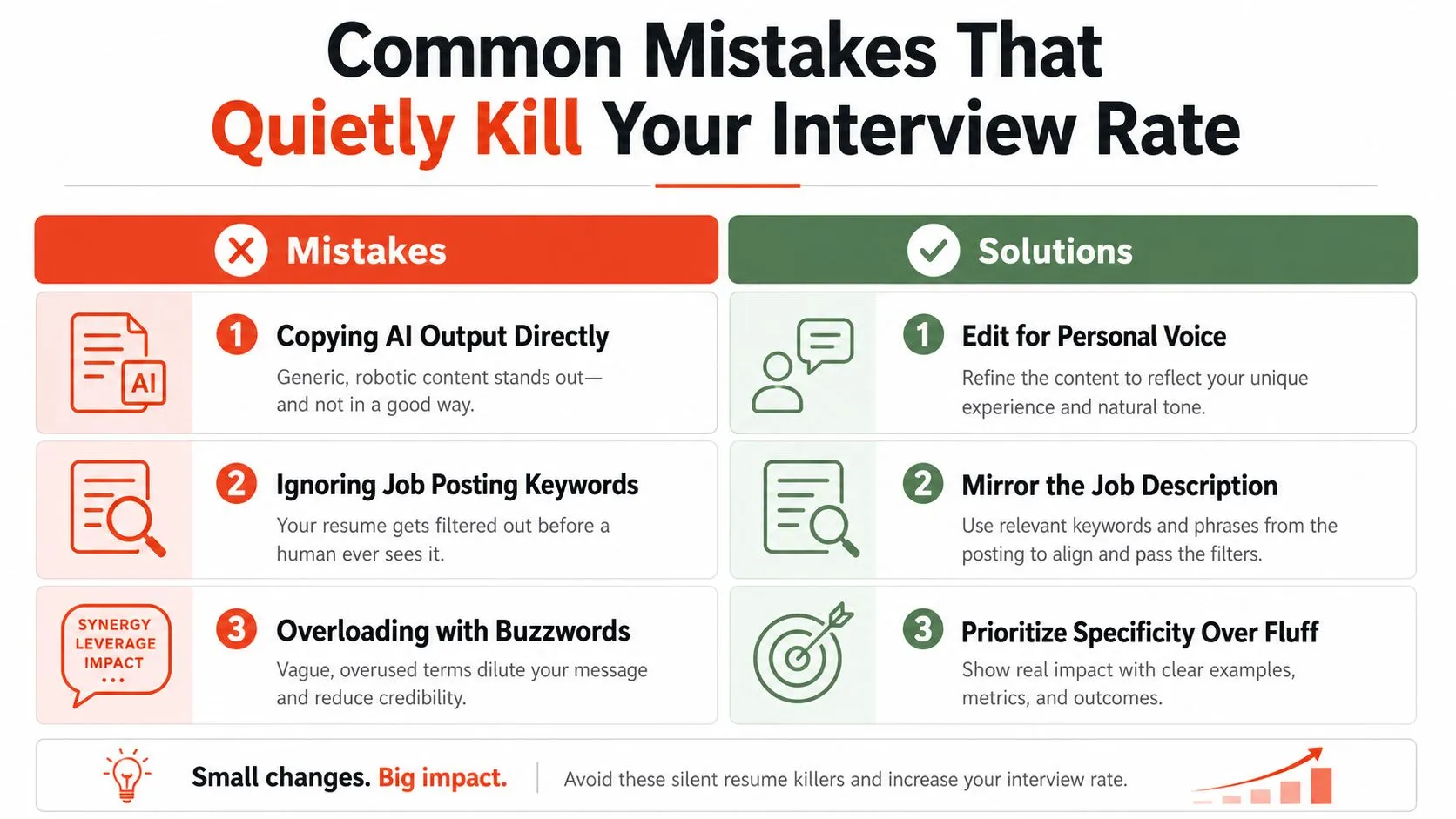
A weak summary doesn't just look sloppy. It makes people doubt the rest of the resume.
The mistakes that cost you
Copying AI output without editing is the fastest way to sound fake. The model may produce a clean sentence, but if it doesn't match your actual experience, you've just made the lie easier to spot.
Writing an objective when you already have experience wastes valuable space. For candidates with real work history, Kickresume says to use a professional summary instead of an objective, while people without professional experience should emphasize education, coursework, internships, volunteer work, and transferable skills. Kickresume career summary guidance
Repeating the rest of the resume is another quiet killer. A summary isn't a second experience section. It's the headline version of your story.
Buzzword stuffing is the easiest way to get ignored. The best summaries are specific, not inflated. That lines up with the broader guidance from resume generators that recommend a structured narrative, measurable results, and role-relevant language, rather than vague claims. Writing Tools resume summary guidance
If you want a clean self-audit, use this filter:
- Voice check: Does it still sound like you?
- Truth check: Can you defend every claim in an interview?
- Role check: Does it match the job posting's language?
- Length check: Is it brief, or did it turn into a paragraph?
- Signal check: Does it add anything new beyond your bullets?
Resume summaries are short. That's the point. If yours needs explanation, it's not doing its job.
Why Guided Interviews Beat Freeform Prompting
Freeform prompting asks candidates to already know what matters. Many people don't. They know they did good work. They just don't know how to package it.
StoryCV uses a guided interview approach, which is the right move for résumé writing because it forces extraction before drafting. The system asks targeted questions, surfaces context, and turns messy experience into a coherent narrative. That's a better process than dropping into a prompt box and hoping the model guesses correctly.
If you want a tool that behaves more like an online resume writer than a blank AI chat window, compare it with the approach described in StoryCV vs ChatGPT. ChatGPT can draft, but it doesn't interview you. That difference matters more than people admit.
An ai resume summary writer should act like an editor with structure. Not a word machine. Not a template farm. The best systems ask better questions first, then write.
If you want a resume summary that sounds like a real professional, not generic AI sludge, StoryCV is built for that job. It asks the right questions, pulls out the proof, and writes the summary from your actual experience instead of guessing. Visit StoryCV and turn your work into a summary that hiring managers can trust.