
Copying more keywords won't fix a sports nutritionist resume that never makes clear what you're qualified to do. Start with your professional category and scope of practice, then prove your impact. Formatting comes last.
Why Your Sports Nutritionist Resume Gets Skipped
Most resume advice starts with layout and ends with “add measurable achievements.” That's backwards. If a hiring manager can't tell whether you're a Registered Dietitian Nutritionist, a sports nutrition coach, or a student, polished formatting won't rescue the application.
Sports nutritionists in the United States are generally counted within the broader dietitians-and-nutritionists occupation, not tracked as a separate federal labor category. The U.S. Bureau of Labor Statistics reported 86,300 jobs in that broader occupation in 2025, with a median annual wage of $76,400. It projects 8% employment growth from 2025 to 2035, with roughly 5,700 openings each year (BLS occupational outlook). Those figures describe the wider profession, not sports nutrition alone. Still, they're a useful reminder that your application has to make your particular value legible among candidates with varied backgrounds.
The problem isn't that everyone has the same experience. It's that resumes often make different experience look identical. “Provided nutrition counseling” could describe clinical medical nutrition therapy, collegiate performance support, private coaching, or a supervised placement. Without the setting, population, scope, and evidence, a reader has to guess.
The order of operations: Credentials first. Evidence second. Formatting third.
A strong sports nutritionist resume makes three things obvious: what role you're qualified for, what work you've done, and what changed because of it. The title and credential set the boundary. The bullets show your judgment and contribution. The formatting helps a reader find both.
That's what keyword lists tend to miss. Keywords can help describe relevant experience, but they can't establish that you're authorized to provide a service, or show how you supported athletes safely. Put your professional identity and scope on the page before you polish the verbs.
Pick Your Category Before You Write a Word
Before writing a summary or bullet, choose the label that accurately describes your credential and work. Then make the roles and populations you've supported clear beside it. A sports dietitian and a sports nutrition coach may both discuss fueling, but they don't necessarily have the same clinical qualifications or scope.
Use the category that matches your current status:
- Registered Dietitian Nutritionist (RDN): Put the credential near your name and specify relevant sports settings, populations, and services. If the role involves medical nutrition therapy, make your clinical qualification and any applicable licensure easy to verify.
- Board Certified Specialist in Sports Dietetics (CSSD): Use this title only if you've earned the credential. Otherwise, describe your progress accurately, such as sports-dietetics practice experience or relevant graduate study. Don't imply certification through a headline or keyword.
- Sports nutrition coach: State that you're a coach, then describe the education, behavior coaching, food-service coordination, or performance support you're qualified to provide. Don't present coaching as clinical authority.
- Student or intern: Say so plainly. Name the supervised setting, populations served, responsibilities, and the work you completed under supervision.
In the United States, the RDN is the core clinical credential described for sports dietetics roles. The CSSD is an additional specialization, not a substitute for the RDN. The credential pathway and its requirements matter: beginning January 1, 2024, the RDN pathway requires a master's degree, and the CSSD criteria include current RDN status, at least two years holding that status, and 2,000 hours of sports-dietetics practice within the previous five years for initial certification. The Commission on Dietetic Registration also describes limited substitutions for some education and professional activities (CDR CSSD eligibility requirements). Separately, sports-nutrition career guidance describes documenting 1,500 hours of sports-nutrition practice experience for CSSD applicants (sports nutrition education and career guidance). Because the requirements and descriptions differ, verify the current CDR criteria before stating eligibility or hours on your resume.
A quick positioning check
Write one line with your credential or training status, one with your practice setting, and one with your qualified scope. For instance: “RDN | collegiate athletics | performance fueling and hydration planning.” A student might write: “Dietetic intern | supervised university sports placement | athlete education and food-service support.” If you're unsure how your experience translates from another athletic role, compare the duties and scope on a sports trainer resume.
For athletes looking for practical snack ideas, an athlete snack guide can also offer useful context for the kinds of food choices that may come up in performance-nutrition education. Your resume should still focus on what you personally did, and what your training authorizes you to do.
The Sections Every Sports Nutritionist Resume Needs
Put information in the order a hiring manager needs to assess it. Lead with identity and credentials, not a mission statement about your passion for wellness. Follow with education and supervised practice, then experience, licenses and certifications, technical skills, and relevant presentations or affiliations.
Build the page around your target role
Your header should identify your name, professional category, and applicable credential. If licensure applies, list its jurisdiction and current status separately. In education and supervised practice, name the programs, placements, and tasks that relate to the role. Don't pad this section with unrelated coursework when you can show relevant athlete contact, assessment, or collaboration instead.
In experience, state the setting and population before listing duties. “Supported collegiate endurance athletes through fueling assessments” tells a reader more than “provided nutrition counseling.” Certifications belong with their issuing body and status. A personal-training credential can be relevant to some roles, but it doesn't replace CSSD when a posting calls for a sports-dietetics specialist.
Technical skills should demonstrate practice, not just interest. Use terms you can support with actual work, and match them to the vacancy:
| Keyword or skill | Best fit for | Weak fit for |
|---|---|---|
| Medical nutrition therapy | Clinical roles that require qualified clinical practice | General performance coaching without clinical scope |
| Energy-availability calculations | Sports-dietetics and performance roles where you performed this work | A resume with no relevant assessment experience |
| Periodized fueling | Collegiate or professional athletics; qualified private coaching | Product education without athlete programming |
| Hydration planning | Athletic teams, events, and performance support | A generic skills list with no applied example |
| Body-composition assessment | Roles where assessment is within your training and scope | Positions where you can't explain the method or purpose |
| Supplement-evidence appraisal | Clinical, performance, or product-education roles involving evidence review | A claim of expertise based only on personal use |
| Monitoring and evaluation | Clinical and performance roles where you tracked response or adherence | An unsupported claim that you “optimized performance” |
A keyword earns its place when it connects to work you can describe. “Nutrition counseling” is too broad on its own. Pair it with the population, relevant method, and purpose. Keep clinical interventions distinct from general coaching, and do not list a technical skill because it appears in the posting.
Turn Your Work Into Evidence-Based Bullet Points
A resume bullet shouldn't merely report that you performed a task. It should give the reader enough context to understand the work and judge your contribution. Start with the athlete population and baseline need. Name your assessment, describe the intervention and how you supported adherence, then report the evaluation period and an outcome you can substantiate.
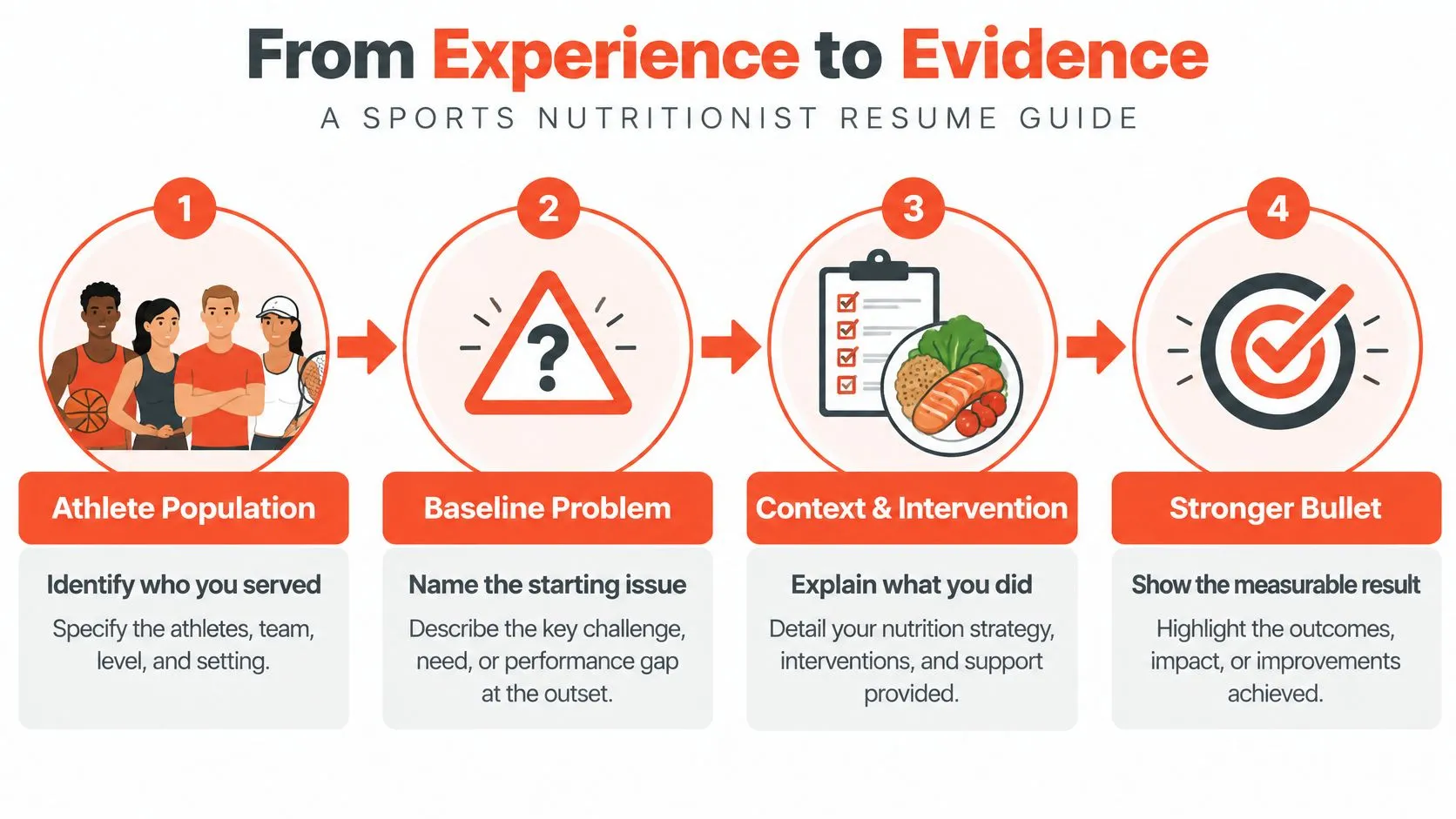
Here's the difference between a duty and evidence. “Counseled athletes on nutrition” tells a reader almost nothing. A fuller example, using the athlete count supplied in sports-nutrition resume guidance, is:
Assessed training load, dietary intake, and hydration markers for 24 collegiate endurance athletes; implemented individualized pre-, intra-, and post-training fueling protocols; monitored adherence weekly and tracked reported late-session fatigue over the evaluation period.
If you have a verified result, add it with its actual measurement and timeframe. Don't fill in a percentage or duration from memory, and don't claim the intervention caused a performance change unless the evidence supports that conclusion. A source example uses placeholders for the result and evaluation period precisely because those details must come from the candidate's own records, not a template (sports nutrition resume guidance).
Show the work behind food service and education
A travel-menu bullet can demonstrate planning and safe coordination without claiming a performance outcome:
- Weak: Planned team meals.
- Stronger: Coordinated travel menus with food-service staff to accommodate documented dietary requirements, confirming suitable options before the team's departure.
For education work, name the audience and what you delivered, then include a real measure if you have one:
- Weak: Presented nutrition information to athletes.
- Stronger: Delivered a fueling education session for athletes, then tracked attendance and follow-up questions to guide the next session.
Use the same structure throughout: responsibility, context, action, outcome. Replace “managed,” “supported,” and “optimized” with what you assessed, changed, coordinated, or tracked. Leave out vague percentages, unsupported cause-and-effect claims, and confidential medical details. If you can't disclose the athlete's specific health information, describe the population or type of work at an appropriate level instead.
Prove Athlete Impact Without Overselling
Some of the most important work in sports nutrition doesn't produce a clean headline statistic. You may not control a competition result, body-composition change, or injury outcome. You may also need to protect confidential information. That's no reason to write weak bullets. Show the process and the result you can responsibly verify.
An early-career candidate might have supported a team through supervised practice rather than owning a program. Instead of implying independent clinical authority, they can state the setting, supervision, task, and process measure:
Supported athlete nutrition screening during supervised practice; coordinated follow-up for dietary requirements and tracked completion of assigned screenings.
If records show a real improvement in completion, attendance, or turnaround time, include the documented result. If they don't, don't invent one. A clear account of the candidate's responsibility and the team's process is more credible than an inflated claim.
Useful measures aren't limited to body weight or race results. Depending on what you tracked and your role, they might include meal-plan adherence, attendance at fueling sessions, recovery-snack compliance, screening completion, dietary-restriction turnaround, or coordination of travel menus. Choose measures tied to your actual work. Don't turn a process metric into a claim about improved athletic performance.
Describe collaboration and body-composition work carefully
Name the professional groups you worked with, such as coaches, athletic trainers, physicians, or strength staff, and explain what you coordinated. Keep athlete health information private. “Coordinated nutrition support with athletic training staff” is more appropriate than disclosing a medical detail that doesn't belong on a resume.
Treat weight and body-composition claims with equal care. Include an assessment only when it was within your qualifications, relevant to the role, and appropriate to disclose. State the method and purpose when that context helps; don't imply that weight loss is a universal performance goal or take credit for a result you didn't control. For more help turning actual work into specific outcomes, see this guide to quantifiable achievements.
ATS, Format, and the Final Sports Nutritionist Resume Pass
An applicant-tracking system needs readable text; it doesn't need a maze of design elements. Use a straightforward, reverse-chronological resume with standard headings. Keep it to one page unless you're a senior candidate with relevant experience that warrants more space. Avoid tables and text boxes in the resume file, even though a comparison table can be useful in a guide like this.
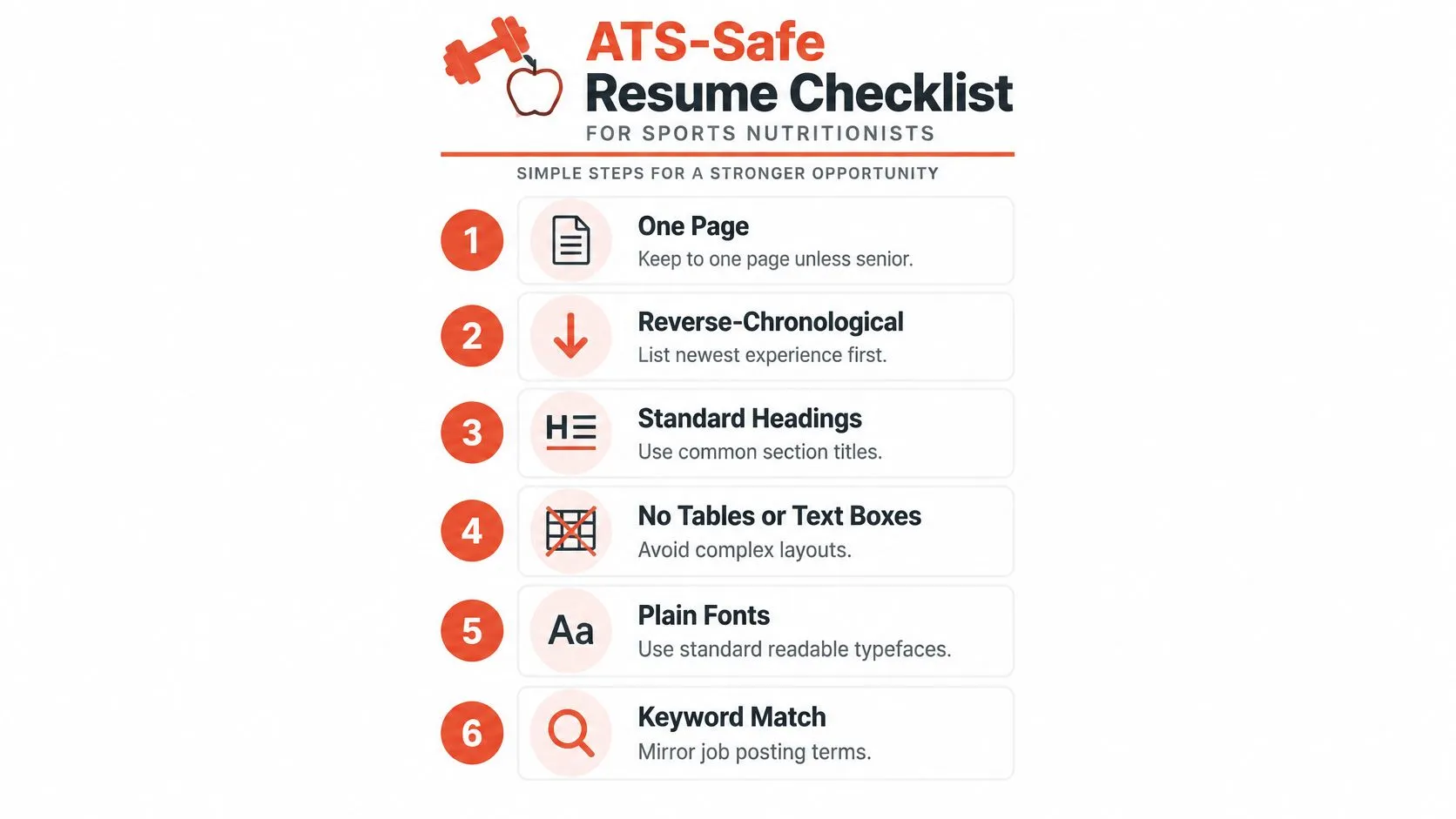
Before you send the application, check the document against the posting:
- Match the role: Identify the population, setting, and competencies the employer names. Use relevant terms where they accurately describe your work.
- Make credentials clear: Put your professional category and relevant credential near your name. List the issuing body and current status.
- Separate licensure: State the jurisdiction and status of each applicable license. Don't make the employer infer where you're authorized to practice.
- Keep scope visible: Check that your summary, skills, and bullets all describe work you're qualified to perform.
- Use plain formatting: Choose standard section headings and a readable font. Save a clean PDF or DOCX, following the employer's instructions.
- Prove the keywords: Don't just repeat phrases from the posting. Show where you applied each relevant skill in your experience.
For more on readable, ATS-conscious documents, use this guide to optimizing a resume for ATS. The point isn't to cram in every matching phrase. It's to make your qualifications easy to verify and your sports-nutrition work easy to understand.
You've learned the useful test: turn responsibility into context, action, and evidence without overstating your scope. StoryCV asks about the work you did and turns your answers into resume-ready bullet points. Talk through your sports nutrition experience and find the words for what changed.