“Add hobbies to seem well-rounded” is the most popular advice about interests on a CV, and it's usually bad advice. Achievements and interests do different jobs: one shows what changed because you were there; the other shows what you choose to do when nobody assigns you anything.
Recruiters may skim both sections last. That doesn't make them harmless decoration. Together, they form the closing argument of your CV. If your achievements are vague and your interests generic, the last thing a reader sees is space that could've been put to better use.
The Two Sections Most People Get Wrong
Most CVs from experienced professionals don't need more at the bottom. They need less, and better. “It looks fine. I just can't tell what you did” is the complaint a vague achievement invites, while a generic interests list leaves a different question unanswered: why is this taking up space?
Achievements answer whether you changed anything during your time in a role. Interests answer what you choose to do when work doesn't assign you a task. They're not interchangeable, and one can't rescue the other. Together, they either reinforce a convincing picture of you or weaken the impression your work history made.
The mistake is treating these sections as a writing problem. Usually, it's a selection problem. You don't need to find a cleverer way to say “reading, travel, spending time with family.” You need to decide whether that information belongs on the page at all.
The test: Does this detail prove something useful, or does it merely occupy space?
Before rewriting anything, take stock of the strengths your work history shows. A practical reflection on identifying strengths and weaknesses at work can help you spot what your CV already demonstrates, and where a claim still needs evidence.
The answer may be to cut the interests section entirely. That's not a failure to appear well-rounded. It's a sign you know what the document is for: making your contribution clear.
What an Achievement Actually Is
An achievement isn't a duty with a number glued onto it. “Managed the customer support queue” still describes a responsibility, even if you add the number of tickets. The question is what changed because of your decisions, not how much activity you can count.
Say you led customer escalations at a software company. Your first draft reads:
Managed customer escalations.
It tells the reader what you were assigned. It doesn't say what you noticed, how you responded, or what improved. Suppose you reviewed recurring cases, identified a handoff problem between support and engineering, and introduced a triage process that helped teams resolve urgent issues sooner. The useful part isn't the grand-sounding verb. It's the evidence that you made a decision and changed how the work moved.
A stronger version could be:
Introduced a shared escalation triage process between support and engineering, clarifying ownership of urgent customer cases and reducing handoff delays.
Keep “reducing handoff delays” only if you can defend it. If you can't substantiate a result, describe the observable change without claiming a measured improvement. Specificity isn't permission to invent.
That matters when you don't have revenue figures. Revenue isn't the only credible evidence. You might be able to verify the volume you handled, how often you delivered a process, the number of teams involved, the time saved, the defects prevented, or a deadline brought forward. Pick a detail you could explain in an interview, not one that merely sounds impressive.
A quick test for each bullet: could the next person in the role have written the same sentence? If yes, you've described the job. Add the decision you made and the consequence you can support. This is the selection standard for the achievement section: keep evidence, not adjectives such as “successful” and “high-performing.”
Why Most Interests Sections Should Be Cut
Reading. Travel. Spending time with family. Cut the list. Those are ordinary parts of life, not evidence that belongs on every professional CV. Recruiters don't need a personal inventory, and filler at the bottom can distract from stronger work above it.
There's no universal agreement that hobbies help. In one HR survey, 46.0% of respondents said hobbies and interests can sometimes improve a resume, 42.1% said they have no place on a professional resume, and 11.9% considered them broadly valuable; younger HR professionals were more receptive than senior ones (HR survey on hobbies and interests). That split is a good reason to stop following universal advice and start judging each interest on what it proves.
Use three tests:
- Discipline: Does it show sustained practice or expertise?
- Relevance: Does it connect to the role or organization?
- Evidence: Does it show something your work history doesn't?
Keep an interest only if it passes at least two. “Competitive long-distance runner, sub-1:30 half-marathon” signals sustained training and a specific level of performance. “Fitness” gives the reader almost nothing. The detail earns its space; the category doesn't.
"Doesn't personality matter?" Yes. But personality isn't improved by a list of generic labels. A specific interest can give an interviewer a useful point of connection, or demonstrate commitment that doesn't appear elsewhere. A vague one asks the reader to do the imaginative work for you.
If a specific technical ability is relevant, state it directly rather than hoping an interest implies it. This distinction between demonstrated capabilities and personal details is also useful when deciding how to write the skills section of a CV. And if your interests don't pass the test? Delete the section. Whitespace is better than filler.
Three Rewrites That Make the Rule Feel Usable
An edit should make the judgment visible. These examples aren't magic lines to copy; they show what to keep, what to cut, and why.
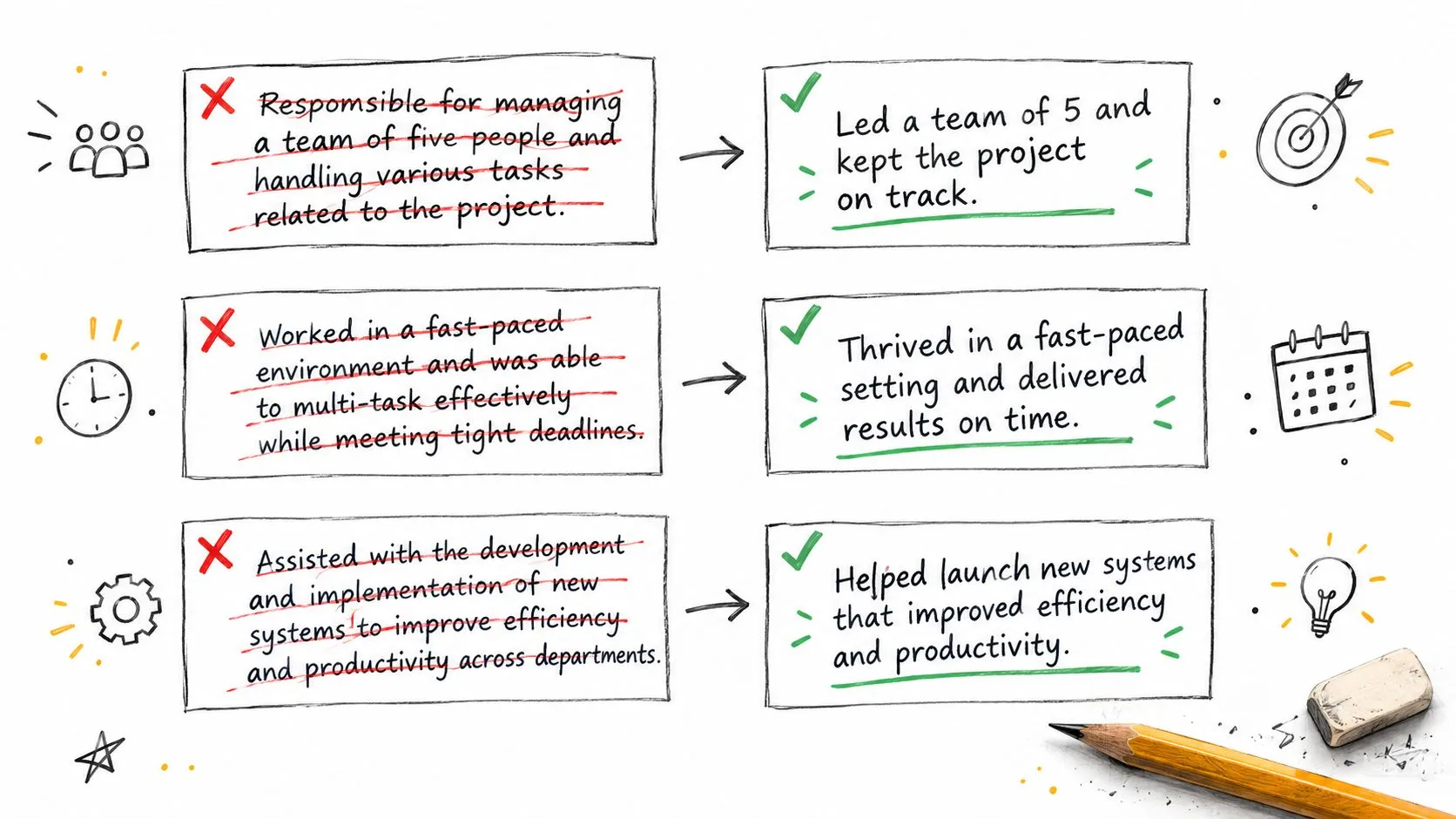
Achievement, from duty to decision
Before: “Managed customer escalations.”
After: “Created a shared escalation process between support and engineering, giving urgent cases clear ownership and reducing handoff delays.”
The stronger version names the decision, the context, and the change. Use “reducing handoff delays” only if you can explain what changed and how you know. For more on the mechanics of making achievements concrete, see how to write quantifiable achievements.
Interest, from filler to nothing
Before: “Reading, travel, spending time with family.”
After: Delete the line.
None of those labels shows a specific skill, a commitment, or a connection to the role. You don't need to replace the space with another hobby. The edit is complete when the filler is gone.
Interest, from generic to specific
Before: “Open-source projects.”
After: “Contribute Python documentation and issue fixes to [repository name], with changes used in its public release.”
This survives because it identifies the activity and the contribution. Only say “used in its public release” if that's accurate. If you can verify a stronger signal, such as a merged contribution or a feature adopted by users, include it. Don't invent usage or inflate your role.
The pattern is simple: make the evidence specific, cut the line that says nothing, and sharpen the interest that shows something the work history can't.
How Tailoring and ATS Change the Calculation
A CV doesn't have one fixed audience. An applicant tracking system may parse your document before a recruiter reads it, and the recruiter will scan for evidence that fits the role. But don't build your closing sections around myths about what an ATS “likes.” Interests aren't a substitute for role-specific skills or relevant experience. Your achievement bullets need to make sense to a person; your wording should also use accurate language that reflects the vacancy.
Tailoring changes which evidence earns space. A leadership role may make community organising relevant. A technical role may make a carefully described open-source contribution worth keeping. For a role where neither adds useful proof, remove it. Interests are a tiebreaker, not a load-bearing section.
For career changers, a focused guide to resume transitions can help you think about how to make transferable experience legible. The same principle applies to the bottom of your CV: keep details that clarify your fit, not details that merely signal personality.
Use this quick decision check when you change target roles:
- Keep an interest when it provides specific evidence that supports the role and your work history doesn't already show.
- Sharpen it when the activity is relevant but the label is too broad to communicate anything.
- Delete it when it passes fewer than two of the three tests: discipline, relevance, and evidence.
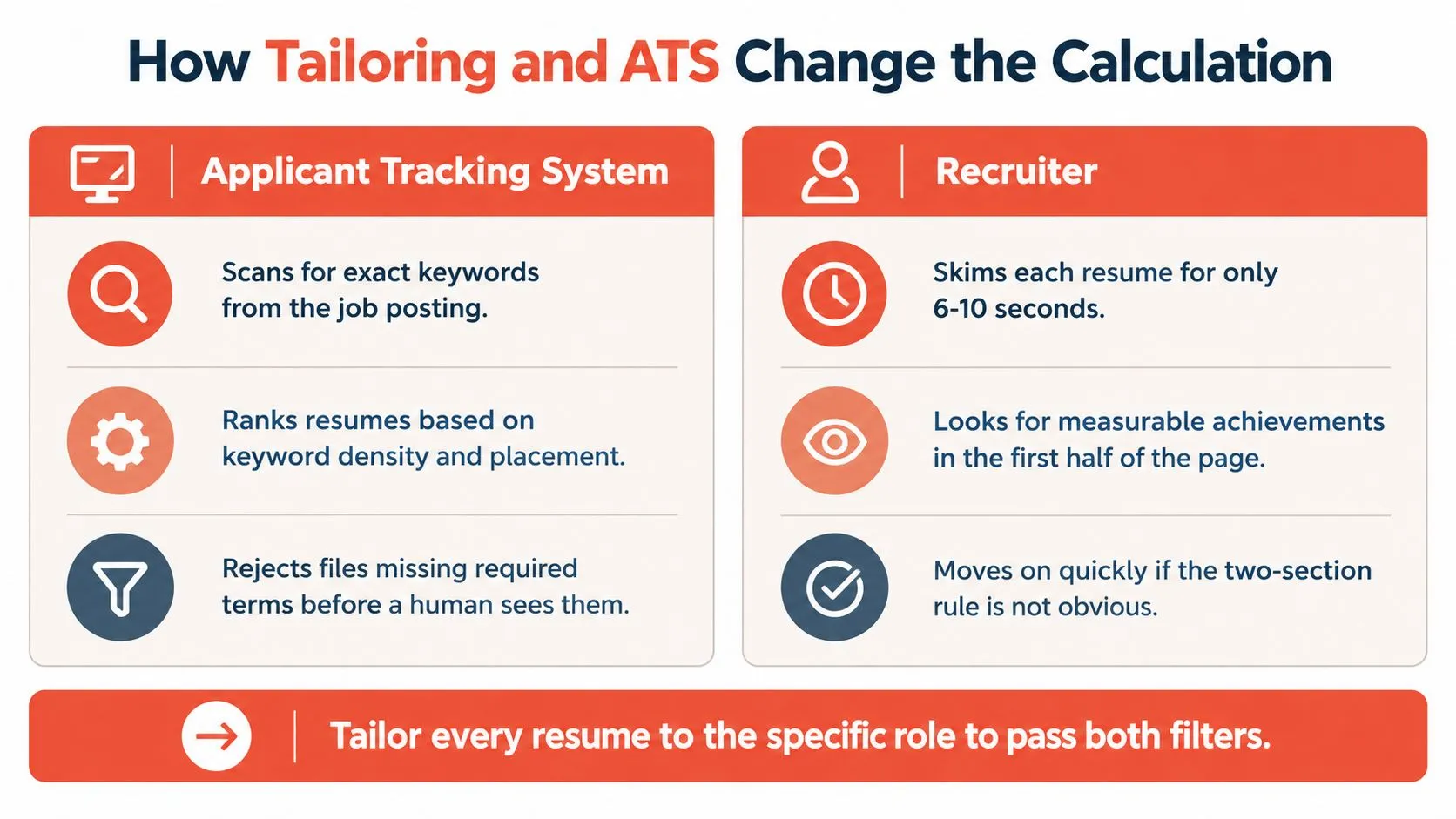
Don't assume that an interest belongs in the same place on every CV. Where you place it depends on how relevant it is and what else the page needs to prove. Tailor the wording to the role, but keep the evidence honest. For practical guidance on tailoring your CV to a job description, focus first on matching your real experience to the employer's needs.
How the Rule Plays Out for Different Readers
The rule doesn't change, but the evidence you have does. A seasoned professional, a career changer, and someone at the start of a career shouldn't make identical choices about the closing sections.

If you're pursuing a promotion or a move at mid-career, let achievements carry the close. Your work history should already show depth, so a generic interests section rarely adds anything. Keep a hobby only if it offers distinct evidence of judgment, sustained discipline, or a skill the role needs.
For an experienced professional: Don't use interests to soften a CV that needs sharper evidence. Fix the achievements first.
If you're changing careers, your job titles may not make your transferable strengths obvious. An interest can help when it shows a capability the work history doesn't. For instance, organised volunteer work might demonstrate logistics and stakeholder coordination; the title of a previous role may not.
Career pivot
Interest: “Volunteer coordinator for a regional mentoring programme, organising mentor matches and session schedules.”
Keep the wording accurate, and make the contribution clear. If your shift involves a specialised path, researching flight training pathway options is a practical way to understand what that training entails. The same logic applies on the CV: name what you did, not what you hope the activity implies.
If you're a student or early-career applicant, interests may provide evidence your shorter work history can't yet carry. Choose sustained activity, leadership, or a practical skill, and show what you contributed. Don't pad the page with broad hobbies just to make a CV look fuller.
The distinction isn't “interests matter for some people and not others.” It's whether the interest supplies evidence that the rest of the CV lacks.
A Cleaner Closing Arc
The bottom of your CV should feel like a conclusion, not a storage cupboard. Achievements show what changed because you acted; an interest earns space only when it adds evidence the work history can't. When either section is weak, the whole close sounds less convincing.
So cut first. Remove duties dressed up as achievements, delete generic interests, and keep only the lines you can defend and explain. If removing the interests section leaves space, leave it empty. You don't owe the page a replacement.
The strongest ending isn't necessarily the one with the most content. It's the one that leaves the reader with a clear sense of what you contributed and what else you bring. Read the last part of your CV as if you've never met yourself. Does every line prove something? If it doesn't, it hasn't earned its place.
A strong CV doesn't fill the bottom of the page. It earns the final line.
If your evidence is there but the wording isn't, talk through the work itself before reaching for another template. A clear account of your contribution is more useful than another line of filler.
StoryCV is an online resume writer that asks about the work you did and turns your answers into clear, resume-ready bullet points. If you're deciding which achievements belong in the closing argument of your CV, tell your story with StoryCV and work out what your experience really proves.