Most resume advice gets the comparison wrong. It treats StoryCV vs Resume Genius as a choice between better writing and better templates, when the key question is simpler: which one helps you produce a resume that still makes sense after a recruiter scans it for seconds and then asks you to defend every line in an interview.
That matters because recruiters do not read like designers. An eye-tracking study of 30 professional recruiters over 10 weeks found they focused on a small set of fields, and a later update put the average review time at around 7.4 seconds. In that kind of scan, title, company, dates, and a few sharp proof points do the work, not decorative formatting or padded bullets. If you need a clean method for turning responsibilities into proof, use STAR format on CV is still a useful reference point.
| Dimension | StoryCV | Resume Genius |
|---|---|---|
| Core idea | Interviews you for the work you actually did | Gives you a guided builder and templates |
| Best input | Raw experience, context, outcomes | Clean history and ready-made bullets |
| Main output | A story-driven resume draft | A formatted resume |
| Weak spot | Can still need trimming for length | Can leave you with generic wording |
| Best fit | Mid-to-senior professionals, career changers | Conventional resumes, faster formatting |
If you want the deeper product contrast in one sentence, this side-by-side overview makes the same point from a different angle. The rest of this article stays on the issue, which is whether the resume survives both the scan and the conversation after it.
Two Resume Tools Built for Different Problems
The popular framing is lazy. StoryCV vs Resume Genius is not a contest between quality and templates. It is a choice between two workflows, and the right one depends on whether you need help extracting the story or just packaging it.
Resume Genius assumes you already have the facts and need a fast way to shape them into a clean resume. It gives you structure first, then helps turn your input into a presentable document. That works for straightforward work histories, especially if speed and formatting matter more than discovery.
StoryCV starts from the opposite problem. It asks for the work behind the work, the context, the constraint, and the outcome, then turns that into resume language. Its value sits in the interview, not the layout. It is not a career coach, a generic text spinner, or an ATS keyword tool.
Practical rule: if you can already explain your last three roles clearly, a builder may be enough. If you keep flattening your own impact when you write, a guided interview is the better choice.
That is why the comparison matters at the recruiter-scan level and in the interview after it. A template can make the page neat. It cannot make weak content stronger. If you need a clean method for turning responsibilities into proof, use STAR format on CV is still a useful reference point.
This side-by-side overview makes the same split from another angle. The core question is simple: which tool gives you a resume that survives a quick scan and still makes sense when someone asks you to defend every line?
What Each Tool Actually Does at the Input Level
Resume Genius starts with structure
Independent reviews describe Resume Genius as a template-driven resume builder with a guided section-by-section workflow, around 25 to 35 templates, AI-generated summaries and bullets, resume parsing, ATS-oriented checking, and exports such as PDF, Word, and TXT. That's a conventional builder with some automation layered on top. It's made for people who can supply the facts and want the software to package them cleanly.
The upside is obvious. You don't have to invent a resume structure from scratch. The downside is just as obvious. If your raw input is thin, the output stays thin, just dressed up better.
StoryCV starts with the work, not the page
StoryCV works more like a short interview. You answer questions about what you did, what changed, what got in the way, and what result followed. The point isn't to decorate a résumé. It's to pull context out of your memory before writing starts.
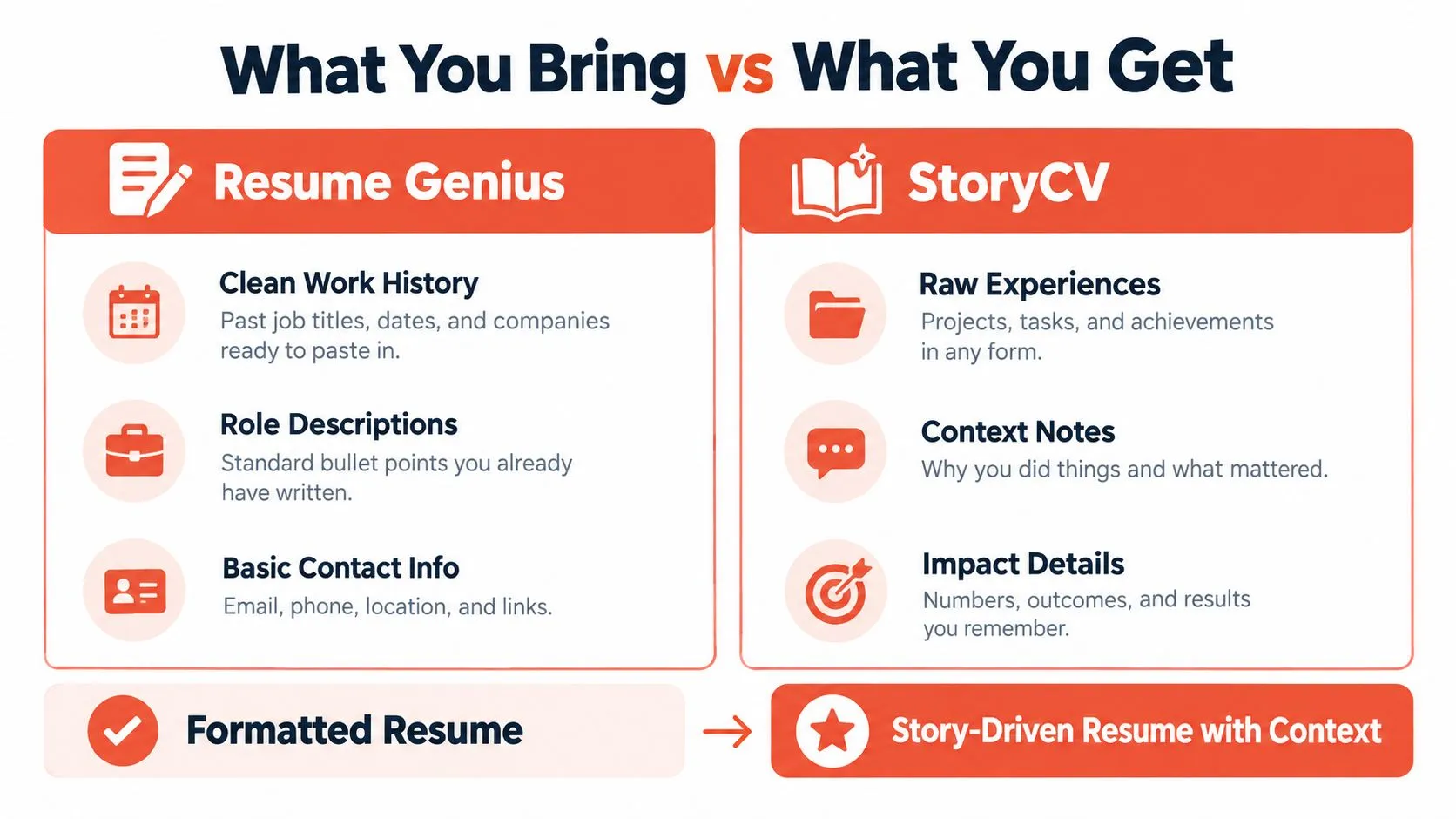
That difference sounds small until you use both. One workflow asks, “What section goes here?” The other asks, “What happened, and why does it matter?” Those are not the same questions.
A good way to think about it is this:
- Resume Genius helps you package what you already know.
- StoryCV helps you uncover what you should have written in the first place.
For a tech professional, that matters because “managed the platform” is not a strong input. “Reduced deployment friction across three teams by standardizing release steps” is. One is a duty. The other is evidence. The interview-led model is trying to get you to the second one before the first draft is even written.
If you want a cleaner benchmark for engineer-specific output, the senior software engineer resume examples are a useful reminder that strong resumes sound specific, not decorative.
Output Quality and the Seven-Second Test
A resume that survives the seven-second scan does one thing fast. It shows role, scope, action, and result. If the line reads like a duty list, a recruiter skims past it. If it names the system, the problem, and the outcome, it earns a second look.
Weak version: “Managed internal tooling and worked with the engineering team on rollout.”
Stronger version: “Led rollout of internal tooling across engineering and support teams, reducing handoff confusion and standardizing the release process.”
That second line is still plain, but it gives a reader something real to test. It says what changed. It also gives you a claim you can defend in an interview, which is the part that matters after the scan.
The senior software engineer resume examples point in the same direction. The strongest resumes read like proof, not decoration.
The 2025 study on writing quality is relevant here. In the same sentence, the authors reported a positive association between resume-and-cover-letter writing quality and interview invitations, with r = 0.32 and p < 0.001. It also found that a one-point improvement in combined writing quality corresponded to roughly 7% more interviews relative to applications and nearly 10 fewer days in job search duration. The point is not that one tool causes those outcomes. The point is that stronger writing quality clearly matters.
Template-led resumes often stall at the surface. They can look neat and still say very little. A recruiter can read a tidy bullet in two seconds and learn nothing useful. A stronger draft answers the silent follow-up question: “So what?”
That is the standard to use when comparing a builder like Resume Genius with an interview-led tool like StoryCV. If you want a more engineer-specific view of what strong output looks like, the best AI resume writer for engineers discussion reaches the same conclusion: engineering resumes are judged on proof, not presentation.
Workflow, Time Cost, and Editing Burden
Resume Genius is faster if your career story is already tidy. You fill in fields, pick a format, accept or tweak suggested bullets, and export. That works well for straightforward histories, especially if you want a usable resume quickly.
StoryCV asks for more thought up front. The interview slows the process because it keeps pushing for the work behind the work. That feels heavier at first, but it cuts down on the later rewrite cycle that starts when a resume looks polished and still sounds empty.
The cost is editing. Template-based resumes often need a second pass to remove generic phrasing, weaken inflated claims, and make each bullet hold up under interview pressure. Interview-led drafts may still need trimming, but the raw material is usually closer to something you can defend.
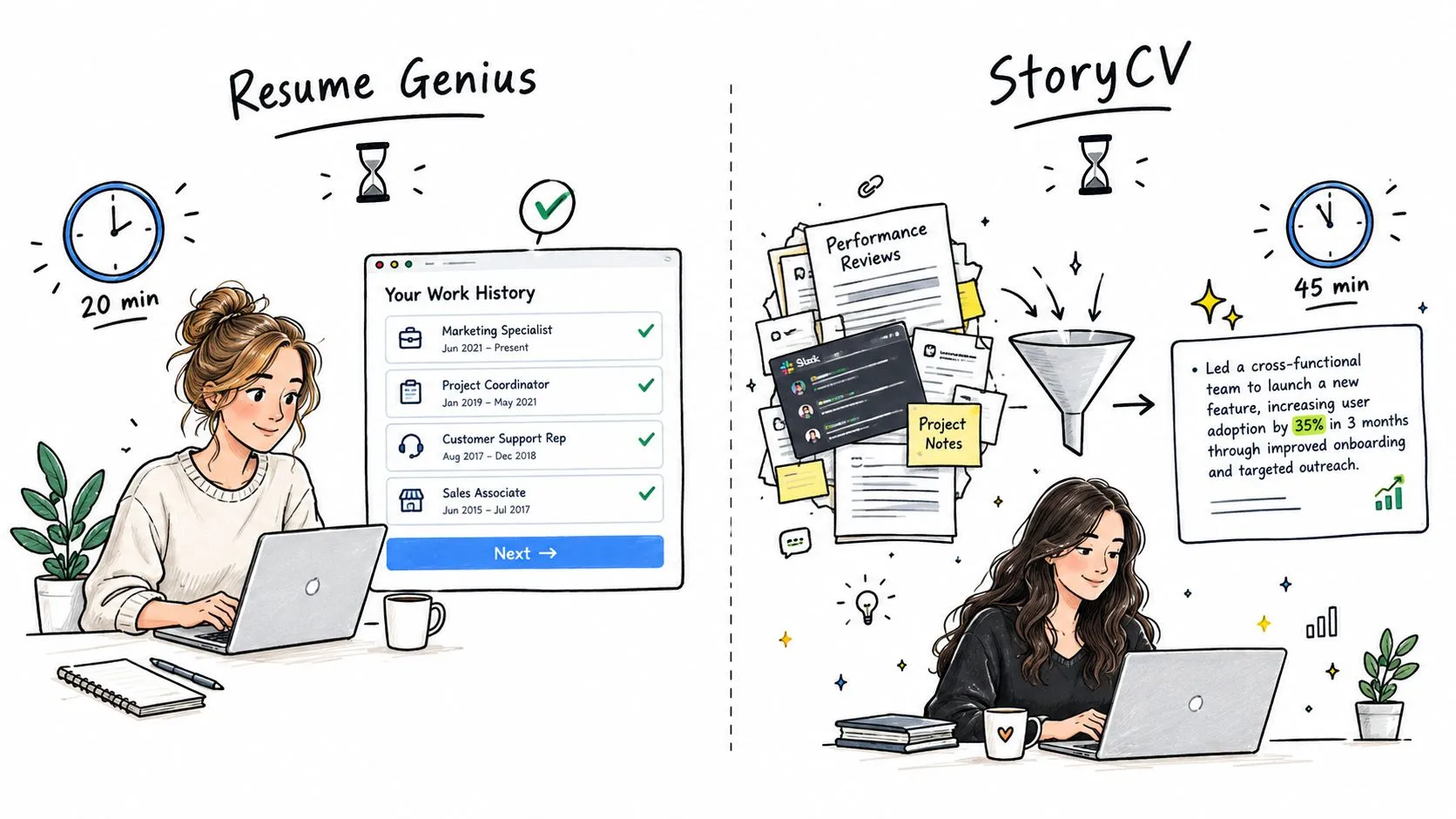
The time question is not which tool is faster. It is where you want to spend the effort. If you already know how to turn your work into clean bullet points, a template builder is enough. If you still need to pull the useful details out of your own experience, the interview-first path is the better use of time.
A concrete example makes the trade-off obvious. A bullet like "Responsible for CI/CD pipelines" usually needs more than a light edit before it survives a recruiter question. You have to show what changed, what improved, and what part you owned. The more generic the line, the more work it takes later.
That is why AI help with resume writing matters here. Good help does not just speed up drafting. It reduces the number of weak bullets you have to rescue after the first draft.
Speed only matters if the resume can survive scrutiny.
Pricing, Plans, and What Happens to Your Data
Resume Genius is the older, larger operation here. It was founded in 2009, and its official company profile reports more than 23 million resumes built, over 480,000 cover letters written, more than 5 million resource downloads, and over 50 million readers worldwide. That scale tells you it is a mature template-and-builder business, not a niche writing service.
StoryCV sits in a different commercial lane. The model is built around guided resume writing, with a free first fully written role and paid access for more roles, edits, and exports. That is a more editorial model than a template-based approach. You are paying for writing help, not for a prettier page.
What to watch with privacy
Job searches are often confidential, so the key question is not just what you pay, it is what you hand over. If a platform stores your career history, role details, and draft wording, treat the content as sensitive from the start. The risk gets sharper when you are job hunting while employed, because one sloppy sharing setting can expose material you did not mean to publish.
A risky setting is easy to spot. If the tool publishes a searchable profile by default, a draft that mentions your current employer's internal project can surface in a recruiter search before you have resigned. That is the kind of mistake that turns a private draft into a workplace problem.
No one should treat a resume builder like a throwaway form if the draft contains sensitive work history, client names, or internal project details. Read the retention and sharing terms before you paste in anything you would not want repeated back in an interview.
| Dimension | StoryCV | Resume Genius |
|---|---|---|
| Core job | Guided resume writing | Template-driven resume building |
| Best use | Turning real work into resume-ready copy | Formatting a conventional resume quickly |
| Input style | Interview-based, contextual | Section-by-section, fill-in-the-box |
| Output focus | Narrative and specificity | Clean document assembly |
| Scale signal | Writing-first product model | Large legacy resume platform |
The honest takeaway is simple. If you want a document factory, Resume Genius fits that job. If you want a writing process that extracts substance before formatting, StoryCV is the better match.
Who Each Tool Is Actually Built For
Mid-level engineer who knows the work but not the wording
A mid-level engineer usually has the harder problem. The work is real. The wording is not.
They have shipped features, debugged failures, handled migrations, supported teammates, and made trade-offs under pressure. What they often lack is a clean way to decide which details deserve space on the page. An interview-led tool fits that gap because it pulls the useful evidence out of work that has become too familiar to sound impressive.
Career changer translating older experience
Before and after matters here.
- Before: managed logistics, handled staff coordination, kept operations moving under pressure.
- After: translated that into process ownership, cross-functional coordination, and measurable execution.
A guided interview does that translation better than a template. It forces the user to connect older responsibilities to the target role's language without pretending the old job title was something it was not. A polished template can make the transition look neat, but neat is not the same as credible. Recruiters notice that quickly.
Recent tech grad with simple history
A recent grad with one or two internships and a straightforward project list can usually use Resume Genius without much friction. The structure is conventional, the story is short, and speed often matters more than depth. There is less hidden context to recover.
NACE's 2025 employer survey found that nearly two-thirds of respondents used skills-based hiring for entry-level candidates, and many also relied on behavior-based interviews, competency-focused job descriptions, and resume scans for specific skills. That supports a simple rule. If the history is clean, a sharp template and clear skills framing can be enough. If the experience needs interpretation, the interview-led route does better work.
Mid-level engineers and career changers need translation. Recent graduates often need formatting and speed. That split is the fundamental line between these two tools.
The Honest Recommendation
Resume Genius is the right pick if your history is clean, your timeline is tight, and you want a downloadable resume with minimal writing friction. It works for conventional resumes and fast turnarounds.
StoryCV is the better pick if your experience is real but fuzzy, your work needs context, and your bullets keep collapsing into duty statements. It fits mid-level and senior professionals, career changers, and anyone who needs help turning “what I did” into “what changed.”
Spring 2025 NACE data also showed 38.2% of surveyed U.S. job seekers used AI for all or most applications, while 82% of AI-assisted users reported suspected ATS rejection or overlooking. That is a warning against keyword stuffing. A resume still has to sound like a believable career story.
Read your top bullet aloud. If you cannot answer “what changed?” in one sentence, start with the interview. If you can, the builder is enough.
StoryCV helps you turn real work into resume-ready bullets by asking the questions most templates skip. If your problem is not formatting but getting your experience into clear, defensible language, that is the right place to start. Visit StoryCV and write the version of your story that can survive both the scan and the interview.